4 open-source alternatives ranked by real activity

Open-source Bonsai alternatives

A curated, ranked list of the 4 best open-source alternatives to Bonsai.

The best open-source alternative to Bonsai is Ever Gauzy. If that doesn't suit you, other good options are Invoice Ninja, Midday and Invio.

Commercial alternatives to Bonsai include Zoho Invoice, Dubsado, Harvest and HoneyBook. See all 70.

Bonsai alternatives are mainly finance & accounting tools, but some are also ERP tools. 3 of them shipped code in the last 30 days, 4 can be self-hosted, and none uses a permissive licence.

Last updated November 12, 2026 · ranked by GitHub stars, growth and recent commits

Ever Gauzy

An open business management platform that combines ERP, CRM, HRM, applicant tracking and project management with time tracking and headless APIs.

GitHub stars
8.8k
Last commit
today
Latest release
v111.142.11
Licence
AGPL-3.0
Self-hosted
Yes
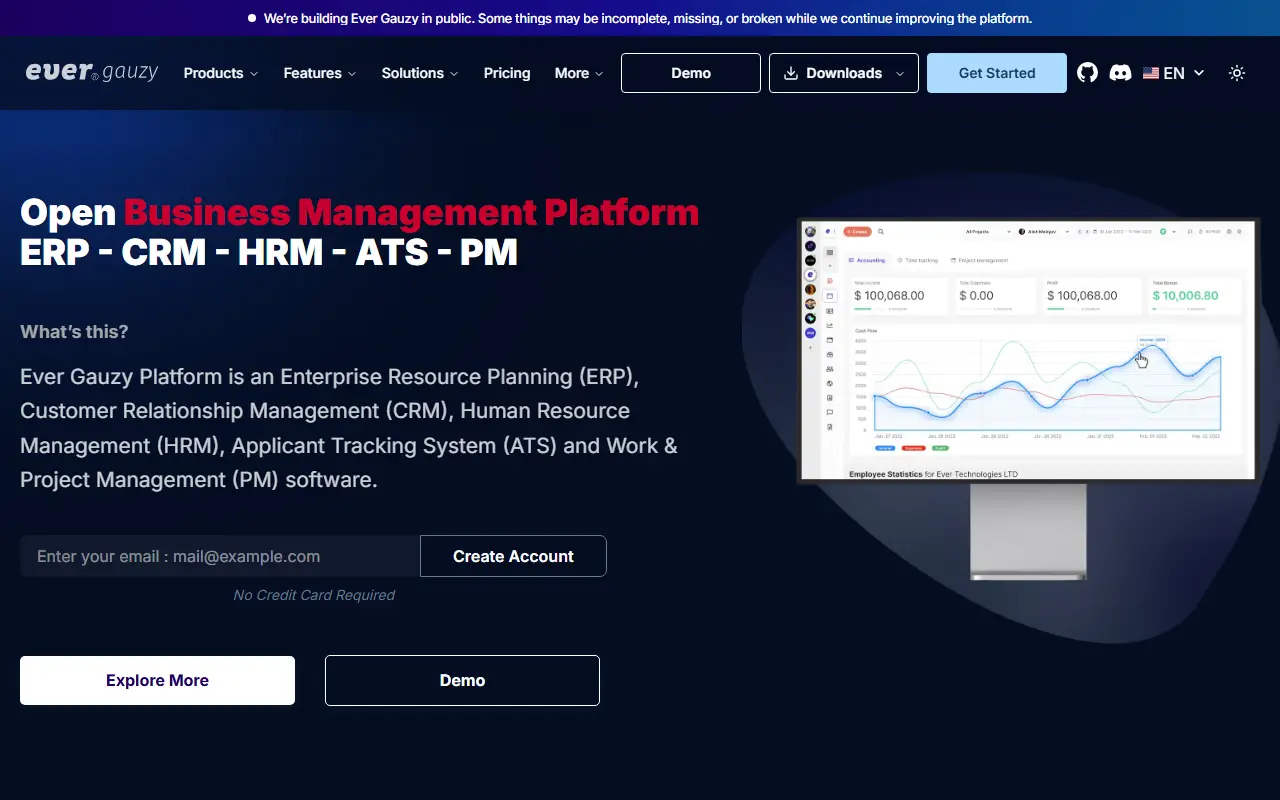
gauzy.coEver Gauzy homepage screenshot

Ever Gauzy is an open business management platform aimed at collaborative, on-demand and sharing-economy businesses. It brings ERP, CRM, human resource management, applicant tracking and project management together with employee time and activity tracking, and is part of the larger Ever Platform.

Main features include HR management with time tracking and performance monitoring, CRM, ERP, project and task management, sales management, financial and cost management with accounting and invoicing, and inventory, supply chain and production management. A dashboard gives an overview of metrics such as company income, expenses and employee bonuses, and the platform offers headless APIs. Topics also mention payroll, expenses and bookkeeping.

The company also builds Ever Teams, a work and productivity app in a React and React Native stack that connects to the Gauzy APIs. Gauzy is written in TypeScript and licensed under AGPL-3.0, and can be self-hosted. It suits agencies, startups and distributed teams that want to run an internal business system without paying per seat for several SaaS tools.

Key features

  • ERP, CRM, HRM and applicant tracking
  • Employee time and activity tracking
  • Project and task management
  • Accounting, invoicing and expenses
  • Inventory and supply chain management
  • Dashboard with business metrics
  • Headless APIs for integration

Pricing: Free Starter plan for one company and one employee. Small Business costs $17 and Enterprise $139 per month on annual billing, each with a 90-day trial. Self-hosted and cloud editions exist.

Invoice Ninja

Source-available invoicing, quote, project and time-tracking app built with Laravel, offered hosted or self-hosted.

GitHub stars
11k
Last commit
2 days ago
Latest release
v5.13.53
Self-hosted
Yes
Hosted version
Available

Invoice Ninja is an invoice, quote, project and time-tracking application built with Laravel. The repository describes it as source-available rather than open source. Version 5 is the current release, and its README says it keeps the best parts of version 4 while adding the most requested features.

It can be used in two ways. The hosted version is a Software as a Service option that the README says is running in under 5 minutes, with no server work. The self-hosted version gives full control over hosting and infrastructure, and all Pro and Enterprise features of the hosted app are included in the source-available code.

Self-hosting options include a plain server or VM, Docker, Cloudron, Softaculous, Elestio and YunoHost. Mobile apps exist for iPhone and Android (including F-Droid), and desktop apps for macOS, Windows and Linux via Snap and Flatpak. The README recommends Stripe and Postmark as providers, and there is a Go SDK for the API.

Key features

  • Hosted SaaS version with fast setup
  • Self-hosted version includes Pro and Enterprise features
  • Several self-hosted install routes
  • Desktop and mobile apps work with self-hosted servers
  • API and client portal built on Laravel
  • SDK available for API use

Pricing: The white-label licence that removes the Invoice Ninja branding from client-facing parts of the app costs $40 per year.

Midday

Midday is an all-in-one business tool for freelancers and solo entrepreneurs, covering time tracking, invoices, receipts, file storage and finances.

GitHub stars
15k
Last commit
5 mo ago
Latest release
midday-v0.5.0
Licence
AGPL-3.0
Hosted version
Available
midday.aiMidday homepage screenshot

Midday is an open-source business assistant for freelancers, contractors, consultants and solo entrepreneurs. It brings functions that are usually spread across several tools into one system, covering time tracking, invoicing, matching receipts to transactions, secure file storage and an overview of finances. The code is TypeScript and is licensed under AGPL-3.0.

According to its README, time tracking records live work on projects, Magic Inbox matches incoming invoices and receipts to the correct transactions, and Vault stores contracts and agreements. Financial data can be exported as CSV files for accountants. An assistant provides insights into spending patterns and helps locate documents. Invoicing was listed as an upcoming feature in the README at the time of the snapshot.

The architecture is a monorepo using Bun, React, Next.js, Supabase, shadcn and Tailwind CSS, with Tauri and Expo for apps. Bank connections use GoCardless in Europe and Plaid or Teller in North America, and the hosted service runs on Supabase, Railway, Vercel and Cloudflare. The README says documentation for local development is still being written.

Key features

  • Time tracking for projects
  • Invoicing for freelancers
  • Magic Inbox matching receipts to transactions
  • Vault for contracts and agreements
  • CSV export of financial data for accountants
  • AI assistant for spending insights

Invio

Invio is a self-hosted invoicing app where you create an invoice, send a link, and get paid, released as free open source software.

GitHub stars
1.2k
Last commit
4 days ago
Latest release
v2.4.1
Licence
Unlicense
Self-hosted
Yes

Invio is an invoicing application you run on your own hardware. Its README describes the workflow in three steps: create an invoice, share a link, get paid, with no setup wizard and no stack of menus in the way. The project calls itself invoicing without the bloat.

Clients receive a secure link to the invoice and do not need to create an account or log in, which removes the back-and-forth about access. Because it is self-hosted, invoice data stays on the operator's own machine, and a change in a SaaS vendor's pricing does not affect it.

The code is written mostly in TypeScript and published under the Unlicense. The project has a website, a live demo, documentation with a Quick Start guide, and a public issue tracker; contributions by pull request are welcome from people of all experience levels.

Key features

  • Create an invoice and share it by link
  • Clients open invoices through a secure link without an account
  • Runs on your own hardware
  • No subscription or per-invoice fees

Commercial Bonsai alternatives

Hosted, closed-source products that compete with Bonsai. Showing 12 of 70.

See every Bonsai alternative on its tool page

Bonsai alternatives: questions

What is the best open-source alternative to Bonsai?
Ever Gauzy is the top-ranked open-source alternative to Bonsai on Enlisted: An open business management platform that combines ERP, CRM, HRM, applicant tracking and project management with time tracking and headless APIs. Other strong options are Invoice Ninja, Midday and Invio.
What are the best commercial alternatives to Bonsai?
Zoho Invoice, Dubsado, Harvest, HoneyBook and Plutio are among the hosted, closed-source alternatives to Bonsai listed on Enlisted, which lists 70 in total. Compare their pricing and features on each tool page.
Are these Bonsai alternatives free?
All 4 are open source, so the code is free to use under its licence, and all of them can be self-hosted on your own server or computer. 2 also offer a paid or managed cloud version if you'd rather not host it yourself.
How is this list of Bonsai alternatives ranked?
By a score built from GitHub stars, star growth over the last 30 days and how recently the code changed. 3 of these projects shipped code in the last 30 days. Data is refreshed daily, and nobody can pay to move up.

People also look for alternatives to…

View all