3 open-source alternatives ranked by real activity

Open-source Auphonic alternatives

A curated, ranked list of the 3 best open-source alternatives to Auphonic.

The best open-source alternative to Auphonic is FFmpeg. If that doesn't suit you, other good options are Audacity and Ardour.

Commercial alternatives to Auphonic include Adobe Podcast, iZotope, Hindenburg and Async (Podcastle). See all 19.

Auphonic alternatives are mainly audio & music production tools, but some are also video editing tools. 3 of them shipped code in the last 30 days, 3 can be self-hosted, and none uses a permissive licence.

Last updated November 12, 2026 · ranked by GitHub stars, growth and recent commits

FFmpeg

A collection of open-source libraries and command-line tools for processing audio, video, subtitles and related metadata, including converting and streaming media.

GitHub stars
67k
Last commit
yesterday
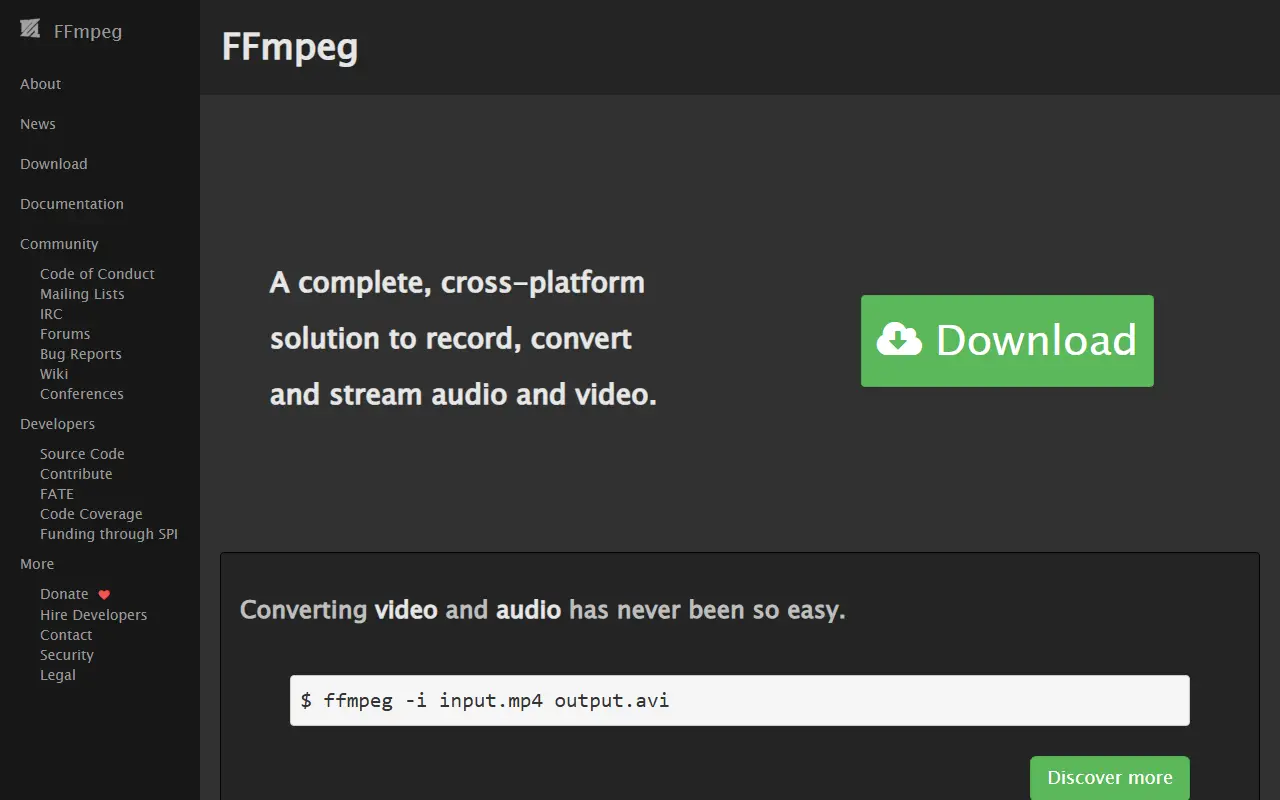
ffmpeg.orgFFmpeg homepage screenshot

FFmpeg is a set of libraries and command-line tools that process multimedia content, including audio, video, subtitles and associated metadata. It is written in C and widely used as the engine behind media conversion, streaming and playback software. Most of the code is under the LGPL, and some optional components fall under the GPL, so check the LICENSE file for details.

The libraries cover distinct jobs: libavcodec implements a wide range of codecs, libavformat handles streaming protocols and container formats, libavfilter alters decoded audio and video through a graph of connected filters, libavdevice accesses capture and playback devices, libswresample handles audio mixing and resampling, libswscale handles color conversion and scaling, and libavutil provides utility functions.

On the command line, ffmpeg manipulates, converts and streams media, ffplay is a minimalist player and ffprobe inspects content, plus small helpers including qt-faststart, ismindex and aviocat. The GitHub repository is a mirror: patches go to the ffmpeg-devel mailing list rather than through pull requests. It suits developers building media applications and anyone who converts or processes audio and video.

Key features

  • Libraries for encoding, decoding and muxing media
  • ffmpeg command-line converter and streaming tool
  • ffprobe for inspecting media files
  • ffplay minimalist media player
  • Filter graphs for audio and video processing
  • Streaming protocols and container format support

Pricing: Free and open source, mainly under the LGPL with optional GPL components.

Audacity

Audacity is a free, open-source multi-track audio editor and recorder for Windows, macOS, GNU/Linux and other Unix-like systems.

GitHub stars
19k
Last commit
2 days ago
Latest release
Audacity-4.0.2

Audacity is a digital audio editor and recording application available for Windows, macOS, Linux and other Unix-like operating systems. The repository describes it as an easy-to-use, multi-track audio editor and recorder. It is written in C++ and built with Qt and wxWidgets.

The project started in autumn 1999 at Carnegie Mellon University under the name CMU Visual Audio, and the first public release, Audacity 0.8, came on May 28, 2000. Some effects use Nyquist, a scripting language developed at CMU. It has been part of Muse Group since 2021, and Wikipedia reports over 114.2 million downloads from FossHub since March 2015.

The repository is in a major restructuring around Audacity 4, which brings an entirely new UI. Patches for the 3.x line should branch from audacity3. Audacity 4.0 is under GPLv3, many source files are GPLv2-or-later, and the documentation is licensed CC-by 3.0.

Key features

  • Multi-track audio editing and recording
  • Available on Windows, macOS, Linux and other Unix-like systems
  • Nyquist scripting language used for some effects
  • Audacity 4 brings an entirely new user interface
  • Updates shared on YouTube, Discord and a blog

Ardour

A free, open-source digital audio workstation for Windows, Linux and macOS, used to record, edit and mix audio and MIDI projects.

GitHub stars
5.4k
Last commit
yesterday
Self-hosted
Yes
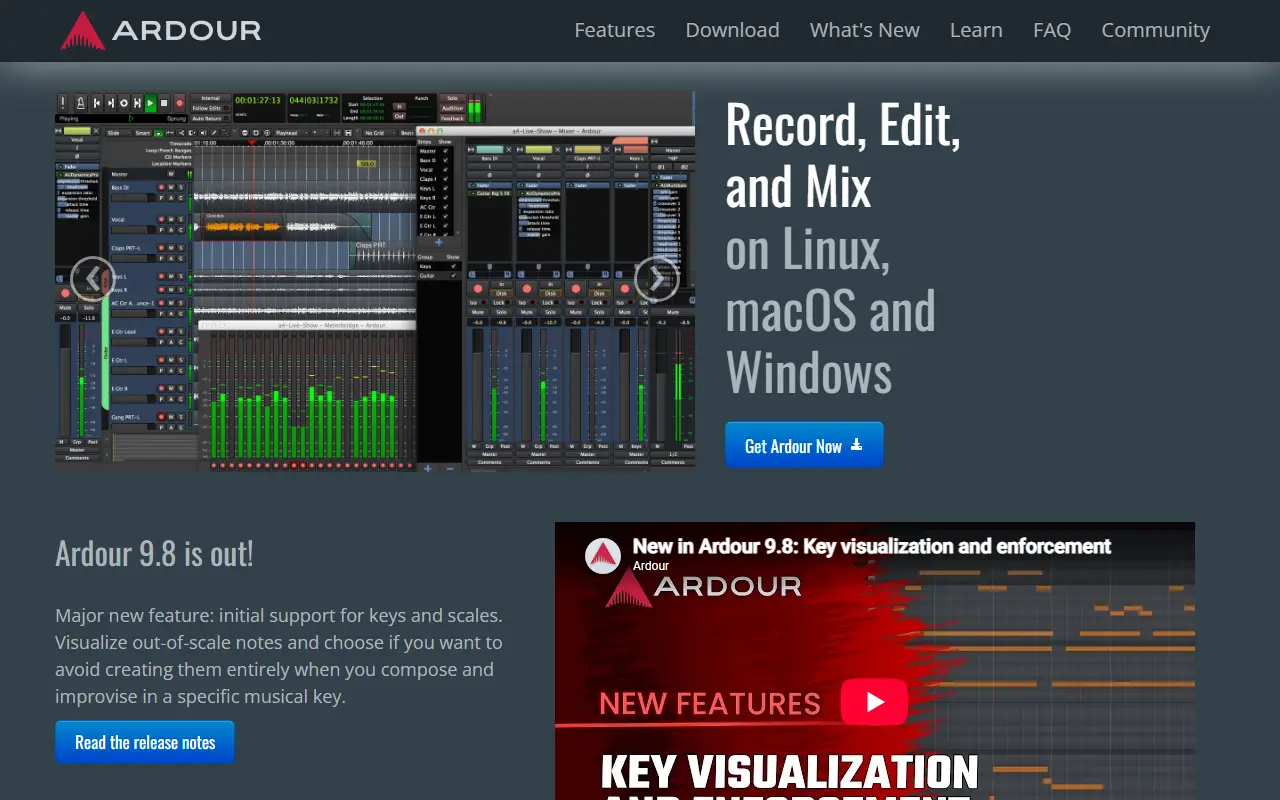
ardour.orgArdour homepage screenshot

Ardour is a digital audio workstation, free and open source, that runs on Windows, Linux and macOS. It is built for recording, editing, mixing and mastering audio and MIDI projects, from capturing vocals and live instruments to producing beats and preparing tracks for streaming.

Recording starts from an audio interface, microphone or keyboard, and material can be imported from a hard drive or the Freesound database. Editing tools include cutting, moving, stretching, trimming, crossfading, transposing and quantizing with unlimited undo and redo, while the mixer offers faders, automation, EQ, dynamics, sends, inserts and support for external control surfaces.

Its core audience is audio engineers who want full control of their tools for long sessions, along with musicians who record real instruments. Ardour supports plugin formats such as LV2 and VST and connects through JACK. It is written in C++, and the GitHub repository is a mirror of the project's source code.

Key features

  • Multitrack audio and MIDI recording
  • Editing with unlimited undo and redo
  • Mixer with automation, EQ and dynamics
  • LV2 and VST plugin support
  • JACK audio connectivity
  • External control surface support
  • Audio and MIDI import including Freesound

Pricing: Distributed as free, open-source software.

Commercial Auphonic alternatives

Hosted, closed-source products that compete with Auphonic. Showing 12 of 19.

See every Auphonic alternative on its tool page

Auphonic alternatives: questions

What is the best open-source alternative to Auphonic?
FFmpeg is the top-ranked open-source alternative to Auphonic on Enlisted: A collection of open-source libraries and command-line tools for processing audio, video, subtitles and related metadata, including converting and streaming media. Other strong options are Audacity and Ardour.
What are the best commercial alternatives to Auphonic?
Adobe Podcast, iZotope, Hindenburg, Async (Podcastle) and Noise Reducer are among the hosted, closed-source alternatives to Auphonic listed on Enlisted, which lists 19 in total. Compare their pricing and features on each tool page.
Are these Auphonic alternatives free?
All 3 are open source, so the code is free to use under its licence, and all of them can be self-hosted on your own server or computer.
How is this list of Auphonic alternatives ranked?
By a score built from GitHub stars, star growth over the last 30 days and how recently the code changed. 3 of these projects shipped code in the last 30 days. Data is refreshed daily, and nobody can pay to move up.

People also look for alternatives to…

View all