#1
Open-source home automation software built around local control and privacy, with automations, dashboards, voice assistants and over 1,500 integrations.
- GitHub stars
- 92k
- Last commit
- yesterday
- Latest release
- 2026.11.1
- Licence
- Apache-2.0
- Self-hosted
- Yes
home-assistant.io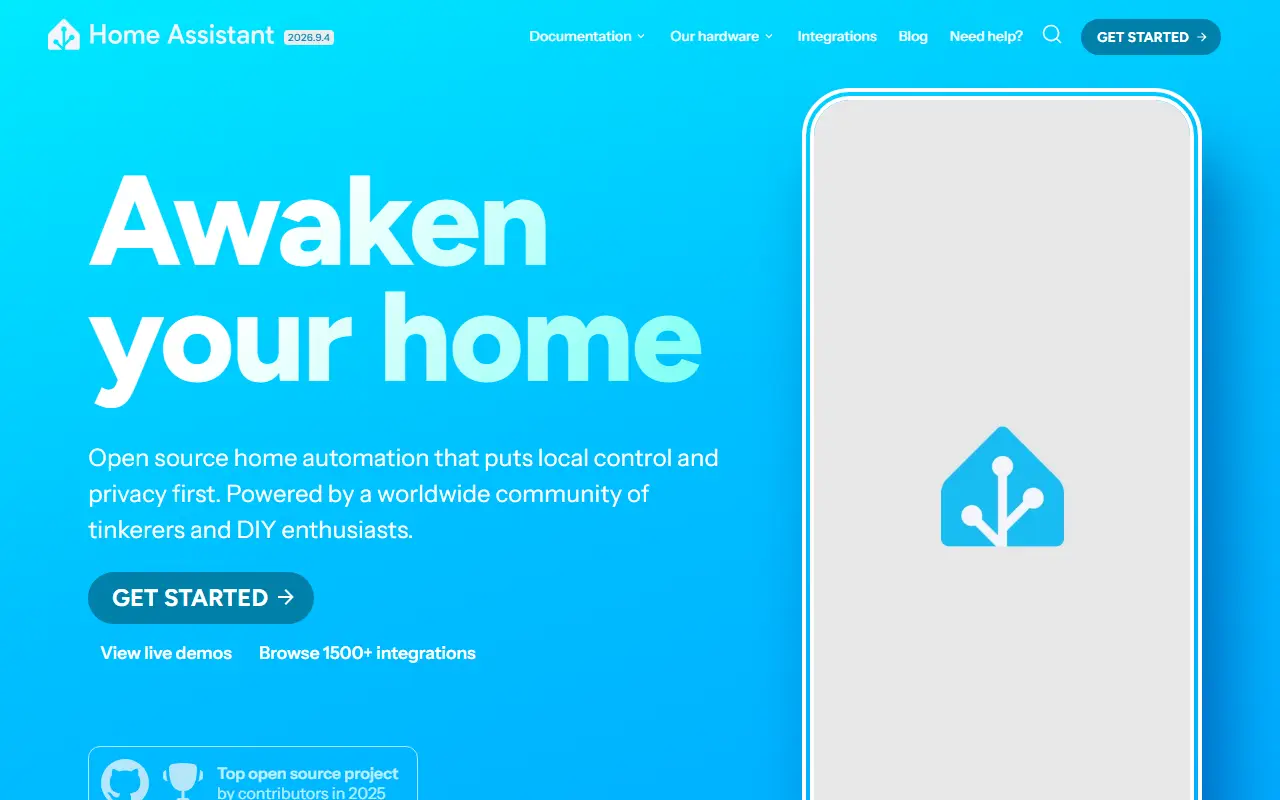
Home Assistant is open-source home automation software built around local control and privacy. It runs on hardware you own, such as a Raspberry Pi or a small home server, and brings smart lights, sensors, switches, thermostats and other devices together in one place. The core is written in Python and released under the Apache-2.0 license.
The documentation is organized around automations and dashboards, voice control, grouping devices by area, tracking energy use and templating, with configuration through the interface or YAML files. The project lists more than 1,500 integrations, and it can be controlled through assistants such as Alexa and Google Assistant. Companion hardware, including Home Assistant Green and the Voice Preview Edition, makes first-time setup simpler.
Home Assistant is a project of the Open Home Foundation, a non-profit that states the project cannot be sold or acquired. It suits tinkerers and DIY enthusiasts who want a home automation hub that does not depend on a single vendor's cloud, as well as people who want to unify devices from many brands under one dashboard.
Key features
- Automations for lights, sensors and other devices
- Customizable dashboards for your home
- Voice assistant support
- Energy management tools
- Templating and YAML-based configuration
- 1,500+ device and service integrations
Pricing: Free and open source under the Apache-2.0 license; the project also sells optional hardware.
#2
Framework that turns ESP32, ESP8266 and RP2040 microcontrollers into smart home devices using YAML configuration, tied closely to Home Assistant.
- GitHub stars
- 12k
- Last commit
- yesterday
- Latest release
- 2026.10.2
- Self-hosted
- Yes
esphome.io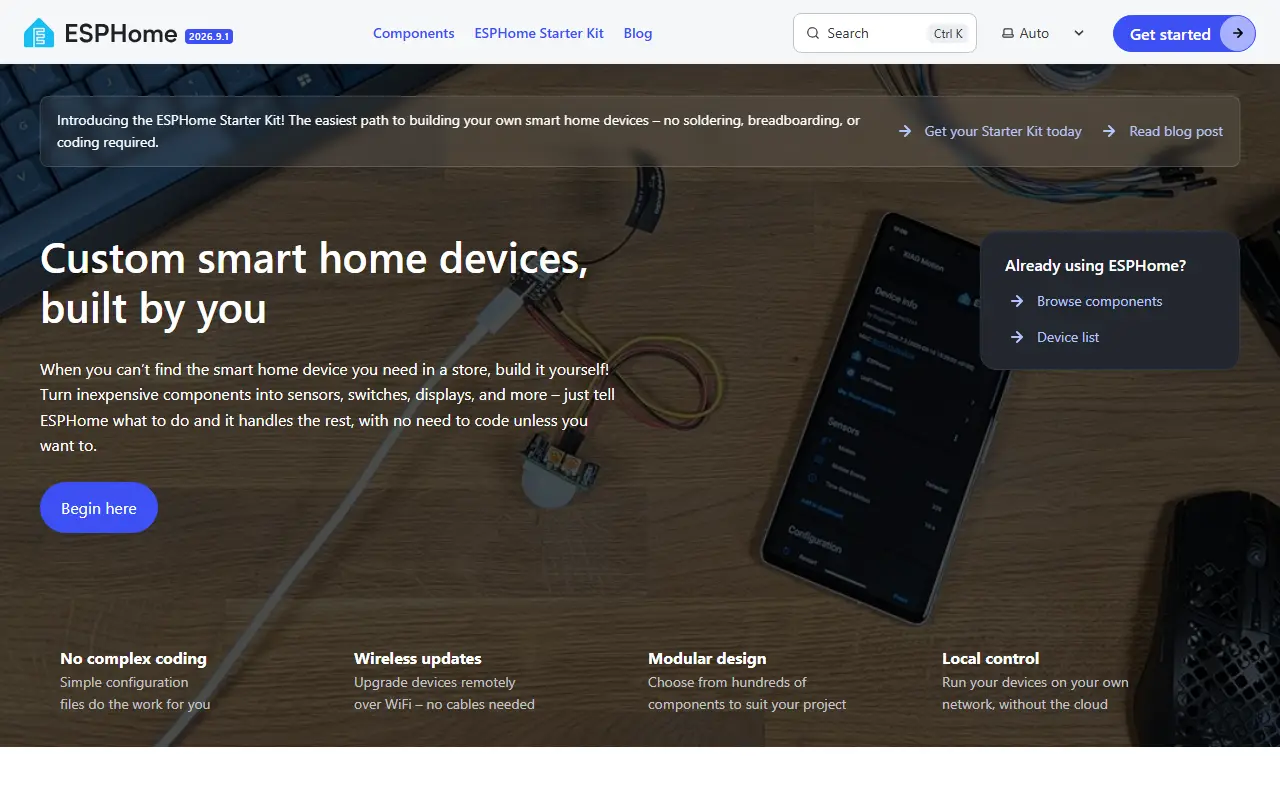
ESPHome is a system for creating custom smart home devices from inexpensive microcontrollers such as the ESP32, ESP8266, BK72xx and RP2040 chips. Instead of writing firmware by hand, you describe the device in a simple configuration file, and ESPHome generates and builds the firmware for sensors, switches, displays and similar hardware.
A visual Device Builder lets beginners set up devices without a command line, while experienced users can edit YAML directly. Devices can be updated wirelessly over WiFi, choose from hundreds of modular components, and run under local control on your own network without the cloud. They integrate with Home Assistant out of the box and can also report over MQTT. PlatformIO is used under the hood.
The project is written in C++ and Python, and its code is covered by licenses listed in the repository. The site offers documentation, a component list, a device list, a blog and an ESPHome Starter Kit for people who want to start building without soldering. Releases follow a year and month version scheme.
Key features
- YAML configuration instead of hand-written firmware
- Visual Device Builder for beginners
- Wireless firmware updates over WiFi
- Hundreds of modular components
- Local control without the cloud
- Native Home Assistant integration
Pricing: Free and open source; hardware such as the ESPHome Starter Kit is sold separately.
#3
Alternative firmware for ESP8266 and ESP32 smart devices that adds a web UI, OTA updates, timers and rules, and fully local control over MQTT, HTTP, serial or KNX.
- GitHub stars
- 25k
- Last commit
- today
- Latest release
- v16.0.0
- Licence
- GPL-3.0
- Self-hosted
- Yes
tasmota.github.io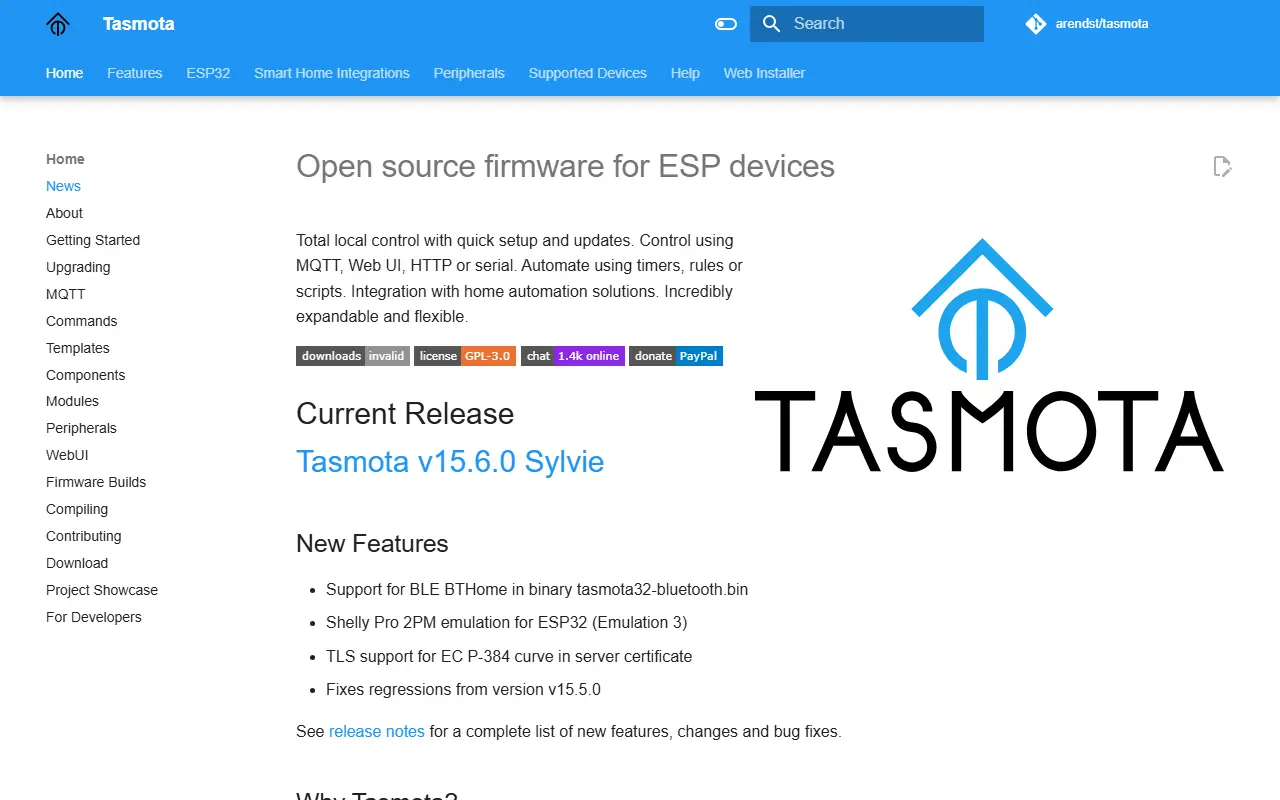
Tasmota is open-source firmware for devices built on ESP8266 and ESP32 chips, such as many smart plugs, switches and sensors from Sonoff and Tuya. You flash it onto compatible hardware to replace the vendor's firmware, which gives you local control rather than dependence on a manufacturer's cloud.
Configuration happens through a web interface, and updates can be delivered over the air. Automation is available through timers and rules, and the device can be controlled locally over MQTT, HTTP, serial or KNX. It talks to your own MQTT broker or a cloud one over TLS, including AWS IoT Core and Azure IoT Hub, or can run standalone with no server at all. Integrations include Home Assistant, Domoticz, openHAB and Node-RED. The code is written in C for PlatformIO and covers the ESP32 family, such as ESP32-S2, S3, C3, C5, C6 and P4.
Tasmota is licensed under GPL-3.0 and has extensive online documentation. It is a favorite of smart-home enthusiasts who want inexpensive devices that work offline and can be fully customized. Because it is firmware, it needs compatible hardware and some willingness to flash devices, so it suits hobbyists and installers more than casual users.
Key features
- Web UI configuration
- Over-the-air firmware updates
- Timers and rules for automation
- Local control over MQTT, HTTP, serial or KNX
- Home Assistant, openHAB and Domoticz integration
- Support for ESP8266 and the ESP32 family
Pricing: Free and open source under the GPL-3.0 license.
#4
A low-code, flow-based programming tool for event-driven applications, where you wire together devices, APIs and services in a browser-based editor.
- GitHub stars
- 24k
- Last commit
- yesterday
- Latest release
- 5.0.9
- Licence
- Apache-2.0
- Self-hosted
- Yes
nodered.org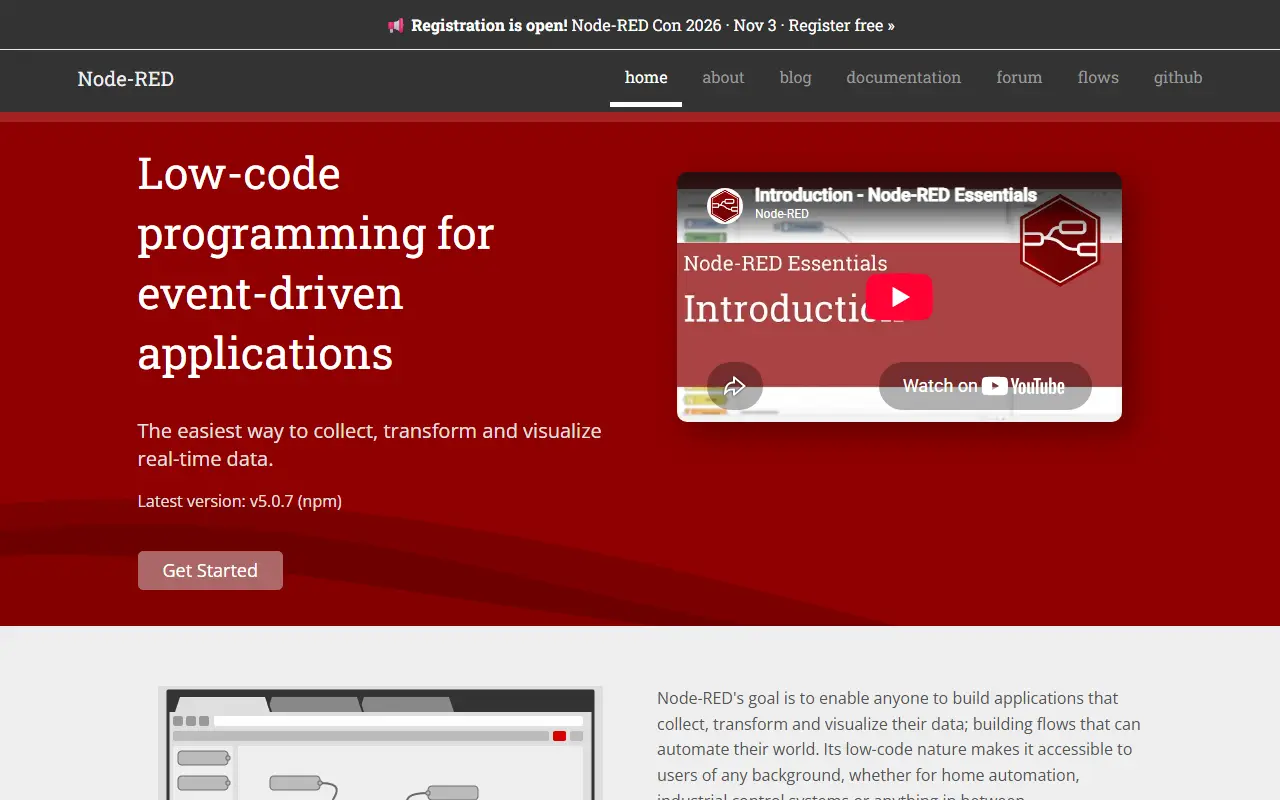
Node-RED is a low-code programming tool for event-driven applications built on flow-based, visual programming. Instead of writing everything as code, you connect nodes that represent inputs, processing steps and outputs, which makes it popular for IoT projects, home automation and wiring together APIs and online services. It is a project of the OpenJS Foundation.
Getting started takes a couple of commands: install it globally with npm, start it with the node-red command, and open it in your browser. A large ecosystem sits around it, with a library of custom nodes and integrations, shared flows and node collections, plus documentation, a forum and a Slack community. Developers can also run the latest code from git by cloning the repository, installing dependencies and building it.
Node-RED is written in JavaScript on Node.js and licensed under Apache-2.0. You run it on your own computer, a Raspberry Pi, a server or in a container, so there is no hosted service to depend on. It suits makers, integrators and engineers who want to prototype and automate event-driven logic quickly.
Key features
- Flow-based visual programming
- Browser-based visual editor
- Large library of community nodes
- Shareable flows and node collections
- Install with npm in one command
- Runs on small devices and servers
Pricing: Free and open source under the Apache-2.0 license.
#5
Zigbee2MQTT bridges Zigbee devices to MQTT so you can use them without a vendor's proprietary gateway in any smart home system.
- GitHub stars
- 16k
- Last commit
- yesterday
- Latest release
- 2.14.3
- Licence
- GPL-3.0
- Self-hosted
- Yes
zigbee2mqtt.io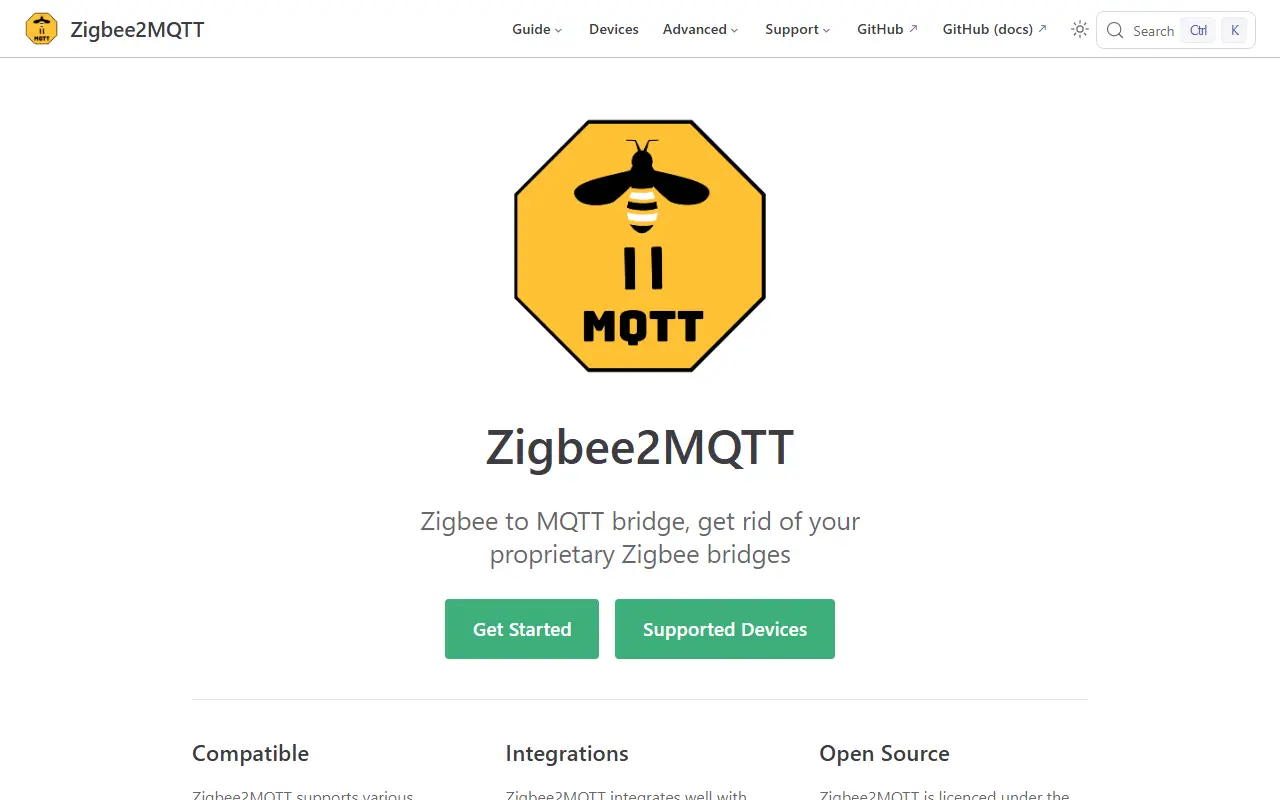
Zigbee2MQTT lets you use Zigbee devices without the manufacturer's bridge or gateway. It bridges events and allows you to control your devices through MQTT, so they can plug into whatever smart home infrastructure you already use. It is written in TypeScript and released under the GPL-3.0 license.
Because it speaks MQTT, it works with almost any home automation system. The README highlights integrations with Home Assistant (including an official add-on), Homey, Domoticz, Gladys Assistant and ioBroker. A Zigbee adapter connects to the host, and documentation guides installation and explains Zigbee terminology for newcomers.
Internally it is made up of modules developed in separate GitHub projects. The zigbee-herdsman module talks to the adapter, such as Texas Instruments hardware, and exposes an API, while zigbee-herdsman-converters maps individual device models to the Zigbee clusters they support. It runs on your own hardware, so there is no vendor cloud involved.
Key features
- Bridges Zigbee devices to MQTT
- Works without vendor bridges or gateways
- Home Assistant add-on available
- Integrations with Homey, Domoticz and ioBroker
- Device converters for many Zigbee models
- Documentation and Zigbee primer
Pricing: Free and open source under the GPL-3.0 license.
#6
The Home Assistant Companion app for Android connects a phone to Home Assistant, with notifications, Wear OS and Android Auto support.
- GitHub stars
- 4k
- Last commit
- yesterday
- Latest release
- 2026.11.1
- Licence
- Apache-2.0
companion.home-assistant.io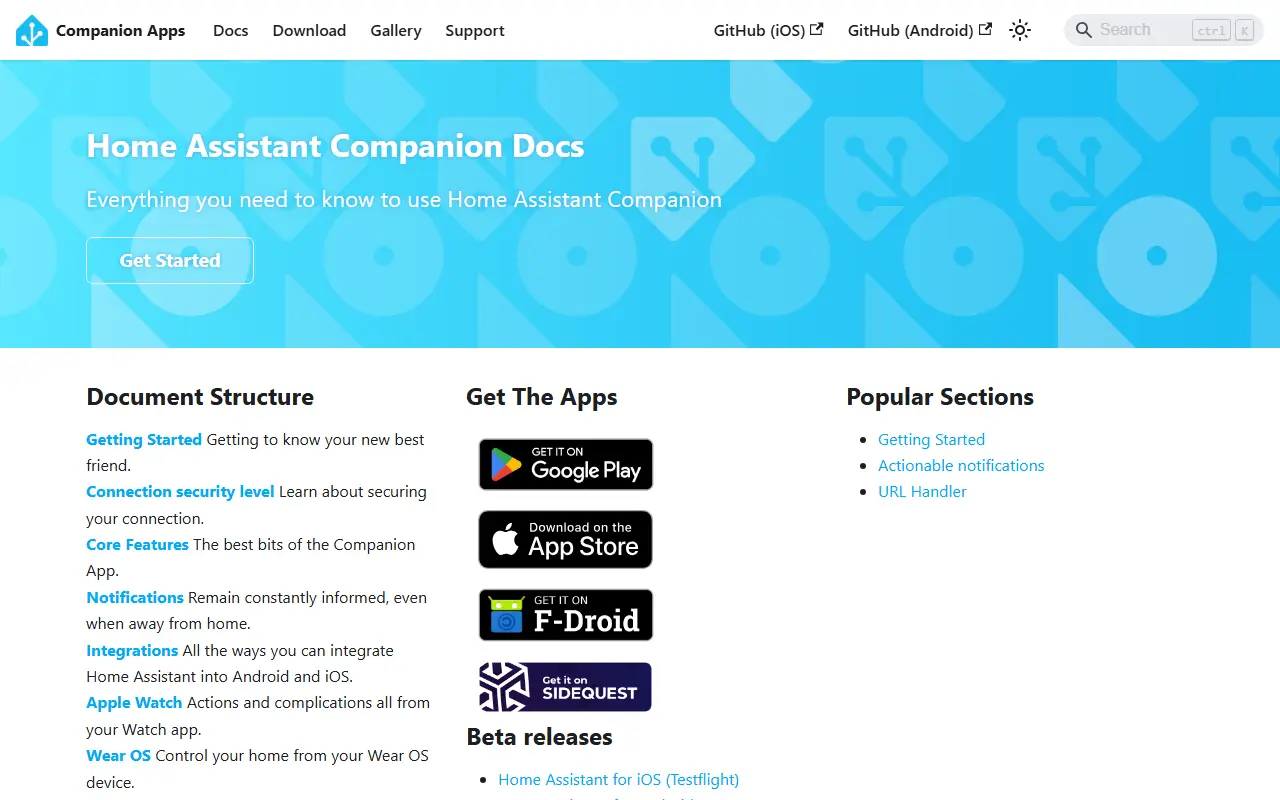
This is the Android app in the Home Assistant Companion family, which also includes an iOS app. Its documentation site is described as everything you need to know to use Home Assistant Companion, and links the source code for both the iOS and Android apps.
The docs cover getting started, connection security levels, core features, notifications and integrations with Android and iOS. Notifications are meant to keep you informed even when you are away from home, and actionable notifications are one of the popular sections.
Beyond phones, the documentation includes pages for controlling the home from a Wear OS device and from an Android Auto or Android Automotive compatible vehicle. Beta releases of the Android app are offered, and the project's code is under the Apache-2.0 licence.
Key features
- Notifications while away from home
- Wear OS control of the home
- Android Auto and Automotive vehicle control
- Integrations between Home Assistant and the phone
- Choice of connection security level

Privacy-focused open-source smart home assistant that runs on your own hardware, such as a Raspberry Pi, mini-PC, or NAS, to automate home devices.
- GitHub stars
- 3.3k
- Last commit
- today
- Latest release
- v5.3.2
- Licence
- Apache-2.0
- Self-hosted
- Yes
gladysassistant.com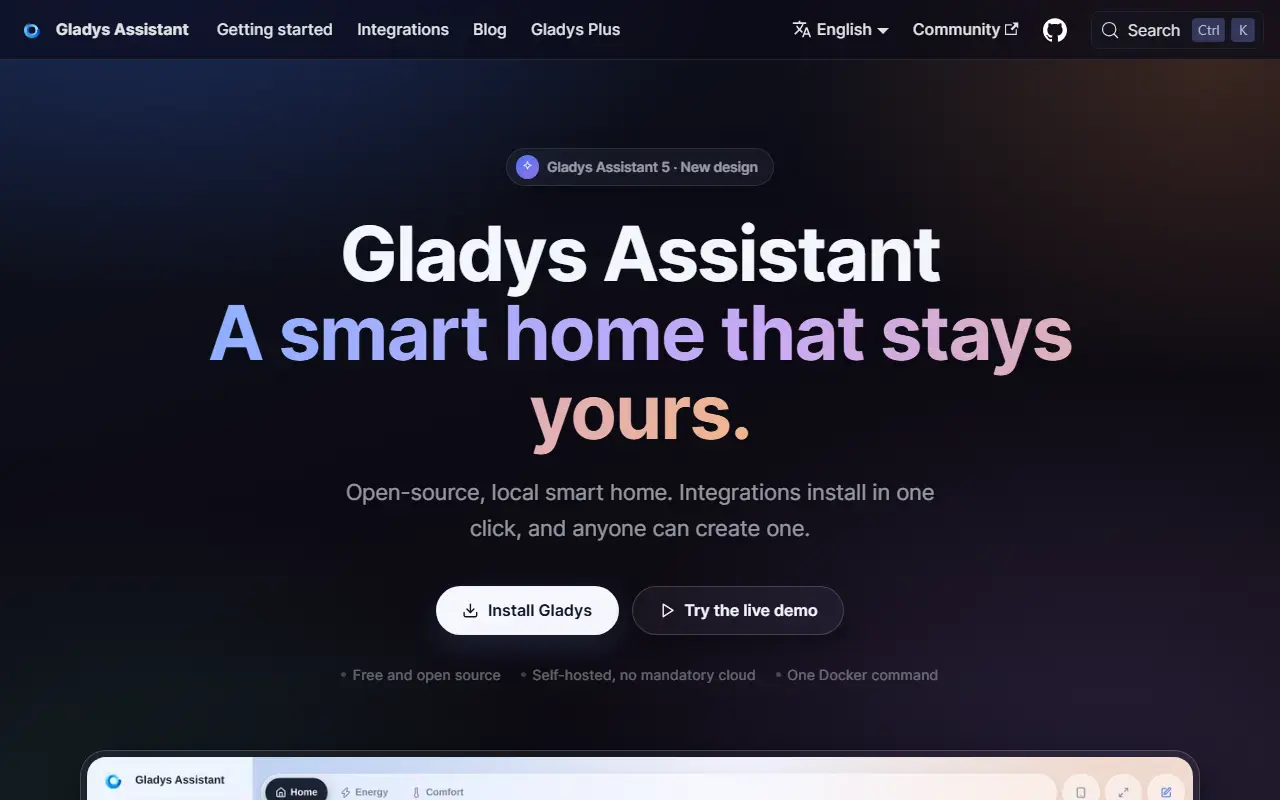
Gladys Assistant is an open-source home assistant that puts privacy first: it runs on a machine in your home and keeps your smart home data local. It has been developed since 2015 and is written in JavaScript on Node.js. The code is released under the Apache-2.0 license.
It is aimed at home automation and IoT setups, where you connect devices and build automations around them from one place. A local instance can be started quickly with Docker or Docker Compose, and the project provides step-by-step installation guides for a mini-PC, a NAS, or a Raspberry Pi, which makes it practical to run on small, always-on hardware.
Gladys is developed by a community that welcomes code, documentation, translations, and feature ideas, and the repository includes guides for contributors. It suits people who want to control a smart home without sending data to a cloud service, and who are comfortable running a small server at home.
Key features
- Runs locally with a privacy-first design
- Docker and Docker Compose installation
- Works on Raspberry Pi, mini-PCs, and NAS devices
- Home automation and IoT device control
- Built on Node.js with community contributions
Pricing: Gladys Assistant itself is free and open source. The optional Gladys Plus cloud service costs €6.99 (Lite) or €9.99 (Plus) per month, cheaper billed yearly, with a one-month free trial.
#8
Domoticz is a free, open source home automation system that lets you monitor and control lights, switches, sensors, and smart devices.
- GitHub stars
- 3.8k
- Last commit
- 2 days ago
- Latest release
- 2026.4
- Licence
- GPL-3.0
- Self-hosted
- Yes
domoticz.com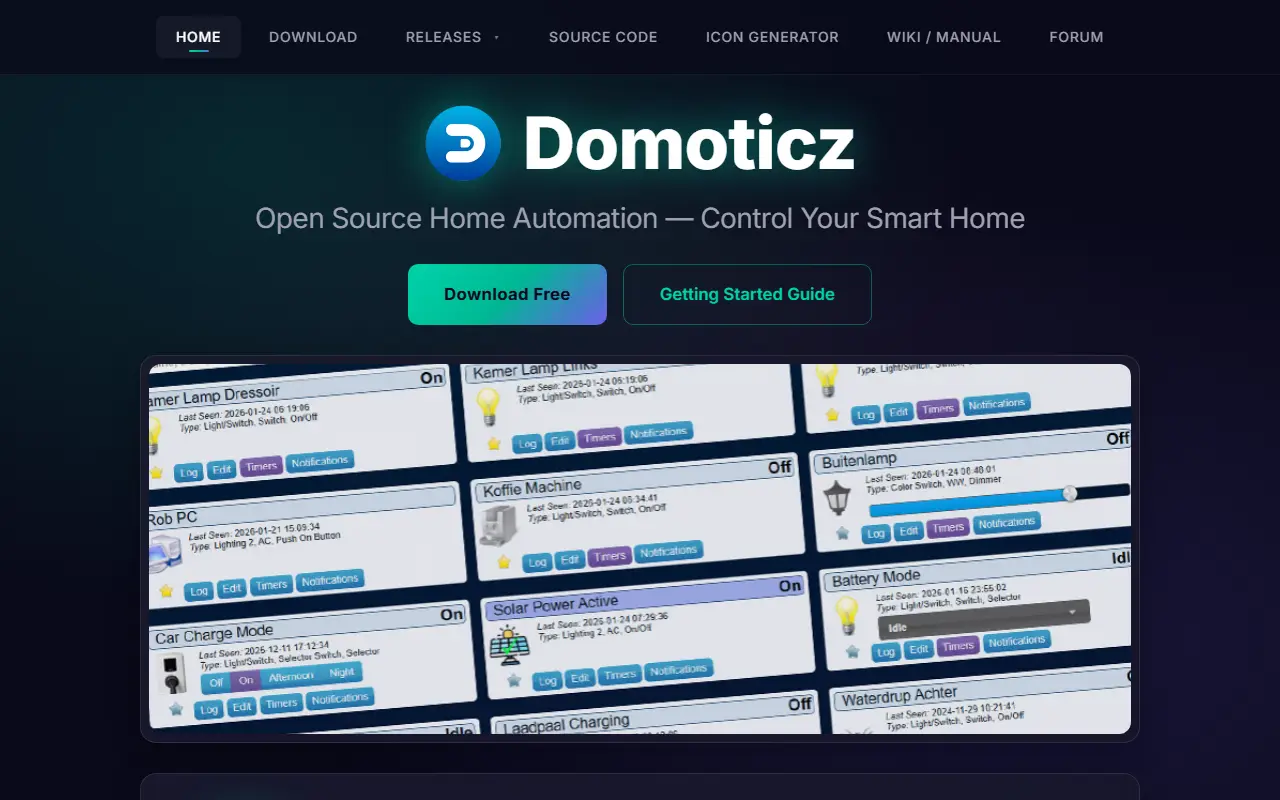
Domoticz is a home automation system that lets users monitor and configure devices such as lights, switches, and various sensors including temperature, rain, wind, UV, electra, gas, and water. Notifications and alerts can be sent to any mobile device. It is designed to be lightweight and runs on a Raspberry Pi Zero, using under 50 MB of RAM.
The system is 100% local and private, with all data staying on the user's hardware and automations running locally without cloud dependency. It has been in development since 2012 and supports over 150 devices including RFXCOM transceivers, Z-Wave, Zigbee, MQTT, P1 smart meters, YouLess meters, Philips Hue, 1-Wire, and EnOcean.
Key features
- Supports Z-Wave, Zigbee, MQTT, and 150+ devices
- Runs on Linux, Windows, Raspberry Pi, and Docker
- HTML5 web frontend adapted for desktop and mobile
- Automation and scripting with dzVents, Lua, Python, and Blockly
- Energy monitoring and smart meter support
- iPhone and Android push notifications

openHAB Core is the Java framework of core bundles that underpins the openHAB smart home and IoT automation runtime.
- GitHub stars
- 1.2k
- Last commit
- yesterday
- Licence
- EPL-2.0
- Self-hosted
- Yes
openhab.org
openHAB Core contains the core bundles of the openHAB runtime, an open-source platform for home automation and the Internet of Things. The README is explicit that Core is not a product by itself but a framework for building solutions on top of it. The repository is mainly an artifact repository of OSGi bundles that the main openHAB distribution picks up and that can be used within smart home products.
Building it uses Maven and a Java SE Development Kit 21. The README walks through checking out the source, setting Maven options, and running a clean install with the spotless formatter, with quicker variants that skip tests or checks for faster local builds. The code is Java and licensed under EPL-2.0.
People who want to run openHAB at home normally install the main distribution instead of building Core. The repository itself is aimed at developers and contributors, and it points to contribution guidelines. Topics mention home automation, the Internet of Things and Java.
Key features
- OSGi bundles for the openHAB runtime
- Framework for smart home solutions
- Maven-based build
- Picked up by the main openHAB distribution
- Contribution guidelines for developers
Pricing: Free and open source under the EPL-2.0 license.
Commercial Aqara Home alternatives
Hosted, closed-source products that compete with Aqara Home.
Aqara Home alternatives: questions
- What is the best open-source alternative to Aqara Home?
- Home Assistant is the top-ranked open-source alternative to Aqara Home on Enlisted: Open-source home automation software built around local control and privacy, with automations, dashboards, voice assistants and over 1,500 integrations. Other strong options are ESPHome, Tasmota, Node-RED and Zigbee2MQTT.
- What are the best commercial alternatives to Aqara Home?
- Tuya Smart, Homey, Amazon Alexa, Apple Home and Google Home are among the hosted, closed-source alternatives to Aqara Home listed on Enlisted, which lists 9 in total. Compare their pricing and features on each tool page.
- Are these Aqara Home alternatives free?
- All 9 are open source, so the code is free to use under its licence, and all of them can be self-hosted on your own server or computer.
- How is this list of Aqara Home alternatives ranked?
- By a score built from GitHub stars, star growth over the last 30 days and how recently the code changed. 9 of these projects shipped code in the last 30 days. Data is refreshed daily, and nobody can pay to move up.
 TrackMedia
 TrackRev