3 open-source alternatives ranked by real activity

Open-source AccelByte alternatives

A curated, ranked list of the 3 best open-source alternatives to AccelByte.

The best open-source alternative to AccelByte is Supabase. If that doesn't suit you, other good options are SpacetimeDB and Nakama.

Commercial alternatives to AccelByte include PlayFab, Unity Gaming Services, Amazon GameLift and Photon Engine. See all 12.

AccelByte alternatives are mainly backend-as-a-service tools, but some are also databases and gaming & emulation tools. 3 of them shipped code in the last 30 days, 3 can be self-hosted, and 2 use a permissive licence.

Last updated November 12, 2026 · ranked by GitHub stars, growth and recent commits

Supabase

An open-source Postgres development platform bundling a database, auth, auto-generated APIs, realtime, storage and vector tools, often chosen as a Firebase alternative.

GitHub stars
115k
Last commit
today
Latest release
v1.26.08
Licence
Apache-2.0
Self-hosted
Yes
Hosted version
Available
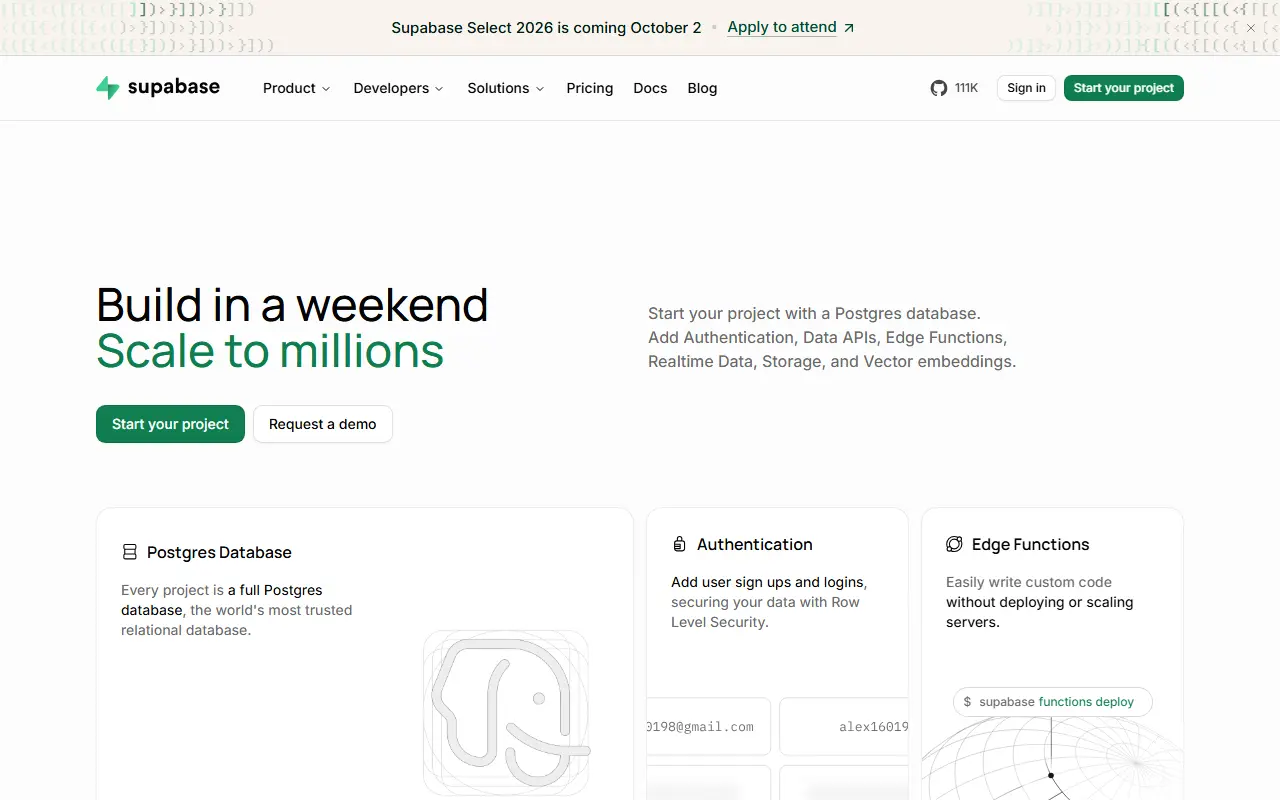
supabase.comSupabase homepage screenshot

Supabase is a backend platform built around a dedicated Postgres database. It packages the pieces most web, mobile and AI apps need, including authentication and authorization, auto-generated APIs, file storage, serverless functions and a dashboard, so developers can start without assembling separate services. Its stated aim is a developer experience similar to Firebase, built from open-source components.

APIs are generated from your schema as REST and GraphQL, with realtime subscriptions over websockets. Logic can live in database functions or in Edge Functions that run on Deno. For AI work there is a toolkit for vectors and embeddings built on pgvector, and Postgres extensions such as PostGIS are available. Supabase combines existing open tools with ones it builds itself when nothing suitable exists.

The code is Apache-2.0 licensed. Supabase is offered as a hosted platform you can sign up for without installing anything, and the same stack can be self-hosted or run locally for development. It suits teams that want Postgres at the core of their app but prefer not to build the surrounding backend themselves.

Key features

  • Hosted Postgres database with a dashboard
  • Authentication and authorization
  • Auto-generated REST and GraphQL APIs
  • Realtime subscriptions over websockets
  • Edge Functions and database functions
  • File storage for user uploads
  • Vector and embeddings toolkit with pgvector

Pricing: Free plan with 50,000 monthly active users. Pro starts at $25 and Team at $599 per month, with usage and extra compute billed on top; Enterprise is custom.

SpacetimeDB

A relational database that doubles as an application server: you upload server logic as modules, and clients connect directly with state synced in real time.

GitHub stars
26k
Last commit
yesterday
Latest release
v2.15.0
Self-hosted
Yes
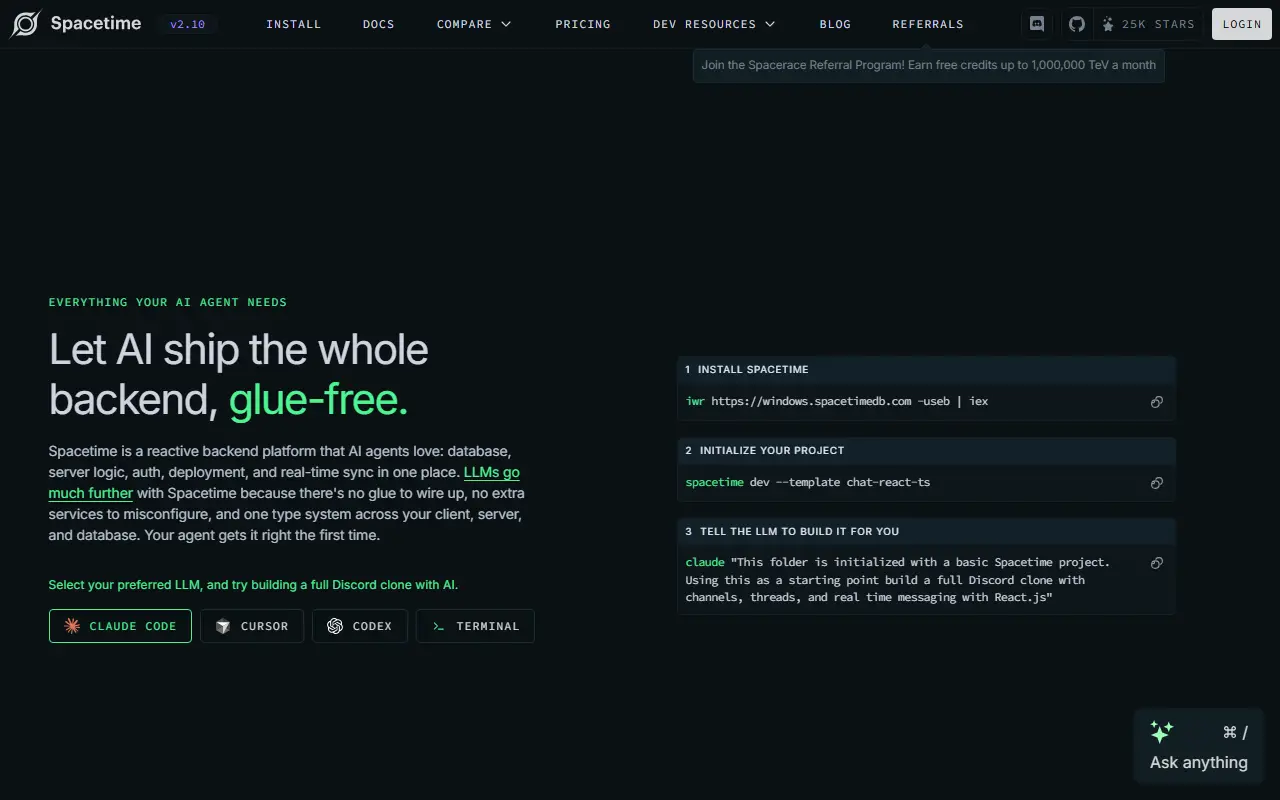
spacetimedb.comSpacetimeDB homepage screenshot

SpacetimeDB is a relational database that doubles as an application server. Instead of deploying a separate web or game server between clients and a database, you describe your schema and business rules in a module, upload it into the database, and let clients connect to it directly. Modules can be written in Rust, C#, TypeScript or C++.

It compiles the module, hosts it inside the database engine and pushes state changes to connected clients in real time. Permission and authorization logic live in the module just as they would in a normal server, so an entire application can be written in a single language and deployed as one binary. The project argues this removes the need for a separate web server, containers, orchestration and a caching layer. Its topics highlight game development, MMORPG servers and web development.

SpacetimeDB is written in Rust, and its license is listed as 'Other' on GitHub, so review the terms before building commercial products on it. Its creators, Clockwork Labs, offer documentation and a website at spacetimedb.com. It suits real-time apps and multiplayer games where low latency and simple architecture matter.

Key features

  • Relational database that runs app logic
  • Modules in Rust, C#, TypeScript or C++
  • Automatic real-time state sync to clients
  • Permissions defined inside modules
  • Deploys as a single binary
  • Direct client connections without a middle server

Pricing: Maincloud Free is $0 per month with a monthly usage credit. Pro is $25 and Team $250 per month with larger credits and pay-as-you-go beyond them; Enterprise is custom.

Nakama

Open-source game backend for online and social games, scriptable in JavaScript, Go and Lua and available as a managed service on Heroic Cloud.

GitHub stars
14k
Last commit
2 days ago
Latest release
v3.42.0
Licence
Apache-2.0
Self-hosted
Yes
Hosted version
Available
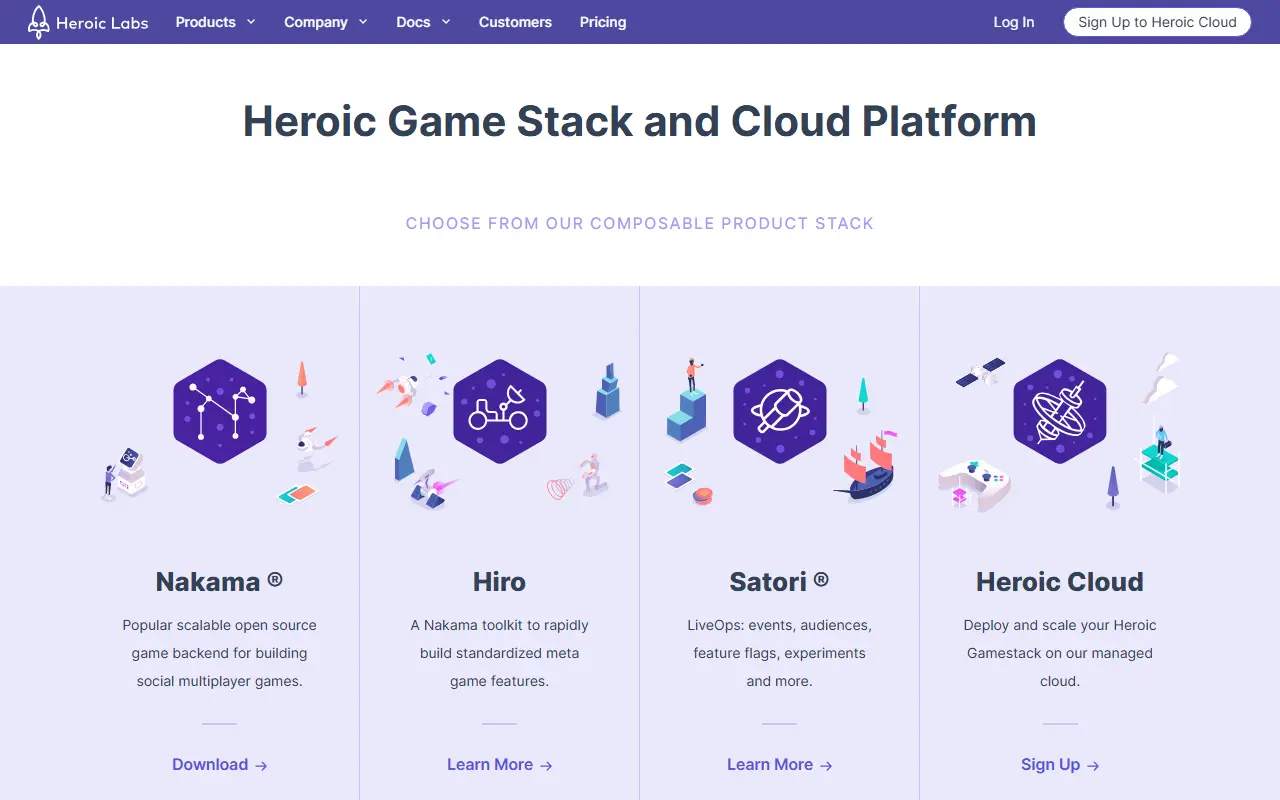
heroiclabs.comNakama homepage screenshot

Nakama is a scalable open-source game backend from Heroic Labs for online and social games, with competitive, social and multiplayer features. The company pitches it as a way to take back control of your game backend and own your data.

Nakama can be customised with JavaScript, Go and Lua, and the site lists adding social gameplay, building multiplayer experiences and growing competitive communities as its focus. It sits in a wider Heroic stack: Hiro, a toolkit for meta game features such as economy models with soft and hard currencies and energy accumulators, and Satori, for LiveOps like events, audiences, feature flags and experiments.

Nakama OSS can be downloaded and started by following the documentation, which promises a start in five minutes, or run on Heroic Cloud, a managed or private cloud where Nakama and Satori are hosted with automated scale out. Heroic Labs publishes a case study with Kwalee and highlights Loom Games' Pixel Flow, which it says has passed 10M players.

Key features

  • Social and multiplayer features, scripted in JavaScript, Go or Lua
  • Hiro toolkit for economy, energy and ad-reward features
  • Satori adds LiveOps such as events and feature flags
  • Managed hosting on Heroic Cloud
  • Client libraries, tutorials and guides in the docs
Read more about NakamaWebsiteGitHub#3 AccelByte alternative

Commercial AccelByte alternatives

Hosted, closed-source products that compete with AccelByte.

AccelByte alternatives: questions

What is the best open-source alternative to AccelByte?
Supabase is the top-ranked open-source alternative to AccelByte on Enlisted: An open-source Postgres development platform bundling a database, auth, auto-generated APIs, realtime, storage and vector tools, often chosen as a Firebase alternative. Other strong options are SpacetimeDB and Nakama.
What are the best commercial alternatives to AccelByte?
PlayFab, Unity Gaming Services, Amazon GameLift, Photon Engine and Beamable are among the hosted, closed-source alternatives to AccelByte listed on Enlisted, which lists 12 in total. Compare their pricing and features on each tool page.
Are these AccelByte alternatives free?
All 3 are open source, so the code is free to use under its licence, and all of them can be self-hosted on your own server or computer. 2 also offer a paid or managed cloud version if you'd rather not host it yourself.
How is this list of AccelByte alternatives ranked?
By a score built from GitHub stars, star growth over the last 30 days and how recently the code changed. 3 of these projects shipped code in the last 30 days. Data is refreshed daily, and nobody can pay to move up.

People also look for alternatives to…

View all