 TrackMedia
 TrackRev

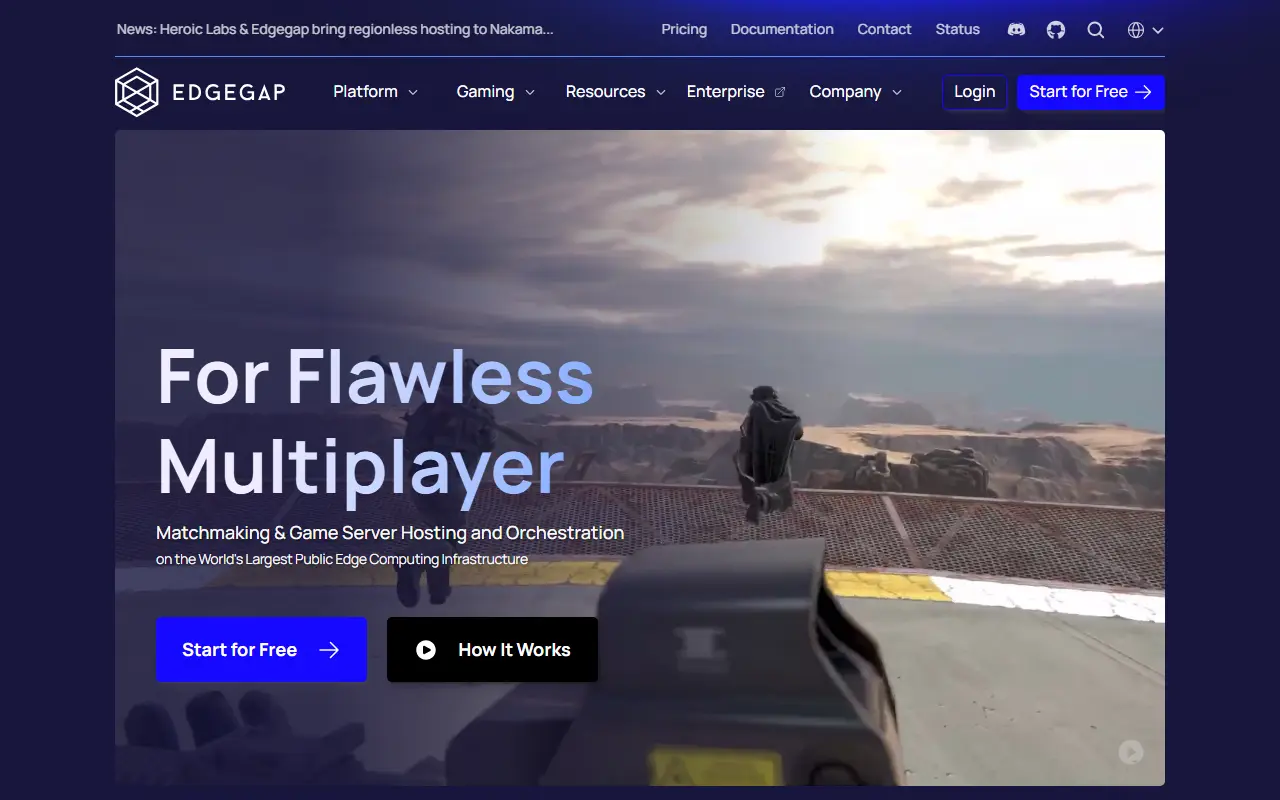
About Edgegap
Edgegap is a commercial platform for running multiplayer game servers. Instead of keeping fixed servers in a few regions, it orchestrates dedicated game server instances on a wide public edge computing network so that matches can be hosted near the players taking part, which helps reduce latency.
The service combines matchmaking with server hosting and orchestration, scaling capacity up during busy periods and back down afterward so costs follow usage. It is described as compatible with major game engines and with other game services, and the vendor publishes documentation, a status page and a free tier to start.
Edgegap is a hosted offering without a self-hosted edition. It is aimed at studios of different sizes that need dedicated servers for competitive or cooperative games and want to avoid operating their own global fleet. Pricing details are on the vendor's pricing page.
Key features
- Dedicated game server orchestration
- Matchmaking integrated with hosting
- Servers placed near players on edge locations
- Automatic scaling with player demand
- Compatibility with major game engines
- Documentation and status page
Good fit for
- Hosting dedicated servers for multiplayer games
- Cutting latency for players in distant regions
- Scaling servers through launch spikes
Edgegap: questions and answers
- What is Edgegap used for?
- Edgegap is a game server hosting and orchestration platform that deploys dedicated multiplayer servers on edge infrastructure close to players. It is a good fit for hosting dedicated servers for multiplayer games, cutting latency for players in distant regions and scaling servers through launch spikes.
- How much does Edgegap cost?
- Edgegap is a paid product with no free plan. A free trial is available. Usage-based game server hosting after a free trial: Edge Cloud is $0.00115 per vCPU-minute and Private Fleets $0.0256 per vCPU-hour. Matchmaking tiers and relays are priced separately; enterprise is custom.
- Is Edgegap open source?
- No. Edgegap is proprietary (closed-source) software and can't be self-hosted. In the Hosting & PaaS category, open-source options include Zeabur, Pterodactyl and HestiaCP.
- What are some alternatives to Edgegap?
- Edgegap competes with Amazon GameLift, AccelByte and Unity Gaming Services.
Open-source alternatives to Edgegap
See all
Zeabur
Hosting & PaaS
A platform that helps you deploy services with one click.
MPL-2.0vs Vercel★ 750
Pterodactyl
Hosting & PaaS
Pterodactyl® is a free, open-source game server management panel built with PHP, React, an
OSS★ 9.5k
HestiaCP
Hosting & PaaS
Hestia Control Panel | A lightweight and powerful control panel for the modern web.
GPL-3.0vs Cloudways★ 4.6k
Convox
Hosting & PaaS
Private PaaS built on native AWS services for maximum privacy and minimum upkeep
OSSvs Heroku★ 1.9k
ZaneOps
Hosting & PaaS
A beautiful and fast self-hosted PaaS for deploying and managing web apps, databases, stat
OSSvs Heroku★ 1.4k
Coolify
Hosting & PaaS
Self-hosting platform with superpowers. Deploy apps, databases & 280+ services to your
Apache-2.0vs Heroku★ 66k
SaaS alternatives to Edgegap
See all
Amazon GameLift
Hosting & PaaS
AWS service for hosting and scaling dedicated multiplayer game servers
SaaS
AccelByte
Backend as a Service
Game backend services for accounts, matchmaking, economy and live operations
SaaS
Unity Gaming Services
Backend as a Service
Unity cloud services for game authentication, cloud save, multiplayer and analytics
SaaS
PlayFab
Backend as a Service
Microsoft game backend with player accounts, economy, leaderboards and live ops
SaaS
Photon Engine
Backend as a Service
Multiplayer game networking and realtime backend for Unity and other engines
SaaS
Zhost
Hosting & PaaS
Polish hosting provider for Discord bots, NGINX web servers and MTA:SA game servers
SaaS