
About Watson
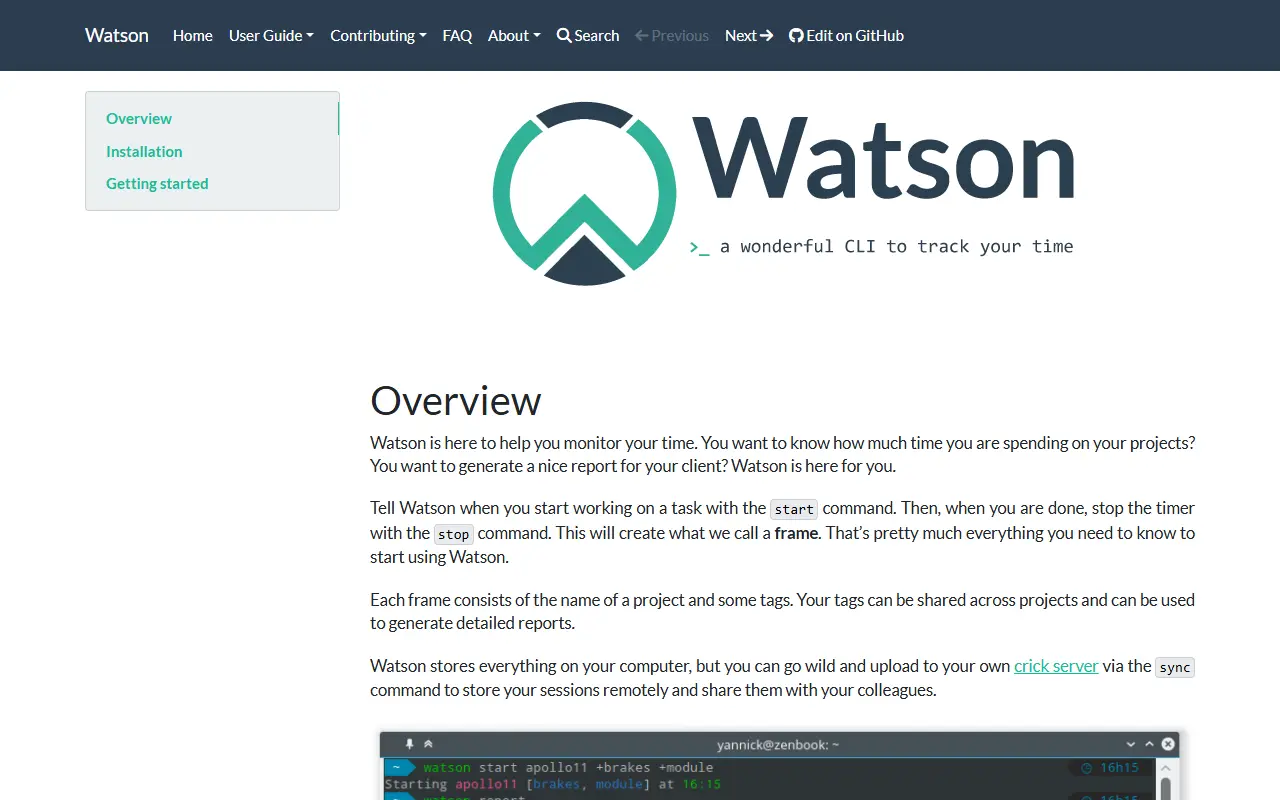
Watson is a command-line tool for tracking how much time you spend on your projects, for example to prepare a report for a client. This listing is named after the Jazzband community that maintains the project. You start the timer with a start command and stop it with a stop command, which records what Watson calls a frame.
Each frame holds a project name and optional tags, and tags can be shared across projects to build detailed reports. Everything is stored on your own computer, and the sync command can upload sessions to your own crick server so they can be kept remotely and shared with colleagues.
Watson is written in Python and runs on any platform Python supports, including Windows, macOS, Linux and BSD. It installs with pip as td-watson, through Homebrew on macOS, or from distribution packages such as the Arch Linux AUR. The documentation has a user guide, command reference and configuration pages, and the project is MIT licensed.
Key features
- Start and stop timers from the terminal
- Frames with project names and tags
- Reports by project and tag
- Local storage on your own computer
- Optional sync to a crick server
- Install via pip, Homebrew or distro packages
Good fit for
- →Freelancers tracking billable hours
- →Developers logging project time from the shell
- Built with
- Python
- Tags
- time-tracking
- cli
- python
- reports
- productivity
- command-line
- project-management
Watson: questions and answers
- What is Watson used for?
- Watson is a Python command-line time tracker that records work sessions by project and tag and produces reports, with optional sync to a crick server. It is a good fit for freelancers tracking billable hours and developers logging project time from the shell.
- Is Watson open source?
- Yes. Watson is open source under the MIT licence. Its source code is on GitHub at jazzband/Watson and is written mainly in Python.
- Is Watson free?
- Yes. Watson is open source, so the software itself is free to use.
- What is Watson an alternative to?
- Watson is an open-source alternative to Clockify, Harvest, Toggl Track and Everhour. Other open-source alternatives to Clockify include Traggo, Solidtime and Kimai.
- Is Watson actively maintained?
- The most recent commit to Watson was on 15 December 2025, and the latest release is 2.1.0, published on 16 May 2022. The project has 2.5k stars on GitHub.
Open-source alternatives to Watson
See all
Traggo
Productivity
self-hosted tag-based time tracking
GPL-3.0vs Clockify★ 1.6k
Solidtime
Productivity
The modern Open-Source Time Tracker for Freelancers and Agencies. Manage Projects, Tasks,
AGPL-3.0vs Clockify★ 9k
Kimai
Productivity
Kimai is the #1 open-source time-tracking application. From freelancers to companies and o
AGPL-3.0vs Clockify★ 5.1k
Ever Teams
Project Management
Ever® Teams™ - The Workplace for Humans. Open Work & Productivity Platform - https://ever.
AGPL-3.0vs Jira★ 589
Super Productivity
Productivity
Super Productivity is an advanced todo list app with integrated Timeboxing and time tracki
MITvs Todoist★ 22k
Midday
Finance & Accounting
Invoicing, Time tracking, File reconciliation, Storage, Financial Overview & your own Assi
AGPL-3.0vs QuickBooks★ 15k
SaaS alternatives to Watson
See all
Clockify
Productivity
Time tracker and timesheet software with reporting
SaaS
Harvest
Productivity
Time tracking with expenses and invoicing for client work
SaaS
Toggl Track
Productivity
Time tracking tool for teams and freelancers with reports and project budgets
SaaS
Everhour
Productivity
Time tracking and budgeting tool that integrates with project management apps
SaaS
TrackingTime
Productivity
Time tracking and project management tool for teams and freelancers
SaaS
Timely
Productivity
Automatic time tracking and capacity planning software for teams
SaaS