7,363 open-source and SaaS tools, with GitHub stats refreshed every day.

5 alternatives ranked by real activity

Open-source Clockify alternatives

A curated, ranked list of the 5 best open-source alternatives to Clockify.

The best open-source alternative to Clockify is Solidtime. If that doesn't suit you, other good options are Kimai, Traggo, Ever Teams and Watson.

Clockify alternatives are mainly productivity tools, but some are also project management tools. 4 of them shipped code in the last 30 days, 5 can be self-hosted, and 1 uses a permissive licence.

Last updated October 3, 2026 · ranked by GitHub stars, growth and recent commits

Solidtime

A modern open-source time tracking app for freelancers and agencies with projects, clients, billable rates, multiple organizations and imports from Toggl and Clockify.

GitHub stars
9k
Last commit
today
Latest release
v0.21.0
Licence
AGPL-3.0
Self-hosted
Yes
Hosted version
Available
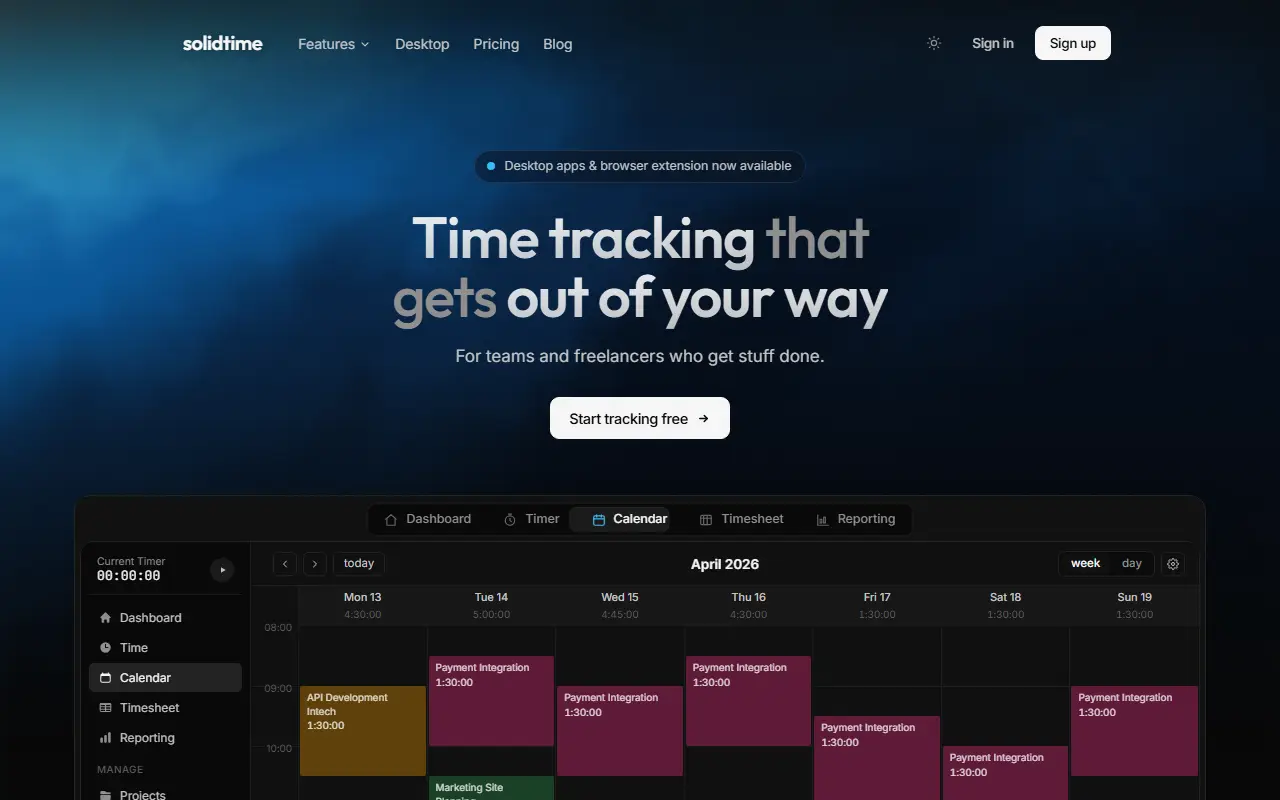
solidtime.ioSolidtime homepage screenshot

Solidtime is a contemporary time tracking application for freelancers and agencies, released as open source. It provides an easy-to-use interface for logging time against projects and tasks, and is built with Laravel and Vue.

Beyond tracking time, you can create and manage projects with members, tasks inside projects, and clients attached to projects. Billable rates can be set for projects, project members, organization members and whole organizations. One account can manage multiple organizations, roles and permissions control access, and data can be imported from Toggl, Clockify and generic time entry CSV files.

Solidtime can be self-hosted using the published guides and an examples repository, or used through solidtime cloud if you do not want to run it. It is licensed under AGPL-3.0, and the contributing rules ask for an issue or discussion before pull requests. It suits small teams moving off Toggl or Clockify who want billing-friendly reports and control over their data.

Key features

  • Time tracking with a modern interface
  • Projects, tasks and clients
  • Billable rates at several levels
  • Multiple organizations per account
  • Roles and permissions
  • Import from Toggl and Clockify

Pricing: Free Solo plan for one user. Professional is €9 per user per month, or €8 billed annually, excluding VAT. An on-premise option is also offered.

Kimai

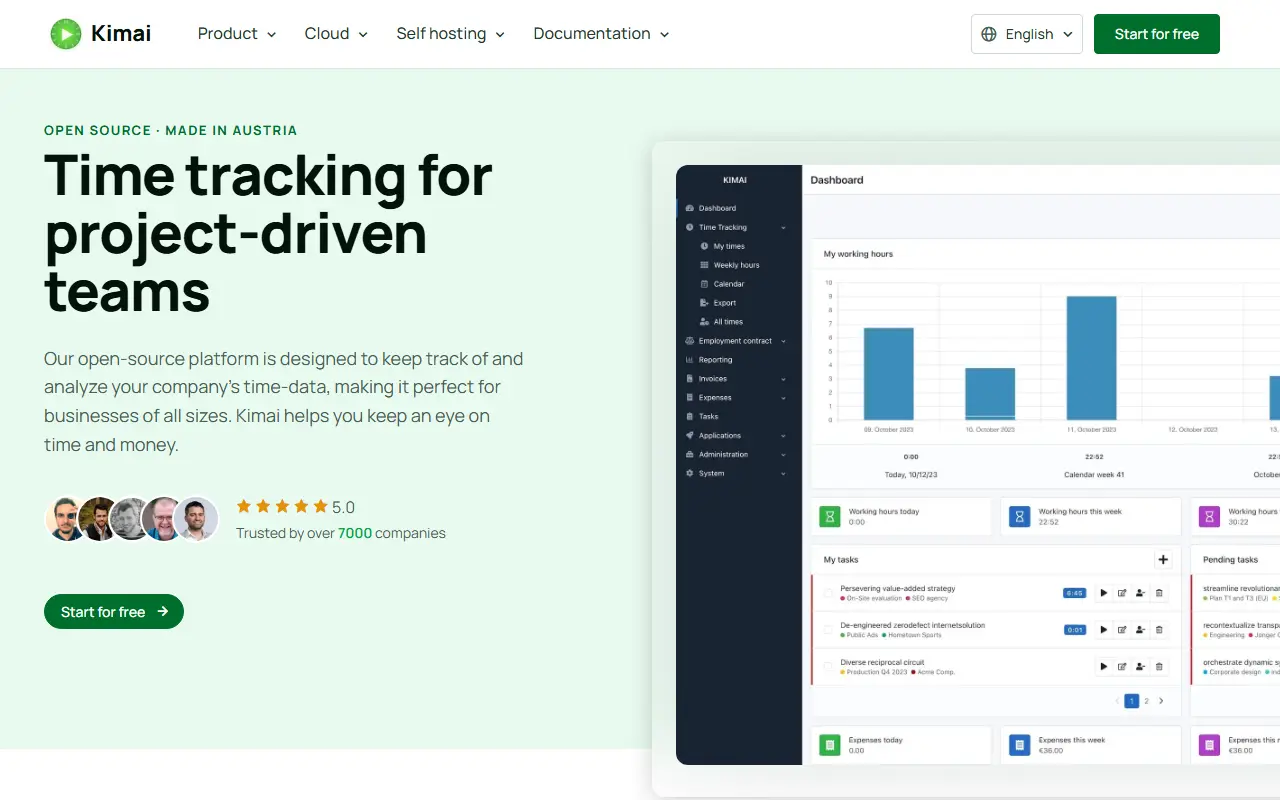
Kimai is an open-source, web-based time-tracking application with timesheets, reports and invoicing for freelancers and teams, in self-hosted or SaaS form.

GitHub stars
5.1k
Last commit
today
Latest release
2.67.0
Licence
AGPL-3.0
Self-hosted
Yes
Hosted version
Available
kimai.orgKimai homepage screenshot

Kimai is a professional time-tracking application that is free and open source. It handles use cases from solo freelancers to companies with dozens or hundreds of users, letting people record the time they spend on customers and projects, review timesheets and produce reports and invoices.

The feature list includes a JSON API, invoicing, data exports, multiple timers, a punch-in and punch-out mode, tags, multi-user support with multiple time zones, and translations into more than 30 languages. For security and administration it offers authentication via SAML, LDAP or the local database, two-factor authentication with TOTP, customizable role and team permissions and a responsive design. The application is built with PHP and Symfony.

Kimai is licensed under AGPL-3.0 and can be run on-premises on your own server, or you can use the SaaS version offered by the project. It suits freelancers, agencies and small and mid-sized companies that bill by the hour and want to keep time data under their control.

Key features

  • Timesheets with multi-timer and punch-in modes
  • Invoicing and data exports
  • Customer and project reports
  • JSON API for integrations
  • SAML, LDAP and two-factor authentication
  • Role and team permissions

Pricing: Hosted Kimai costs €3.99 (Standard) or €4.99 (Professional) per user per month, or €2.99 and €3.99 on annual billing, with a 30-day free trial. Prices exclude tax.

Traggo

A self-hosted time tracker built around tags instead of tasks, with dashboards, calendar and list views and simple user management.

GitHub stars
1.6k
Last commit
5 days ago
Latest release
v0.8.3
Licence
GPL-3.0
Self-hosted
Yes
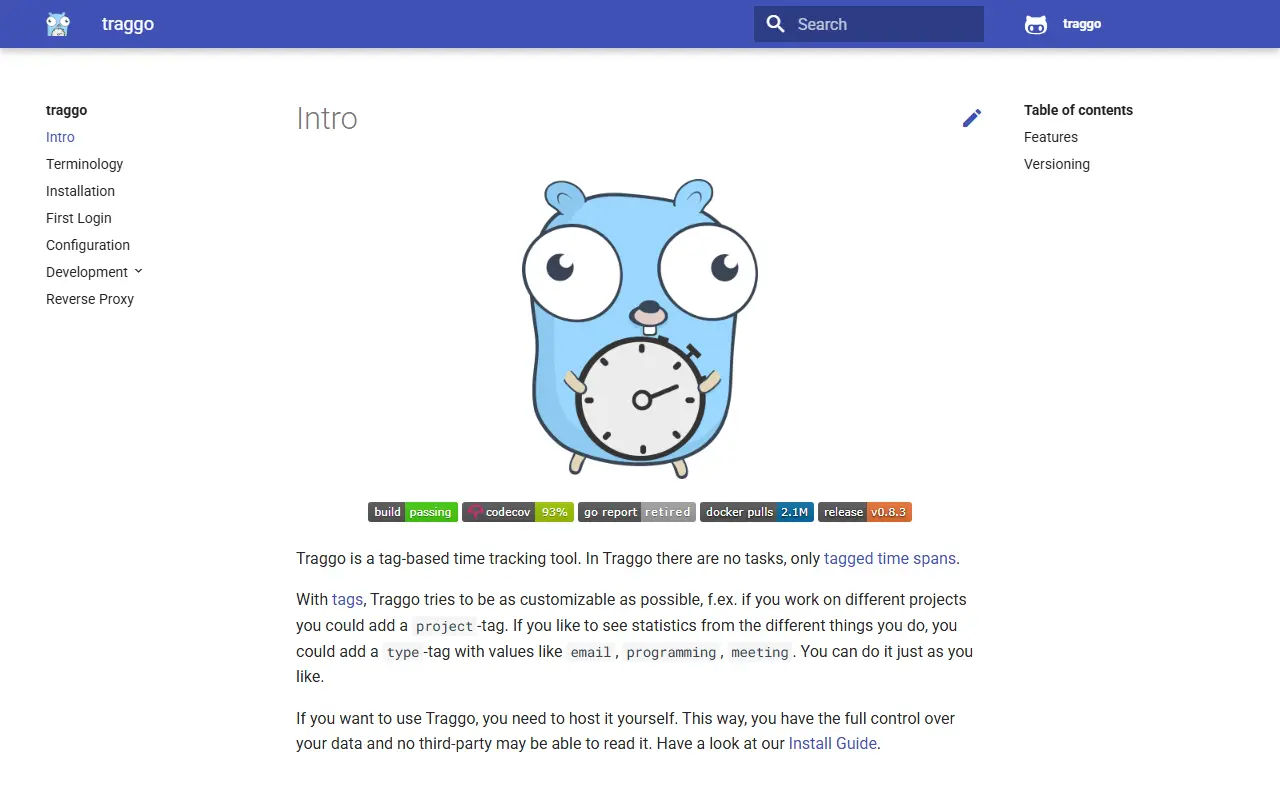
traggo.netTraggo homepage screenshot

Traggo is a self-hosted time tracking tool with an unusual model: there are no tasks or projects, only tagged time spans. You decide what the tags mean, so you might add a project tag for client work and a type tag with values like email, programming or meeting to see how your hours are really spent.

The web interface offers customizable dashboards with diagrams, a list view and a calendar view of tracked time, several themes, and simple user management. It is designed to be easy to set up, and the project provides an install guide and configuration documentation. Because you run it yourself, no third party can read your time data.

Traggo is written in Go and licensed under GPL-3.0. It ships as a server you host on your own machine or a small VPS, with versioning based on SemVer. It suits freelancers, small teams and individuals who want flexible, privacy-respecting time statistics and who prefer organizing work with free-form tags rather than a fixed project hierarchy.

Key features

  • Tag-based time tracking model
  • Customizable dashboards with diagrams
  • List and calendar views of time
  • Multiple web UI themes
  • Simple multi-user management
  • Single Go server that is easy to set up

Pricing: Free and open source under the GPL-3.0 licence.

Ever Teams

Ever Teams is an open work and project management platform with time tracking, tasks and issues, teams and integrations, currently in active development.

GitHub stars
589
Last commit
today
Latest release
v0.137.4
Licence
AGPL-3.0
Hosted version
Available
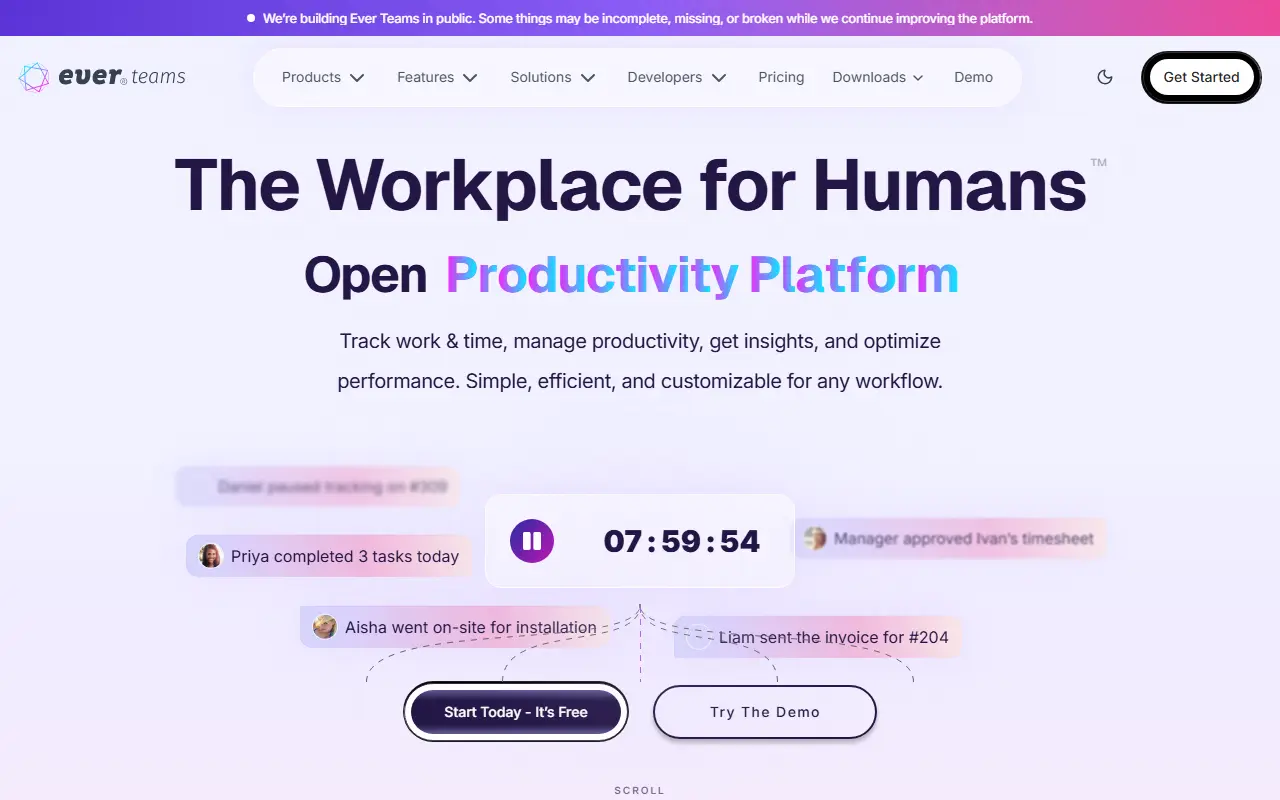
ever.teamEver Teams homepage screenshot

Ever Teams is an open work and project management platform from Ever Co, described as the workplace for humans. It combines project and task management with time tracking, and its topics position it as an alternative to tools such as Jira and Linear, with kanban boards, issue tracking and team management.

The README states the platform is in active development, so it should be used with caution. Planned features include workforce management, time and activity tracking, productivity metrics, projects, tasks and issues, organizations and teams, tags and labels, integrations with GitHub, GitLab, Bitbucket and Jira, and dark, black and light themes. It ships as a web platform, mobile apps for iOS and Android built with React Native and a browser extension, and it uses the headless APIs of Ever Gauzy, the company's open business management platform.

Hosted web, demo and staging applications are linked from the repository, along with documentation and a Storybook for the UI kit. Ever Teams is written in TypeScript and licensed under AGPL-3.0.

Key features

  • Tasks, issues and project tracking
  • Time and activity tracking
  • Organizations and teams
  • Tags and labels
  • Integrations with GitHub, GitLab and Jira
  • Web, mobile and browser extension clients

Pricing: A free Starter plan exists and Small Business has a 90-day trial. Small Business costs $25 per month including 10 employees, and Enterprise $199 per month when billed monthly, with lower annual rates.

Watson

Watson is a Python command-line time tracker that records work sessions by project and tag and produces reports, with optional sync to a crick server.

GitHub stars
2.5k
Last commit
9 mo ago
Latest release
2.1.0
Licence
MIT
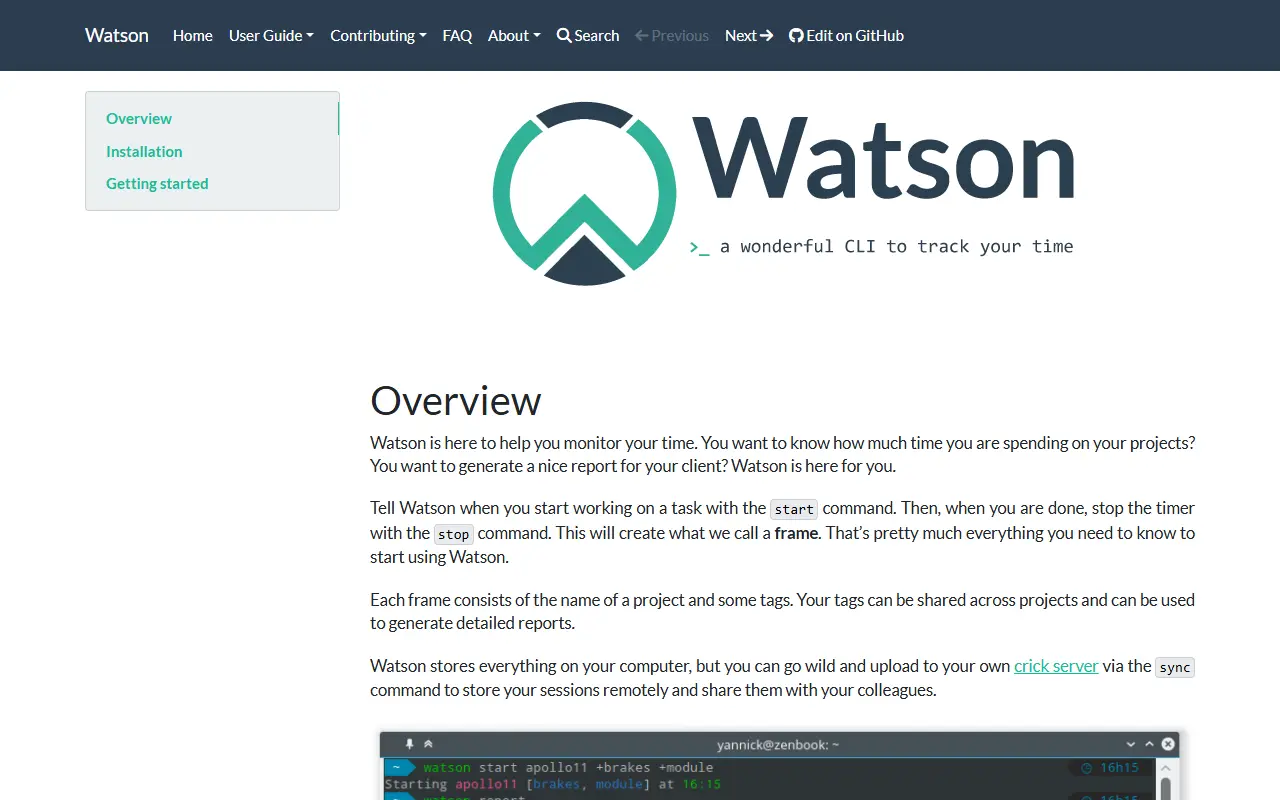
jazzband.github.ioWatson homepage screenshot

Watson is a command-line tool for tracking how much time you spend on your projects, for example to prepare a report for a client. This listing is named after the Jazzband community that maintains the project. You start the timer with a start command and stop it with a stop command, which records what Watson calls a frame.

Each frame holds a project name and optional tags, and tags can be shared across projects to build detailed reports. Everything is stored on your own computer, and the sync command can upload sessions to your own crick server so they can be kept remotely and shared with colleagues.

Watson is written in Python and runs on any platform Python supports, including Windows, macOS, Linux and BSD. It installs with pip as td-watson, through Homebrew on macOS, or from distribution packages such as the Arch Linux AUR. The documentation has a user guide, command reference and configuration pages, and the project is MIT licensed.

Key features

  • Start and stop timers from the terminal
  • Frames with project names and tags
  • Reports by project and tag
  • Local storage on your own computer
  • Optional sync to a crick server
  • Install via pip, Homebrew or distro packages

Pricing: Free and open source under the MIT licence.

Clockify alternatives: questions

What is the best open-source alternative to Clockify?
Solidtime is the top-ranked open-source alternative to Clockify on Enlisted: A modern open-source time tracking app for freelancers and agencies with projects, clients, billable rates, multiple organizations and imports from Toggl and Clockify. Other strong options are Kimai, Traggo, Ever Teams and Watson.
Are these Clockify alternatives free?
All 5 are open source, so the code is free to use under its licence, and all of them can be self-hosted on your own server or computer. 3 also offer a paid or managed cloud version if you'd rather not host it yourself.
How is this list of Clockify alternatives ranked?
By a score built from GitHub stars, star growth over the last 30 days and how recently the code changed. 4 of these projects shipped code in the last 30 days. Data is refreshed daily, and nobody can pay to move up.

People also look for alternatives to…

View all