 TrackMedia
 TrackRev

About Space Cloud
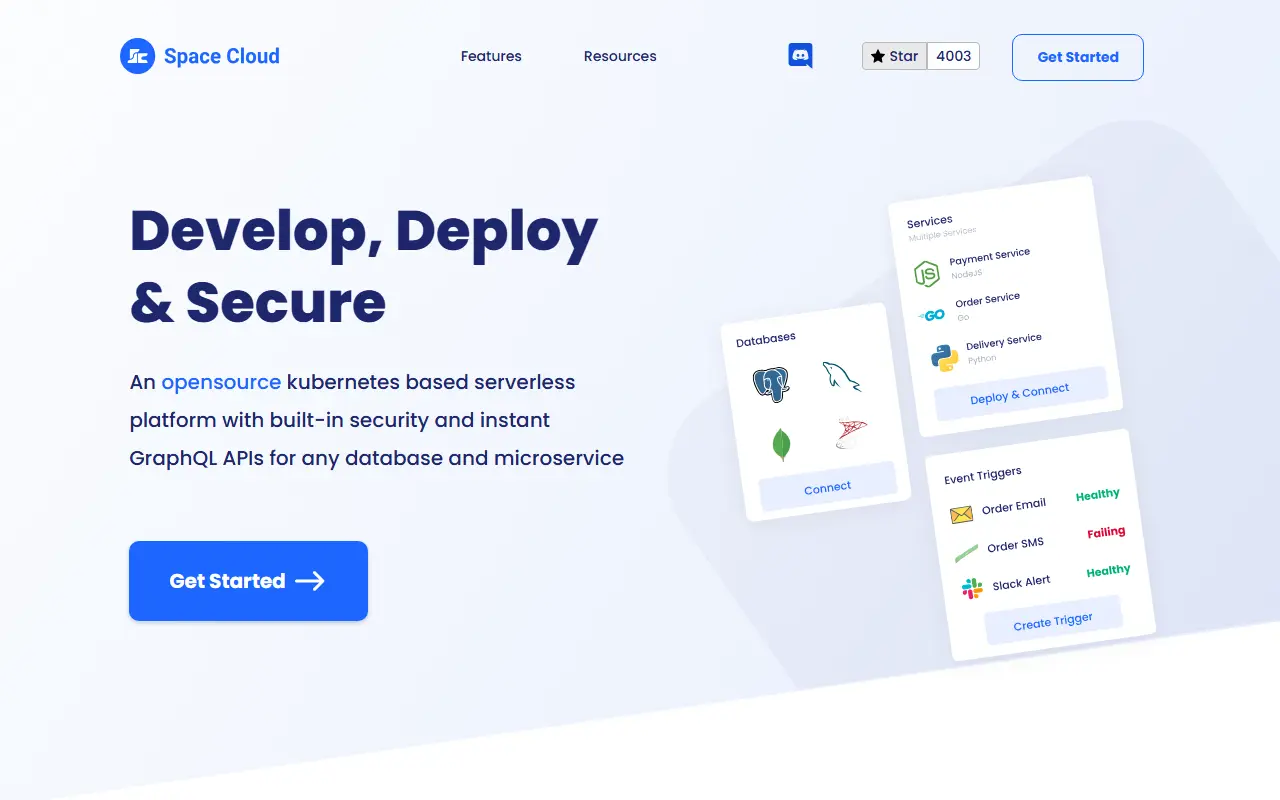
Space Cloud was an open-source serverless platform for developing, deploying and securing applications on Kubernetes, aiming to combine the convenience of Firebase with the deployment model of Heroku. It targeted teams who wanted instant, realtime APIs over their database with minimal custom backend code.
It generated GraphQL and REST APIs directly from supported databases, including MongoDB, PostgreSQL and compatible systems such as CockroachDB and Yugabyte, MySQL and compatible systems such as TiDB and MariaDB, and SQL Server. Features included flexible CRUD with cross-database joins, realtime live queries, file storage integration with services such as Amazon S3, event-driven webhooks and serverless functions, fine-grained access control integrating with systems such as Auth0 or Firebase Auth, and automatic scale-to-zero for HTTP workloads.
The README now states the project is in maintenance mode and recommends Hasura or WunderGraph as alternatives. It is written in Go, runs on Kubernetes, and is released under the Apache-2.0 license, so existing self-hosted deployments remain usable but new projects should weigh the lack of active development.
Key features
- Auto-generated GraphQL and REST APIs over databases
- Realtime live queries
- Event-driven webhooks and serverless functions
- File storage integration
- Fine-grained, auth-integrated access control
- Kubernetes-native scaling to zero
Good fit for
- Rapid backend APIs over an existing database
- Serverless apps on self-managed Kubernetes
Space Cloud: questions and answers
- What is Space Cloud used for?
- Space Cloud was an Apache-licensed, Kubernetes-based backend-as-a-service platform offering GraphQL and REST APIs over several databases; the project is now in maintenance mode. It is a good fit for rapid backend APIs over an existing database and serverless apps on self-managed Kubernetes.
- Is Space Cloud open source?
- Yes. Space Cloud is open source under the Apache-2.0 licence. Its source code is on GitHub at spacecloud-io/space-cloud and is written mainly in Go.
- Is Space Cloud free?
- Yes. Space Cloud is open source, so the software itself is free to use.
- Can I self-host Space Cloud?
- Yes. Space Cloud can be self-hosted on your own server or infrastructure; there is no official hosted version.
- What is Space Cloud an alternative to?
- Space Cloud is an open-source alternative to Firebase, Backendless and Back4App. Other open-source alternatives to Firebase include Appwrite, Supabase and Parse Server.
- Is Space Cloud actively maintained?
- The most recent commit to Space Cloud was on 4 July 2024, and the latest release is v0.21.5, published on 5 September 2021. The project has 4k stars on GitHub.
Open-source alternatives to Space Cloud
See all
Appwrite
Backend as a Service
Appwrite is an open-source developer platform with Auth, Databases, Storage, Functions, Me
BSD-3-Clausevs Firebase★ 58k
Supabase
Backend as a Service
The Postgres development platform. Supabase gives you a dedicated Postgres database to bui
Apache-2.0vs Firebase★ 115k
Parse Server
Backend as a Service
Parse Server for Node.js / Express
Apache-2.0vs Firebase★ 21k
Nhost
Backend as a Service
The Open Source Firebase Alternative with GraphQL.
MITvs Firebase★ 9.4k
CloudBoost
Backend as a Service
Realtime JavaScript Backend.
Apache-2.0vs Firebase★ 1.5k
PocketBase
Backend as a Service
Open Source realtime backend in 1 file
MITvs Firebase★ 62k
SaaS alternatives to Space Cloud
See all
Firebase
Backend as a Service
Firebase is Google's mobile and web app development platform, bundling authentication, databases, hosting, messaging and analytics as a managed backend.
SaaS
Backendless
Backend as a Service
Visual backend platform with a database, user management and API services
SaaS
Back4App
Backend as a Service
Hosted backend built on Parse Server with a database, auth and cloud functions
SaaS
Zoho Catalyst
Backend as a Service
Zoho serverless platform with a database, functions, storage and auth
SaaS
PocketBase Cloud
Backend as a Service
Hosting for PocketBase apps with database, auth, API, frontends and backends on one platform and CLI
SaaS
Userbase
Backend as a Service
Adds user accounts and data persistence to static sites using only JavaScript, HTML and CSS
SaaS