7,363 open-source and SaaS tools, with GitHub stats refreshed every day.

6 alternatives ranked by real activity

Open-source Back4App alternatives

A curated, ranked list of the 6 best open-source alternatives to Back4App.

The best open-source alternative to Back4App is Supabase. If that doesn't suit you, other good options are PocketBase, Appwrite, CloudBoost and Space Cloud.

Back4App alternatives are mainly backend-as-a-service tools. 3 of them shipped code in the last 30 days, 6 can be self-hosted, and 6 use a permissive licence.

Last updated October 2, 2026 · ranked by GitHub stars, growth and recent commits

Supabase

An open-source Postgres development platform bundling a database, auth, auto-generated APIs, realtime, storage and vector tools, often chosen as a Firebase alternative.

GitHub stars
111k
Last commit
today
Latest release
v1.26.08
Licence
Apache-2.0
Self-hosted
Yes
Hosted version
Available
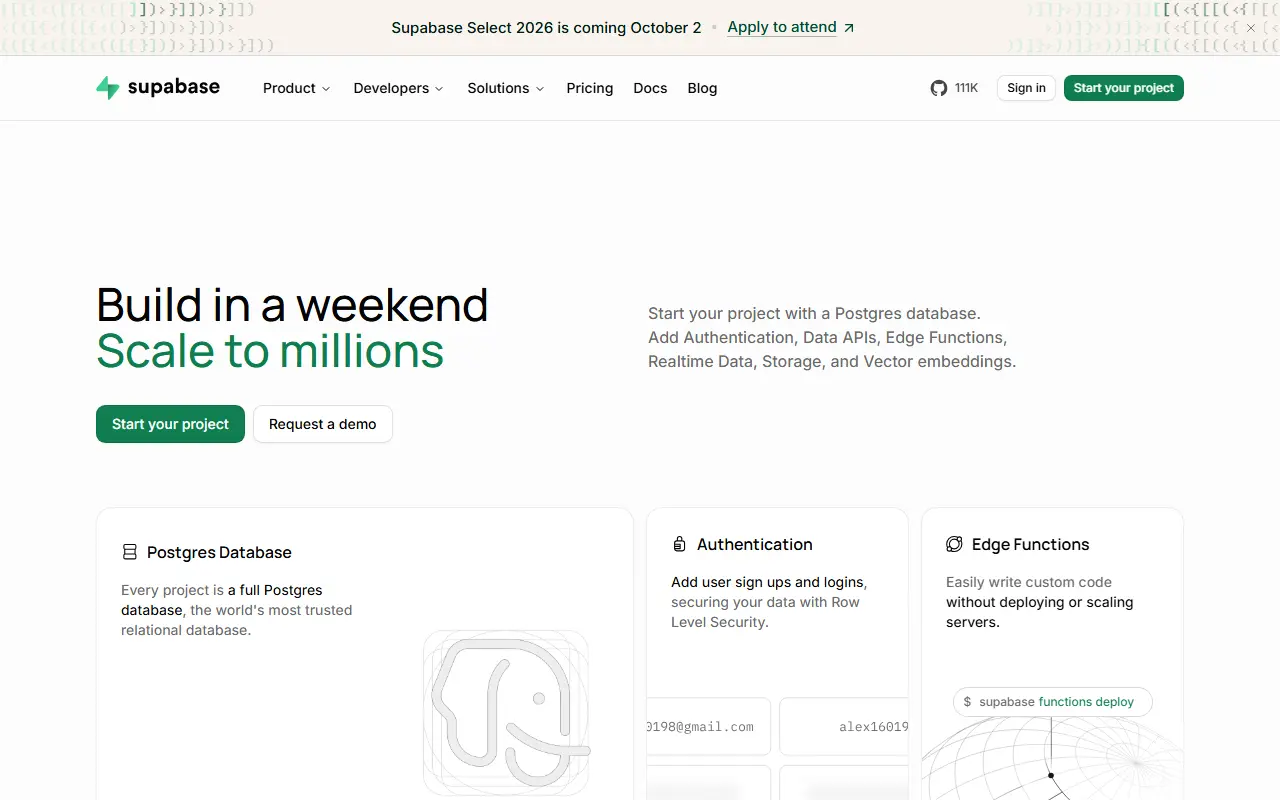
supabase.comSupabase homepage screenshot

Supabase is a backend platform built around a dedicated Postgres database. It packages the pieces most web, mobile and AI apps need, including authentication and authorization, auto-generated APIs, file storage, serverless functions and a dashboard, so developers can start without assembling separate services. Its stated aim is a developer experience similar to Firebase, built from open-source components.

APIs are generated from your schema as REST and GraphQL, with realtime subscriptions over websockets. Logic can live in database functions or in Edge Functions that run on Deno. For AI work there is a toolkit for vectors and embeddings built on pgvector, and Postgres extensions such as PostGIS are available. Supabase combines existing open tools with ones it builds itself when nothing suitable exists.

The code is Apache-2.0 licensed. Supabase is offered as a hosted platform you can sign up for without installing anything, and the same stack can be self-hosted or run locally for development. It suits teams that want Postgres at the core of their app but prefer not to build the surrounding backend themselves.

Key features

  • Hosted Postgres database with a dashboard
  • Authentication and authorization
  • Auto-generated REST and GraphQL APIs
  • Realtime subscriptions over websockets
  • Edge Functions and database functions
  • File storage for user uploads
  • Vector and embeddings toolkit with pgvector

Pricing: Free plan with 50,000 monthly active users. Pro starts at $25 and Team at $599 per month, with usage and extra compute billed on top; Enterprise is custom.

PocketBase

An open-source backend packaged as a single Go executable, with an embedded SQLite database, realtime subscriptions, user and file management and an admin dashboard.

GitHub stars
61k
Last commit
today
Latest release
v0.40.4
Licence
MIT
Self-hosted
Yes
pocketbase.ioPocketBase homepage screenshot

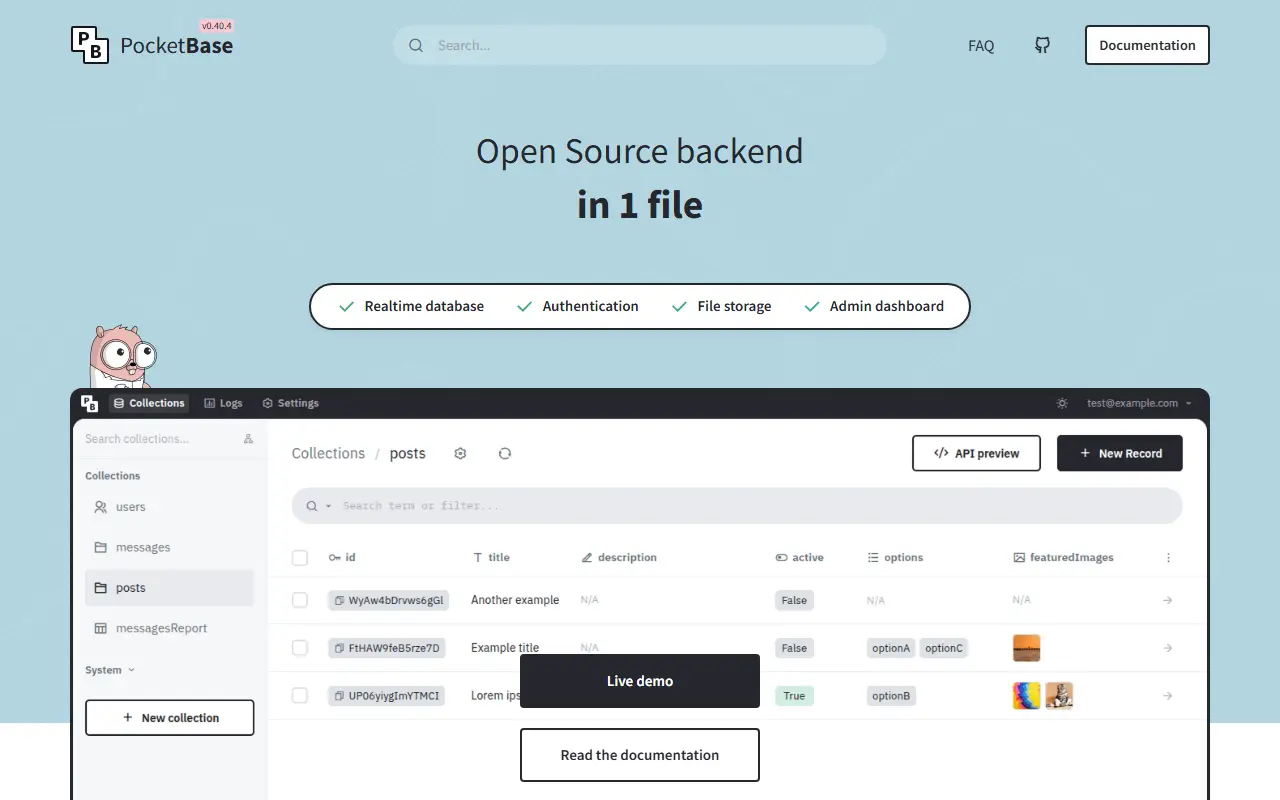
PocketBase is an open-source backend written in Go that ships as one file. It bundles an embedded SQLite database with realtime subscriptions, built-in management of users and files, a convenient admin dashboard and a simple REST-style API, which makes it quick to stand up a backend for a small web or mobile project.

You can use it as a standalone application by downloading the prebuilt executable for your platform and running its serve command, or you can extend it as a Go library to add custom routes and logic. The prebuilt binaries come with a JavaScript VM plugin enabled for scripting. Official SDK clients exist for JavaScript, covering browsers, Node.js and React Native, and for Dart, covering web, mobile, desktop and CLI.

PocketBase is MIT licensed. The maintainers warn that it is still under active development and that backward compatibility is not guaranteed before version 1.0.0, so upgrades deserve some care. It suits solo developers and small teams who want a simple, self-contained backend without managing a database server separately.

Key features

  • Embedded SQLite database with realtime subscriptions
  • Built-in user authentication and file management
  • Admin dashboard for managing data
  • REST-style API for client access
  • Official JavaScript and Dart SDKs
  • Single executable that can also extend as a Go library

Pricing: Free and open source under the MIT license.

Appwrite

An open-source backend platform offering auth, databases, storage, functions, messaging, realtime and hosting, available as a managed cloud or self-hosted with Docker.

GitHub stars
58k
Last commit
today
Latest release
2.3.0
Licence
BSD-3-Clause
Self-hosted
Yes
Hosted version
Available
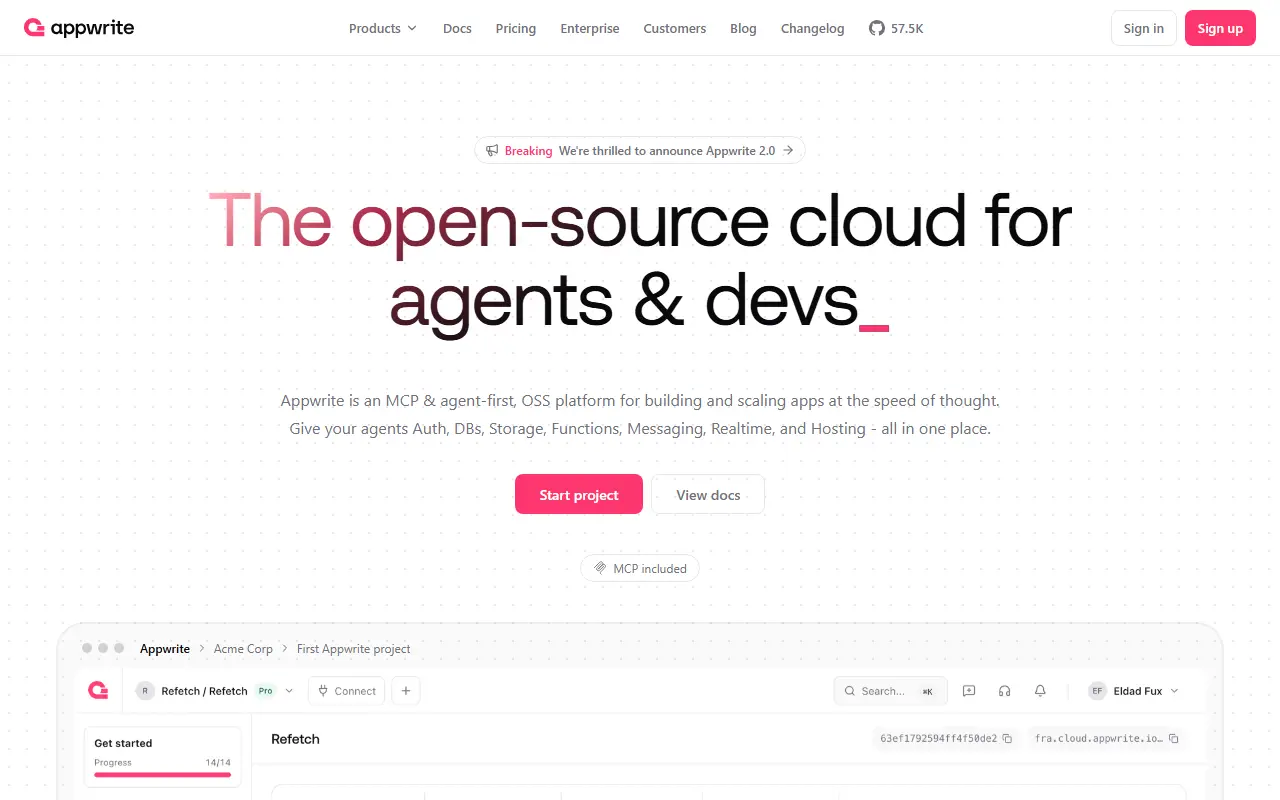
appwrite.ioAppwrite homepage screenshot

Appwrite is an open-source platform for building and scaling web, mobile and AI apps. It bundles the backend services most apps need, namely auth, databases, storage, functions, messaging, realtime and hosting, and presents them as an agent-friendly cloud with MCP support. It can run as a managed cloud platform or be self-hosted on infrastructure you control.

Auth supports email, SMS, OAuth, anonymous sessions and magic URLs. Databases can be modeled and queried through Appwrite itself or backed by managed PostgreSQL and MySQL. Storage keeps files with compression, encryption, image transformations and permission controls, and Functions run serverless code in isolated runtimes triggered by events. Sites deploys static, SSR and CSR frontends from Git with previews, and Messaging sends email, SMS and push notifications.

Developers integrate through client and server SDKs, including Flutter, Swift, React Native and JavaScript, or let coding agents such as Cursor, Claude Code and Codex operate a live project through a hosted MCP server. Appwrite is BSD-3-Clause licensed and written mainly in PHP, with Docker-based self-hosting for Unix and Windows.

Key features

  • Auth with email, SMS, OAuth and magic URLs
  • Databases including managed PostgreSQL and MySQL
  • File storage with encryption and image transformations
  • Serverless functions in isolated runtimes
  • Messaging via email, SMS and push
  • Realtime updates and static or SSR site hosting
  • Hosted MCP server and client and server SDKs

Pricing: A free plan and a Pro plan exist, but the captured page does not show their prices. Dedicated databases start at $10 a month each and go up to $960 a month; serverless databases have no fixed fee.

CloudBoost

Realtime backend-as-a-service for JavaScript apps, combining data storage, search, realtime updates, user authentication and ACLs, self-hosted or managed.

GitHub stars
1.5k
Last commit
7 mo ago
Latest release
2.0.994
Licence
Apache-2.0
Self-hosted
Yes
Hosted version
Available

CloudBoost is a backend platform for applications that bundles database storage, realtime data, search, file storage, access control and user authentication in one service. Its README likens it to a combination of Parse, Firebase, Algolia and Iron.io, and stresses full ownership of your data. It is aimed at developers who want a backend without writing server code for every app.

The platform covers JSON and blob storage, realtime updates, search and access control lists. It can be installed anywhere using the supplied Docker Compose file, including local machines and cloud hosts such as Azure, AWS and DigitalOcean. Running it without Docker requires MongoDB and Redis plus Node.js, with configuration files for the database and for an SMTP provider used to send emails.

A managed service is also available for people who prefer not to install or configure anything. CloudBoost is written in JavaScript and licensed under Apache-2.0, and its topics include backendless, BaaS and realtime database. Because the README references MongoDB 3.4 and Redis 3.0, check the current documentation for compatible versions before deploying.

Key features

  • JSON and blob data storage
  • Realtime data updates
  • Built-in search
  • User authentication and ACLs
  • Docker Compose deployment
  • Managed cloud option

Space Cloud

Space Cloud was an Apache-licensed, Kubernetes-based backend-as-a-service platform offering GraphQL and REST APIs over several databases; the project is now in maintenance mode.

GitHub stars
4k
Last commit
2 yr ago
Latest release
v0.21.5
Licence
Apache-2.0
Self-hosted
Yes
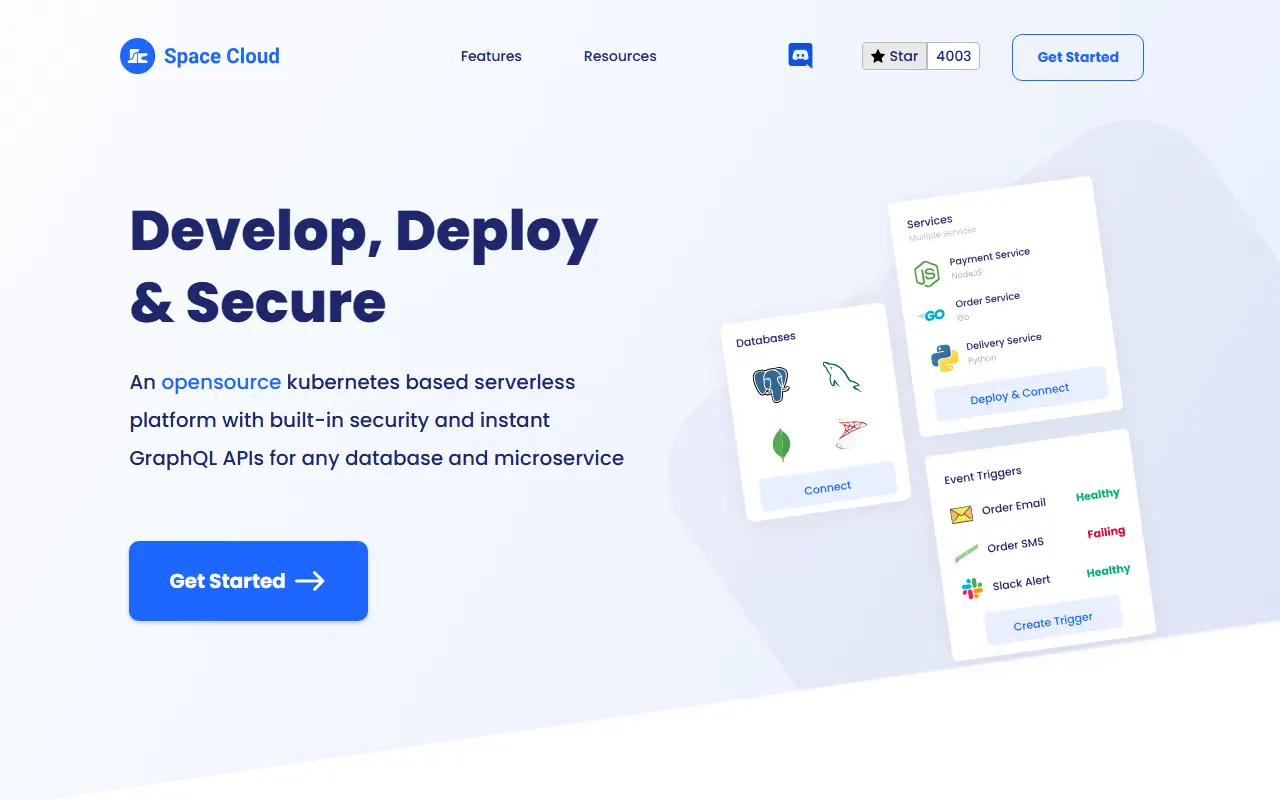
space-cloud.ioSpace Cloud homepage screenshot

Space Cloud was an open-source serverless platform for developing, deploying and securing applications on Kubernetes, aiming to combine the convenience of Firebase with the deployment model of Heroku. It targeted teams who wanted instant, realtime APIs over their database with minimal custom backend code.

It generated GraphQL and REST APIs directly from supported databases, including MongoDB, PostgreSQL and compatible systems such as CockroachDB and Yugabyte, MySQL and compatible systems such as TiDB and MariaDB, and SQL Server. Features included flexible CRUD with cross-database joins, realtime live queries, file storage integration with services such as Amazon S3, event-driven webhooks and serverless functions, fine-grained access control integrating with systems such as Auth0 or Firebase Auth, and automatic scale-to-zero for HTTP workloads.

The README now states the project is in maintenance mode and recommends Hasura or WunderGraph as alternatives. It is written in Go, runs on Kubernetes, and is released under the Apache-2.0 license, so existing self-hosted deployments remain usable but new projects should weigh the lack of active development.

Key features

  • Auto-generated GraphQL and REST APIs over databases
  • Realtime live queries
  • Event-driven webhooks and serverless functions
  • File storage integration
  • Fine-grained, auth-integrated access control
  • Kubernetes-native scaling to zero

Pricing: Free and open source under the Apache-2.0 license. The project is in maintenance mode; the maintainers suggest Hasura or WunderGraph as alternatives.

Hook

Hook is a RESTful, extendable Backend as a Service written in PHP, with multitenancy, user authentication, data collections and real-time messaging.

GitHub stars
771
Last commit
9 yr ago
Latest release
v0.4.0
Licence
MIT
Self-hosted
Yes
hook-platform.orgHook homepage screenshot

Hook is a Backend as a Service built in PHP that provides a ready-made backend so sites and apps can be developed faster. It exposes a REST API and comes with client libraries so front-end developers can integrate without writing server code.

Features include multitenancy so one instance can serve many apps, user authentication with registration, login and password reset, data persistence through collections, data storage through multiple providers, real-time communication through the WAMP subprotocol over WebSockets, and package management through Composer. A command-line tool creates applications and prints the access keys used by front ends.

Client SDKs are listed for JavaScript, C and Unity3D, Corona SDK, iOS and OS X, Java and Android, C++, PHP, Ruby and Flash ActionScript 3. Hook requires PHP 5.5 or newer, or PHP 5.3 in some setups, and is MIT licensed. The latest release listed is v0.4.0.

Key features

  • Multitenant backend for many apps
  • User registration, login and password reset
  • Data collections via REST API
  • Real-time messaging over WebSockets
  • Client SDKs for web, mobile and game engines
  • Command-line app creation

Pricing: Free and open source under the MIT license.

Back4App alternatives: questions

What is the best open-source alternative to Back4App?
Supabase is the top-ranked open-source alternative to Back4App on Enlisted: An open-source Postgres development platform bundling a database, auth, auto-generated APIs, realtime, storage and vector tools, often chosen as a Firebase alternative. Other strong options are PocketBase, Appwrite, CloudBoost and Space Cloud.
Are these Back4App alternatives free?
All 6 are open source, so the code is free to use under its licence, and all of them can be self-hosted on your own server or computer. 3 also offer a paid or managed cloud version if you'd rather not host it yourself.
How is this list of Back4App alternatives ranked?
By a score built from GitHub stars, star growth over the last 30 days and how recently the code changed. 3 of these projects shipped code in the last 30 days. Data is refreshed daily, and nobody can pay to move up.

People also look for alternatives to…

View all