
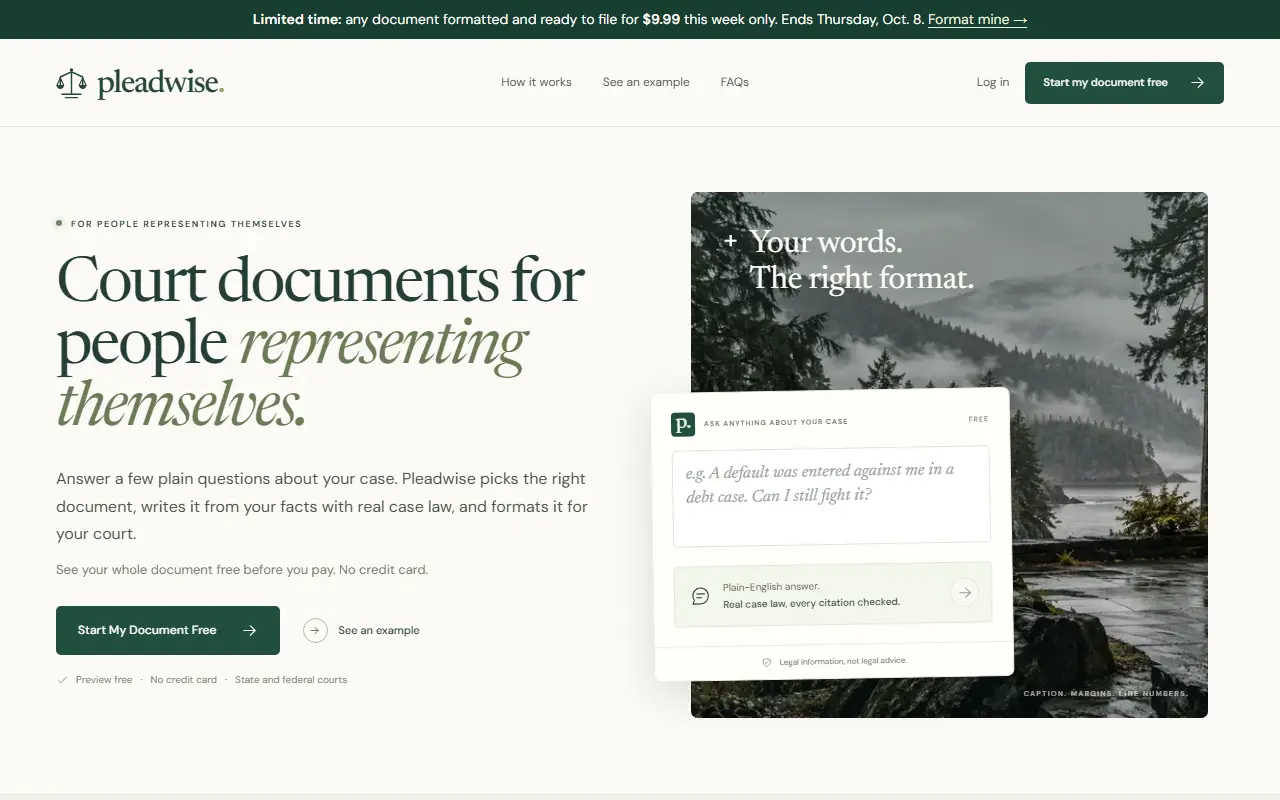
About PleadWise
Pleadwise guides people who represent themselves through case intake, organizes the information they provide into a draft and formats the filing to the rules of a chosen court. After entering case details and selecting a jurisdiction, it applies the court's margins, spacing, fonts, caption blocks, page numbers and pleading-paper layout, and PDFs usually compile in minutes. Supported filings include complaints, answers, motions with oppositions and replies, declarations, briefs, subpoenas and discovery requests.
A case-law research feature searches opinions and links to the source, and an argument builder helps structure legal arguments with citations. The site states clearly that users must independently verify every citation before filing, that it provides formatting services, and that it is not a law firm and does not give legal advice.
The first formatted document is free with no credit card. A one-time $79 Case Pass covers one case for 60 days with three court-ready documents, guided AI drafting, case-law search and a persistent case file, and it does not renew automatically.
Key features
- Guided case intake
- Court-specific document formatting
- Caption blocks and pleading paper
- Source-linked case-law search
- Argument builder for legal reasoning
- Support for motions, briefs and discovery requests
- Persistent case file
Good fit for
- Pro se litigants formatting a motion
- Preparing an answer to a complaint
- Researching case law with source links
PleadWise: questions and answers
- What is PleadWise used for?
- Pleadwise helps self-represented civil litigants in the US draft court documents and format them to court-specific rules, with source-linked case-law search. It is a good fit for pro se litigants formatting a motion, preparing an answer to a complaint and researching case law with source links.
- Is PleadWise free?
- Yes. PleadWise has a free plan, and paid plans start at $79 as a one-time payment.
- Is PleadWise open source?
- No. PleadWise is proprietary (closed-source) software and can't be self-hosted. In the AI Tools category, open-source options include OpenClaw, Open WebUI and ComfyUI.
- What are some alternatives to PleadWise?
- PleadWise competes with Harvey and CoCounsel.
Open-source alternatives to PleadWise
See all
OpenClaw
AI Tools
The AI that really does things. Any OS. Any Platform. The lobster way. 🦞
OSSvs ChatGPT★ 391k
Open WebUI
AI Tools
Run AI on your own terms. Connect any model, extend with code, and protect what matters wi
OSSvs ChatGPT★ 154k
ComfyUI
AI Tools
The most powerful and modular diffusion model GUI, api and backend with a graph/nodes inte
GPL-3.0vs Midjourney★ 136k
LobeHub
AI Tools
🤯 LobeHub is your Chief Agent Operator, organizing your agents into 7×24 operations by hi
OSSvs ChatGPT★ 83k
AnythingLLM
AI Tools
Stop renting your intelligence. Own it with AnythingLLM. Everything you need for a powerfu
MITvs ChatGPT★ 67k
openpilot
AI Tools
openpilot is an operating system for robotics. Currently, it upgrades the driver assistanc
MIT★ 64k
SaaS alternatives to PleadWise
See all
Harvey
AI Tools
Generative AI assistant for law firms and legal teams, covering research and drafting
SaaS
CoCounsel
AI Tools
AI legal assistant from Thomson Reuters for research and document review
SaaS
Pakistan LawBot
AI Tools
AI legal platform for Pakistani law: research, document analysis, draft generation and lawyer search
SaaS
Avocadosai
AI Tools
AI legal assistant that answers questions about Swiss law
SaaS
Legora
AI Tools
Collaborative AI platform for law firms to review and draft legal documents
SaaSAgreedly
AI Tools
AI tools to draft professional agreements and analyze contracts
SaaS