
About Payoneer
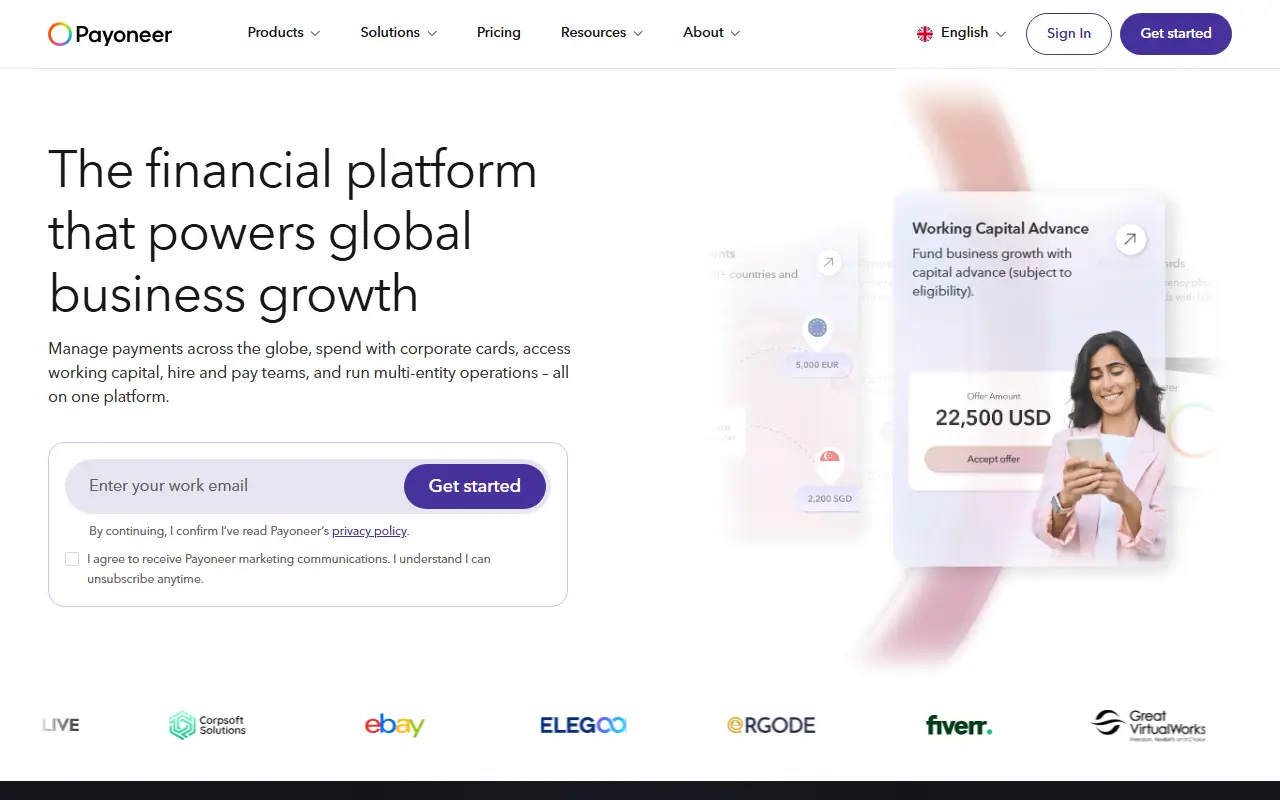
Payoneer is a financial platform for businesses and individuals who get paid or pay others across borders. Freelancers, ecommerce sellers, marketplaces and companies use it to receive funds from international customers, send payments to suppliers and contractors, and manage balances in several currencies.
Products include receiving accounts that can collect payments in more than 70 currencies, payment requests and invoices, payment links, a website checkout, single, batch and mass payouts, VAT payments across several countries, corporate cards, expense management, Smart FX for currency conversion and working capital advances. A workforce suite offers Employer of Record, Agent of Record and contractor management, and developer APIs and integrations connect Payoneer to other tools.
Solutions are organized by customer type, such as business, freelancer, marketplace and ecommerce seller, and by industry, including software, BPO and professional services, marketing agencies, wholesale and mobile apps and gaming. Payoneer is a hosted commercial service with a published pricing page, and it cannot be self-hosted.
Key features
- Receiving accounts in 70+ currencies
- Payment requests, invoices and payment links
- Single, batch and mass payouts
- VAT payments across countries
- Corporate cards and expense management
- Employer of Record and contractor management
- Developer APIs and integrations
Good fit for
- →Freelancers getting paid by overseas clients
- →Marketplaces paying sellers at scale
- →Companies paying international contractors
- Tags
- payments
- cross-border
- freelancers
- payouts
- marketplaces
- fintech
- multi-currency
Payoneer: questions and answers
- What is Payoneer used for?
- Payoneer is a cross-border payments platform for freelancers, marketplaces and businesses that receive, send and manage money internationally. It is a good fit for freelancers getting paid by overseas clients, marketplaces paying sellers at scale and companies paying international contractors.
- How much does Payoneer cost?
- Payoneer is a paid product with no free plan.
- Is Payoneer open source?
- No. Payoneer is proprietary (closed-source) software and can't be self-hosted. In the Finance & Accounting category, open-source options include Hyperswitch, Lago and Invoice Ninja.
Open-source alternatives to Payoneer
See all
Hyperswitch
Finance & Accounting
Open source, composable payments platform | PCI compliant | SaaS and Self-host options | E
Apache-2.0vs Stripe★ 45k
Lago
Finance & Accounting
Open-source billing for usage, subscriptions and hybrid pricing. Lago customers include Co
AGPL-3.0vs Chargebee★ 11k
Invoice Ninja
Finance & Accounting
A source-available invoice, quote, project and time-tracking app built with Laravel
OSSvs FreshBooks★ 10k
Wallos
Finance & Accounting
Wallos is an open-source personal subscription tracker designed to empower you in managing
GPL-3.0vs Rocket Money★ 8.6k
InvoicePlane
Finance & Accounting
A self-hosted open source application for managing your invoices, clients and payments.
OSSvs QuickBooks★ 3.1k
Midday
Finance & Accounting
Invoicing, Time tracking, File reconciliation, Storage, Financial Overview & your own Assi
AGPL-3.0vs QuickBooks★ 15k
SaaS alternatives to Payoneer
See all
Wise
Finance & Accounting
International money transfer and multi-currency account service
SaaS
PayPal
Finance & Accounting
Online payments, invoicing and checkout for merchants and individuals
SaaS
Tipalti
Finance & Accounting
Accounts payable automation and global supplier payments
SaaS
Stripe
Finance & Accounting
Payment processing and financial infrastructure APIs for online businesses
SaaS
Remitly
Finance & Accounting
Digital money transfer service for international remittances
SaaS
Airwallex
Finance & Accounting
Global business accounts, payments and expense management platform
SaaS