 TrackMedia
 TrackRev

About Optimus
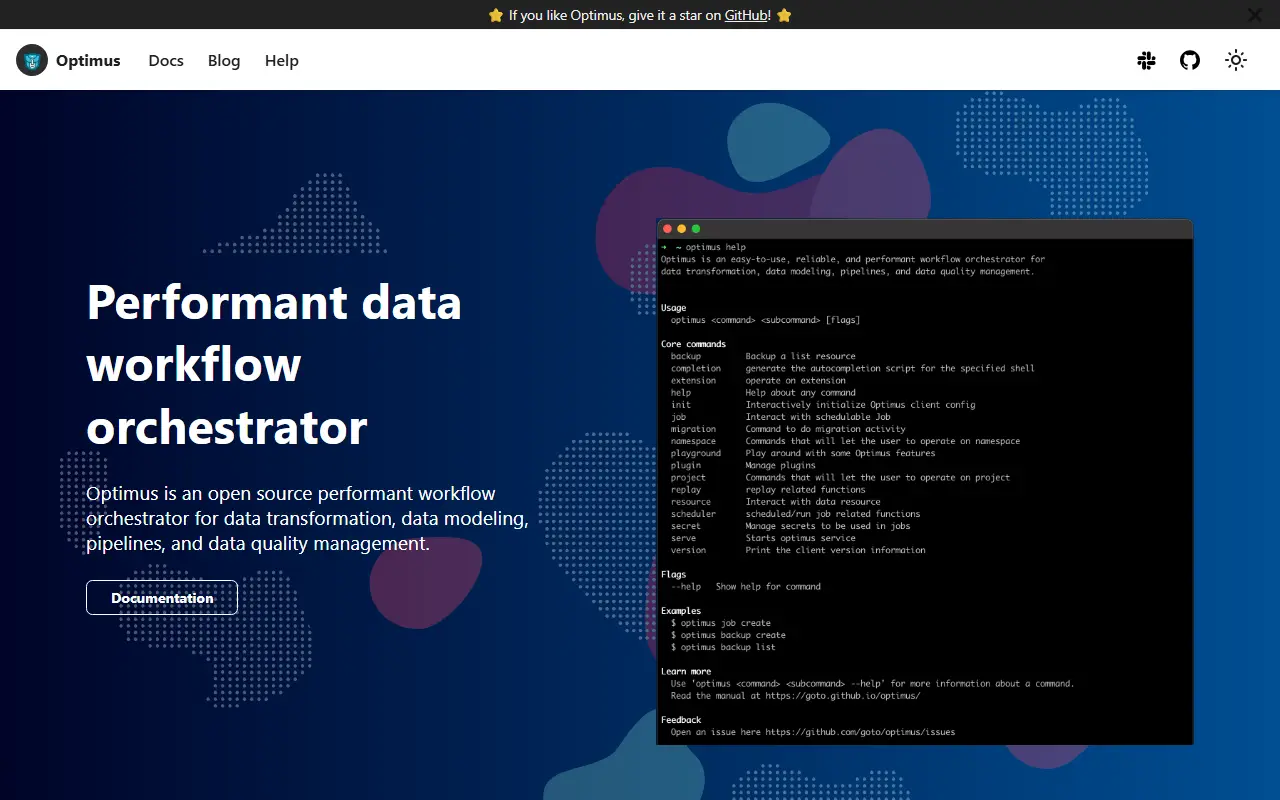
Optimus is a workflow orchestrator for data transformation, data modeling, pipelines and data quality management. Analysts and engineers write simple SQL queries and YAML configuration, and Optimus takes care of dependency management, scheduling and running transformation jobs at scale. The listing name Raystack is the organization behind it.
Key capabilities include managing warehouse tables and views through YAML, scheduling SQL transformations, automatically parsing queries to build dependency graphs rather than hand-writing DAGs, dry-running queries during deployment, and compile-time templating with variables, loops, conditionals and macros. It also supports cross-tenant dependencies, post-transformation hooks such as sinking BigQuery tables to Kafka, Python transformations and custom plugins.
Specifications are managed in git and the service is driven through REST and gRPC. The topics point to Airflow and BigQuery integrations, and the Go codebase is licensed under Apache-2.0. It suits data teams building ELT or analytics engineering workflows.
Key features
- SQL and YAML based transformation jobs
- Automatic dependency graph resolution
- Warehouse tables and views as YAML
- Dry runs before deployment
- Query templating with loops and macros
- Hooks, Python transformations and plugins
Good fit for
- ELT pipelines on BigQuery
- Analytics engineering with SQL
Optimus: questions and answers
- What is Optimus used for?
- Optimus is a Go workflow orchestrator from Raystack that runs SQL and YAML based data transformation jobs, handling dependencies and scheduling. It is a good fit for ELT pipelines on BigQuery and analytics engineering with SQL.
- Is Optimus open source?
- Yes. Optimus is open source under the Apache-2.0 licence. Its source code is on GitHub at raystack/optimus and is written mainly in Go.
- Is Optimus free?
- Yes. Optimus is open source, so the software itself is free to use.
- Can I self-host Optimus?
- Yes. Optimus can be self-hosted on your own server or infrastructure.
- What are some alternatives to Optimus?
- Similar open-source tools in the Data Pipelines & ETL category include Mage AI, Bruin and Kestra. SaaS products in the same category include Astronomer, Rivery and Azure Data Factory.
- Is Optimus actively maintained?
- The most recent commit to Optimus was on 8 June 2024, and the latest release is v0.7.1, published on 25 July 2023. The project has 770 stars on GitHub, with 3 added in the last 30 days.
Open-source alternatives to Optimus
See all
Mage AI
Data Pipelines & ETL
🧙 Build, run, and manage data pipelines for integrating and transforming data.
Apache-2.0vs Fivetran★ 8.8k
Bruin
Data Pipelines & ETL
Build data pipelines with SQL and Python, ingest data from different sources, add quality
Apache-2.0vs Fivetran★ 1.8k
Kestra
Data Pipelines & ETL
Event Driven Orchestration & Scheduling Platform for Mission Critical Applications
Apache-2.0vs AWS Step Functions★ 30k
Airbyte
Data Pipelines & ETL
Airbyte is the open-source data movement platform. Run ELT pipelines across 700+ connector
OSSvs Fivetran★ 22k
Duckle
Data Pipelines & ETL
Open-source ETL/ELT you deploy on your own servers or cloud. Built on DuckDB: no-code/low-
Apache-2.0vs SnapLogic★ 1.6k
dbt
Data Pipelines & ETL
dbt enables data analysts and engineers to transform their data using the same practices t
Apache-2.0vs Matillion★ 14k
SaaS alternatives to Optimus
See all
Astronomer
Data Pipelines & ETL
Managed Apache Airflow platform for orchestrating data pipelines
SaaS
Rivery
Data Pipelines & ETL
Cloud data integration and orchestration platform for ELT and reverse ETL
SaaS
Azure Data Factory
Data Pipelines & ETL
Managed Azure service for building data integration and ETL pipelines
SaaS
Estuary
Data Pipelines & ETL
Real-time data pipeline platform that unifies CDC, streaming and batch ELT
SaaS
Hevo Data
Data Pipelines & ETL
No-code data pipeline platform for replicating data into warehouses and lakes
SaaS
IBM DataStage
Data Pipelines & ETL
Enterprise ETL tool for designing and running data integration jobs
SaaS