
About Opserver
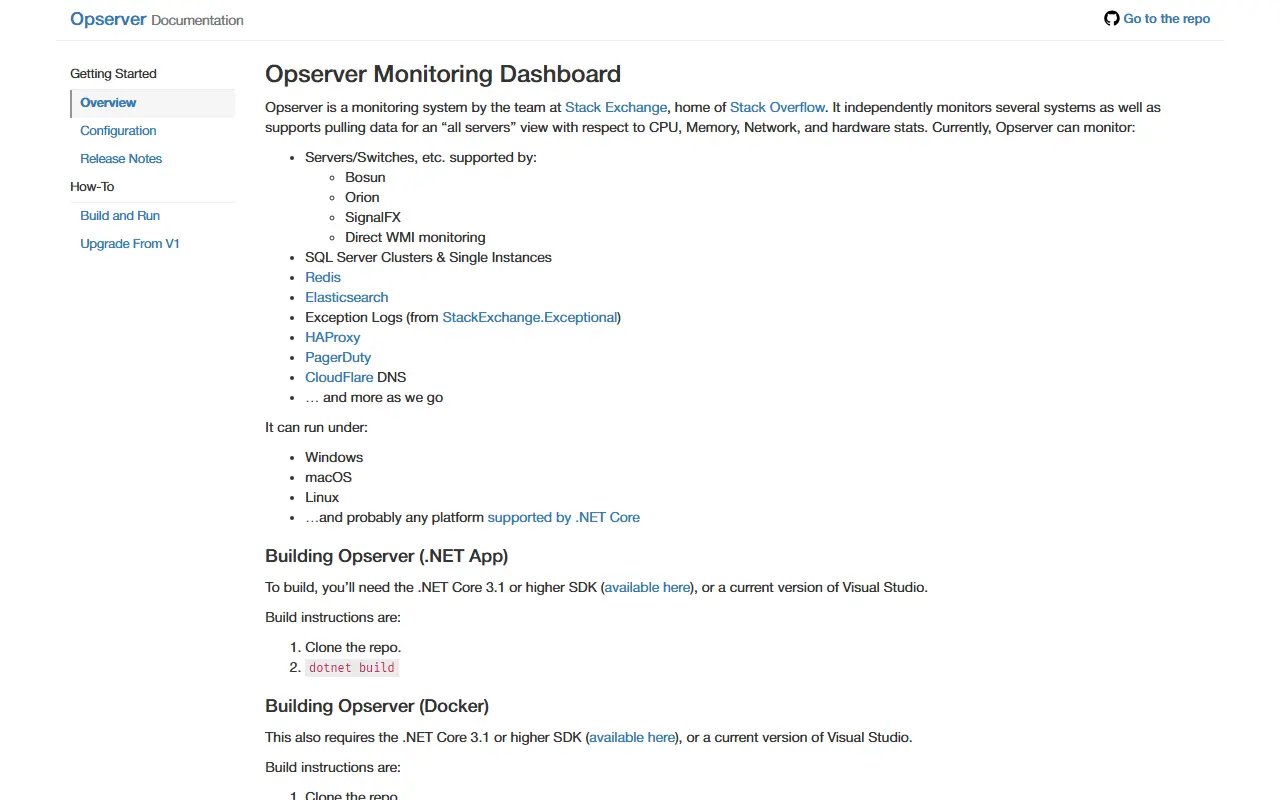
Opserver is a monitoring system that originated at Stack Exchange, the team behind Stack Overflow. It is aimed at operations teams who want a single dashboard that pulls together status and performance data for many different kinds of infrastructure rather than switching between separate tools.
It can monitor servers and switches through Bosun, Orion, SignalFX or direct WMI, as well as SQL Server clusters and single instances, Redis, Elasticsearch, exception logs from StackExchange.Exceptional, HAProxy, PagerDuty and CloudFlare DNS, with more integrations added over time. It presents an all-servers view covering CPU, memory, network and hardware stats alongside system-specific dashboards.
Opserver is built on .NET Core and can run on Windows, macOS or Linux, including as a Docker container, and can be hosted under IIS or run standalone with the Kestrel web server. It is released under the MIT license, with documentation covering building, running and upgrading from the earlier V1 model.
Key features
- Unified dashboard for many infrastructure types
- SQL Server, Redis and Elasticsearch monitoring
- Exception log monitoring via StackExchange.Exceptional
- HAProxy and PagerDuty integration
- Cross-platform .NET Core deployment
- Docker-based deployment option
Good fit for
- →Centralized infrastructure monitoring for ops teams
- →Monitoring mixed stacks of SQL, Redis and web servers
- Tags
- monitoring
- dotnet
- observability
- self-hosted
- sql-monitoring
- redis
- elasticsearch
Opserver: questions and answers
- What is Opserver used for?
- Opserver is a free, MIT-licensed .NET monitoring dashboard originally built by Stack Exchange, covering servers, SQL, Redis, Elasticsearch and more from one view. It is a good fit for centralized infrastructure monitoring for ops teams; and monitoring mixed stacks of SQL, Redis and web servers.
- Is Opserver open source?
- Yes. Opserver is open source under the MIT licence. Its source code is on GitHub at opserver/Opserver and is written mainly in C#.
- Is Opserver free?
- Yes. Opserver is open source, so the software itself is free to use.
- Can I self-host Opserver?
- Yes. Opserver can be self-hosted on your own server or infrastructure; there is no official hosted version.
- What are some alternatives to Opserver?
- Similar open-source tools in the Monitoring & Observability category include ElasticHQ, OpenStatus and Kener. SaaS products in the same category include Sematext, Amazon CloudWatch and AppDynamics.
- Is Opserver actively maintained?
- The most recent commit to Opserver was on 30 November 2024. The project has 4.6k stars on GitHub.
Open-source alternatives to Opserver
See all
ElasticHQ
Monitoring & Observability
Monitoring and Management Web Application for ElasticSearch instances and clusters.
OSS★ 5k
OpenStatus
Monitoring & Observability
🫖 Status page with uptime monitoring & API monitoring as code 🫖
AGPL-3.0vs Pingdom★ 9.2k
Kener
Monitoring & Observability
Stunning status pages, batteries included!
MITvs Atlassian Statuspage★ 5.2k
Netdata
Monitoring & Observability
The fastest path to AI-powered full stack observability, even for lean teams.
GPL-3.0vs Datadog★ 81k
SigNoz
Monitoring & Observability
SigNoz Cloud is a one-stop observability tool built on top of OpenTelemetry. Get APM, logs
OSSvs Datadog★ 32k
HyperDX
Monitoring & Observability
Resolve production issues, fast. An open source observability platform unifying session re
MITvs Datadog★ 9.9k
SaaS alternatives to Opserver
See all
Sematext
Monitoring & Observability
Monitoring and log management cloud service for apps and infrastructure
SaaS
Amazon CloudWatch
Monitoring & Observability
AWS service for metrics, logs, alarms and dashboards
SaaS
AppDynamics
Monitoring & Observability
Cisco application performance monitoring that maps technical metrics to business impact
SaaS
Axiom
Monitoring & Observability
Cloud service for ingesting, storing and querying logs, traces and event data
SaaS
Azure Monitor
Monitoring & Observability
Azure service for collecting and analyzing metrics, logs and traces
SaaS
Clawwatcher
Monitoring & Observability
Observability for OpenClaw agents with token and cost tracking and anomaly alerts
SaaS