
About OpenWrt
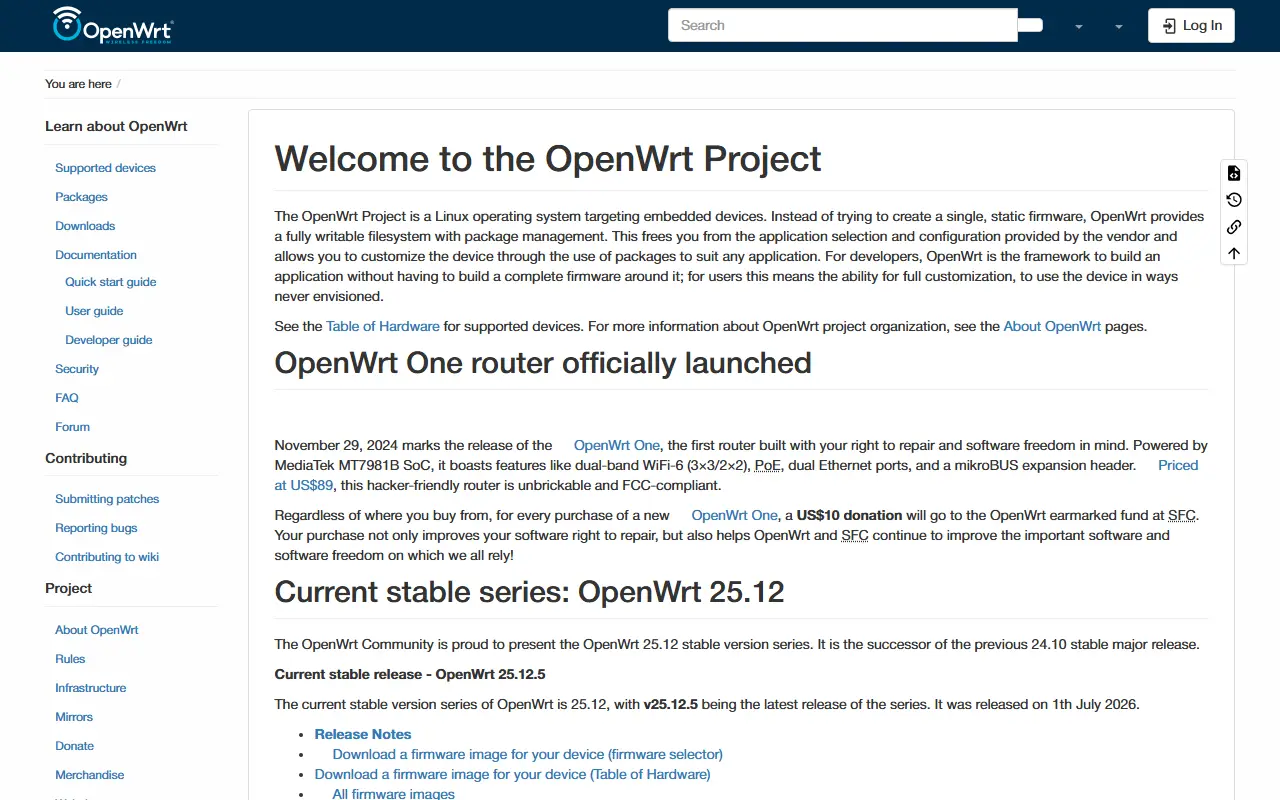
OpenWrt is a Linux operating system targeting embedded devices, most often home routers. Rather than shipping one static firmware image, it provides a fully writable filesystem with package management. That frees you from the applications and configuration chosen by the device vendor, so you can customize the device with packages for almost any purpose. The code is written in C.
For developers, OpenWrt is a framework for building an application without creating a complete firmware around it. Prebuilt firmware images are published for numerous CPU architectures, each with a package set that suits a WiFi home router. The Firmware Selector helps you find a factory image for moving from vendor firmware, and the wiki has further downloads such as toolchains and SDKs. Building your own firmware needs GNU/Linux, BSD or macOS with a case-sensitive filesystem, and a feeds script pulls in package definitions. This GitHub repository is a mirror of the project's main git server and still accepts pull requests.
Key features
- Linux firmware for routers and embedded devices
- Writable filesystem with package management
- Prebuilt images for many architectures
- Firmware Selector for supported devices
- Build system with feeds for package definitions
- Toolchain and SDK downloads
Good fit for
- →Replacing vendor router firmware
- →Building custom firmware for embedded hardware
- Built with
- C
- Tags
- router
- firmware
- embedded
- linux
- networking
- wifi
- package-manager
- openwrt
OpenWrt: questions and answers
- What is OpenWrt used for?
- OpenWrt is a Linux operating system for embedded devices such as routers, with a writable filesystem and package management. It is a good fit for replacing vendor router firmware and building custom firmware for embedded hardware.
- Is OpenWrt open source?
- Yes. OpenWrt is open source under a custom licence. Its source code is on GitHub at openwrt/openwrt and is written mainly in C.
- Is OpenWrt free?
- Yes. OpenWrt is open source, so the software itself is free to use under the terms of its own licence.
- Can I self-host OpenWrt?
- Yes. OpenWrt can be self-hosted on your own server or infrastructure; there is no official hosted version.
- What is OpenWrt an alternative to?
- OpenWrt is an open-source alternative to Cisco Meraki. Other open-source alternatives to Cisco Meraki include OPNsense and pfSense.
- Is OpenWrt actively maintained?
- Yes. The most recent commit to OpenWrt was on 2 October 2026, and the latest release is v25.12.5, published on 1 July 2026. The project has 29k stars on GitHub.
Open-source alternatives to OpenWrt
See all
OPNsense
Security
OPNsense GUI, API and systems backend
BSD-2-Clausevs Fortinet★ 4.7k
pfSense
Security
Main repository for pfSense
Apache-2.0vs Fortinet★ 5.7kfrp
Networking & VPN
A fast reverse proxy to help you expose a local server behind a NAT or firewall to the int
Apache-2.0vs ngrok★ 110kHeadscale
Networking & VPN
An open source, self-hosted implementation of the Tailscale control server
BSD-3-Clausevs Tailscale★ 44k
sing-box
Networking & VPN
The universal proxy platform
OSS★ 39k
NetBird
Networking & VPN
Connect your devices, users, and agents into a secure WireGuard®-based overlay network wit
OSSvs Tailscale★ 30k
SaaS alternatives to OpenWrt
See allCisco Meraki
Networking & VPN
Cloud-managed networking platform for wireless, switching, security and SD-WAN
SaaS
Aruba Central
Networking & VPN
Cloud-based network management platform from HPE Aruba
SaaS
Juniper Mist
Networking & VPN
AI-driven cloud-managed wired and wireless networking from Juniper
SaaS
SonicWall
Security
Network firewalls and security products for small and mid-sized businesses
SaaS
Cloudflare
Networking & VPN
CDN, DNS, DDoS protection and edge computing platform
SaaS
Fastly
Networking & VPN
Edge cloud platform for CDN, security and serverless compute
SaaS