
About MusicBrainz Picard
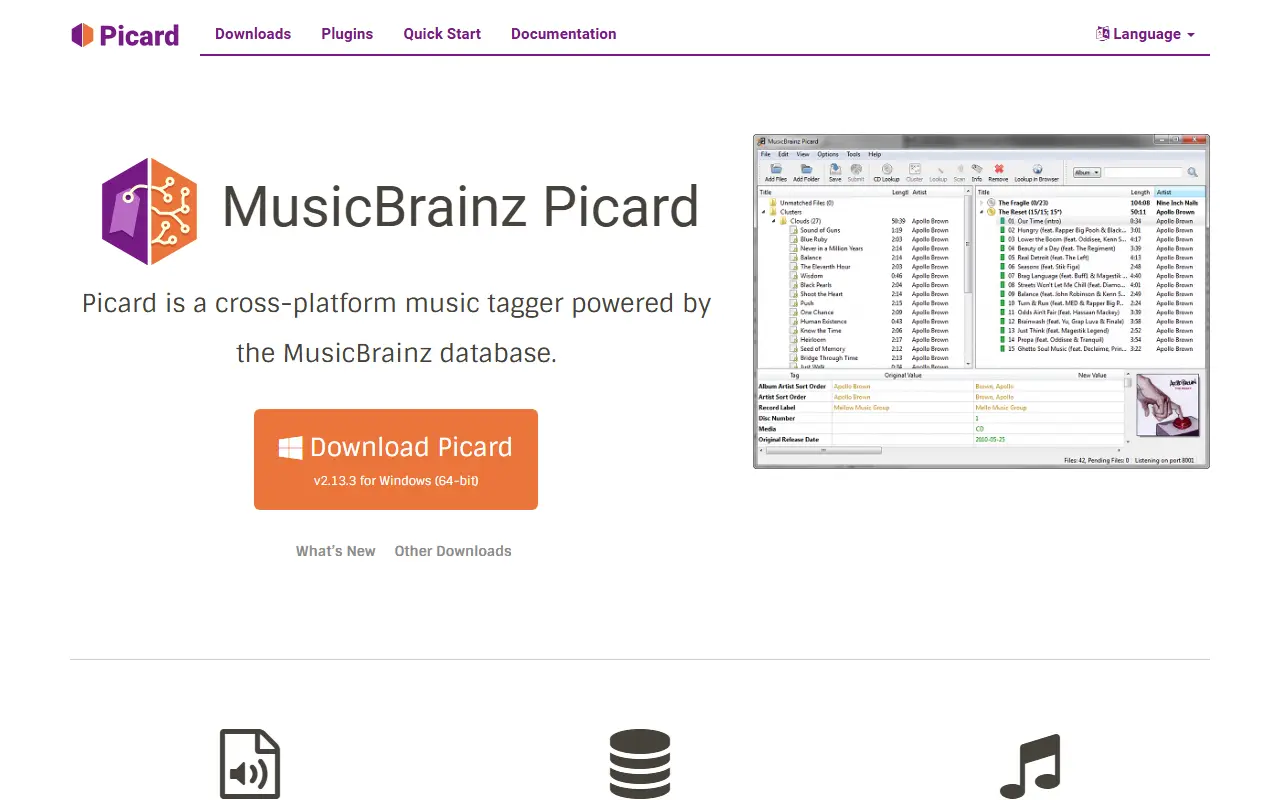
Picard is the official tagger for the MusicBrainz database, a cross-platform application for Linux, macOS and Windows that labels audio files. It takes an album-oriented approach, so tags come from MusicBrainz release data, which helps collections get labeled consistently.
Picard handles most popular formats, including MP3, FLAC, OGG, M4A, WMA and WAV. AcoustID audio fingerprints identify files by what they sound like even if they have no metadata, and entire CDs can be looked up with a click. It can find and download cover art, and a scripting language controls exactly how files are named and how tags look.
Plugins extend the application, and users can pick from available ones or write their own. Picard has strong Unicode handling, is written in Python and is licensed under GPL-2.0 or later. Binary downloads are on the project site, with a quick-start guide and documentation for tagging.
Key features
- Album-oriented tagging from MusicBrainz data
- AcoustID audio fingerprint identification
- One-click CD lookups
- Support for MP3, FLAC, OGG and M4A
- Cover art search and download
- Scripting for file naming and tags
- Plugin support
Good fit for
- →Cleaning up messy music libraries
- →Adding cover art to albums
- →Identifying untagged tracks
- Built with
- Python
- Tags
- music-tagger
- musicbrainz
- audio
- metadata
- acoustid
- python
- id3
- desktop
MusicBrainz Picard: questions and answers
- What is MusicBrainz Picard used for?
- MusicBrainz Picard is the official MusicBrainz audio tagger for Linux, macOS and Windows, which identifies and tags music files using the MusicBrainz database and audio fingerprints. It is a good fit for cleaning up messy music libraries, adding cover art to albums and identifying untagged tracks.
- Is MusicBrainz Picard open source?
- Yes. MusicBrainz Picard is open source under the GPL-2.0 licence. Its source code is on GitHub at metabrainz/picard and is written mainly in Python.
- Is MusicBrainz Picard free?
- Yes. MusicBrainz Picard is open source, so the software itself is free to use.
- Can I self-host MusicBrainz Picard?
- Yes. MusicBrainz Picard can be self-hosted on your own server or infrastructure; there is no official hosted version.
- What are some alternatives to MusicBrainz Picard?
- Similar open-source tools in the Media & Streaming category include Beets, Mopidy and Open Library. SaaS products in the same category include Apple Podcasts, Audiomack and Castbox.
- Is MusicBrainz Picard actively maintained?
- Yes. The most recent commit to MusicBrainz Picard was on 2 October 2026. The project has 5.2k stars on GitHub.
Open-source alternatives to MusicBrainz Picard
See all
Beets
Media & Streaming
music library manager and MusicBrainz tagger
MIT★ 16k
Mopidy
Media & Streaming
Mopidy is an extensible music server written in Python
Apache-2.0vs Pandora★ 8.6k
Open Library
Media & Streaming
One webpage for every book ever published!
AGPL-3.0vs Everand★ 6.7k
DroppedNeedle
Media & Streaming
A self-hosted music request and discovery app with a built-in library manager that drives a download client you supply and plays through Jellyfin, Navidrome or Plex.
AGPL-3.0★ 1.5k
mpv
Media & Streaming
🎥 Command line media player
OSS★ 37k
calibre
Media & Streaming
The official source code repository for the calibre ebook manager
GPL-3.0vs Kobo★ 26k
SaaS alternatives to MusicBrainz Picard
See all
Apple Podcasts
Media & Streaming
Apple's podcast directory and listening app with show subscriptions
SaaS
Audiomack
Media & Streaming
Music streaming and artist discovery platform
SaaS
Castbox
Media & Streaming
Podcast and audiobook player app
SaaS
CastPlus
Media & Streaming
Podcast hosting and distribution platform for podcasters
SaaS
DeeVee
Media & Streaming
AI-powered search engine for finding audio stories
SaaS
iHeartRadio
Media & Streaming
Streaming service for live radio, podcasts and personalized music stations
SaaS