
About IWE
IWE turns a directory of Markdown files into a knowledge graph. The same plain notes can be browsed and edited from your code editor and queried by AI agents from the command line, without a cloud service or a database, and you can keep everything under version control with git.
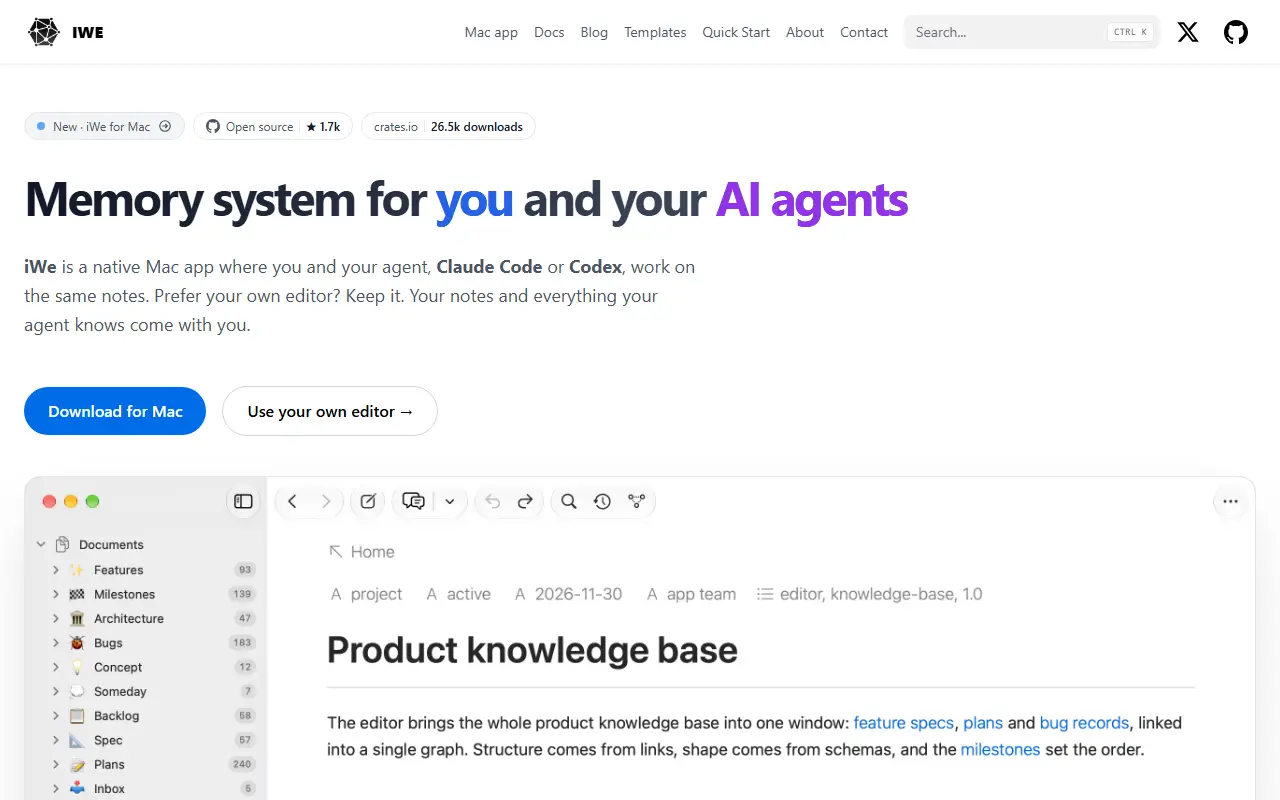
For editors, IWE provides a language server with search, refactoring, renaming and autocomplete, with integrations for VS Code, Neovim, Zed and Helix. For agents, a CLI and an MCP server give structured navigation over the same notes, using links and parent context rather than similarity guessing. IWE has no built-in AI and works alongside tools such as Claude and Codex, and there is a set of skills for coding agents plus an early native Mac app.
The tool is written in Rust and licensed under Apache-2.0. Notes stay as ordinary .md files you own, and a note can belong to several topics through links instead of file copies. It suits writers, developers and researchers who keep a Zettelkasten-style knowledge base and want database-like queries on it without leaving Markdown.
Key features
- Markdown notes organized as a knowledge graph
- Language server for VS Code, Neovim, Zed, Helix
- CLI for structured queries over notes
- MCP server for AI agent memory
- Skills extension for coding agents
- Plain files that work with git
Good fit for
- →Giving a coding agent persistent project memory
- →Managing a Zettelkasten in a text editor
- →Querying notes without moving them to a database
- Built with
- Rust
- Tags
- markdown
- knowledge-graph
- note-taking
- lsp
- mcp
- local-first
- zettelkasten
- rust
- ai-memory
IWE: questions and answers
- What is IWE used for?
- IWE is a local-first Markdown knowledge graph that adds editor language-server features for your notes and CLI plus MCP tools so AI agents can navigate them. It is a good fit for giving a coding agent persistent project memory, managing a Zettelkasten in a text editor and querying notes without moving them to a database.
- Is IWE open source?
- Yes. IWE is open source under the Apache-2.0 licence. Its source code is on GitHub at iwe-org/iwe and is written mainly in Rust.
- Is IWE free?
- Yes. IWE is open source, so the software itself is free to use.
- What is IWE an alternative to?
- IWE is an open-source alternative to Obsidian. Other open-source alternatives to Obsidian include zk, Logseq and Foam.
- Is IWE actively maintained?
- Yes. The most recent commit to IWE was on 2 October 2026. The project has 1.7k stars on GitHub.
Open-source alternatives to IWE
See all
zk
Note Taking
A plain text note-taking assistant
GPL-3.0vs Obsidian★ 2.8k
Logseq
Note Taking
A privacy-first, open-source platform for knowledge management and collaboration. Download
AGPL-3.0vs Notion★ 45k
Foam
Note Taking
A personal knowledge management and sharing system for VSCode
OSSvs Roam Research★ 17k
NoteGen
Note Taking
Capture first. Organize later. A local-first Markdown app that turns scattered records int
GPL-3.0vs Mem★ 13k
Lumen
Note Taking
A free, open-source note-taking app that syncs with markdown files in your GitHub reposito
MITvs Obsidian★ 721
SwarmVault
Note Taking
The local-first LLM Wiki: open-source knowledge graph builder, RAG knowledge base, and age
MITvs Obsidian★ 708
SaaS alternatives to IWE
See all
Obsidian
Note Taking
Obsidian is a free, flexible note-taking app for private notes, with plugins, linked notes and optional paid Sync and Publish services.
SaaS
Bear
Note Taking
Markdown notes app for Apple devices with tags and nested organization
SaaS
Capacities
Note Taking
Object-based notes where pages are typed items linked into a graph
SaaS
iA Writer
Note Taking
Minimal markdown writing app with focus mode and cross-device sync
SaaS
Inkdrop
Note Taking
Markdown note app with a plugin ecosystem aimed at developers
SaaS
Supernotes
Note Taking
Card-based note app with real-time collaboration
SaaS