 TrackMedia
 TrackRev

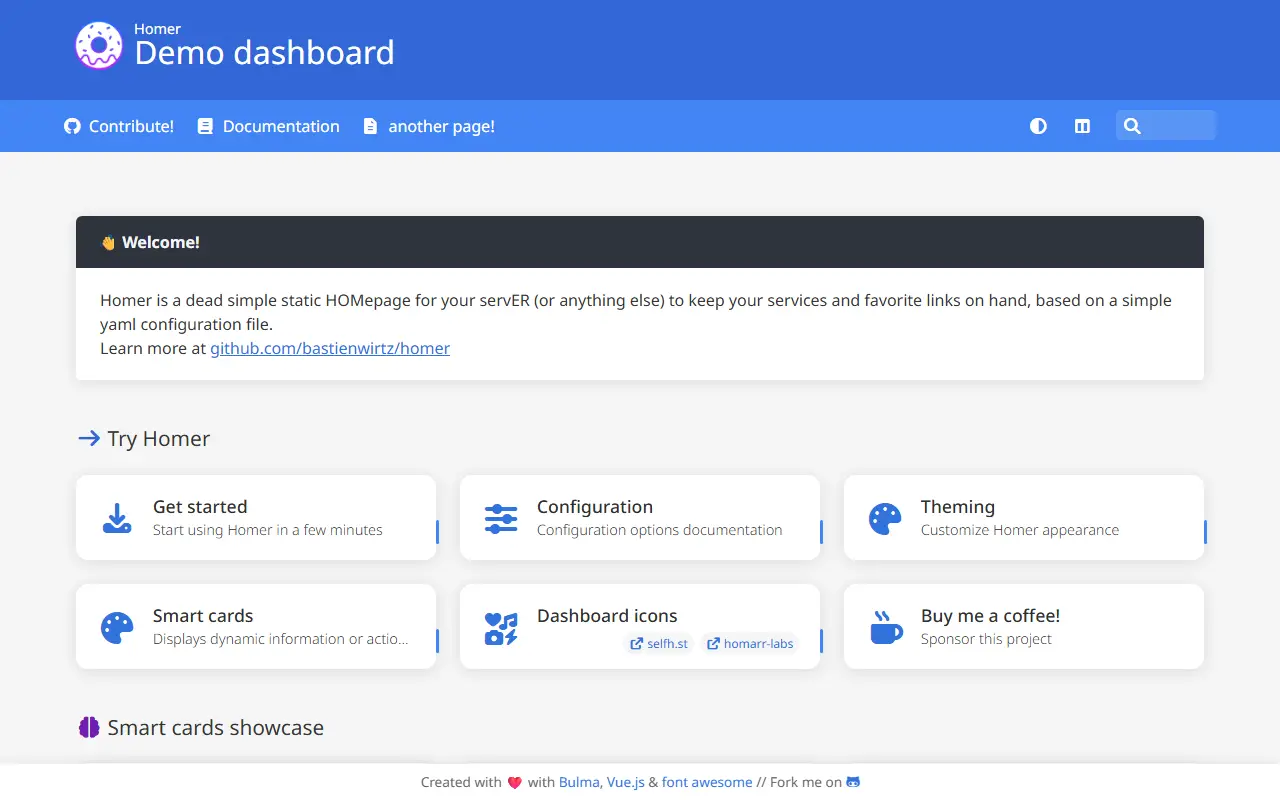
About Homer
Homer is a static homepage for a server or home lab, intended to keep links to your services in one place. It is built as plain HTML and JavaScript with Vue and is configured from a single YAML file, so there is no database or backend to maintain and very little upkeep is required.
The dashboard supports multiple pages, grouped items, smart cards that show extra information from services, fuzzy search with keyboard shortcuts, and theme customization. It can be installed as a progressive web app. Keyboard handling lets you start a search with a slash, open the first match with Enter and open it in a new tab with Alt plus Enter.
Homer is released under Apache-2.0 and is usually deployed with Docker, where the configuration directory is bind mounted and options such as the port, a subfolder path and example asset initialization are set with environment variables. A Kubernetes installation guide is also provided. The files must be served over HTTP rather than opened directly from disk.
Key features
- Single YAML file configuration
- Fuzzy search with keyboard shortcuts
- Multiple pages and grouped items
- Smart cards showing service information
- Theme customization
- Installable as a progressive web app
Good fit for
- A start page for a home lab
- Bookmarking internal tools for a team
Homer: questions and answers
- What is Homer used for?
- Homer is a static, YAML-configured dashboard homepage for your server, giving quick access to self-hosted services with search and themes. It is a good fit for a start page for a home lab and bookmarking internal tools for a team.
- Is Homer open source?
- Yes. Homer is open source under the Apache-2.0 licence. Its source code is on GitHub at bastienwirtz/homer and is written mainly in Vue.
- Is Homer free?
- Yes. Homer is open source, so the software itself is free to use.
- Can I self-host Homer?
- Yes. Homer can be self-hosted on your own server or infrastructure; there is no official hosted version.
- What are some alternatives to Homer?
- Similar open-source tools in the Productivity category include Homepage, Dashy and Homarr. SaaS products in the same category include actiTIME, canihavesex.today and DeskDash.
- Is Homer actively maintained?
- Yes. The most recent commit to Homer was on 11 November 2026, and the latest release is v26.11.2, published on 10 November 2026. The project has 12k stars on GitHub, with 59 added in the last 30 days.
Open-source alternatives to Homer
See all
Homepage
Productivity
A modern, fully static, fast, secure, fully proxied, highly customizable application dashb
GPL-3.0★ 34k
Dashy
Productivity
🚀 A self-hostable personal dashboard built for you. Includes status-checking, widgets, th
MIT★ 27k
Homarr
Productivity
A modern and easy to use dashboard. 40+ integrations. 20K+ icons built in. Authentication
Apache-2.0★ 5.3k
Yuvomi
Productivity
Self-hosted family planner - tasks, calendars, shopping, meals, budget. Your data, your se
MIT★ 2.3k
Mealie
Productivity
Mealie is a self hosted recipe manager and meal planner with a RestAPI backend and a react
AGPL-3.0★ 14k
Linkding
Productivity
A self-hosted bookmarking service that is designed to be minimal, fast and easy to set up.
MITvs Raindrop.io★ 11k
SaaS alternatives to Homer
See allactiTIME
Productivity
Time tracking and timesheet software for project budgeting, billing and payroll
SaaS
canihavesex.today
Productivity
Cycle tracking app based on the symptothermal method, with a self-hosting option
SaaS
DeskDash
Productivity
Desktop app for customizing your desktop with widgets from an open marketplace or built with an SDK
SaaS
F1X Dashboard
Productivity
Chrome extension that turns the new tab into an F1 race-weekend dashboard with standings, lap charts and news
SaaS
ManicTime
Productivity
Automatic time tracker for Windows, Mac and Linux with local or server storage
SaaS
Oku
Productivity
Combines your feeds and content sources into one clean, organized board without ads or pop-ups
SaaS