 TrackMedia
 TrackRev

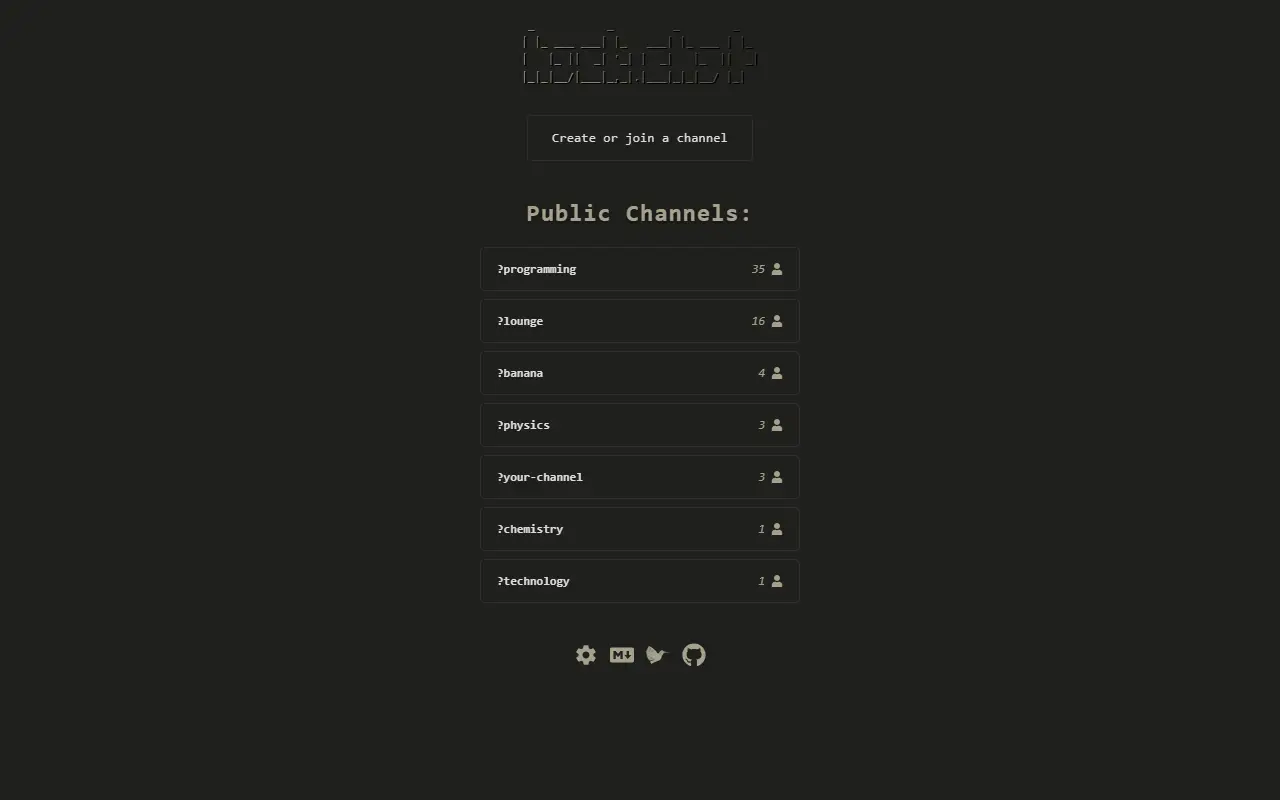
About hack.chat
hack.chat is a minimal chat application built around the idea of simple, disappearing conversations. It requires no accounts, keeps no logs and is designed to be distraction-free, so people can join a channel by name and start talking. It runs on Node.js with WebSockets and can be deployed as your own private service.
The bundled client renders LaTeX using KaTeX and highlights code using highlight.js. The server code is a backwards-compatible continuation of earlier work by Andrew Belt and has been updated to ES6, with extra commands and hot-reloading of commands and the protocol. A separate list collects third-party software for the framework, including bots, clients and Docker containers, and documentation is provided.
Installation for development means cloning the repository, running npm install and npm start, while a separate deployment guide covers live setups; Node.js 16.14 or newer is required. The README states the project is under the MIT licence, although the repository metadata lists none. It suits people who want a quick anonymous chat room for a small community or for experimenting with a simple chat server.
Key features
- Accountless, anonymous chat channels
- No message logs kept
- LaTeX rendering with KaTeX
- Code syntax highlighting
- Hot-reload of commands and protocol
- Community bots and clients ecosystem
Good fit for
- Quick throwaway chat rooms
- Private anonymous chat for a small group
- Experimenting with a WebSocket chat server
hack.chat: questions and answers
- What is hack.chat used for?
- hack.chat is a minimal, accountless and logless web chat service you can deploy yourself, with LaTeX rendering and code highlighting. It is a good fit for quick throwaway chat rooms, private anonymous chat for a small group and experimenting with a WebSocket chat server.
- Is hack.chat open source?
- Yes. hack.chat is open source. Its source code is on GitHub at hack-chat/main and is written mainly in JavaScript.
- Is hack.chat free?
- Yes. hack.chat is open source, so the software itself is free to use. A managed cloud version is also available.
- Can I self-host hack.chat?
- Yes. hack.chat can be self-hosted on your own server or infrastructure.
- What are some alternatives to hack.chat?
- Similar open-source tools in the Team Chat category include Haven, The Lounge and Fiora. SaaS products in the same category include Google Chat, JANDI and Kik.
- Is hack.chat actively maintained?
- Yes. The most recent commit to hack.chat was on 26 October 2026. The project has 1.5k stars on GitHub.
Open-source alternatives to hack.chat
See all
Haven
Team Chat
Self-hosted private chat: no cloud, no telemetry, no Big Tech. Discord alternative that ru
AGPL-3.0vs Discord★ 1k
The Lounge
Team Chat
💬 Modern, responsive, cross-platform, self-hosted web IRC client
MIT★ 6.4kFiora
Team Chat
An interesting open source chat application. Developed with node.js, mongoDB, socket.io an
MITvs Discord★ 7.2k
Campfire
Team Chat
Super simple group chat, without a subscription
MITvs Slack★ 4.8k
Cinny
Team Chat
Yet another matrix client
AGPL-3.0vs Slack★ 4k
Sharkord
Team Chat
Lightweight, self-hosted, open-source chat server with voice, video, text, and screen shar
MITvs Discord★ 1.6k
SaaS alternatives to hack.chat
See all
Google Chat
Team Chat
Messaging and spaces inside Google Workspace with Meet and Docs integration
SaaS
JANDI
Team Chat
Korean team messenger and collaboration tool with file sharing and task management
SaaS
Kik
Team Chat
Mobile messaging app with private chats, public groups and communities
SaaS
Slackoff
Team Chat
Slack app for out-of-office periods: redirects urgent messages and gives an organised catch-up on return
SaaS
TeamSpeak
Team Chat
Voice communication software for gaming teams, communities and businesses
SaaS
Telegram
Team Chat
Cloud-based messenger with large groups, channels and bots
SaaS