
About exit1.dev
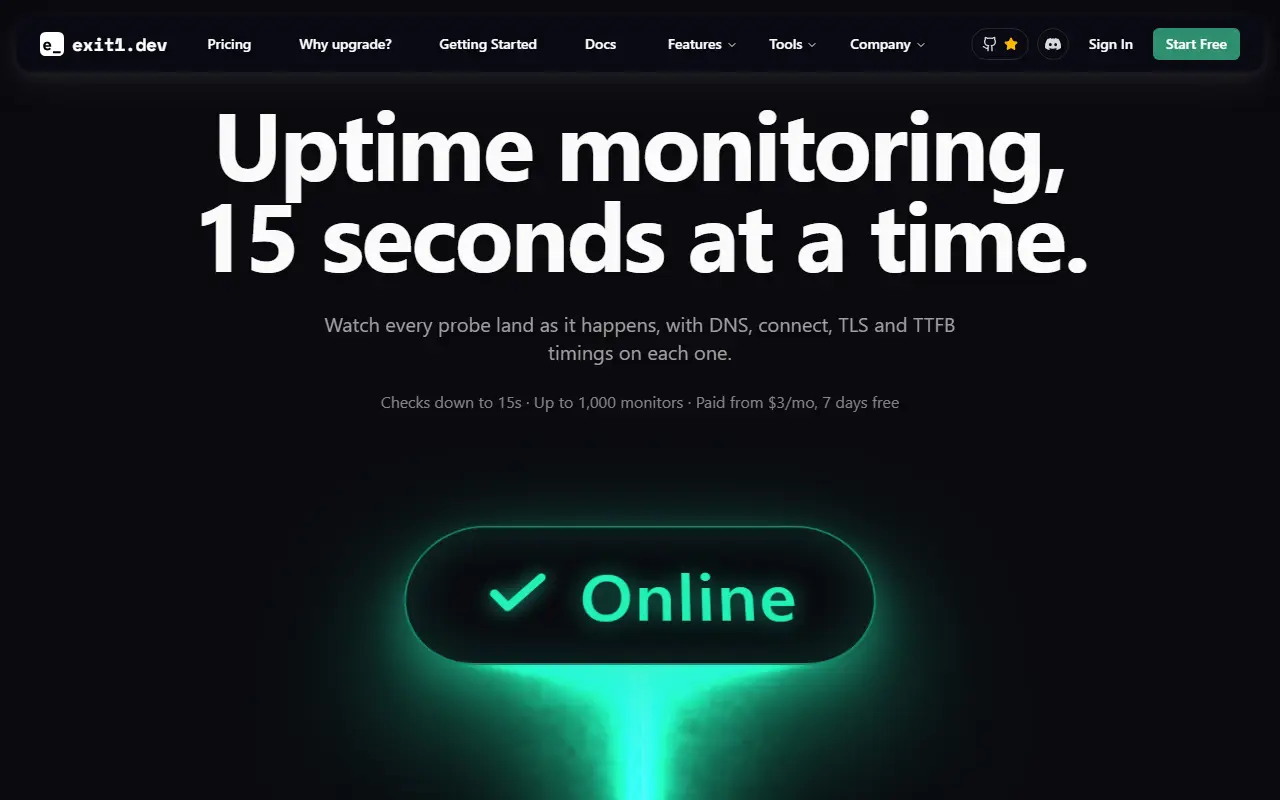
exit1.dev is a hosted uptime monitor that checks websites and services as often as every 15 seconds. A live view streams each probe as it happens with DNS, connect, TLS and time-to-first-byte timings, so status, latency and failures are visible immediately. Monitors can be HTTP and HTTPS endpoints, plain TCP or UDP ports, WebSocket connections and ICMP ping.
Checks can originate from both US and EU locations, so a regional outage is not confused with a problem at one vantage point. The product also watches domains, covering when SSL certificates expire, who the registrar is according to WHOIS, and the DNS records, organizes monitors in folders, keeps logs and offers custom public status pages. An MCP server lets assistants such as Claude Code, Cursor, VS Code and Claude Desktop set up monitoring from a repo.
Sign-up works with GitHub or Google and needs no card. The listing says 50 monitors are free, plans scale up to 1,000 monitors, and paid plans start at $3 a month with a 7-day free trial. The site also publishes live status pages and 90-day uptime figures for well-known services.
Key features
- Checks every 15 seconds
- Live probe streaming with DNS, TLS and TTFB timings
- HTTP, TCP, UDP, WebSocket and ICMP monitors
- Probes from US and EU regions
- SSL expiry, WHOIS and DNS record tracking
- Custom public status pages
- MCP server for AI coding assistants
Good fit for
- Watching a website or API for downtime
- Publishing a status page for customers
exit1.dev: questions and answers
- What is exit1.dev used for?
- exit1.dev is uptime and website monitoring with checks as often as every 15 seconds, live probe timings, SSL and domain tracking, status pages and an MCP server. It is a good fit for watching a website or API for downtime and publishing a status page for customers.
- Is exit1.dev free?
- Yes. exit1.dev has a free plan, and paid plans start at $4 per month. A free trial is also available.
- Is exit1.dev open source?
- No. exit1.dev is proprietary (closed-source) software and can't be self-hosted. In the Monitoring & Observability category, open-source options include OpenStatus, CheckCle and Uptime Kuma.
- What are some alternatives to exit1.dev?
- exit1.dev competes with UptimeRobot, Better Stack and StatusCake.
Open-source alternatives to exit1.dev
See all
OpenStatus
Monitoring & Observability
🫖 Status page with uptime monitoring & API monitoring as code 🫖
AGPL-3.0vs Pingdom★ 9.2k
CheckCle
Monitoring & Observability
CheckCle is a self-hosted, open-source monitoring platform for seamless, real-time full-st
MITvs UptimeRobot★ 3.3k
Uptime Kuma
Monitoring & Observability
A self-hosted monitoring tool
MITvs UptimeRobot★ 92k
Changedetection.io
Monitoring & Observability
Best and simplest way to monitor websites for changes, change detection, website checker,
Apache-2.0★ 35k
Checkmate
Monitoring & Observability
Checkmate is an open-source, self-hosted tool designed to track and monitor server hardwar
AGPL-3.0vs UptimeRobot★ 11kVigil
Monitoring & Observability
🚦 Microservices Status Page. Monitors a distributed infrastructure and sends alerts (Slac
MPL-2.0vs UptimeRobot★ 2k
SaaS alternatives to exit1.dev
See all
UptimeRobot
Monitoring & Observability
Website, port and keyword uptime checks with alerting and status pages
SaaS
Better Stack
Monitoring & Observability
Uptime monitoring, on-call alerts, status pages and log management in one product
SaaS
StatusCake
Monitoring & Observability
Uptime, page speed and SSL monitoring with alerts
SaaS
Pingdom
Monitoring & Observability
Pingdom is a website monitoring service that checks uptime and page performance from outside locations and alerts teams when a site has problems.
SaaS
Hyperping
Monitoring & Observability
Uptime monitoring with status pages and on-call alerting
SaaS
Instatus
Monitoring & Observability
Hosted status pages with incident updates and subscriber notifications
SaaS