 TrackMedia
 TrackRev

 Dataedo
About DataHub
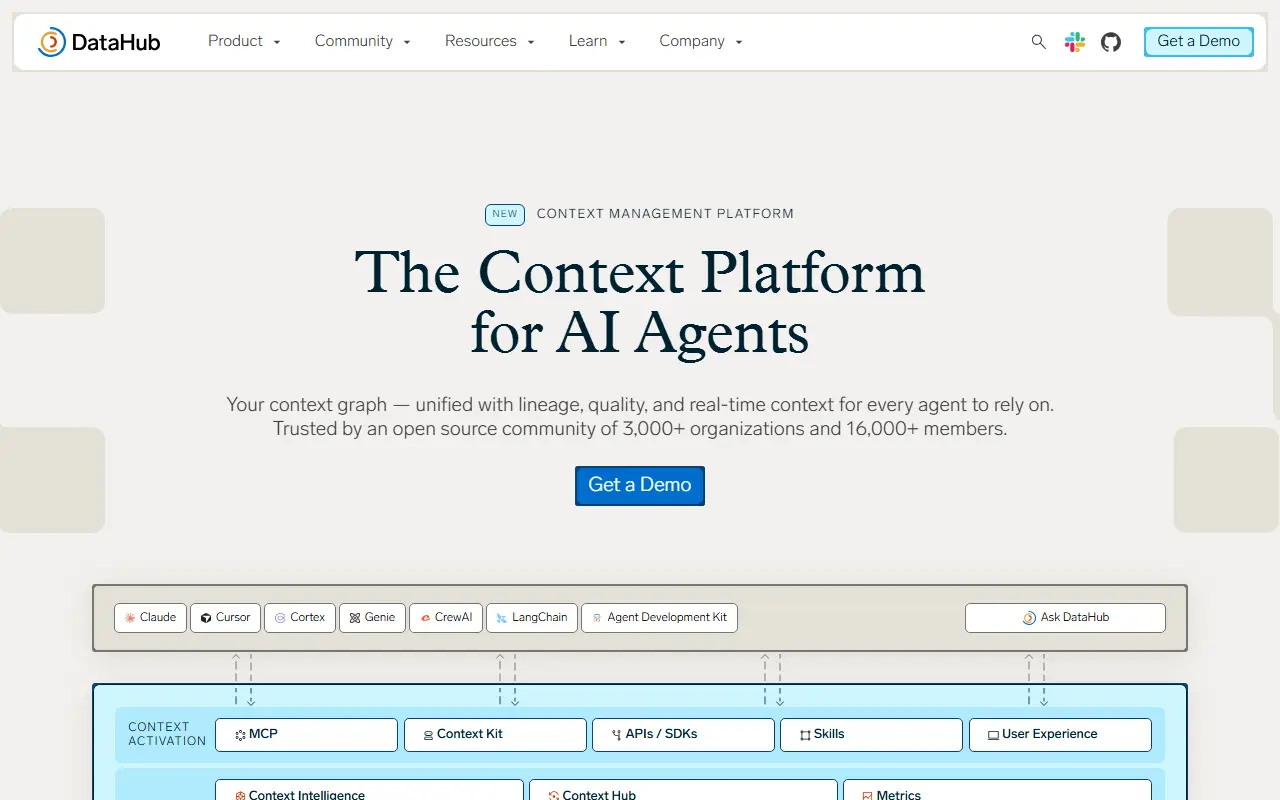
DataHub started at LinkedIn in 2019 to manage metadata at scale and is presented as a context platform for data and AI. It pulls metadata from 150+ integrations into one graph and offers natural-language search, column-level lineage and data profiling covering schema, statistics, ownership and usage.
Governance features include a business glossary, ownership and stewardship for assets, and access policies. Observability adds data quality assertions, freshness checks and SLA tracking, and incident tracking with root-cause lineage. Validated context can be served to agents through MCP, GraphQL, APIs or SDKs, and ingestion runs from a UI or the CLI.
DataHub OSS is Apache 2.0 and self-hosted, deployable with Docker or Kubernetes Helm charts, and runs locally through pip and datahub docker quickstart, which needs Docker with 8GB RAM and Python 3.10+. DataHub Cloud is the managed, SLA-backed edition with a free trial and additional observability and context features.
Key features
- Metadata ingestion from 150+ integrations
- Natural-language search across the data estate
- Column-level lineage from source to consumption
- Business glossary with owned, versioned definitions
- Data quality assertions, freshness checks and incident tracking
- Serves context to agents via MCP, GraphQL, API or SDK
- UI-based and CLI-based ingestion
Good fit for
- Data discovery and cataloguing
- Column-level lineage tracing
- Data governance and ownership tracking
- Giving AI agents data context over MCP
DataHub: questions and answers
- What is DataHub used for?
- DataHub is an open-source metadata platform and data catalog covering discovery, lineage, governance and observability, with a managed DataHub Cloud edition. It is a good fit for data discovery and cataloguing, column-level lineage tracing, and data governance and ownership tracking.
- Is DataHub open source?
- Yes. DataHub is open source under the Apache-2.0 licence. Its source code is on GitHub at datahub-project/datahub and is written mainly in Python.
- Is DataHub free?
- Yes. DataHub is open source, so the software itself is free to use. A managed cloud version is also available.
- Can I self-host DataHub?
- Yes. DataHub can be self-hosted on your own server or infrastructure.
- What is DataHub an alternative to?
- DataHub is an open-source alternative to Dataedo. Other open-source alternatives to Dataedo include Marquez, Metabase and DBeaver.
- Is DataHub actively maintained?
- Yes. The most recent commit to DataHub was on 12 November 2026, and the latest release is v1.8.0, published on 22 October 2026. The project has 13k stars on GitHub, with 163 added in the last 30 days.
Open-source alternatives to DataHub
See all
Marquez
Open source
Collect, aggregate, and visualize a data ecosystem's metadata
Apache-2.0vs Dataedo★ 2.3k
Metabase
BI & Dashboards
The easy-to-use open source Business Intelligence and Embedded Analytics tool that lets ev
OSSvs Tableau★ 50k
DBeaver
Database Tools
Free universal database tool and SQL client
Apache-2.0vs DataGrip★ 52k
ChartDB
Database Tools
Database diagrams editor that allows you to visualize and design your DB with a single que
AGPL-3.0vs dbdiagram.io★ 23k
MySQL
Databases
MySQL Server, the world's most popular open source database, and MySQL Cluster, a real-tim
OSSvs Oracle Database★ 13k
Liam ERD
Database Tools
Automatically generates beautiful and easy-to-read ER diagrams from your database.
Apache-2.0vs dbdiagram.io★ 5.2k