#1
An open-source BI and embedded analytics tool for exploring data, building dashboards and asking questions without SQL, self-hosted or through Metabase Cloud.
- GitHub stars
- 50k
- Last commit
- today
- Latest release
- v0.65.3
- Self-hosted
- Yes
- Hosted version
- Available
metabase.com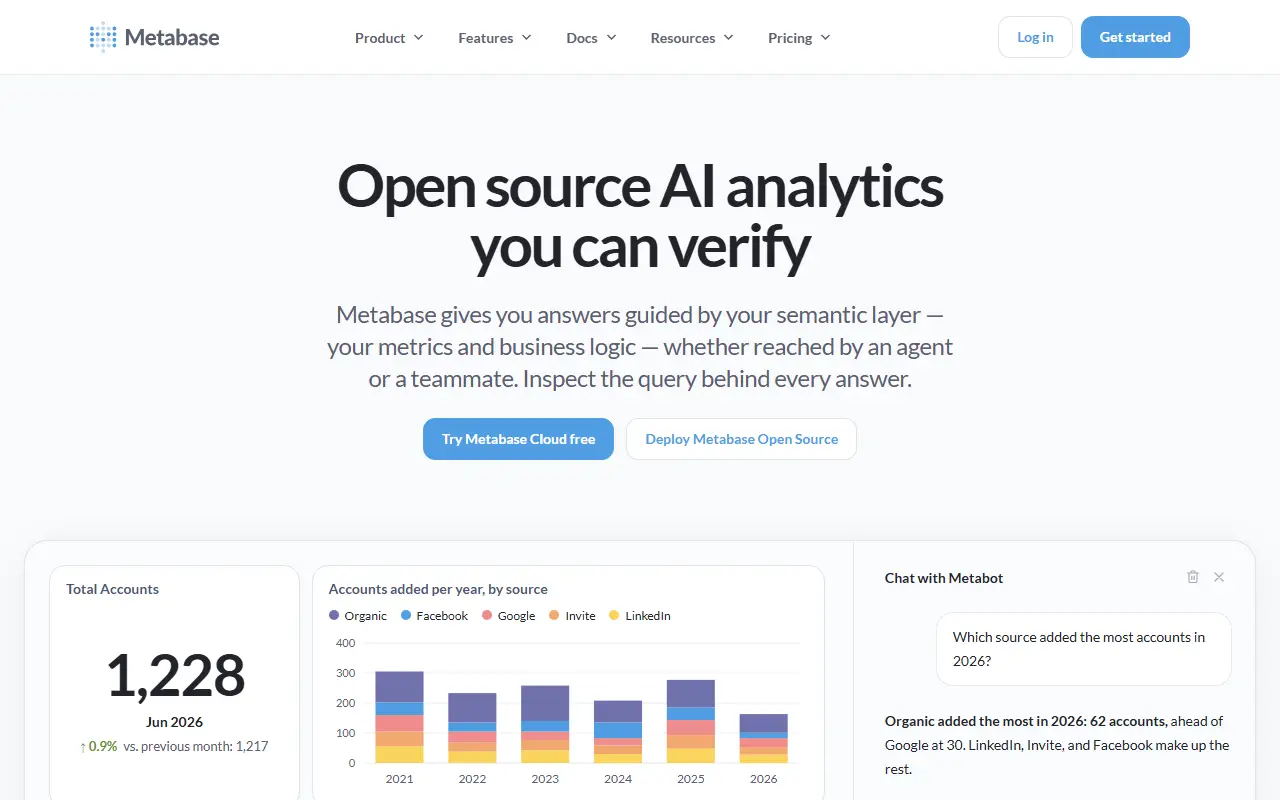
Metabase is an open-source business intelligence and embedded analytics tool meant for everyone in a company, not only analysts. People can ask questions about their data without knowing SQL, while an SQL editor is available for more complex queries. Written in Clojure, it connects to databases such as PostgreSQL and MySQL.
Its features include interactive dashboards with filters, auto-refresh and custom click behavior, plus documents for long-form analysis that colleagues can comment on. An AI assistant called Metabot helps answer questions and write queries, and you can build your own AI agent against your data. Data Studio supports transforming raw data into analytics-ready tables and defining canonical metrics. Alerts and scheduled dashboard subscriptions go to email, Slack or a webhook, and a Library plus Git integration help version your work.
Metabase can also be embedded in your own product with components for charts, dashboards, a data browser and AI chat, and granular permissions work for internal teams and embedded customers. You can self-host it or use Metabase Cloud, which the project says includes support, backups, upgrades and a free trial. The repository license is listed as 'Other', so review its terms.
Key features
- Question builder that needs no SQL
- SQL editor for complex queries
- Interactive dashboards with filters and auto-refresh
- Alerts and scheduled subscriptions to email or Slack
- Embedding of charts and dashboards in apps
- Granular permissions for teams and customers
- Metabot AI assistance for queries
Pricing: The open-source edition is free. Cloud Starter is $100 per month and Pro $575 per month with a 14-day trial; extra users cost $6 or $12 per month. Enterprise starts at $20,000 per year.
#2
A free multi-platform desktop database tool and SQL client for developers, DBAs and analysts, supporting over 100 databases through JDBC and ODBC drivers.
- GitHub stars
- 52k
- Last commit
- today
- Latest release
- 26.2.4
- Licence
- Apache-2.0
- Self-hosted
- Yes
dbeaver.io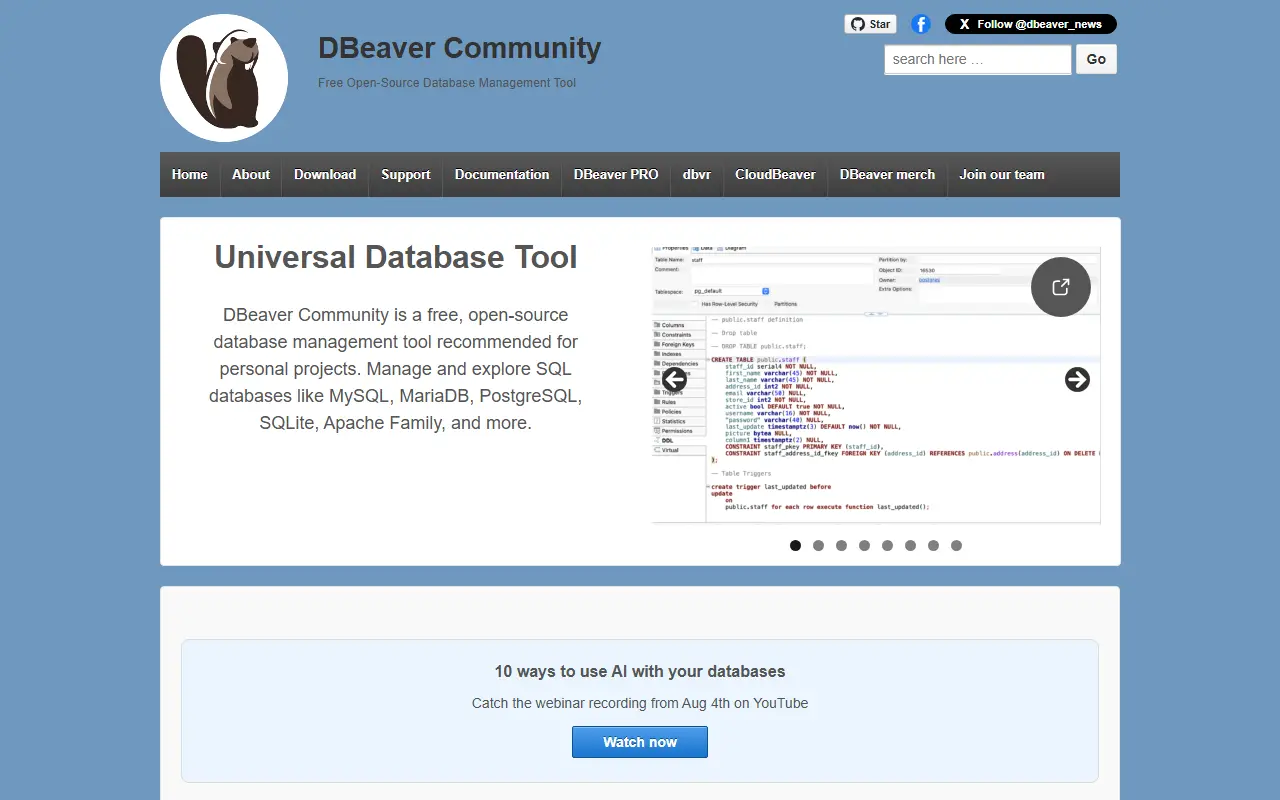
DBeaver is a free, multi-platform database tool aimed at developers, SQL programmers, database administrators and analysts. A single desktop application lets you browse schemas, write and run SQL, edit data and administer many different database systems, instead of switching between vendor-specific clients.
Its feature set covers a schema editor, an SQL editor, a data editor, ER diagrams, data export, import and migration, SQL execution plans, administration tools, database dashboards, a spatial data viewer, proxy and SSH tunneling, and an editor for custom database drivers. An AI chat integrates AI tools for working with data, SQL and database structure. More than 100 drivers are supported out of the box, and anything with a JDBC or ODBC driver can be connected.
DBeaver is a Java application, with OpenJDK included in all distributions so no separate Java install is needed. It is Apache-2.0 licensed and can be downloaded as prebuilt binaries from the website or GitHub releases, with an Early Access build published daily. The vendor also sells paid editions with additional capabilities.
Key features
- SQL editor with execution plans
- Schema editor and ER diagrams
- Data editor with export, import and migration
- 100+ database drivers plus any JDBC or ODBC source
- SSH tunneling and proxy support
- Built-in AI chat for SQL and data
- Database dashboards and spatial data viewer
Pricing: The Community Edition is free and open source under Apache-2.0; the vendor also sells paid editions.
#3
A web-based database diagram editor that imports your schema with one query, lets you edit entity-relationship diagrams and exports SQL, with no account required.
- GitHub stars
- 23k
- Last commit
- 12 days ago
- Latest release
- v1.21.0
- Licence
- AGPL-3.0
- Self-hosted
- Yes
- Hosted version
- Available
chartdb.io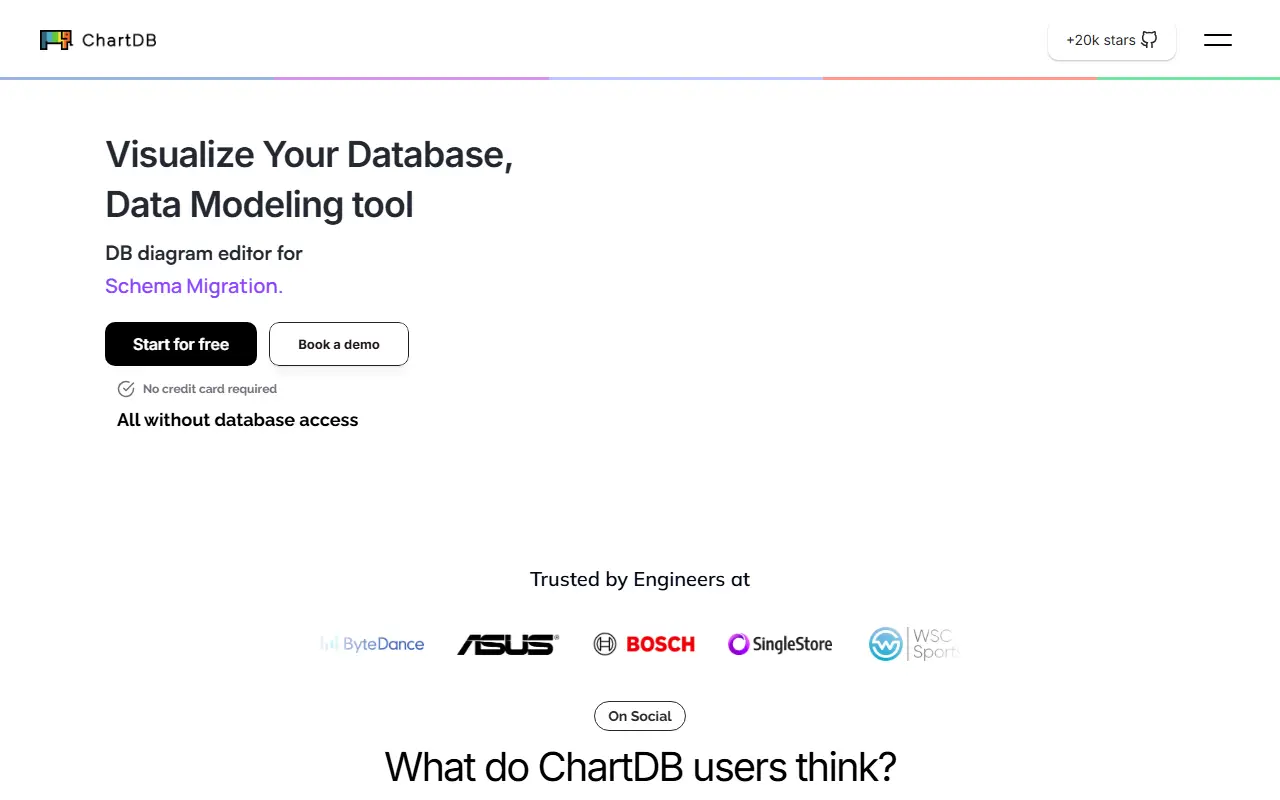
ChartDB is an open-source database diagramming editor that runs in the browser. Its signature feature is a Smart Query: you run one query against your database, paste the resulting JSON schema into ChartDB, and your tables and relationships are visualized instantly, with no installation and no database password shared with the tool.
From there you can edit the diagram interactively and export it, and an AI-powered export generates DDL scripts in the SQL dialect of your choice, which helps when moving between engines, such as MySQL to PostgreSQL or SQLite to MariaDB. The diagrams are useful for documentation, team discussions and understanding an unfamiliar database. Topics show support for MySQL, PostgreSQL, SQLite, SQL Server and MariaDB, and the app is built with React and TypeScript.
ChartDB is AGPL-3.0 licensed. You can use the hosted editor at chartdb.io, which works without an account, or self-host the open-source code. It suits developers, data engineers and students who need quick schema visualizations and migration scripts without setting up heavy modeling software.
Key features
- One-query schema import as JSON
- Interactive ER diagram editing
- AI-assisted DDL export across SQL dialects
- No installation or database password required
- Supports MySQL, PostgreSQL, SQLite and SQL Server
- No account needed
Pricing: A free plan covers one user. Pro is $25 per month for one person and Teams starts at $59 on its Basic tier; yearly billing is up to 40% cheaper and the Custom plan is quoted by sales.
#4
DataHub is an open-source metadata platform and data catalog covering discovery, lineage, governance and observability, with a managed DataHub Cloud edition.
- GitHub stars
- 13k
- Last commit
- yesterday
- Latest release
- v1.8.0
- Licence
- Apache-2.0
- Self-hosted
- Yes
- Hosted version
- Available
datahub.com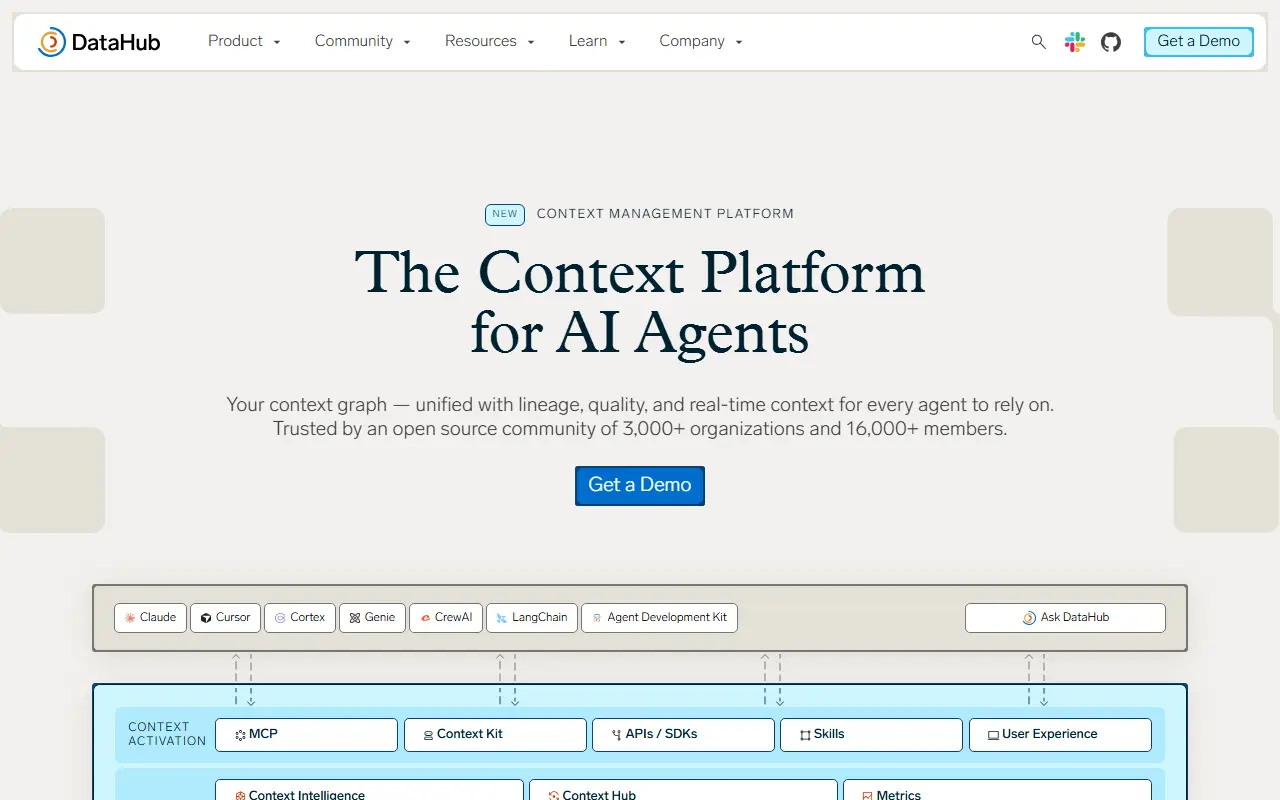
DataHub started at LinkedIn in 2019 to manage metadata at scale and is presented as a context platform for data and AI. It pulls metadata from 150+ integrations into one graph and offers natural-language search, column-level lineage and data profiling covering schema, statistics, ownership and usage.
Governance features include a business glossary, ownership and stewardship for assets, and access policies. Observability adds data quality assertions, freshness checks and SLA tracking, and incident tracking with root-cause lineage. Validated context can be served to agents through MCP, GraphQL, APIs or SDKs, and ingestion runs from a UI or the CLI.
DataHub OSS is Apache 2.0 and self-hosted, deployable with Docker or Kubernetes Helm charts, and runs locally through pip and datahub docker quickstart, which needs Docker with 8GB RAM and Python 3.10+. DataHub Cloud is the managed, SLA-backed edition with a free trial and additional observability and context features.
Key features
- Metadata ingestion from 150+ integrations
- Natural-language search across the data estate
- Column-level lineage from source to consumption
- Business glossary with owned, versioned definitions
- Data quality assertions, freshness checks and incident tracking
- Serves context to agents via MCP, GraphQL, API or SDK
- UI-based and CLI-based ingestion
Pricing: DataHub OSS is self-hosted and Apache 2.0 licensed; DataHub Cloud is the managed edition and offers a free trial. No prices are listed.
#5
Source repository of the MySQL relational database server, covering the open-source Community edition and the clustered MySQL Cluster variant.
- GitHub stars
- 13k
- Last commit
- 16 days ago
- Self-hosted
- Yes
- Hosted version
- Available
mysql.com
MySQL is a widely used open-source relational database. This repository contains the MySQL Server source code along with MySQL Cluster, which the description presents as a real-time, open-source transactional database. Applications talk to it using SQL, and it is a common choice for web applications and embedded products.
The MySQL website describes several offerings built around the server: the Community Edition, with a published governance model and early access builds; MySQL Enterprise Edition for advanced features, management tools and technical support; MySQL HeatWave, a cloud service that combines transactions with analytics and machine learning; and MySQL Cluster CGE. A program for OEM and ISV vendors covers embedding the database in other products.
The server is written in C++ and distributed under licenses detailed in the repository. Organizations can run the Community Edition on their own infrastructure, buy a commercial edition from Oracle, which owns the project, or use a managed cloud offering. Documentation, downloads and a developer zone are available on mysql.com.
Key features
- Open-source relational database server
- SQL query interface
- MySQL Cluster for transactional workloads
- Community and Enterprise editions
- HeatWave managed cloud option
- Documentation and developer resources
Pricing: Community Edition is open source; Enterprise Edition and the HeatWave cloud service are commercial offerings.
#6
Liam ERD generates interactive entity relationship diagrams from your database schema, with zoom, pan and filtering for exploring complex structures.
- GitHub stars
- 5.2k
- Last commit
- yesterday
- Latest release
- @liam-hq/cli@0.7.24
- Licence
- Apache-2.0
- Self-hosted
- Yes
- Hosted version
- Available
liambx.com
Liam ERD turns an existing database schema into a clear, interactive entity relationship diagram. It is meant for developers and teams who need to understand or document a database without drawing the diagram manually, and it works with both public and private repositories.
The interface supports panning, zooming and filtering so even complex schemas stay readable, and it reverse-engineers diagrams directly from your schema with little setup. Repository topics list PostgreSQL, Prisma, Ruby on Rails, tbls and SQL as input sources, with React Flow used for rendering. A command-line package is published for generating diagrams locally, and the project provides documentation and a roadmap.
Liam is written in TypeScript and licensed under Apache-2.0. You can run the CLI yourself, and the project's website also offers a hosted way to view diagrams. It suits engineering teams who want schema documentation that stays in sync with the code.
Key features
- Interactive ER diagrams from existing schemas
- Panning, zooming and filtering
- Reverse engineering with minimal setup
- Works with PostgreSQL, Prisma and Rails schemas
- Command-line package for local use
- Open-source TypeScript codebase
Pricing: Free and open source under the Apache-2.0 license.
#7
pgModeler is a locally installed PostgreSQL schema design tool with reverse engineering, diffing and a command-line interface.
- GitHub stars
- 3.6k
- Last commit
- 8 days ago
- Latest release
- v2.0.0
- Licence
- GPL-3.0
pgmodeler.io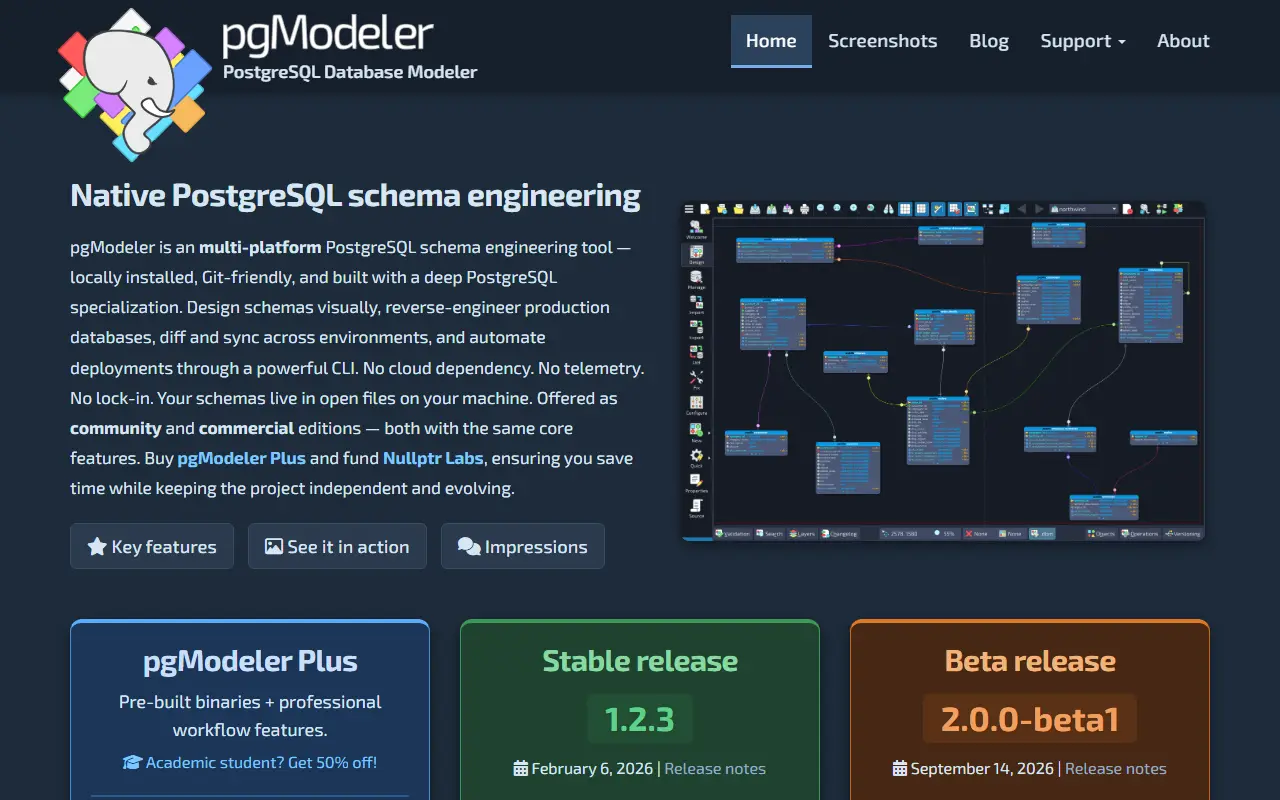
pgModeler is a multi-platform PostgreSQL schema engineering tool that is installed locally and designed to work with Git. You design schemas visually, reverse-engineer production databases, diff and sync across environments, and automate deployments through a CLI.
The site states there is no cloud dependency, no telemetry and no lock-in, with schemas kept in open files on your machine. It is offered as community and commercial editions that share the same core features. The paid pgModeler Plus adds pre-built binaries and workflow features such as versioning and an SSH tunnel plugin.
The stable release shown is 1.2.3 from February 2026, and a 2.0.0 beta line is available. The project is maintained by Nullptr Labs under the GPL-3.0 licence, and academic students are offered 50% off Plus.
Key features
- Visual schema design for PostgreSQL
- Reverse engineering of existing databases
- Local use with no cloud dependency or telemetry
- Plus edition adds Git versioning and SSH tunnel plugins
- Beta adds support for PostgreSQL 18 temporal keys

Marquez is an open-source metadata server and web UI for collecting, storing, and visualizing OpenLineage metadata from data pipelines.
- GitHub stars
- 2.3k
- Last commit
- 2 days ago
- Latest release
- 0.50.0
- Licence
- Apache-2.0
- Self-hosted
- Yes
marquezproject.ai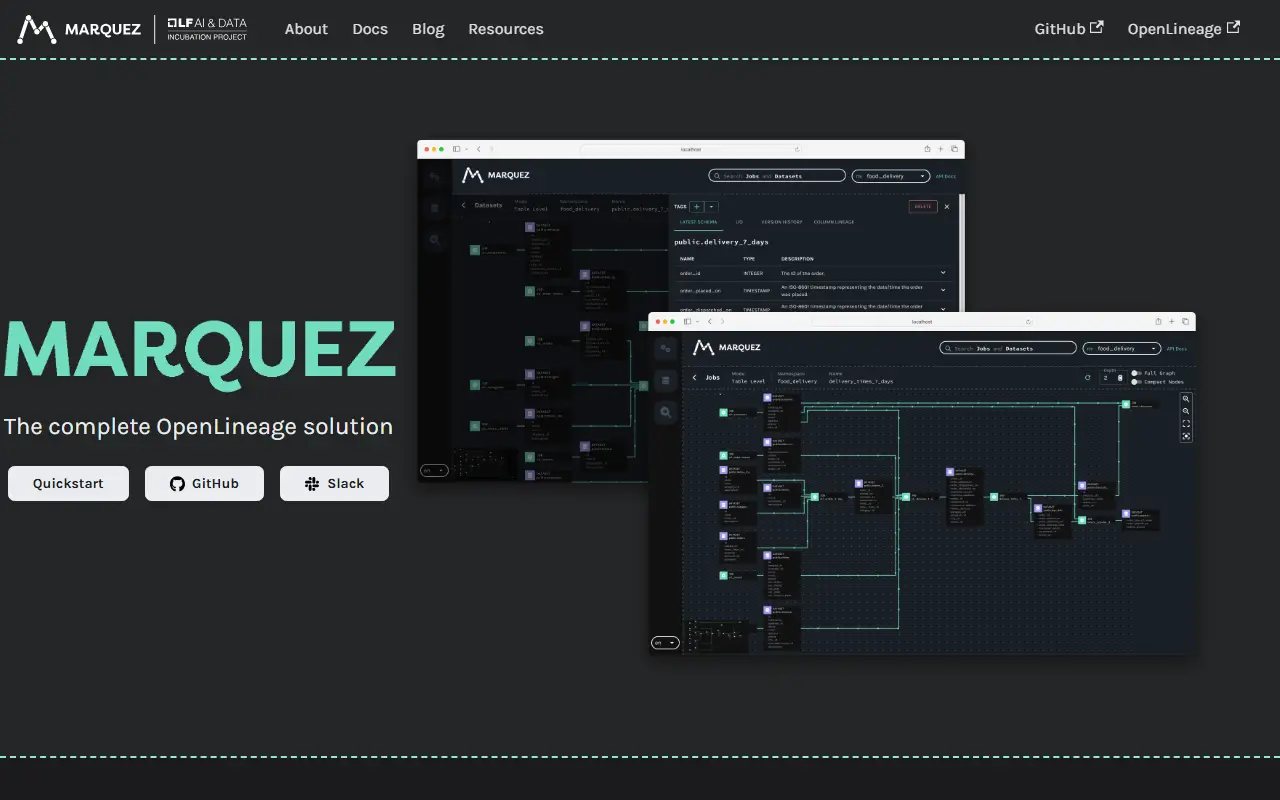
Marquez is an open-source metadata server that provides an OpenLineage-compatible endpoint for real-time collection of metadata from running jobs and applications. It serves as the reference implementation of OpenLineage and works with integrations such as Apache Airflow, Apache Spark, Apache Flink, dbt, and Dagster.
Through a web user interface, Marquez offers a visual map showing complex interdependencies within a data ecosystem. Users can browse metadata, see inputs and outputs of jobs, trace dataset lineage, and study performance metrics and execution details.
Key features
- Real-time metadata server with OpenLineage-compatible endpoint
- Unified visual graph showing interdependencies in the data ecosystem
- Lineage API for querying metadata to automate backfills and root cause analysis
- Supports integrations with Apache Airflow, Apache Spark, Apache Flink, dbt, and Dagster
- Web UI for browsing metadata, tracing dataset lineage, and viewing performance metrics

Archi is an open source, cross-platform modelling toolkit for creating ArchiMate models and sketches, used by enterprise architects.
- GitHub stars
- 1.3k
- Last commit
- 2 days ago
- Licence
- MIT
archimatetool.com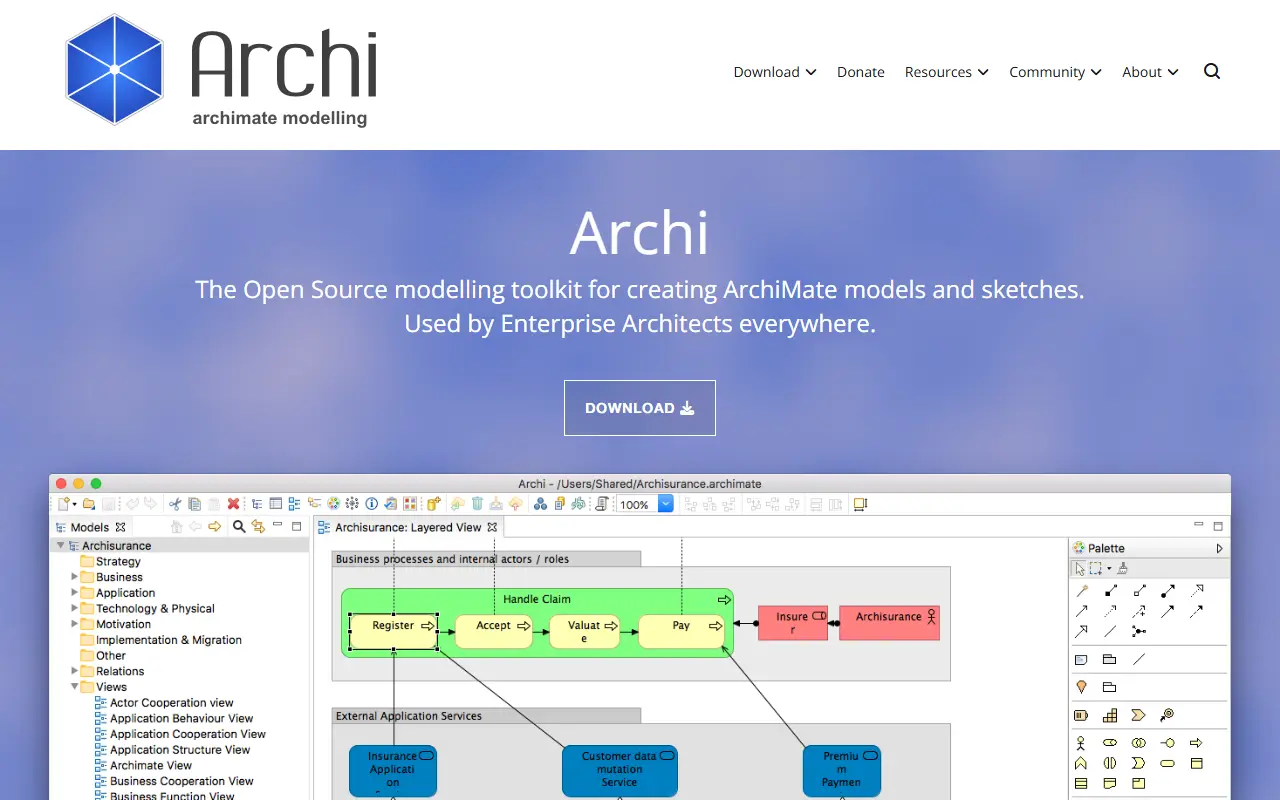
Archi is a modelling tool for the ArchiMate language, an open Enterprise Architecture standard hosted by The Open Group and aligned with TOGAF. The site describes it as aimed at all levels of enterprise architects and modellers, including people taking their first steps with ArchiMate.
It supports ArchiMate 3.2 and lets users create elements and relations across the ArchiMate views, with a magic connector that proposes valid connections. Models can be refined with user-defined properties and colour schemes, and views can be set to a viewpoint suited to a particular audience.
Two helper views are built in: a Hints view that explains every ArchiMate element, relationship and viewpoint, and a Visualiser that shows a selected element with its relationships. The project is MIT licensed, accepts donations through PayPal and Patreon, and says it is downloaded about 6,000 times a month.
Key features
- Create all ArchiMate elements, relations and views
- Magic connector proposes correct connections
- User-defined properties and colour schemes
- Views with audience-specific viewpoints
- Hints view explains elements and relationships
- Visualiser shows an element and its relationships
Pricing: Donations are accepted through PayPal or Patreon, and the site says all development work and support is done for free.
#10
SchemaCrawler is a free tool for discovering and comprehending database schemas, supporting output in multiple formats and schema diagram generation.
- GitHub stars
- 1.8k
- Last commit
- 3 days ago
- Latest release
- v18.0.2
- Self-hosted
- Yes
schemacrawler.com
SchemaCrawler is a free database schema discovery and comprehension tool. It allows users to search for database schema objects using regular expressions and output the schema and data in a readable text format. The output is designed to be diff-ed against other database schemas and serves for database documentation.
SchemaCrawler also generates schema diagrams and supports executing scripts in any standard scripting language against a database. It can find potential schema design issues with lint and rank tables and views by graph metrics and importance. The tool supports almost any database with a JDBC driver and works on any operating system that supports Java SE 17 or better.
Key features
- Search for database schema objects using regular expressions
- Output schema and data in readable text format, HTML5, JSON, or YAML
- Generate schema diagrams
- Execute scripts in any standard scripting language against the database
- Find potential schema design issues with lint
- Rank tables and views by graph metrics and importance
Dataedo alternatives: questions
- What is the best open-source alternative to Dataedo?
- Metabase is the top-ranked open-source alternative to Dataedo on Enlisted: An open-source BI and embedded analytics tool for exploring data, building dashboards and asking questions without SQL, self-hosted or through Metabase Cloud. Other strong options are DBeaver, ChartDB, DataHub and MySQL.
- What are the best commercial alternatives to Dataedo?
- ER/Studio, SqlDBM, DbSchema, DrawSQL and erwin Data Modeler are among the hosted, closed-source alternatives to Dataedo listed on Enlisted, which lists 13 in total. Compare their pricing and features on each tool page.
- Are these Dataedo alternatives free?
- All 10 are open source, so the code is free to use under its licence, and all of them can be self-hosted on your own server or computer. 5 also offer a paid or managed cloud version if you'd rather not host it yourself.
- How is this list of Dataedo alternatives ranked?
- By a score built from GitHub stars, star growth over the last 30 days and how recently the code changed. 10 of these projects shipped code in the last 30 days. Data is refreshed daily, and nobody can pay to move up.
 TrackMedia
 TrackRev