 TrackMedia
 TrackRev

 PythonAnywhere
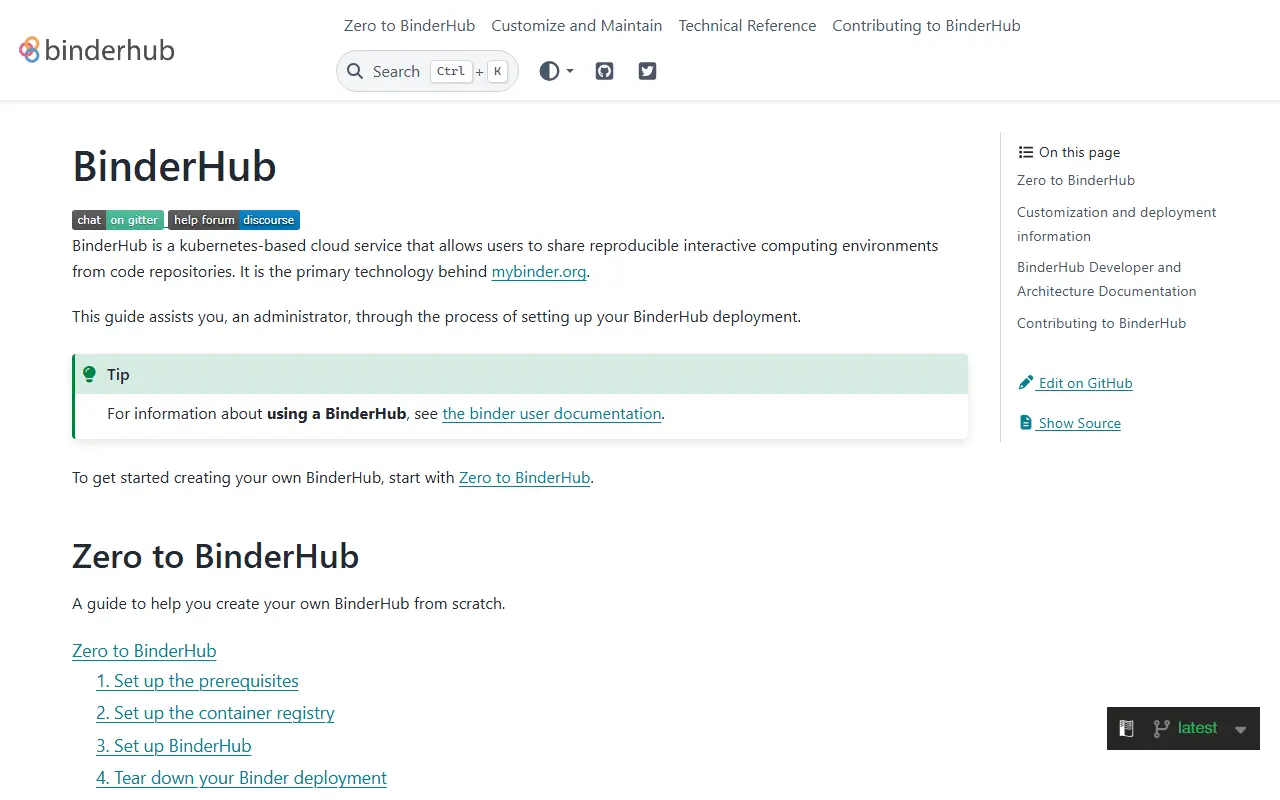
About BinderHub
BinderHub is a Kubernetes-based cloud service that lets people share reproducible, interactive computing environments from code repositories. It is the main technology behind mybinder.org. It builds and registers a Docker image from a Git repository, then connects to JupyterHub so users get a live session with the code and environment, and a specific branch, commit or tag can be served.
Two projects do the heavy lifting: JupyterHub authenticates users and spawns single-user notebook servers, and repo2docker generates the image from the repository. The architecture page lists a cloud provider, Kubernetes, Helm, Docker, a BinderHub interface, a Docker registry and JupyterHub as the parts. When a Binder link is opened, BinderHub checks whether an image exists for the latest ref, builds one in a pod if not, pushes it to the registry, and JupyterHub starts a pod for the user and removes it after a short period of inactivity.
The README names three audiences: users who want to interact with environments others created, authors who create links to such environments, and deployers who run their own BinderHub on hardware of their choice. The documentation includes a Zero to BinderHub guide, plus pages on authentication, HTTPS, CORS, debugging and the API. It is Python 3 code under a BSD 3-Clause licence.
Key features
- Builds and registers Docker images from Git repos
- Serves a chosen branch, commit or tag
- Reuses an existing image for the latest ref
- Temporary user pods removed after inactivity
- Guide for setting up a deployment from scratch
- Docs on authentication, HTTPS and CORS
Good fit for
- Share a research notebook as a live environment
- Run a private Binder service
- Teach with ready-to-run repositories
BinderHub: questions and answers
- What is BinderHub used for?
- BinderHub builds a Docker image from a Git repository and serves it as a temporary JupyterHub session on Kubernetes. It is a good fit for share a research notebook as a live environment, run a private Binder service and teach with ready-to-run repositories.
- Is BinderHub open source?
- Yes. BinderHub is open source under the BSD-3-Clause licence. Its source code is on GitHub at jupyterhub/binderhub and is written mainly in Python.
- Is BinderHub free?
- Yes. BinderHub is open source, so the software itself is free to use.
- Can I self-host BinderHub?
- Yes. BinderHub can be self-hosted on your own server or infrastructure.
- What is BinderHub an alternative to?
- BinderHub is an open-source alternative to PythonAnywhere. Other open-source alternatives to PythonAnywhere include Coolify, Dokploy and Dokku.
- Is BinderHub actively maintained?
- Yes. The most recent commit to BinderHub was on 2 November 2026. The project has 2.7k stars on GitHub, with 2 added in the last 30 days.
Open-source alternatives to BinderHub
See all
Coolify
Hosting & PaaS
Self-hosting platform with superpowers. Deploy apps, databases & 280+ services to your
Apache-2.0vs Heroku★ 66k
Dokploy
Hosting & PaaS
Open-source self-hostable Platform as a Service (PaaS) that simplifies the deployment and
OSSvs Heroku★ 38k
Dokku
Hosting & PaaS
A docker-powered PaaS that helps you build and manage the lifecycle of applications
MITvs Heroku★ 32k
CapRover
Hosting & PaaS
Scalable PaaS (automated Docker+nginx) - aka Heroku on Steroids
OSSvs Heroku★ 15k
Jupyter Notebook
Developer Tools
Jupyter Interactive Notebook
BSD-3-Clausevs MATLAB★ 13k
Coder
Developer Tools
Secure environments for developers and their agents
AGPL-3.0vs CodeSandbox★ 17k