
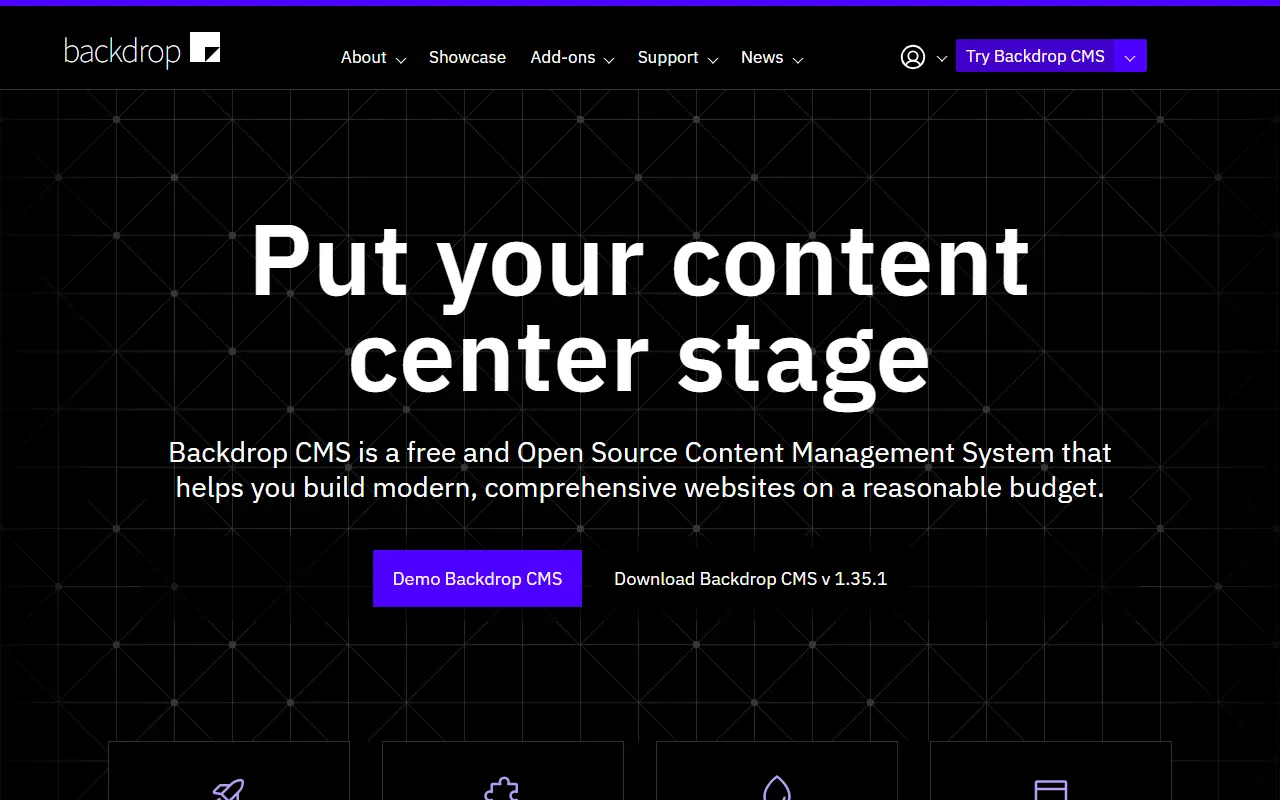
About Backdrop CMS
Backdrop is a content management system that lets non-technical users manage many kinds of content. It can be used to build blogs, image galleries, social networks, intranets and other websites, and its stated aims are a CMS that works out of the box, code that can be learned quickly and extensible APIs.
The README lists requirements of PHP 7.1 or higher, though it recommends a currently supported PHP version, MySQL 5.5 or higher with PDO, and an Apache or Nginx web server, with about 50 MB of disk space recommended. Installation involves creating a database and running the web installer. Bugs and feature requests go to a separate GitHub issue tracker, and security problems are reported privately to the Backdrop Security Team.
Backdrop is written in PHP, licensed under GPL-2.0 and installed on your own hosting, with contributed modules and themes available from its community. It suits site owners, small organizations and developers who want a self-hosted CMS with a straightforward structure and a clear security process.
Key features
- Out-of-the-box content management
- Web-based installer
- Extensible APIs
- Contributed modules and themes
- Apache or Nginx with MySQL
- Private security reporting process
Good fit for
- →Building blogs and intranet sites
- →Creating image galleries
- →Running a community website on your own hosting
- Built with
- PHP
- Tags
- cms
- php
- content-management
- backdrop
- self-hosted
- mysql
- websites
- modules
Backdrop CMS: questions and answers
- What is Backdrop CMS used for?
- Backdrop CMS is a full-featured PHP content management system for blogs, galleries, intranets and more, designed to work out of the box with extensible APIs. It is a good fit for building blogs and intranet sites, creating image galleries, and running a community website on your own hosting.
- Is Backdrop CMS open source?
- Yes. Backdrop CMS is open source under the GPL-2.0 licence. Its source code is on GitHub at backdrop/backdrop and is written mainly in PHP.
- Is Backdrop CMS free?
- Yes. Backdrop CMS is open source, so the software itself is free to use.
- Can I self-host Backdrop CMS?
- Yes. Backdrop CMS can be self-hosted on your own server or infrastructure.
- What are some alternatives to Backdrop CMS?
- Similar open-source tools in the CMS category include Textpattern, Joomla and Drupal. SaaS products in the same category include Adobe Experience Manager, Contentful and Sitecore.
- Is Backdrop CMS actively maintained?
- Yes. The most recent commit to Backdrop CMS was on 25 September 2026, and the latest release is 1.35.1, published on 24 September 2026. The project has 1k stars on GitHub.
Open-source alternatives to Backdrop CMS
See all
Textpattern
CMS
A flexible, elegant, fast and easy-to-use content management system written in PHP.
GPL-2.0★ 881
Joomla
CMS
Home of the Joomla! Content Management System
GPL-2.0vs WordPress.com★ 5.1k
Drupal
CMS
Verbatim mirror of the git.drupal.org repository for Drupal core. Please see the https://g
OSSvs WordPress.com★ 4.3k
Winter CMS
CMS
Free, open-source, self-hosted CMS platform based on the Laravel PHP Framework.
MIT★ 1.5k
Sulu
CMS
Core framework that implements the functionality of the Sulu content management system
MITvs Sitecore★ 1.4k
TYPO3
CMS
The TYPO3 Core - Enterprise Content Management System. Synchronized mirror of https://revi
GPL-2.0vs Sitecore★ 1.2k
SaaS alternatives to Backdrop CMS
See all
Adobe Experience Manager
CMS
Enterprise content management and digital asset management for websites and brand content
SaaS
Contentful
CMS
Headless CMS and content platform with APIs, structured content and localization
SaaS
Sitecore
CMS
Enterprise digital experience platform with CMS, personalization and commerce
SaaS
Sitefinity
CMS
Enterprise .NET CMS from Progress with personalization and marketing tools
SaaS
Squiz
CMS
Australian digital experience platform with CMS and search products
SaaS
1FoodMenu
CMS
One-page website builder for restaurants and food trucks with menu, hours and contact info
SaaS