#1
Keycloak is an open-source identity and access management server that adds single sign-on, user management and authorization to applications.
- GitHub stars
- 38k
- Last commit
- yesterday
- Latest release
- 26.8.2
- Licence
- Apache-2.0
- Self-hosted
- Yes
keycloak.org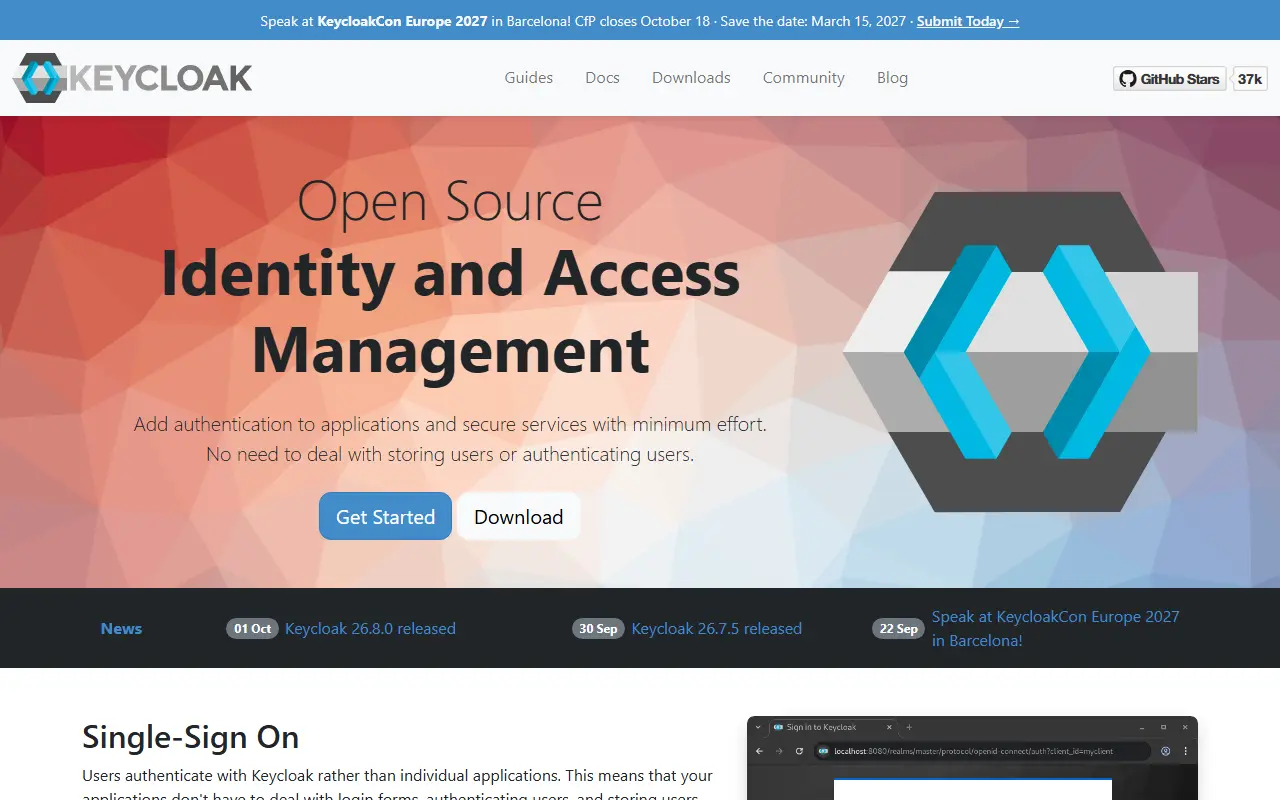
Keycloak is an open-source identity and access management server. It lets application teams add authentication and secure services without building their own login system, since Keycloak handles storing users and authenticating them. The project is written in Java, released under the Apache-2.0 license and governed under the Cloud Native Computing Foundation code of conduct.
Keycloak supports standard protocols such as OpenID Connect and SAML, and offers user federation, strong authentication, user management and fine-grained authorization. You can run it from the downloadable distribution using a start-dev command, or use the official Docker image published on Quay for containers and Kubernetes setups. The project provides documentation, a user mailing list and community channels for help, along with guidance for building and testing from source.
Key features
- Single sign-on with OpenID Connect and SAML
- User federation with external directories
- Strong and multi-step authentication options
- Central user and account management
- Fine-grained authorization policies
- Docker image and standalone distribution
Pricing: Free and open source under the Apache-2.0 license; you host and operate it yourself.
#2
An open-source identity and access management platform with SSO, MFA, passkeys, OIDC, SAML, SCIM and native multi-tenancy, available self-hosted or as a cloud service.
- GitHub stars
- 16k
- Last commit
- yesterday
- Latest release
- v4.20.2
- Licence
- AGPL-3.0
- Self-hosted
- Yes
- Hosted version
- Available
zitadel.com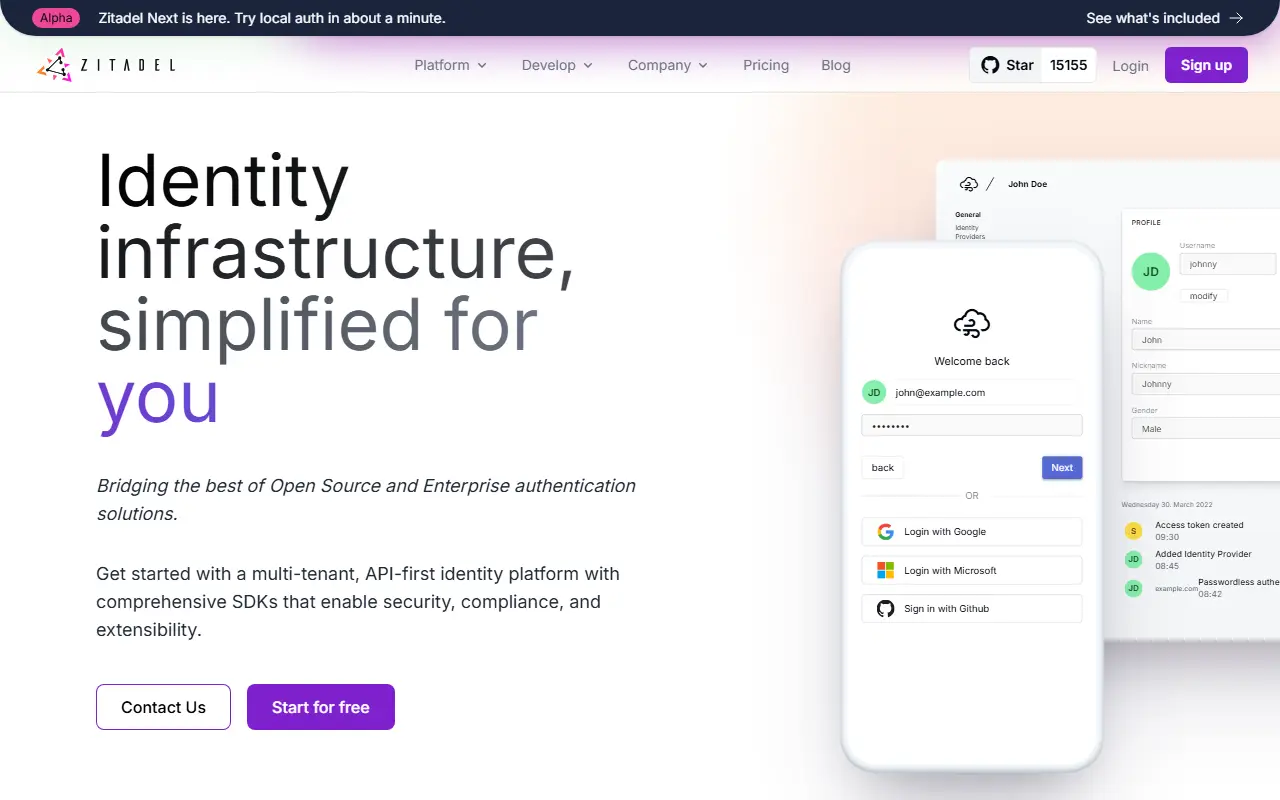
ZITADEL is an identity and access management platform, open source, for teams that need more than basic login. It targets SaaS products, B2B platforms and self-hosted IAM stacks, and bundles single sign-on, multi-factor authentication, passkeys, OIDC, SAML and SCIM in an API-first design, with an emphasis on a mature multi-tenancy model.
A comparison table in the README sets it against FusionAuth, Keycloak and Auth0 or Okta on points such as open-source status, self-hosting, infrastructure-level tenants, native B2B organizations and a comprehensive event-stream audit trail. Topics list standards and features including OAuth 2, OpenID Connect, FIDO2, 2FA and passkeys. The positioning is that you can own the identity layer without vendor lock-in while still getting a polished product.
ZITADEL is written in Go and licensed under AGPL-3.0, with a website, chat, docs and blog. You can run it yourself or use the vendor's managed cloud. It suits developers and security teams building multi-tenant applications who want a self-hostable alternative to commercial identity providers.
Key features
- Single sign-on with OIDC and SAML
- Multi-factor authentication and passkeys
- SCIM user provisioning support
- Native multi-tenancy with B2B organizations
- Event-stream audit trail
- API-first, self-hostable design
Pricing: Free cloud plan for 100 daily active users. Pro costs $100 per month and includes 25,000 daily active users; Enterprise is custom and can run on your own infrastructure.
#3
Open-source identity infrastructure that adds sign-in, enterprise SSO and role-based access control to SaaS and AI products, using OIDC and OAuth 2.1 standards.
- GitHub stars
- 15k
- Last commit
- yesterday
- Latest release
- v1.46.0
- Licence
- MPL-2.0
- Self-hosted
- Yes
- Hosted version
- Available
logto.io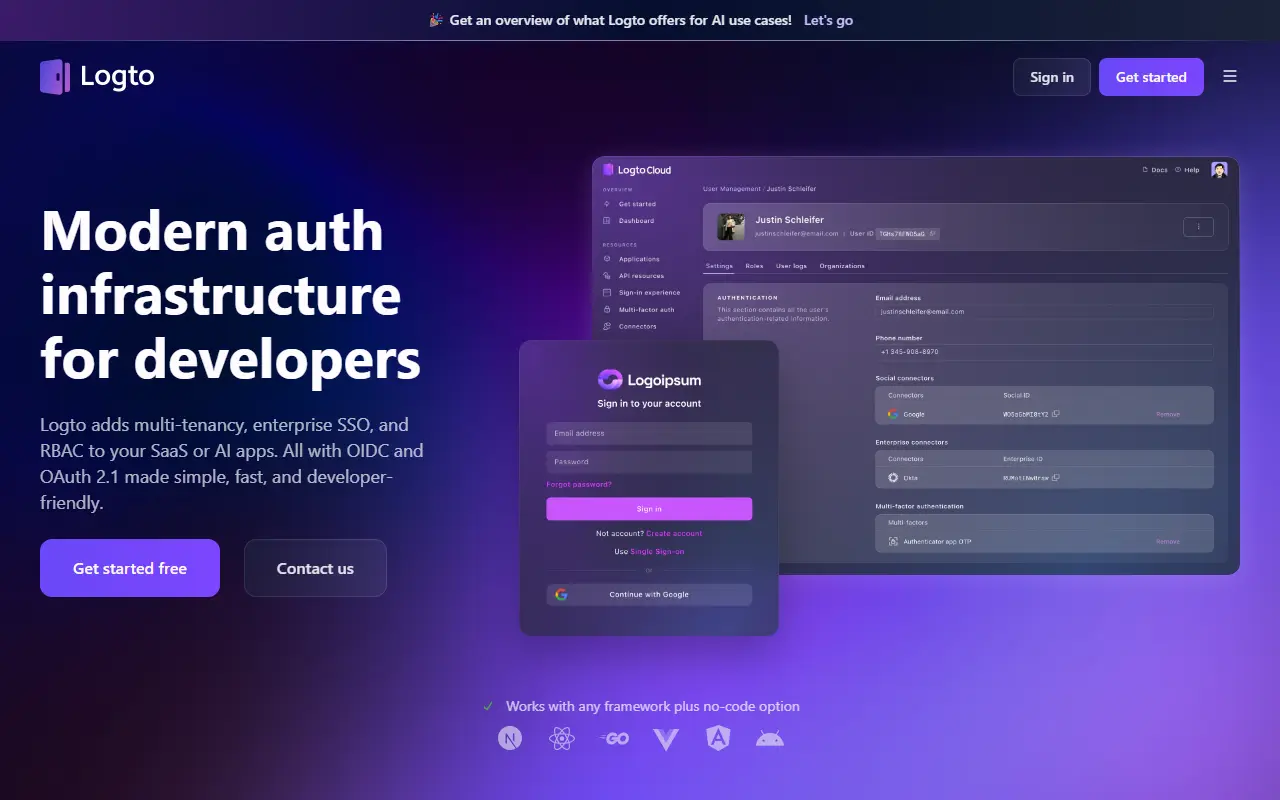
Logto is an open-source identity platform that handles sign-in, sign-up and access control so product teams do not have to build them from scratch. It is built on OpenID Connect and OAuth 2.1, with SAML also supported, and is aimed at SaaS products and AI or agent-based platforms that need production-ready authentication.
Out of the box it provides multi-tenancy and organizations with member invites and role-based access, enterprise SSO, and prebuilt sign-in flows with a customizable interface. Sign-in options include social login, passwordless methods, MFA and Google One Tap, and it can connect to external identity providers such as Google, Azure AD and Okta. SDKs cover more than 30 frameworks, among them React, Next.js, Angular, Vue, Flutter, Go and Python.
The core is licensed under MPL-2.0 and can be self-hosted by following the OSS installation guide or run locally for development. Logto Cloud offers the same product as a fully managed service. The project also advertises support for the Model Context Protocol and agent-style AI architectures.
Key features
- OIDC, OAuth 2.1 and SAML support
- Multi-tenancy with organization RBAC
- Enterprise single sign-on
- Prebuilt, customizable sign-in flows
- Social login, passwordless and MFA
- SDKs for over 30 frameworks
- Machine-to-machine access for APIs and CLIs
Pricing: Free cloud plan for up to 50,000 MAU. Pro starts at $24 per month plus token usage and add-ons; Enterprise is quoted, and self-hosting is available.
#4
Apereo CAS is an enterprise identity provider and single sign-on server written in Java, supporting CAS, SAML2, OpenID Connect, OAuth2 and multifactor authentication.
- GitHub stars
- 11k
- Last commit
- yesterday
- Latest release
- v8.0.3
- Licence
- Apache-2.0
- Self-hosted
- Yes
apereo.github.io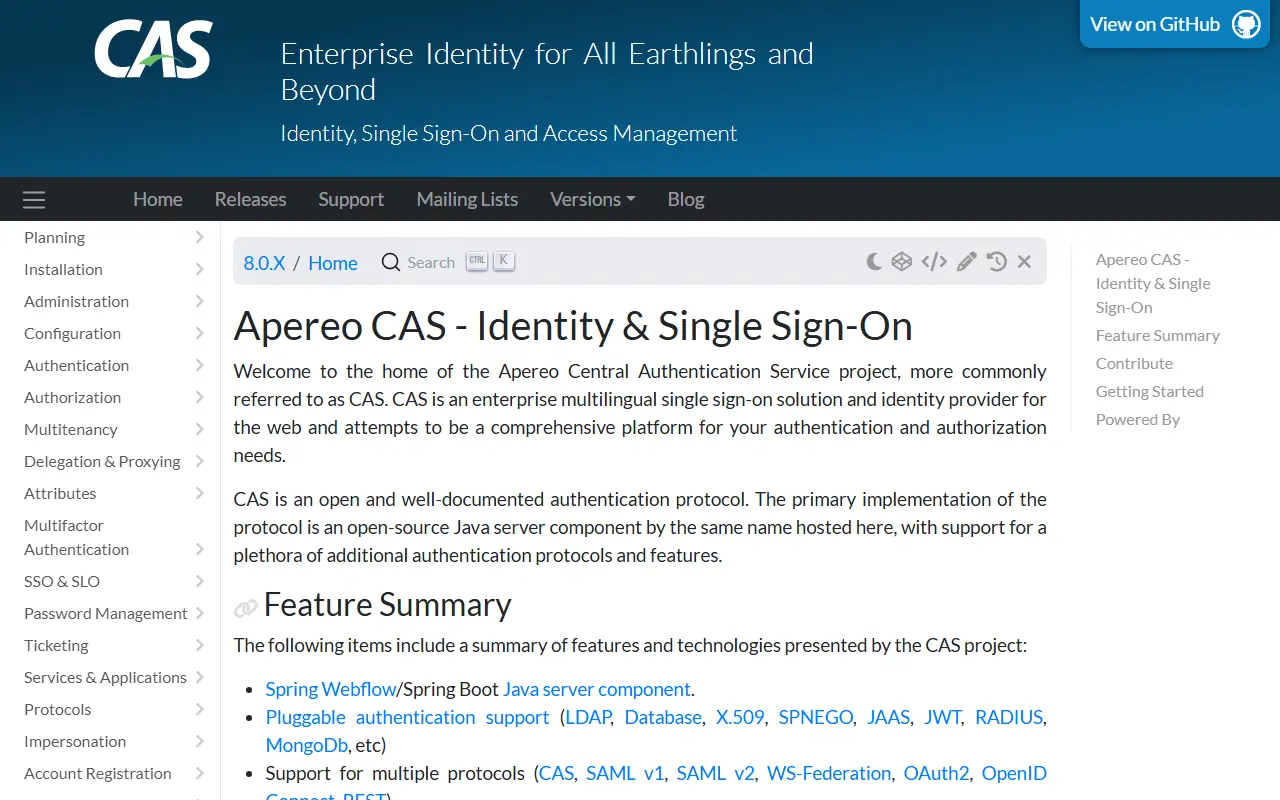
This entry covers Apereo CAS, the Central Authentication Service. CAS is both an open and well-documented authentication protocol and the primary open-source Java server implementing it, which works as a multilingual, enterprise-grade identity provider and web single sign-on solution.
Beyond its own protocol, the server supports additional authentication protocols and features, including SAML2, OpenID Connect, OAuth2, LDAP authentication and multifactor authentication, with topics also referencing FIDO and Duo Security. It is built on Spring Boot, Spring Webflow and Spring Cloud, and aims to be a comprehensive platform for authentication and authorization needs.
Apereo CAS is licensed under Apache-2.0. The recommended way to deploy it is the WAR Overlay method, and cloning the full codebase is only needed if you want to contribute. Documentation, release notes, a maintenance policy and a release schedule are published by the project. It is typically adopted by universities and other organizations that need centralized login across many applications.
Key features
- Single sign-on for web applications
- CAS protocol server
- SAML2 and OpenID Connect support
- OAuth2 and LDAP authentication
- Multifactor authentication including FIDO
- Spring Boot based Java server
- WAR overlay deployment method
Pricing: Free and open source under the Apache-2.0 licence.
#5
An open-source authentication and user management service built around passkeys, with MFA, social login, SAML SSO and web components, self-hosted or on Hanko Cloud.
- GitHub stars
- 9.1k
- Last commit
- today
- Latest release
- backend/v3.1.0
- Self-hosted
- Yes
- Hosted version
- Available
hanko.io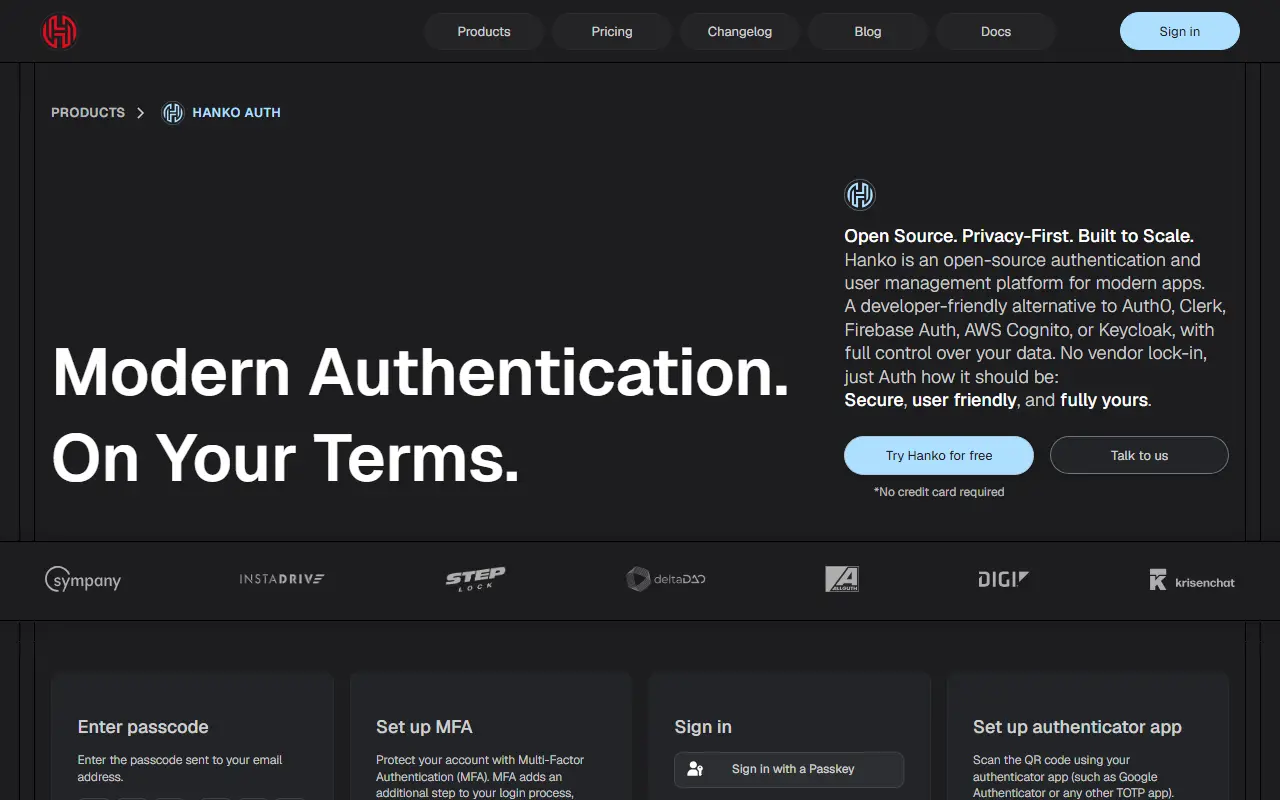
Hanko is an authentication and user management solution released as open source, framework-agnostic and designed around privacy-first principles such as data minimalism and phishing resistance. It is presented as an alternative to Auth0, Clerk, WorkOS and Stytch, written in Go, with an API-first and lightweight design.
It supports modern sign-in methods including passwords, email passcodes, passkeys, MFA with TOTP and security keys, social logins such as Apple, Google and GitHub, custom OIDC and OAuth connections and SAML enterprise SSO. Configuration is flexible, for example passkey-only or OAuth-only setups, and passwords can be deletable by users. Hanko Elements web components make integration quick, a JS SDK is available, webhooks and server-side sessions with remote revocation are included, and a full API supports custom front ends. Organizations, roles and permissions plus mobile SDKs are on the roadmap.
You can self-host Hanko or use it as a fully managed service on Hanko Cloud. The repository lists the licence as Other, so review the licence file for the terms. It suits developers who want to own their authentication stack without building it from scratch.
Key features
- Passkeys, passwords and email passcodes
- MFA with TOTP and security keys
- Social login and custom OIDC connections
- SAML enterprise SSO
- Hanko Elements web components
- Webhooks and server-side sessions
- JS SDK and API-first design
Pricing: Free Starter plan covers 10,000 monthly active users. Pro is $29 per month plus $0.01 per user above 10,000; Enterprise is custom. The code is open source for self-hosting.
#6
A user infrastructure platform that handles authentication, teams, RBAC, API keys, payments, emails and analytics for apps, with a dashboard and optional deployment hosting.
- GitHub stars
- 6.9k
- Last commit
- yesterday
- Latest release
- dashboard-v1.0.137
- Self-hosted
- Yes
- Hosted version
- Available
hexclave.com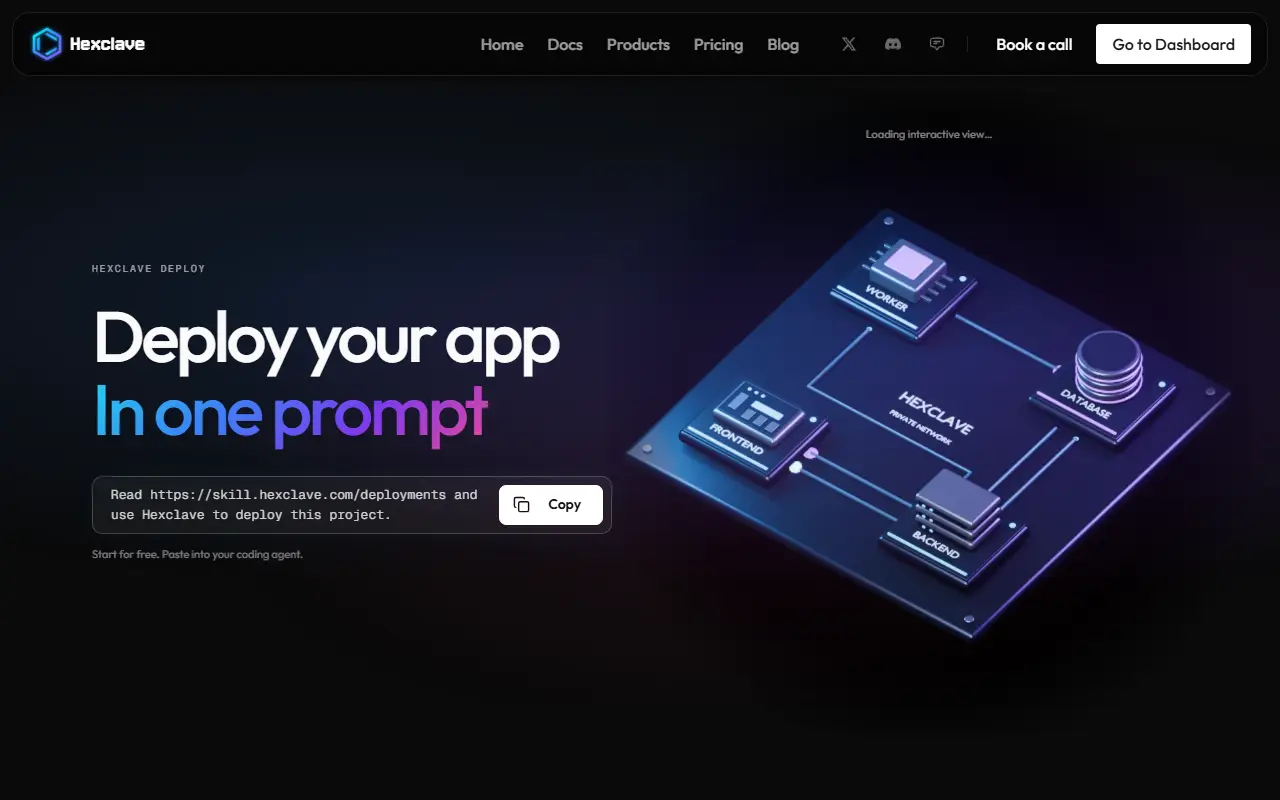
Hexclave positions itself as infrastructure for the user side of an app: you pick the frontend, backend and database, and it manages everything around your users. That covers authentication, teams, permissions, API keys, payments, emails and analytics, packaged as a catalog of modules that you enable when your product needs them, all sharing one user model.
Authentication supports passkeys, OAuth and CLI auth, with methods toggled from the dashboard without code changes. Teams add workspaces, email invites and roles, while RBAC provides nested roles and a single permission check usable on server or client. API keys are auto-revoked if leaked and show their secret only once. Payments cover subscriptions, single charges and credit-based usage metering for individuals or teams, and emails cover transactional and marketing sends with an AI template editor.
Setup is designed around pasting one prompt into a coding agent, and a Hexclave Deploy offering can deploy the frontend, backend and database together. The code is TypeScript with Next.js, topics mention self-hosting and alternatives such as Auth0, Clerk, Supabase and PostHog, and the repository lists the licence as Other, so review the licence terms.
Key features
- Passkey, OAuth and CLI authentication
- Teams, workspaces and email invites
- Nested roles with RBAC checks
- API keys with auto-revocation of leaks
- Subscriptions, one-time payments and usage credits
- Transactional and marketing emails
- Product analytics for user activity
Pricing: Free forever plan for up to 10,000 auth users, and free self-hosting. Team is $49 per month and Growth $299 per month, with extra dashboard admins at $29 each.
#7
SimpleSAMLphp is a PHP authentication application that acts as a SAML 2.0 service provider or identity provider and supports CAS, OpenID Connect and OAuth.
- GitHub stars
- 1.1k
- Last commit
- 2 days ago
- Latest release
- v2.5.4
- Licence
- LGPL-2.1
- Self-hosted
- Yes
simplesamlphp.org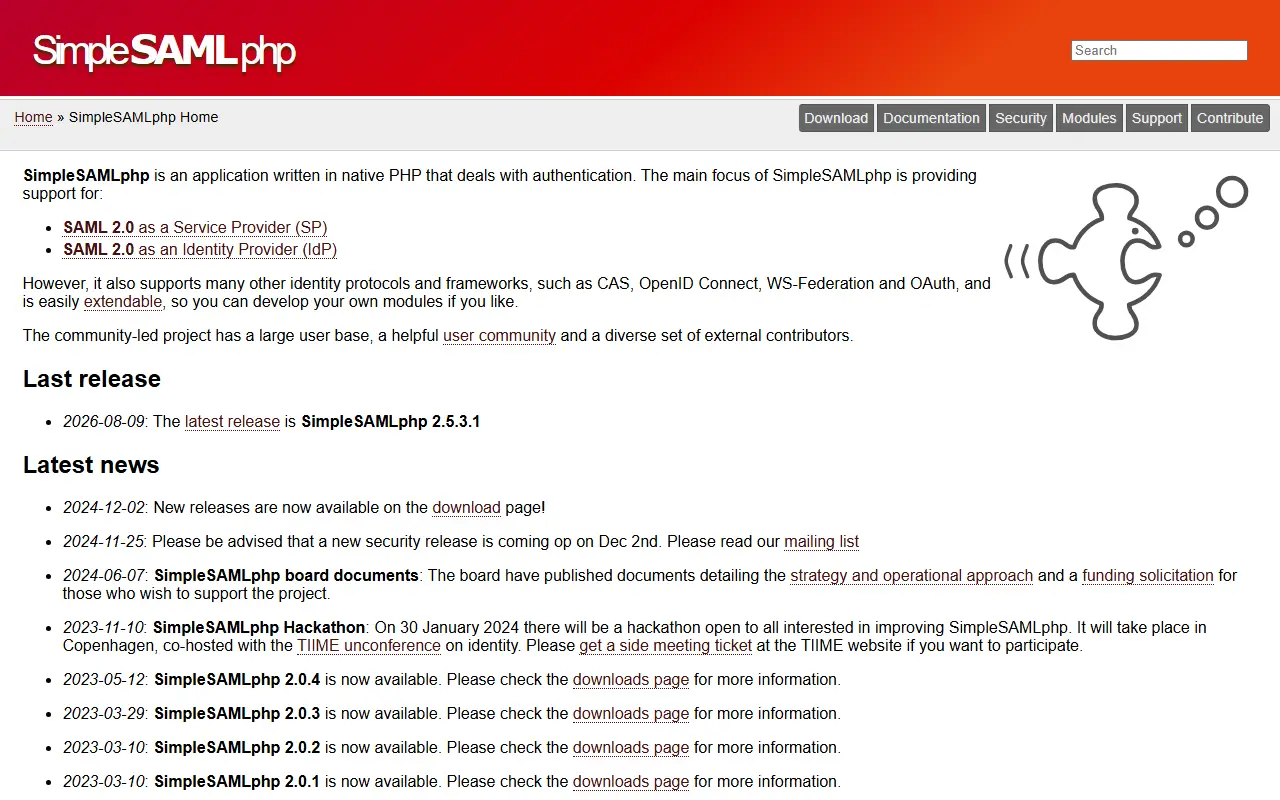
SimpleSAMLphp is an application written in native PHP that deals with authentication. Its main focus is SAML 2.0, where it can act either as a service provider that protects a web application or as an identity provider that authenticates users, which makes it common in universities and organizations using federated login.
It also supports other identity protocols and frameworks including CAS, OpenID Connect, WS-Federation and OAuth, and it is easy to extend with custom modules. The project site offers downloads, documentation, security announcements, modules and support, and the community-led project publishes regular releases, with security releases announced on its mailing list in advance.
SimpleSAMLphp is licensed under LGPL-2.1 and installed on your own PHP web server, so it is self-hosted. The project is run by a board and community of contributors. It suits developers and identity administrators who need to connect PHP applications to a SAML federation or run a lightweight identity provider.
Key features
- SAML 2.0 service provider
- SAML 2.0 identity provider
- CAS, OpenID Connect, and WS-Federation support
- OAuth support
- Extensible through modules
- Regular releases with security announcements
Pricing: Free and open source under the LGPL-2.1 licence.
#8
SSOReady is an open-source toolkit for adding SAML single sign-on and SCIM directory sync to a product, with SDKs in several languages.
- GitHub stars
- 1.5k
- Last commit
- 1 yr ago
- Licence
- MIT
- Self-hosted
- Yes
- Hosted version
- Available
SSOReady helps software vendors support enterprise SSO. It covers SAML for single sign-on, SCIM for directory sync, and a self-serve setup UI that customers use to onboard themselves onto SAML or SCIM. The README says most teams implement SAML and SCIM in an afternoon.
It works as an authentication middleware layer and does not own your users or require changes to your user database. Language SDKs wrap a plain HTTP API, and exist for TypeScript, Python, Go, Java, C, Ruby and PHP. In the SAML flow you redirect to SSOReady, then redeem a SAML access code at your own callback endpoint.
You can use the cloud-hosted instance or self-host it. The Enterprise plan adds custom domains and branding, a management API and SLA'd support, including for self-hosted deployments. The software is MIT licensed, which the authors present as protection against future price rises.
Key features
- SAML support for enterprise SSO
- SCIM directory sync
- Self-serve setup UI for customers
- SDKs over a plain HTTP API
- Custom domains and branding on Enterprise
- Management API on Enterprise
WorkOS alternatives: questions
- What is the best open-source alternative to WorkOS?
- Keycloak is the top-ranked open-source alternative to WorkOS on Enlisted: Keycloak is an open-source identity and access management server that adds single sign-on, user management and authorization to applications. Other strong options are ZITADEL, Logto, Apereo CAS and Hanko.
- What are the best commercial alternatives to WorkOS?
- Descope, Scalekit, Kinde, Frontegg and PropelAuth are among the hosted, closed-source alternatives to WorkOS listed on Enlisted, which lists 28 in total. Compare their pricing and features on each tool page.
- Are these WorkOS alternatives free?
- All 8 are open source, so the code is free to use under its licence, and all of them can be self-hosted on your own server or computer. 5 also offer a paid or managed cloud version if you'd rather not host it yourself.
- How is this list of WorkOS alternatives ranked?
- By a score built from GitHub stars, star growth over the last 30 days and how recently the code changed. 7 of these projects shipped code in the last 30 days. Data is refreshed daily, and nobody can pay to move up.
 TrackMedia
 TrackRev