7,380 open-source and SaaS tools, with GitHub stats refreshed every day.

5 alternatives ranked by real activity

Open-source UI Bakery alternatives

A curated, ranked list of the 5 best open-source alternatives to UI Bakery.

The best open-source alternative to UI Bakery is Appsmith. If that doesn't suit you, other good options are ToolJet, Motor Admin, Openblocks and DashPress.

UI Bakery alternatives are mainly low-code & internal tools. 2 of them shipped code in the last 30 days, 5 can be self-hosted, and 2 use a permissive licence.

Last updated October 2, 2026 · ranked by GitHub stars, growth and recent commits

Appsmith

An open-source low-code platform for building admin panels, internal tools and dashboards that connect to more than 25 databases and any API.

GitHub stars
41k
Last commit
today
Latest release
v2.4.3
Licence
Apache-2.0
Self-hosted
Yes
Hosted version
Available
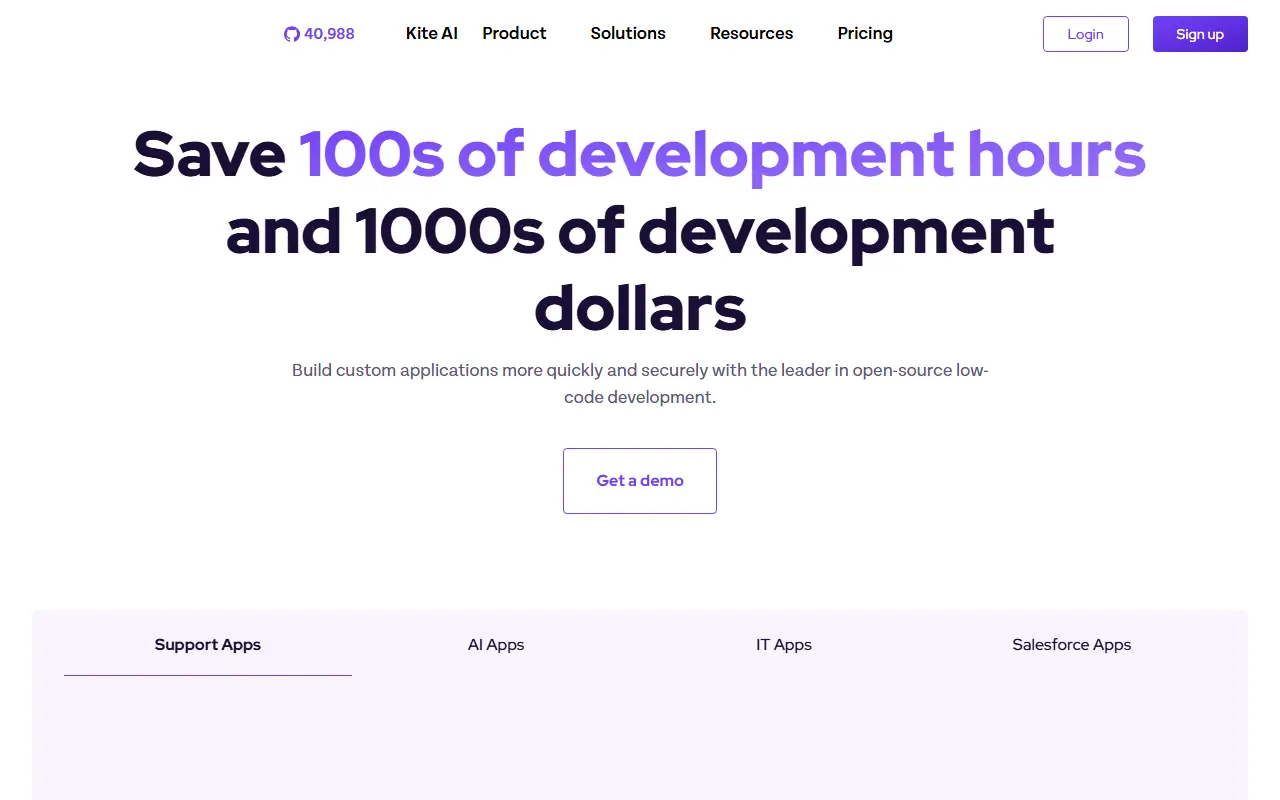
appsmith.comAppsmith homepage screenshot

Appsmith is an open-source low-code platform for building custom internal applications such as dashboards, admin panels, customer 360 views, IT automation and service management tools. It aims to simplify building, deploying and maintaining these apps, which otherwise tend to be tedious to code from scratch.

You assemble interfaces visually and connect them to data through integrations with more than 25 databases and any REST or GraphQL API, with JavaScript available where you need custom logic. Topics also point to CRUD generation, workflows and automation. The front end is built with React and TypeScript, and the server side is mostly Java.

You can sign up for Appsmith Cloud or install it on your own machine, with Docker as the recommended method, plus Kubernetes and an AWS AMI. The code is Apache-2.0 licensed. It is a common choice for engineering teams that want to ship internal tools quickly without maintaining a bespoke front-end codebase.

Key features

  • Visual builder for internal tools
  • Integrates with 25+ databases and any API
  • JavaScript for custom logic
  • Admin panels, dashboards and CRUD apps
  • Docker, Kubernetes and AWS AMI installation
  • Cloud or self-hosted deployment

Pricing: Free for up to 5 cloud users. Business is $15 per user per month with a 15-day trial; Enterprise is listed at $2,500 per month for 100 users. The open-source Community edition is free.

ToolJet

An open-source platform for building internal tools, dashboards and workflows visually or from prompts, with an MCP server so coding agents can build apps.

GitHub stars
41k
Last commit
today
Latest release
v3.20.237-lts
Licence
AGPL-3.0
Self-hosted
Yes
Hosted version
Available
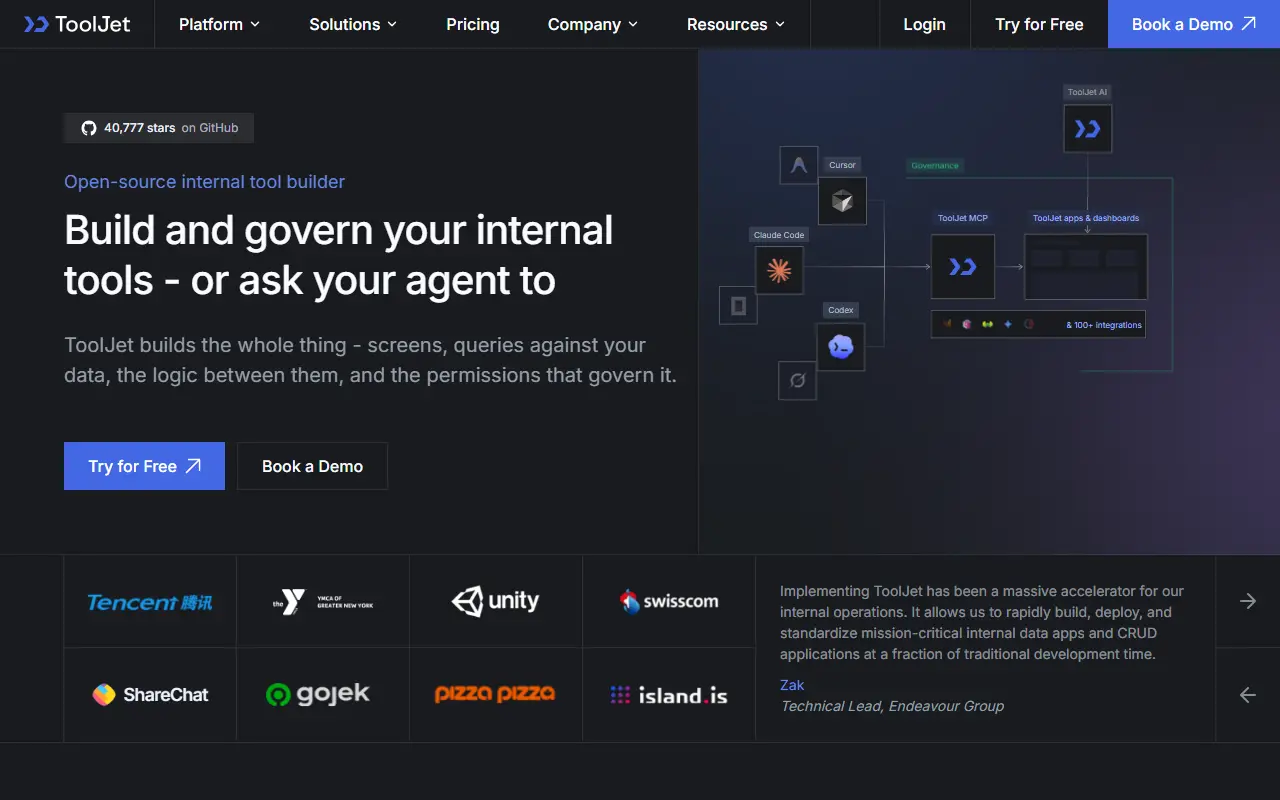
tooljet.comToolJet homepage screenshot

ToolJet is an open-source platform for creating internal software, including admin panels, dashboards and operational apps that sit on top of your existing databases, APIs and SaaS systems. Apps are assembled visually in a builder, so teams can ship tools without writing a full front end.

AI plays a large role. ToolJet AI turns a text description into pages, queries and components, and a Model Context Protocol server lets coding agents such as Claude Code and Codex build and modify ToolJet apps directly. Agents work against the platform's real component and data contracts, so the output is an ordinary ToolJet app that the team can keep editing in the visual builder with the same permissions, environments and version history. Workflows and AI agents are part of the offering.

You can self-host ToolJet or use ToolJet Cloud, and the open-source foundation is AGPL-3.0 licensed with a JavaScript and TypeScript codebase. It targets teams that need internal software quickly and want an open-source option with a managed alternative.

Key features

  • Visual builder for internal tools and dashboards
  • AI generation of pages, queries and components
  • MCP server for coding agents
  • Permissions, environments and version history
  • Workflows and AI agents
  • Self-hosted or ToolJet Cloud

Pricing: A free plan covers 2 builders. Paid plans are priced per builder per month: Basic $29, Pro $99 and Team $249 on monthly billing, with 20% off annually; Enterprise is custom.

Motor Admin

Rails engine that adds a low-code admin panel and SQL-based business intelligence, configured from a settings UI rather than code.

GitHub stars
839
Last commit
8 mo ago
Latest release
0.4.27
Licence
MIT
Self-hosted
Yes

Motor Admin is a Rails engine that provides a low-code admin panel and business intelligence tools for a Rails application. Everything can be configured from a settings interface with no DSL, and it is presented as a modern alternative to Rails Admin, Active Admin and Blazer. It is aimed at Rails teams who want internal tools and dashboards quickly without hand-coding screens.

Features include customizable CRUD, custom actions through Active Record method calls or API endpoints, virtual attributes, a forms builder, SQL queries with embedded variables, data visualization and dashboards, email alerts, authorization, Active Storage support, search, internationalization, a mobile-friendly layout, configuration sync between environments, authentication, multiple databases, audit logs, collaboration notes and personalized report alerts via Slack. Resource pages can show data from SQL queries and attached dashboards.

The engine is installed by adding a gem and running a migration. The core is MIT licensed, and a Pro edition adds white-label styling and logos, multi-factor authentication and SSO or SAML. A demo app is available for trying it out.

Key features

  • Admin panel configured from a settings UI
  • SQL queries, charts and dashboards
  • Custom actions and virtual attributes
  • Forms builder
  • Email and Slack alerts
  • Audit log and authorization
  • Pro: white label, MFA and SSO

Pricing: Core engine is free under MIT. A Pro edition adds white labeling, multi-factor authentication and SSO or SAML; see the vendor for pricing.

Openblocks

Openblocks is an AGPL-licensed, open-source internal tools builder positioned as an alternative to Retool, with a visual UI builder and native database connections.

GitHub stars
6.2k
Last commit
2 yr ago
Latest release
v1.1.8
Licence
AGPL-3.0
Self-hosted
Yes
Hosted version
Available

Openblocks is an open-source platform for building internal and customer-facing applications, positioned as an alternative to Retool. It targets teams that need to connect to data sources and assemble working apps quickly without designing a custom interface and wiring together multiple languages and frameworks from scratch.

It provides a visual UI builder with more than 50 components, a module and query library for reusable pieces, and native connections to PostgreSQL, MongoDB, MySQL, Redis, Elasticsearch, REST APIs and SMTP, with JavaScript usable throughout for transforming data and controlling components. Custom components can be shared through React and the Openblocks SDK, or whole Openblocks pages can be embedded as a React component. Team features include role-based access control, autosaved and restorable version history, DIY app theming, and audit logs for compliance tracking.

Openblocks is written in TypeScript and React and is released under the AGPL-3.0 license, so it can be self-hosted. A cloud-hosted version is also available at cloud.openblocks.dev. The README includes direct feature comparisons against other low-code tools in its space.

Key features

  • Visual UI builder with 50-plus components
  • Native connections to Postgres, MongoDB, MySQL and more
  • Reusable module and query library
  • Role-based access control
  • Version history with autosave
  • Audit logs for compliance

Pricing: Free and open source under the AGPL-3.0 license, self-hostable; a cloud-hosted version is also available.

DashPress

DashPress is a free, AGPL-licensed, open-source admin app generator that turns an existing database schema into a customizable admin dashboard without writing code.

GitHub stars
1.9k
Last commit
1 yr ago
Licence
AGPL-3.0
Self-hosted
Yes

DashPress is an admin app generator aimed at developers who want to produce a working admin dashboard from an existing database schema quickly, without hand-coding CRUD screens for every table. It transforms the schema directly into a sleek, customizable and performant admin interface.

It can be run instantly with a single npx dashpress command, pointing it at an existing database to generate the admin app, with a Docker-based setup also available through an example Dockerfile in the repository. A public demo at demo.dashpress.io shows an example admin app generated this way without writing a line of code.

DashPress is written in TypeScript with Node.js and React, and is released under the GNU Affero General Public License v3.0, so self-hosted deployments remain subject to that copyleft license. The README states the project follows good security practices but offers no warranty, and provides a community Discord, Twitter and GitHub Discussions for support.

Key features

  • Generates an admin dashboard from a database schema
  • No-code setup via a single CLI command
  • Docker deployment option
  • Customizable, performant admin UI
  • React and Node.js based architecture

Pricing: Free and open source under the AGPL-3.0 license.

UI Bakery alternatives: questions

What is the best open-source alternative to UI Bakery?
Appsmith is the top-ranked open-source alternative to UI Bakery on Enlisted: An open-source low-code platform for building admin panels, internal tools and dashboards that connect to more than 25 databases and any API. Other strong options are ToolJet, Motor Admin, Openblocks and DashPress.
Are these UI Bakery alternatives free?
All 5 are open source, so the code is free to use under its licence, and all of them can be self-hosted on your own server or computer. 3 also offer a paid or managed cloud version if you'd rather not host it yourself.
How is this list of UI Bakery alternatives ranked?
By a score built from GitHub stars, star growth over the last 30 days and how recently the code changed. 2 of these projects shipped code in the last 30 days. Data is refreshed daily, and nobody can pay to move up.

People also look for alternatives to…

View all