7 open-source alternatives ranked by real activity

Open-source Torq alternatives

A curated, ranked list of the 7 best open-source alternatives to Torq.

The best open-source alternative to Torq is Wazuh. If that doesn't suit you, other good options are OpenCTI, Kibana, MISP and Tracecat.

Commercial alternatives to Torq include Swimlane, Tines, Prisma Access and Rapid7. See all 13.

Torq alternatives are mainly security tools, but some are also monitoring & observability tools and workflow automation tools. 7 of them shipped code in the last 30 days, 7 can be self-hosted, and 2 use a permissive licence.

Last updated November 13, 2026 · ranked by GitHub stars, growth and recent commits

Wazuh

Wazuh is a free, open-source security platform combining XDR and SIEM capabilities for endpoints, servers and cloud workloads.

GitHub stars
18k
Last commit
yesterday
Latest release
v4.14.10
Self-hosted
Yes
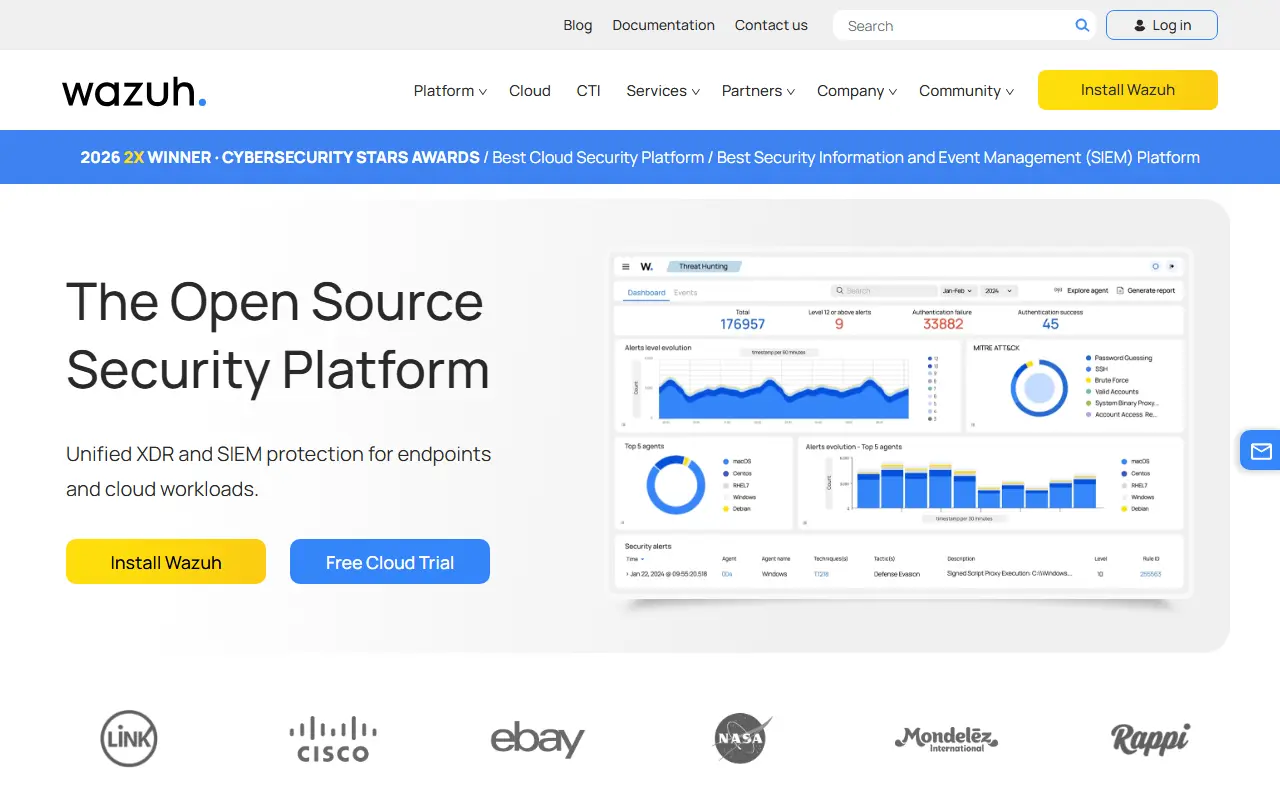
wazuh.comWazuh homepage screenshot

Wazuh is a free and open-source platform for threat prevention, detection and response. It protects workloads across on-premises, virtualized, containerized and cloud environments and combines XDR and SIEM functions in one product. The code is written mainly in C++.

The solution consists of an endpoint security agent installed on monitored systems and a management server that collects and analyzes the agents' data. It is integrated with the Wazuh Indexer, which offers a search engine and visualization for navigating security alerts. Agents scan for malware, rootkits and suspicious anomalies, read system and application logs, and monitor files for changes to content, permissions, ownership and attributes.

Rule-based analysis of collected logs, including data received from network devices through syslog, helps surface misconfigurations, policy violations and attempted or successful attacks. Repository topics also cover vulnerability detection, configuration assessment, incident response and compliance such as PCI DSS. The repository lists its license as 'Other', so review the license files for the exact terms.

Key features

  • Endpoint agents with a central management server
  • Intrusion and malware detection
  • Log data analysis with rule-based alerts
  • File integrity monitoring
  • Vulnerability detection and configuration assessment
  • Cloud and container workload coverage

OpenCTI

Open-source cyber threat intelligence platform for storing, structuring and visualizing threat knowledge on a STIX2-based schema.

GitHub stars
10k
Last commit
yesterday
Latest release
7.261109.0
Self-hosted
Yes
opencti.ioOpenCTI homepage screenshot

OpenCTI is an open source platform for managing cyber threat intelligence knowledge and observables. It structures, stores, organizes and visualizes technical and non-technical information about cyber threats, using a knowledge schema based on the STIX2 standards. It is designed and developed by the company Filigran.

The platform is a web application with a GraphQL API and a frontend focused on user experience. Each piece of information can be linked to its primary source, such as a report or a MISP event, with first and last seen dates and levels of confidence. Relations can be inferred from existing ones, and data can be exported as CSV or STIX2 bundles.

OpenCTI has a Community Edition under Apache 2.0 and an Enterprise Edition under a separate license, which can be enabled in the platform settings. Installation options are Docker, a manual install, and community-maintained Terraform and Helm charts. A public demo instance is reset every night.

Key features

  • Structures and visualizes threat information
  • Knowledge schema based on STIX2
  • GraphQL API and web frontend
  • Integrates with MISP, TheHive and MITRE ATT&CK
  • Links each fact to its primary source
  • Infers new relations from existing ones
  • Exports to CSV and STIX2 bundles

Kibana

Kibana is the web interface for querying, visualizing and managing data stored in Elasticsearch, used for dashboards, observability and analytics.

GitHub stars
21k
Last commit
yesterday
Latest release
v9.5.6
Self-hosted
Yes
Hosted version
Available
elastic.coKibana homepage screenshot

Kibana is the user interface that sits on top of Elasticsearch. It lets people query, analyze, visualize and manage the data stored there, turning indexes into charts, metrics views and dashboards. It is part of the Elastic Stack and is commonly used for log analysis, observability and general analytics work.

Teams build visualizations and assemble them into shared dashboards, explore documents with search, and use the interface to manage parts of an Elasticsearch deployment. The project advises running Kibana and Elasticsearch at the same version, with major versions required to match, because mismatches can cause problems and support may ask for an upgrade first.

The code is written in TypeScript. The repository lists its license as 'Other' rather than a standard SPDX identifier, so the license files should be read for the exact terms. Kibana can be downloaded and run on your own infrastructure, and Elastic also offers a hosted version through its Cloud service.

Key features

  • Query and explore Elasticsearch data
  • Visualizations and metrics charts
  • Shared dashboards for monitoring
  • Observability views for logs and metrics
  • Management tools for Elasticsearch data
  • Hosted option through Elastic Cloud

MISP

MISP is an open-source threat intelligence platform for collecting, storing and sharing cyber security indicators between analysts and security teams.

GitHub stars
6.7k
Last commit
2 days ago
Latest release
v2.5.51
Licence
AGPL-3.0
Self-hosted
Yes
Hosted version
Available
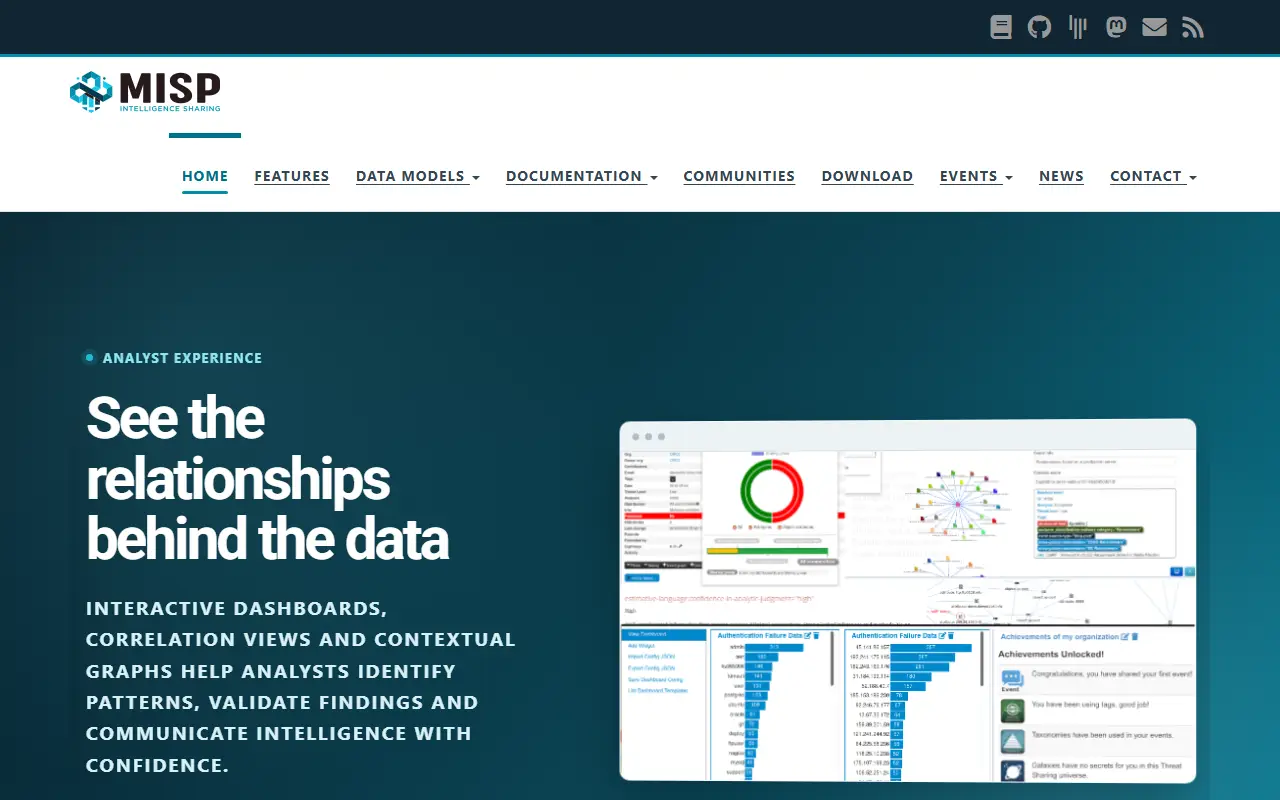
misp-project.orgMISP homepage screenshot

MISP is open-source software for gathering, storing, distributing and sharing cyber security indicators and details from incident and malware analysis. It is aimed at incident analysts, security and ICT staff and malware reverse engineers, who use it to exchange structured information efficiently.

Beyond sharing, MISP supports the consumption of that information by network intrusion detection systems, log analysis tools and SIEMs. Threat intelligence from indicators through techniques to tactics can be described in a machine-readable form or as detailed reports in Markdown, and the integrated reporting system cross-references the structured data. Repository topics point to STIX, threat hunting and fraud detection use cases.

The core software is written in PHP and licensed under AGPL-3.0. The README says it can be deployed on premises, in the cloud or as a SaaS solution, so organizations of different sizes can run their own instance and choose which partners to share data with. Installation guides, documentation and a support site are linked from the repository.

Key features

  • Collect and store threat indicators
  • Share structured intelligence with communities
  • Machine-readable and Markdown reports
  • Export to IDS, log analysis tools and SIEMs
  • STIX-related threat intelligence formats
  • On-premise, cloud or SaaS deployment

Pricing: Free and open source under the AGPL-3.0 licence.

Tracecat

Tracecat is a security automation platform, open source, in which security teams and AI agents build workflows, handle cases and automate incident response.

GitHub stars
3.9k
Last commit
today
Latest release
1.4.0
Licence
AGPL-3.0
Self-hosted
Yes
Hosted version
Available
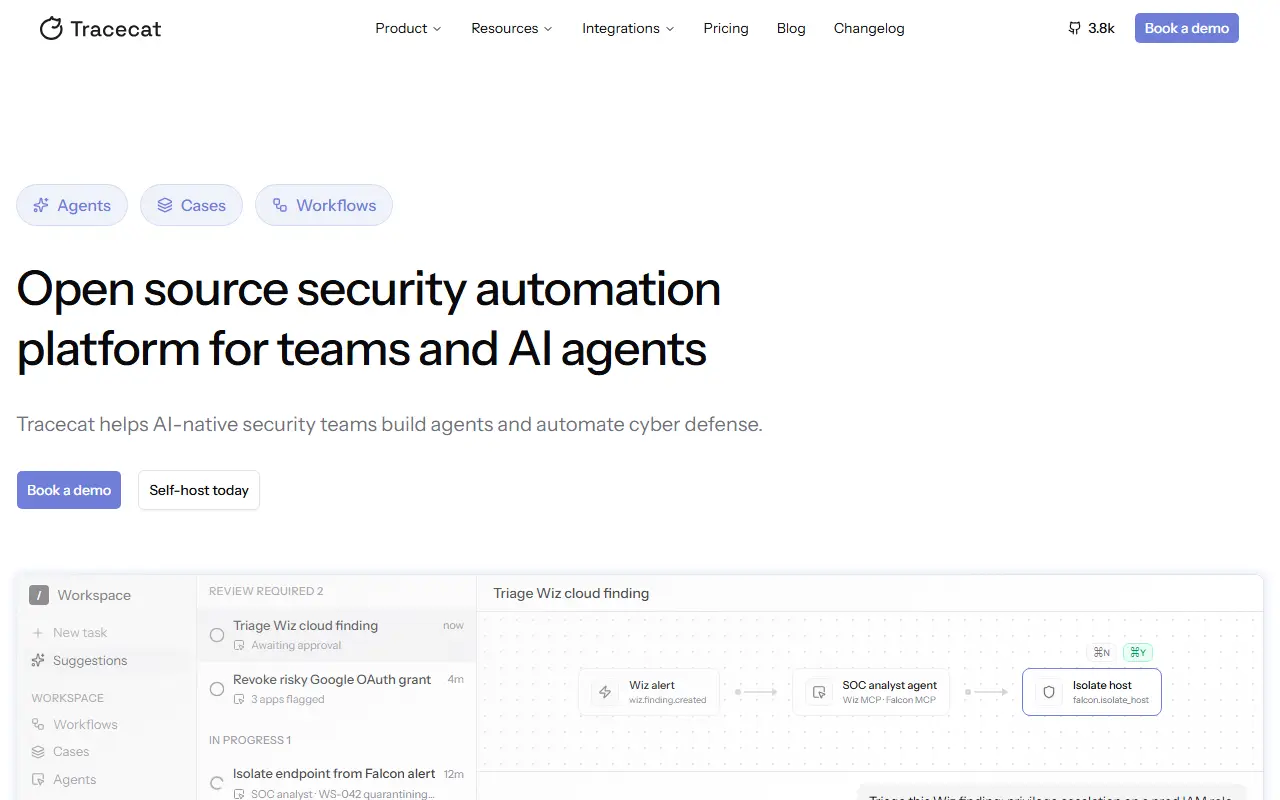
tracecat.comTracecat homepage screenshot

Tracecat is open-source software for automating security operations, used by teams and AI agents together. It aims to give security teams everything they need to build agents and automate cyber defense in one place, from alert handling to incident response, with unlimited agents, cases, lookup tables and workflows.

Its building blocks include agents and skills built from prompts, tools and MCP, case management for tracking and resolving incidents with agent help, workflows that execute deterministic logic with resilience on Temporal, tables for storing and querying structured data, and a Tracecat MCP that turns prompts into automations from Claude Code, Codex and similar tools. The stack is Python with FastAPI and a Next.js interface.

Tracecat is licensed under AGPL-3.0 and can be self-hosted, with a managed cloud also offered by the vendor. It suits security operations, detection engineering and incident response teams that want a programmable, AI-ready alternative to proprietary SOAR tools.

Key features

  • AI agents with prompts, tools and MCP
  • Case management for incidents
  • Workflows running on Temporal
  • Tables for structured data lookups
  • Tracecat MCP for prompt-driven automation
  • Unlimited agents, cases and workflows

Pricing: The open-source edition is free to self-host with no execution limits. Enterprise is priced by quote and scales with usage, deployment model and support needs.

StackStorm

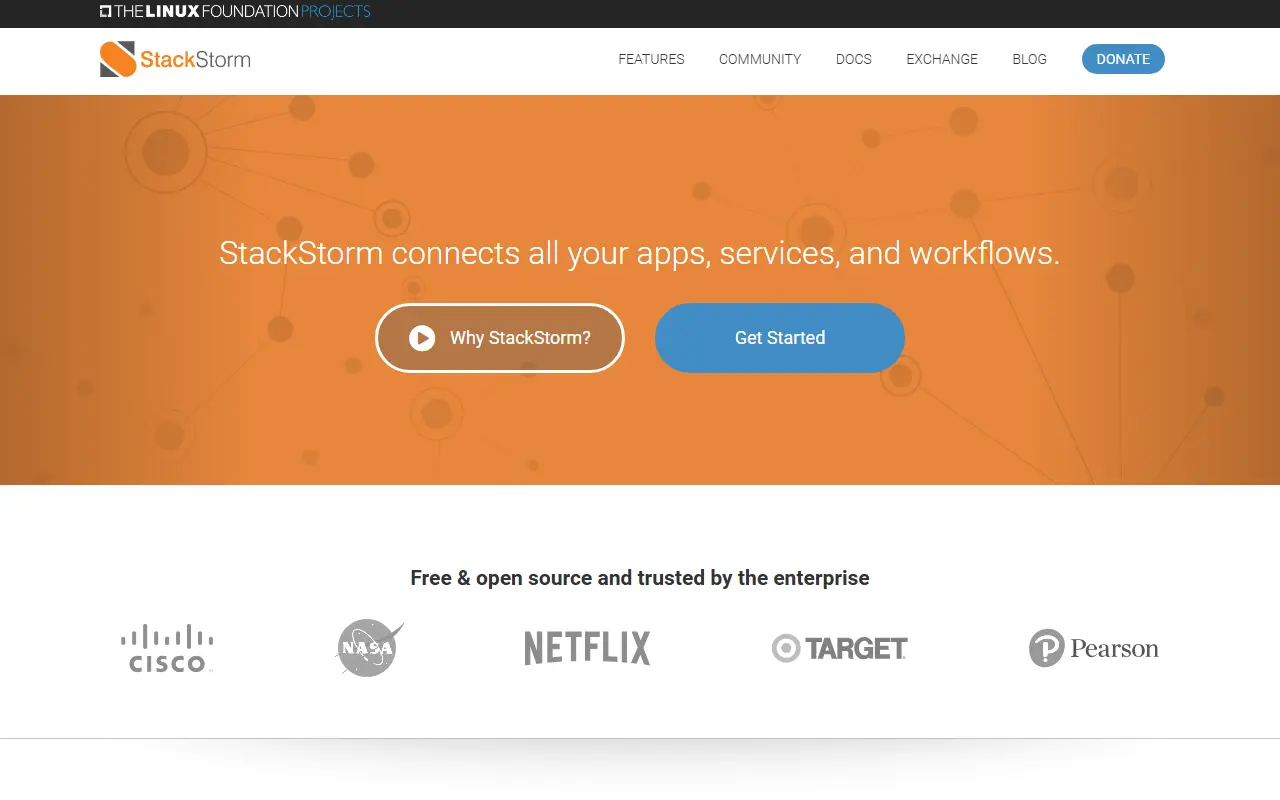
StackStorm is an event-driven automation platform for DevOps and SRE teams, covering auto-remediation, incident response, deployments and ChatOps.

GitHub stars
6.6k
Last commit
14 days ago
Latest release
v3.9.0
Licence
Apache-2.0
Self-hosted
Yes
stackstorm.comStackStorm homepage screenshot

StackStorm is an open-source platform that connects the tools in your infrastructure and runs automated actions when events occur. Nicknamed 'IFTTT for Ops', it targets DevOps and site reliability teams who want to automate remediation, incident response, troubleshooting and deployments instead of handling every alert by hand.

It combines a rules engine that matches incoming events, workflows that chain several actions together, and ChatOps so operators can trigger and follow automation from chat. A catalog of integration packs, about 160 according to the project description, supplies more than 6,000 ready-made actions for common tools, and you can add your own. The project provides an installer script for a clean 64-bit Linux server.

StackStorm is Apache-2.0 licensed software that you run on your own Linux hosts. It suits operations teams building event-driven runbooks who prefer to self-host, and community help is available through a forum and a Slack group.

Key features

  • Event-driven rules engine
  • Multi-step workflows across tools
  • Triggering automation from chat via ChatOps
  • Integration packs with thousands of actions
  • Auto-remediation and incident response runbooks
  • Custom actions written in Python or shell

Pricing: Free and open source under the Apache-2.0 license.

Cortex

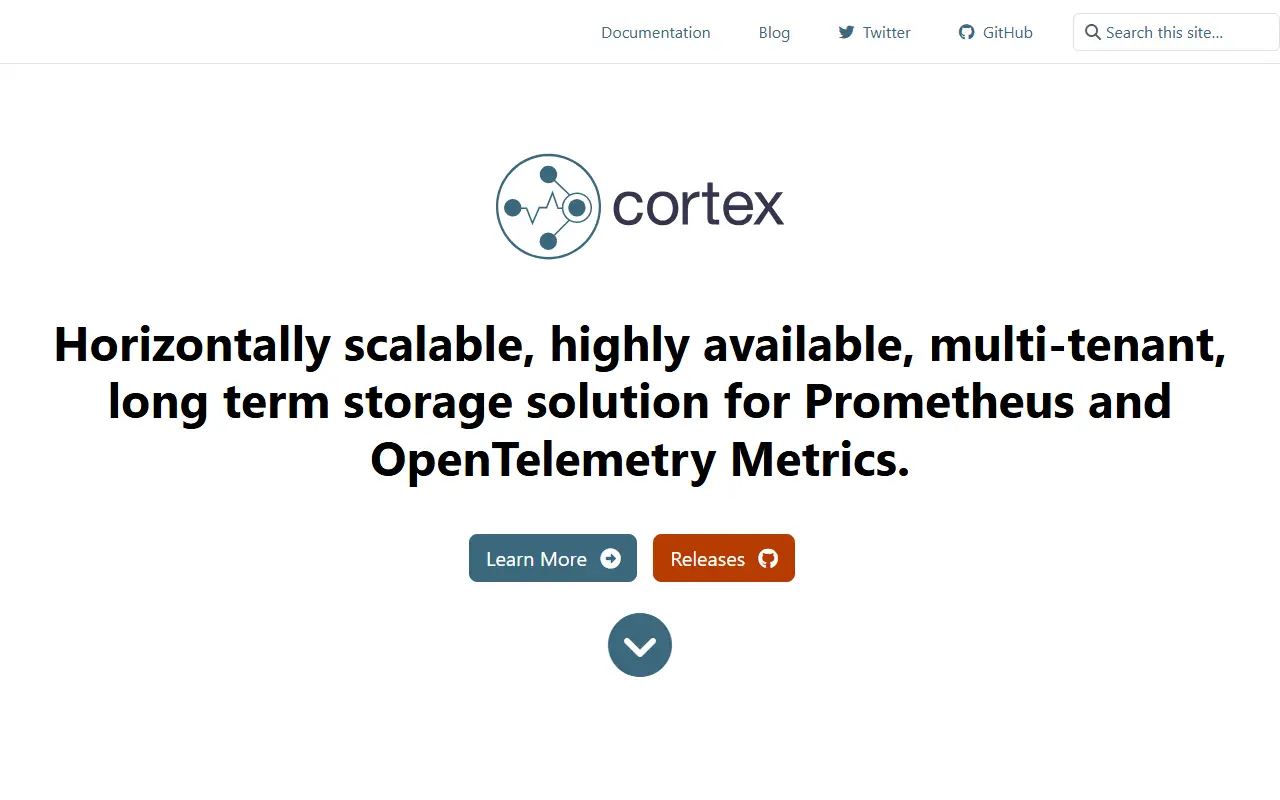
Cortex is a horizontally scalable, multi-tenant, long-term storage backend for Prometheus and OpenTelemetry metrics, written in Go.

GitHub stars
5.9k
Last commit
today
Latest release
v1.21.1
Licence
Apache-2.0
Self-hosted
Yes
cortexmetrics.ioCortex homepage screenshot

Cortex is a storage and query layer for metrics that extends Prometheus beyond what a single server can handle. It runs as a cluster spread over several machines, which lets it go past the throughput and storage limits of a single node, and it replicates data between machines when run as a cluster so metrics remain available if a node fails.

A key feature is multi-tenancy: Cortex isolates data and queries from several independent Prometheus sources within a single cluster. It supports long-term storage of metric data on S3, GCS, Swift and Microsoft Azure object storage, and handles both Prometheus and OpenTelemetry metrics. The project is a CNCF project, and its documentation covers architecture, configuration, guides and security.

Cortex is licensed under Apache-2.0 and is run by you, typically on Kubernetes. It suits platform teams and service providers that need shared, durable, scalable metrics storage for many teams or customers.

Key features

  • Horizontally scalable metrics storage
  • Replication for high availability
  • Multi-tenant data and query isolation
  • Long-term storage on S3, GCS, Swift and Azure
  • Prometheus and OpenTelemetry metrics support
  • Runs on Kubernetes clusters

Pricing: Free and open source under the Apache-2.0 license.

Commercial Torq alternatives

Hosted, closed-source products that compete with Torq. Showing 12 of 13.

See every Torq alternative on its tool page

Torq alternatives: questions

What is the best open-source alternative to Torq?
Wazuh is the top-ranked open-source alternative to Torq on Enlisted: Wazuh is a free, open-source security platform combining XDR and SIEM capabilities for endpoints, servers and cloud workloads. Other strong options are OpenCTI, Kibana, MISP and Tracecat.
What are the best commercial alternatives to Torq?
Swimlane, Tines, Prisma Access, Rapid7 and Splunk Observability Cloud are among the hosted, closed-source alternatives to Torq listed on Enlisted, which lists 13 in total. Compare their pricing and features on each tool page.
Are these Torq alternatives free?
All 7 are open source, so the code is free to use under its licence, and all of them can be self-hosted on your own server or computer. 3 also offer a paid or managed cloud version if you'd rather not host it yourself.
How is this list of Torq alternatives ranked?
By a score built from GitHub stars, star growth over the last 30 days and how recently the code changed. 7 of these projects shipped code in the last 30 days. Data is refreshed daily, and nobody can pay to move up.

People also look for alternatives to…

View all