7 open-source alternatives ranked by real activity

Open-source Sophos alternatives

A curated, ranked list of the 7 best open-source alternatives to Sophos.

The best open-source alternative to Sophos is Wazuh. If that doesn't suit you, other good options are ClamAV, Suricata, OPNsense and Security Onion.

Commercial alternatives to Sophos include CrowdStrike, Trend Micro, SentinelOne and Huntress. See all 28.

Sophos alternatives are mainly security tools. 6 of them shipped code in the last 30 days, 7 can be self-hosted, and 2 use a permissive licence.

Last updated November 13, 2026 · ranked by GitHub stars, growth and recent commits

Wazuh

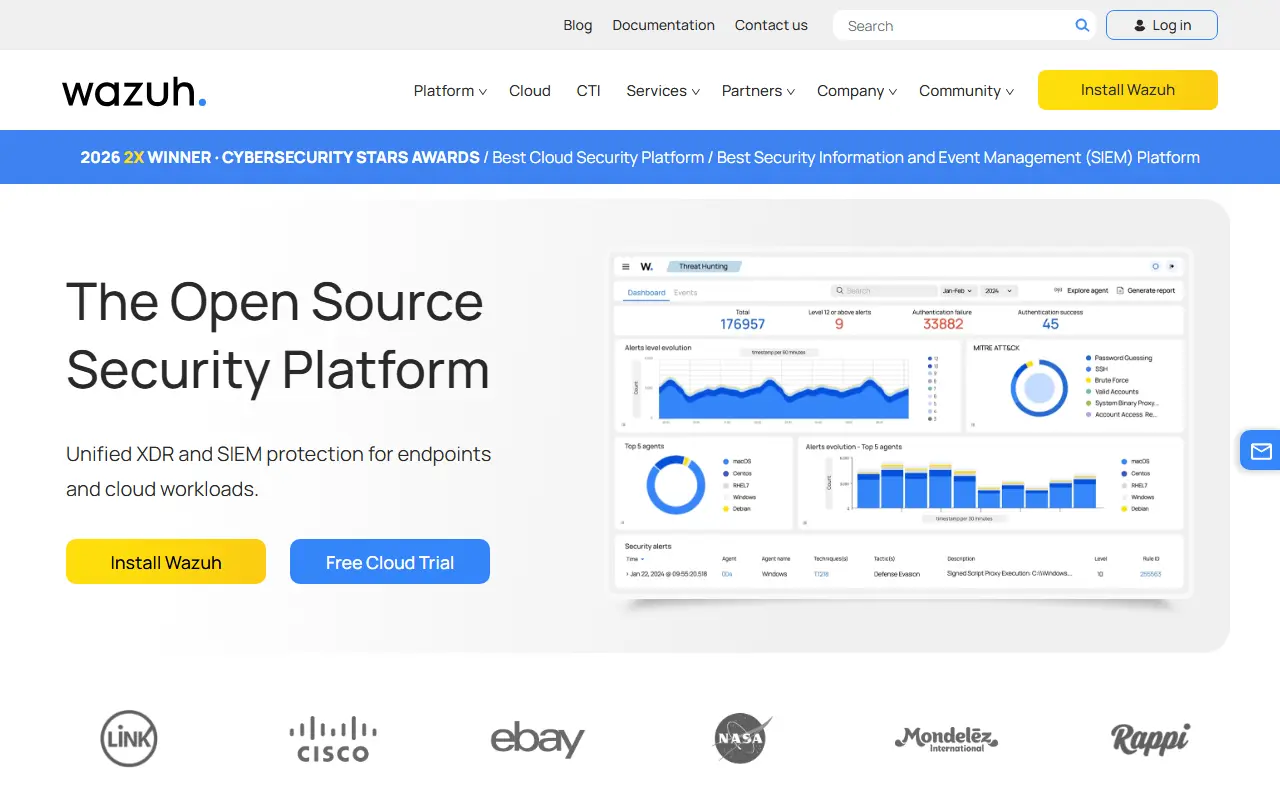
Wazuh is a free, open-source security platform combining XDR and SIEM capabilities for endpoints, servers and cloud workloads.

GitHub stars
18k
Last commit
yesterday
Latest release
v4.14.10
Self-hosted
Yes
wazuh.comWazuh homepage screenshot

Wazuh is a free and open-source platform for threat prevention, detection and response. It protects workloads across on-premises, virtualized, containerized and cloud environments and combines XDR and SIEM functions in one product. The code is written mainly in C++.

The solution consists of an endpoint security agent installed on monitored systems and a management server that collects and analyzes the agents' data. It is integrated with the Wazuh Indexer, which offers a search engine and visualization for navigating security alerts. Agents scan for malware, rootkits and suspicious anomalies, read system and application logs, and monitor files for changes to content, permissions, ownership and attributes.

Rule-based analysis of collected logs, including data received from network devices through syslog, helps surface misconfigurations, policy violations and attempted or successful attacks. Repository topics also cover vulnerability detection, configuration assessment, incident response and compliance such as PCI DSS. The repository lists its license as 'Other', so review the license files for the exact terms.

Key features

  • Endpoint agents with a central management server
  • Intrusion and malware detection
  • Log data analysis with rule-based alerts
  • File integrity monitoring
  • Vulnerability detection and configuration assessment
  • Cloud and container workload coverage

ClamAV

ClamAV is an open-source antivirus engine for detecting trojans, viruses and other malware, maintained by Cisco Talos.

GitHub stars
7.5k
Last commit
7 days ago
Latest release
clamav-1.5.4
Licence
GPL-2.0
Self-hosted
Yes
clamav.netClamAV homepage screenshot

ClamAV is an open-source antivirus engine that detects trojans, viruses, malware and other malicious threats. It is written in C, released under GPL-2.0 and developed by Cisco Talos. It is used as an engine that other tools and servers can build on, for example scanning files or mail attachments, rather than as a polished desktop product.

Documentation and an FAQ are hosted at docs.clamav.net, and each release archive includes an offline copy. The project explains how to read and write ClamAV signatures through a signature writing manual, so anyone can create detection rules. News, release notes and a blog track new features, and documentation contributions go through a separate repository.

Installation options include official Docker images, distribution package managers, and downloadable installers: Debian and RPM packages for Linux, a universal PKG for macOS and MSI or portable ZIP packages for Windows. It can also be built from source for Unix, Linux, Mac and Windows. Upgrade notes describe moving from earlier versions.

Key features

  • Open-source antivirus scanning engine
  • Detects trojans, viruses and other malware
  • Signature format with a writing manual
  • Docker images and distro packages
  • Installers for Linux, macOS and Windows
  • Offline copy of documentation in each release

Pricing: Free and open source under the GPL-2.0 license.

Suricata

Suricata is an open-source network intrusion detection, intrusion prevention and network security monitoring engine developed by OISF and its community.

GitHub stars
6.9k
Last commit
2 days ago
Latest release
suricata-8.0.8
Licence
GPL-2.0
Self-hosted
Yes
suricata.ioSuricata homepage screenshot

Suricata is an engine for network intrusion detection (IDS), intrusion prevention (IPS) and network security monitoring (NSM), developed by the Open Information Security Foundation and the Suricata community. It inspects network traffic to detect threats, can block them when run inline as an intrusion prevention system, and supports network security monitoring and threat hunting.

The README stresses why the software is built so carefully. It processes mostly untrusted input and often sits directly reachable by an attacker, so a crash in IPS mode could knock a network offline, a compromise in passive mode could expose confidential data, and missed detections could hide an intrusion. For that reason contributions go through a long QA process that includes GitHub CI checks, peer review and private QA runs with build tests, static analysis, runtime analysis with valgrind and sanitizers, and regression tests.

Suricata is written in C and licensed under GPL-2.0. The project provides a user guide, an installation guide, a developer guide, a bug tracker and a user support forum for administrators who deploy it on their own networks.

Key features

  • Network intrusion detection (IDS)
  • Inline intrusion prevention (IPS)
  • Network security monitoring
  • Extensive QA and regression testing
  • User, installation and developer guides

Pricing: Free and open source under the GPL-2.0 licence.

OPNsense

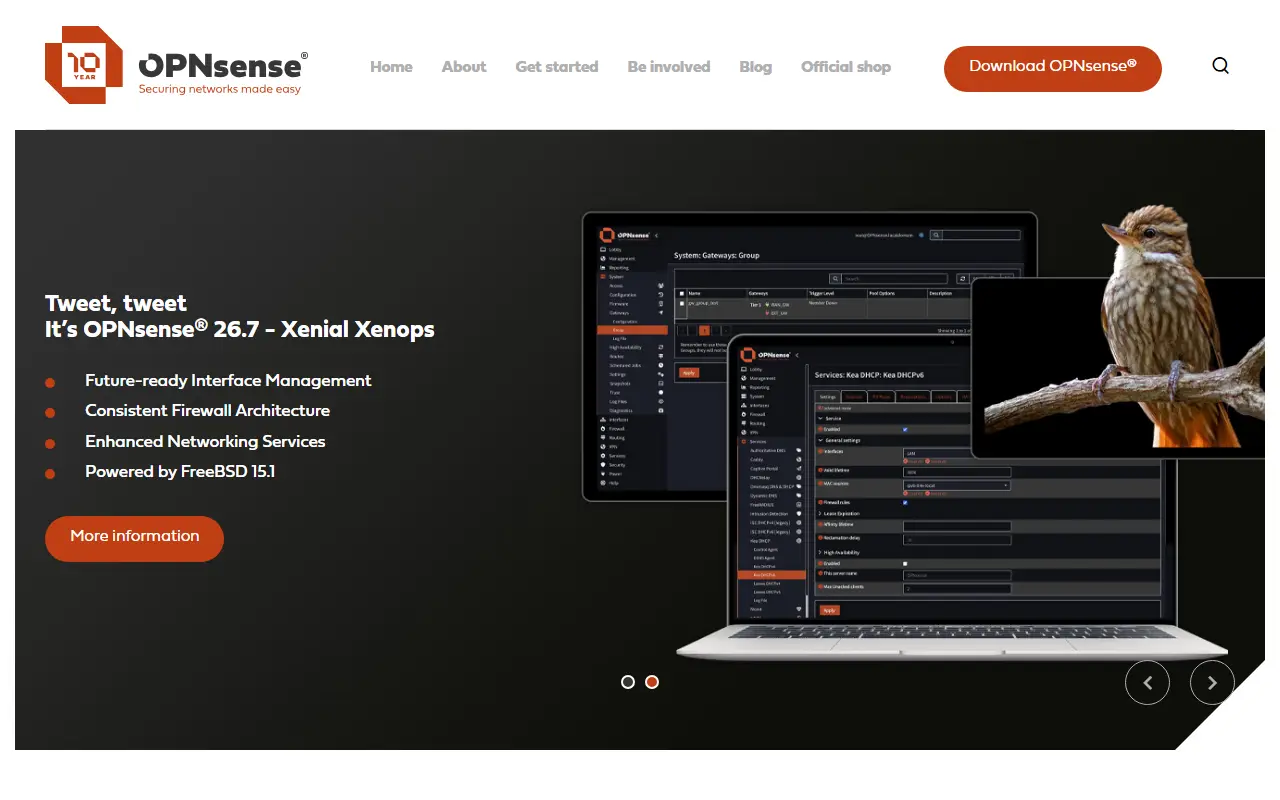
An open-source firewall and routing platform; this repository holds its web GUI, API and system backend, licensed under BSD-2-Clause.

GitHub stars
4.8k
Last commit
yesterday
Licence
BSD-2-Clause
Self-hosted
Yes
opnsense.orgOPNsense homepage screenshot

OPNsense is an open-source firewall project, and this repository contains its web GUI, API and systems backend. Its topics point to a broad feature set that includes a firewall, intrusion prevention, proxy, VPN, traffic shaping, a captive portal and routing, built on a BSD base.

The project invites developers to contribute and has designed its build process so that anyone can build and write code. Build tools are freely available in a separate tools repository, an architecture overview is on docs.opnsense.org, and the repository offers Makefile targets such as make package for assembling a package from the current state of the code. The team aims to evolve toward a new codebase gradually rather than in one big switch.

OPNsense is written mostly in PHP and is committed to staying available under the 2-clause BSD license, with every contribution required to carry the same terms. Contributions can be as simple as testing functionality, filing bug reports or sending pull requests.

Key features

  • Web GUI for firewall management
  • API and system backend
  • Intrusion prevention and proxy
  • VPN and traffic shaping
  • Captive portal and routing
  • BSD-based platform

Pricing: Free and open source under the BSD-2-Clause licence.

Security Onion

Security Onion is a free Linux platform for threat hunting, network and host security monitoring and log management, with a unified web console.

GitHub stars
5k
Last commit
today
Latest release
3.4.0-20261102
Self-hosted
Yes
securityonion.netSecurity Onion homepage screenshot

Security Onion is a no-cost, open Linux distribution built for threat hunting, security monitoring across an enterprise, and log management. It bundles a suite of tools designed to work together so defenders get visibility into both network and host activity from a single platform.

The Security Onion Console is a unified web interface for analyzing events and managing the deployment, with its own tools for alerting, dashboards, hunting, packet capture, detections and case management. Underneath it uses the Elastic Stack for search, Suricata for network intrusion detection, Elastic Fleet for host monitoring, Zeek for network metadata and other tools such as osquery and CyberChef. The installer and configuration are largely shell scripts.

The repository license appears as 'Other' on GitHub. Security Onion is deployed on your own hardware or virtual machines, either standalone or as a distributed grid. It suits security operations centers, incident responders and blue teams that want an integrated, open alternative to commercial monitoring platforms.

Key features

  • Unified Security Onion Console web interface
  • Network intrusion detection with Suricata
  • Network metadata from Zeek
  • Elastic Stack search and dashboards
  • Case management and threat hunting
  • Packet capture and detections

OSSEC

An open-source host-based intrusion detection system that combines log analysis, file integrity checking, rootkit detection, real-time alerting and active response.

GitHub stars
5.1k
Last commit
yesterday
Latest release
4.4.1
Licence
GPL-2.0
Self-hosted
Yes
ossec.netOSSEC homepage screenshot

OSSEC is a host-based intrusion detection system (HIDS) that watches individual servers and endpoints for signs of compromise. Its README describes it as a platform that brings together HIDS, log monitoring and SIM/SIEM capabilities in one open-source package.

The project's description lists log analysis, file integrity checking, policy monitoring, rootkit detection, real-time alerting and active response. Those capabilities support compliance work as well as detection, and the repository's topics refer to PCI DSS and NIST 800-53. Stable releases and documentation are published on ossec.net, with community help on Slack and Discord.

OSSEC is written in C and licensed under GPL-2.0. It bundles a modified zlib and a small part of OpenSSL, along with the cJSON library. Atomicorp hosts the annual OSSEC conference, and the development version is available through a simple git clone.

Key features

  • Host-based intrusion detection
  • Log analysis and monitoring
  • File integrity monitoring
  • Policy monitoring
  • Rootkit detection
  • Real-time alerting and active response

Pricing: Free and open source under the GPL-2.0 licence.

pfSense

Free firewall and router distribution based on FreeBSD, managed through a web interface and extendable with packages.

GitHub stars
5.8k
Last commit
7 mo ago
Licence
Apache-2.0
Self-hosted
Yes
pfsense.orgpfSense homepage screenshot

pfSense is a network firewall distribution built on the FreeBSD operating system. It uses a custom kernel and bundles third-party free software to cover routing and security tasks. The project began in 2004 as a fork of the m0n0wall project and has since diverged significantly.

All components are configured through a web interface, so the project says no UNIX knowledge or command-line work is needed and rule sets never have to be edited by hand. A package system adds functionality, and the project states that with packages it can match or exceed the functionality of common commercial firewalls, without artificial limits. It lists products from Check Point, Cisco, Juniper, Sonicwall, Netgear and Watchguard among those it has replaced.

pfSense is copyright Rubicon Communications (Netgate) and published under an open source license, listed as Apache-2.0 on GitHub. Netgate sells bundled hardware appliances and commercial support, which is the main way the team funds development. Administrators used to commercial firewalls may find the interface familiar, though others face a learning curve.

Key features

  • FreeBSD-based firewall and router distribution
  • Web interface for all configuration tasks
  • Package system for extra functionality
  • No command-line work required for setup
  • Hardware appliances and commercial support available

Pricing: Free open-source software; Netgate sells bundled hardware appliances and commercial support.

Commercial Sophos alternatives

Hosted, closed-source products that compete with Sophos. Showing 12 of 28.

See every Sophos alternative on its tool page

Sophos alternatives: questions

What is the best open-source alternative to Sophos?
Wazuh is the top-ranked open-source alternative to Sophos on Enlisted: Wazuh is a free, open-source security platform combining XDR and SIEM capabilities for endpoints, servers and cloud workloads. Other strong options are ClamAV, Suricata, OPNsense and Security Onion.
What are the best commercial alternatives to Sophos?
CrowdStrike, Trend Micro, SentinelOne, Huntress and Fortinet are among the hosted, closed-source alternatives to Sophos listed on Enlisted, which lists 28 in total. Compare their pricing and features on each tool page.
Are these Sophos alternatives free?
All 7 are open source, so the code is free to use under its licence, and all of them can be self-hosted on your own server or computer.
How is this list of Sophos alternatives ranked?
By a score built from GitHub stars, star growth over the last 30 days and how recently the code changed. 6 of these projects shipped code in the last 30 days. Data is refreshed daily, and nobody can pay to move up.

People also look for alternatives to…

View all