7,363 open-source and SaaS tools, with GitHub stats refreshed every day.

5 alternatives ranked by real activity

Open-source Signiant alternatives

A curated, ranked list of the 5 best open-source alternatives to Signiant.

The best open-source alternative to Signiant is croc. If that doesn't suit you, other good options are Magic Wormhole, SFTPGo, Safebucket and LinShare.

Signiant alternatives are mainly file storage & sharing tools. 5 of them shipped code in the last 30 days, 5 can be self-hosted, and 3 use a permissive licence.

Last updated October 3, 2026 · ranked by GitHub stars, growth and recent commits

croc

A cross-platform command line tool for sending files and folders between any two computers with end-to-end encryption, resumable transfers and no port forwarding.

GitHub stars
40k
Last commit
yesterday
Latest release
v11.5.4
Licence
MIT
Self-hosted
Yes
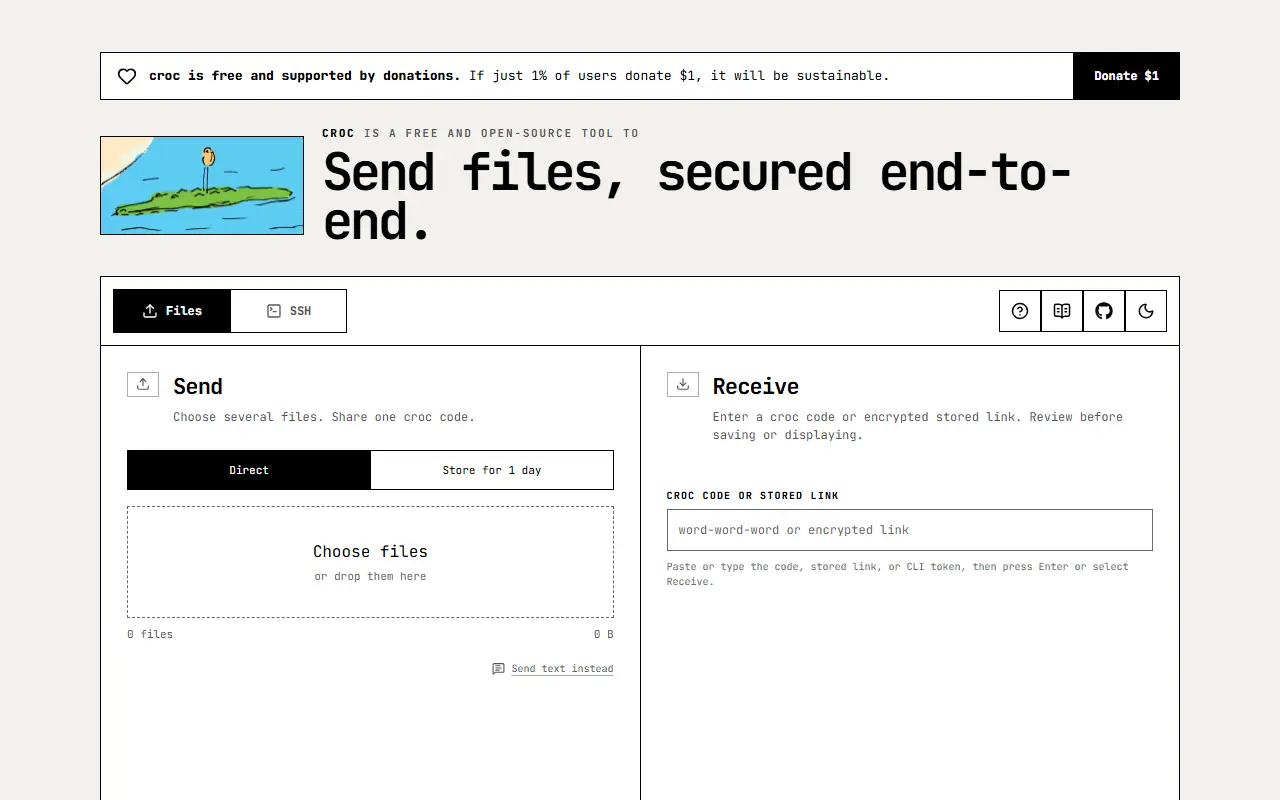
getcroc.comcroc homepage screenshot

croc is a command line tool for transferring files and folders between any two computers. The sender gets a short code phrase, the receiver types it in, and the data moves directly between them where possible, falling back to a relay when a direct connection is not available. It is written in Go and runs on Windows, Linux and macOS.

Transfers are end-to-end encrypted using a password-authenticated key exchange, so the relay cannot read your files. Other capabilities include sending multiple files at once, resuming transfers that were interrupted, IPv6-first networking with IPv4 fallback, and routing through a proxy such as Tor. You do not need to set up a local server or forward ports. A browser version at getcroc.com is compatible with the command line client, so you can send and receive between them without installing anything.

croc is MIT licensed and can be installed from a release download or the command line. The maintainer notes that the project relies on community sponsorship. It suits anyone who regularly needs to move files between machines without cloud storage or accounts.

Key features

  • Code phrase pairing for transfers
  • End-to-end encryption using PAKE
  • Peer-to-peer with relay fallback
  • Resumable transfers and multiple files
  • No server setup or port forwarding
  • Browser version compatible with the CLI

Pricing: Free and open source under the MIT license.

Magic Wormhole

Magic Wormhole is a Python library and command-line tool for safely sending files, folders or text between two computers using short codes.

GitHub stars
23k
Last commit
9 days ago
Licence
MIT
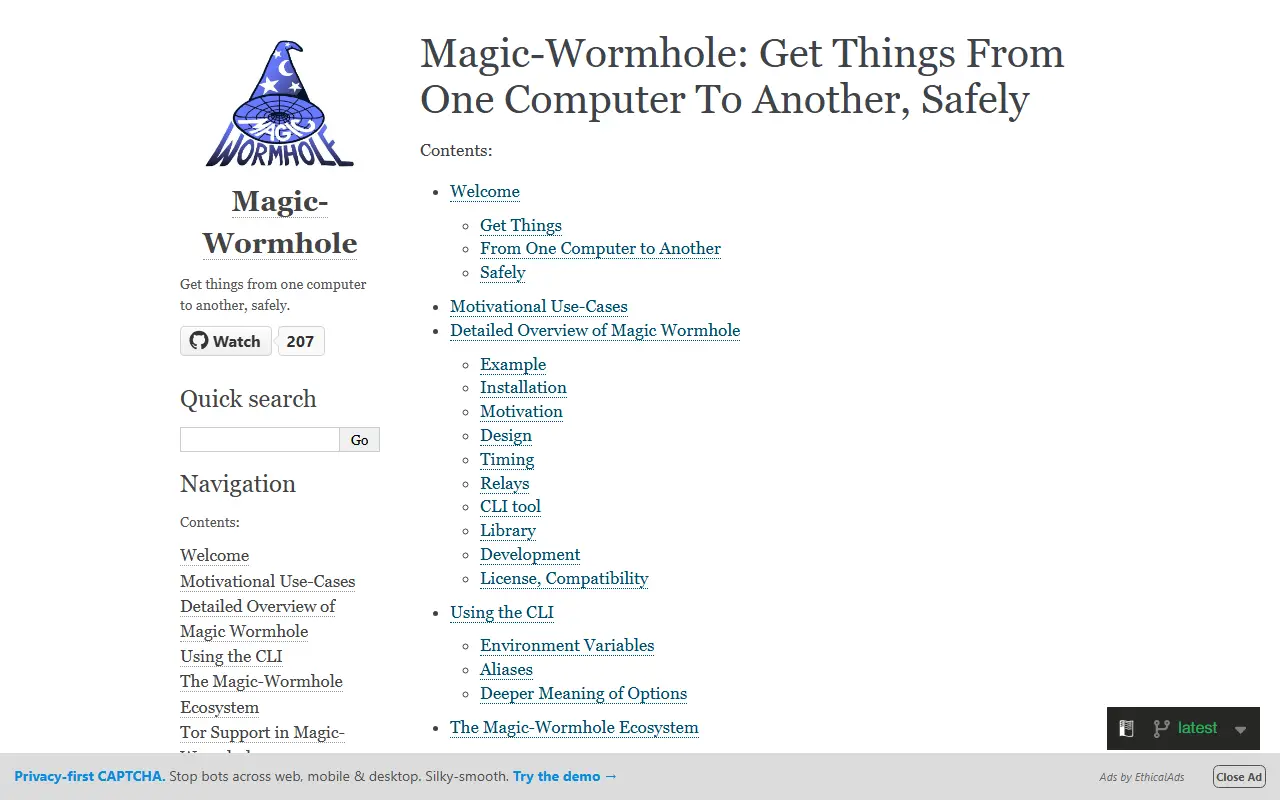
magic-wormhole.readthedocs.ioMagic Wormhole homepage screenshot

Magic Wormhole is a Python package that provides a library and a command-line tool named wormhole. It moves files and directories of any size, or brief snippets of text, between two computers. The two ends are matched by an identical wormhole code: the sending machine generates and shows it, and the receiving person types it in. It is released under the MIT license.

Codes are short, single-use and human-pronounceable, drawn from a phonetically distinct word list, and the receiving side offers tab completion so usually only a few characters are needed. Nothing has to be memorized. The program relies on two servers, a mailbox server and a transit relay, whose source code lives in separate repositories. The library works with Python 3.10 and newer, packages exist in many operating systems, and complete documentation is on Read the Docs along with a PyCon 2016 talk.

Key features

  • Send files, folders or text between computers
  • Short single-use pronounceable codes
  • Tab completion for entering codes
  • Python library and wormhole CLI
  • Mailbox server and transit relay components
  • Packaged for many operating systems

Pricing: Free and open source under the MIT license.
SFTPGo

Event-driven file transfer server speaking SFTP, FTP/S, HTTP/S and WebDAV, with local, S3, Google Cloud and Azure storage backends.

GitHub stars
13k
Last commit
7 days ago
Latest release
v2.7.6
Licence
AGPL-3.0
Self-hosted
Yes
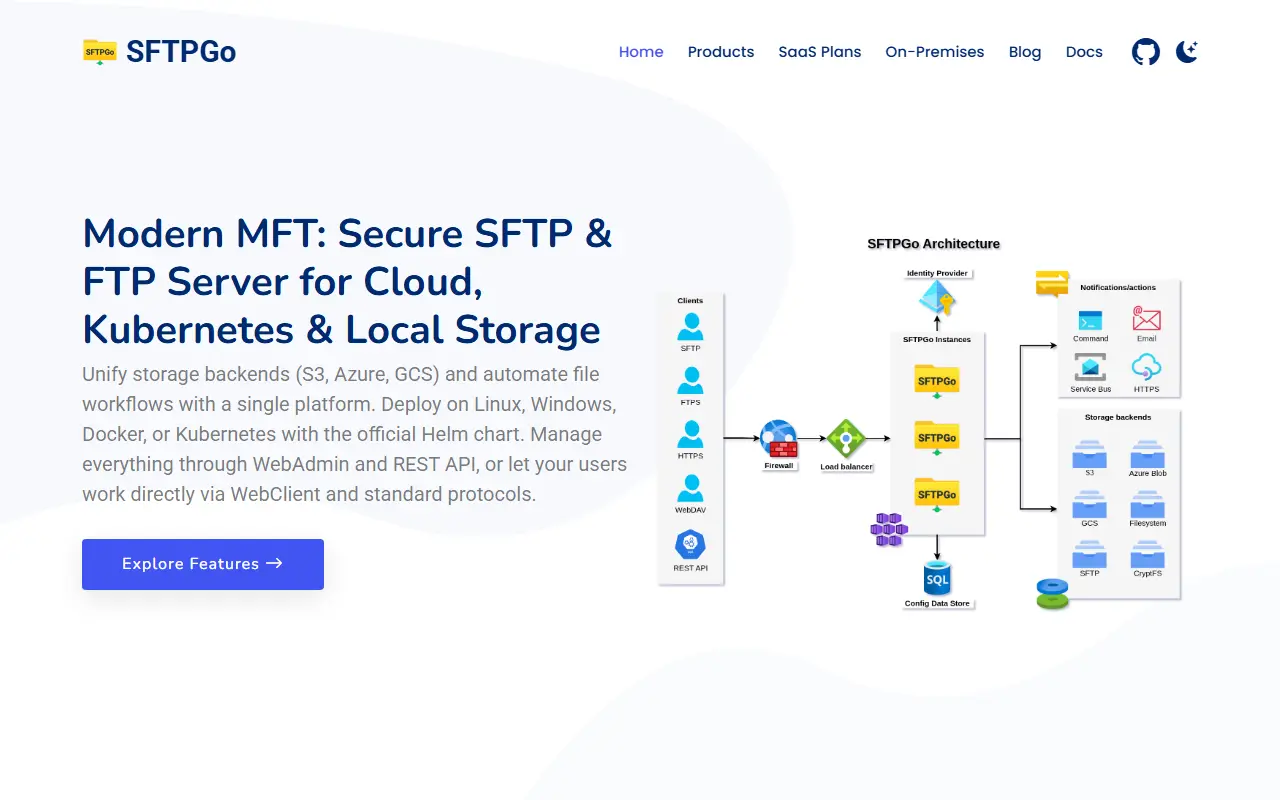
sftpgo.comSFTPGo homepage screenshot

SFTPGo is a configurable file transfer server that exposes SFTP, HTTP/S, FTP/S and WebDAV. Storage can be a local filesystem, an encrypted local filesystem, S3-compatible object storage, Google Cloud Storage, Azure Blob Storage or another SFTP server, so teams can exchange files internally or with business partners using familiar tools and protocols.

The Community edition includes the core protocols, the storage backends and the WebAdmin and WebClient interfaces. The project topics highlight multi-factor authentication, Prometheus metrics, proxy protocol support and data-at-rest encryption. It is also used to place legacy protocols in front of cloud storage, which lets older clients write to S3, Google Cloud Storage or Azure Blob.

SFTPGo is written in Go and released under the AGPL-3.0 license, with community support through GitHub. A separate Enterprise edition is sold under a commercial license with direct support from the authors, ISO 27001 vendor status and extra features for compliance-heavy environments. It is described as a drop-in upgrade from the Community edition.

Key features

  • SFTP, FTP/S, HTTP/S and WebDAV protocols
  • Local, S3, Google Cloud and Azure Blob storage
  • Web admin and web client interfaces
  • Multi-factor authentication
  • Prometheus metrics and Docker deployment
  • Encrypted local filesystem option

Pricing: Managed SFTPGo SaaS runs from 50 euros (Tiny) to 850 euros (Premium) per month by storage and bandwidth, with a 10-day free trial and two months free on annual billing; Custom is quoted.

Safebucket

Safebucket is an open-source, self-hosted file sharing platform where uploads and downloads go directly to storage via presigned URLs.

GitHub stars
964
Last commit
4 days ago
Latest release
v0.7.5
Licence
Apache-2.0
Self-hosted
Yes
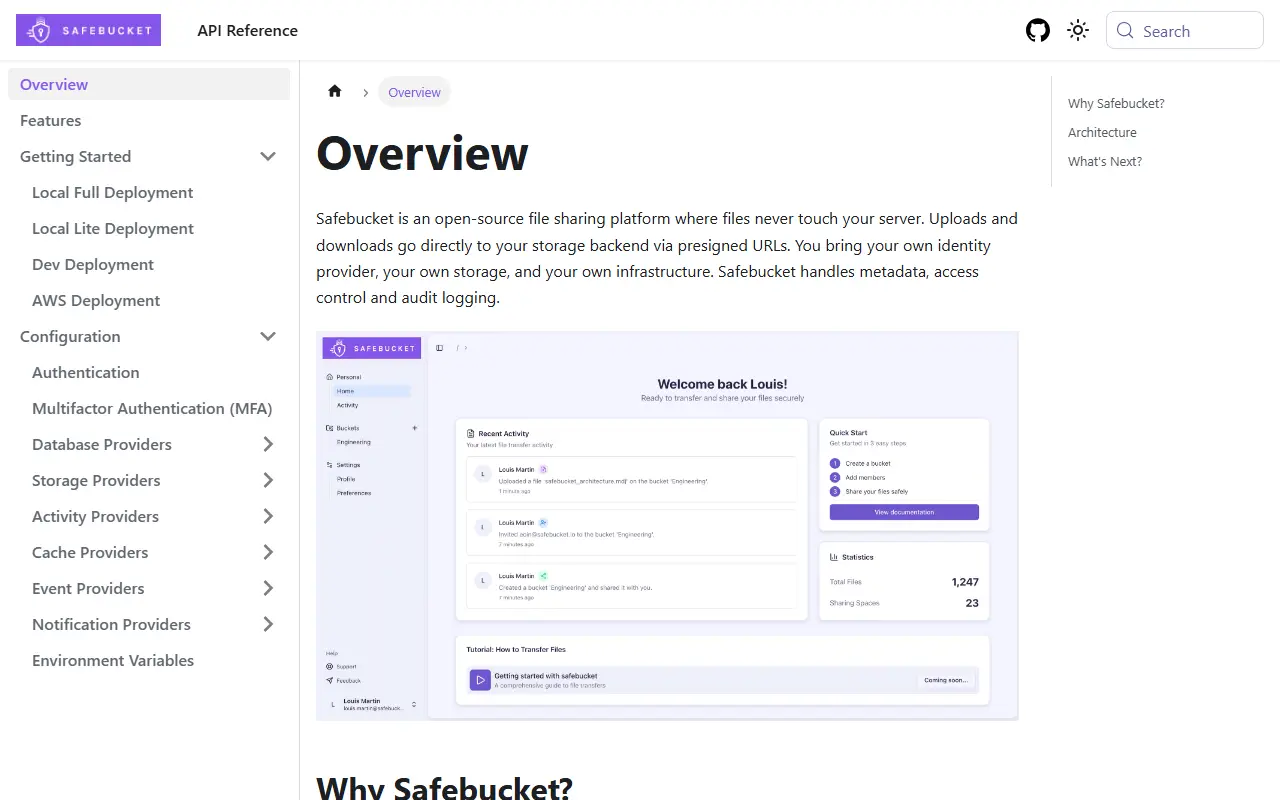
docs.safebucket.ioSafebucket homepage screenshot

Safebucket is an open-source platform for sharing files on infrastructure you control. Its distinguishing design choice is that uploads and downloads use presigned URLs, so file data goes straight between the user and the storage backend and bypasses the application server. That keeps the server light and avoids it becoming a bottleneck for large transfers.

The platform covers the sharing workflow with quick and reverse share links that can be protected by a password or limited by download or view count, role-based access control at platform and bucket level, and file expiration with a configurable trash retention period. Sign-in works through any OIDC provider, local accounts exist for external users, and TOTP multifactor authentication is supported. Administrators get an activity feed, audit logs and a dashboard with platform-wide statistics.

Each component, including storage, database, events, cache and notifier, can be swapped for another implementation. The backend is written in Go, is licensed under Apache-2.0 and ships as container images that are signed with cosign. A Docker-based quick start brings it up locally on port 8080.

Key features

  • Direct uploads via presigned URLs
  • Password-protected public share links
  • Reverse share for receiving files
  • OIDC single sign-on and TOTP
  • Role-based access at bucket level
  • Audit logs and admin dashboard
  • File expiration and configurable trash

Pricing: Free and open source under the Apache-2.0 license.

LinShare

LinShare is an open-source, self-hosted file sharing platform from Linagora for organizations that need traceable, private exchange of documents.

GitHub stars
577
Last commit
17 days ago
Licence
AGPL-3.0
Self-hosted
Yes
linshare.appLinShare homepage screenshot

LinShare is an open-source file sharing platform built for organizations that need to exchange documents with internal and external collaborators while keeping full control over privacy and traceability. It is meant to replace email attachments, USB sticks and consumer cloud drives with a service you run on your own infrastructure.

Key features include a personal space where you upload, version and organize files and share them by link or email, shared spaces as workgroups with roles and nested folders, upload requests that let outsiders send files through a secure expiring drop box, guest accounts with restricted time-limited access, reusable contact lists, and activity logs and audit trails for every download, share and change. Enterprise integration covers LDAP directories, LemonLDAP::NG, Microsoft Azure SSO through OpenID Connect, JWT, antivirus scanning and file previews, plus a REST API and an MCP server that lets compatible AI assistants manage files, shares, guests and workgroups.

LinShare is licensed under AGPL-3.0, is documented with install and upgrade guides, and a recent release added guest sharing through contact lists. A demo can be tried before installing.

Key features

  • Personal and shared workspaces
  • Upload requests via expiring drop boxes
  • Guest accounts with time limits
  • Audit logs for downloads and shares
  • LDAP and Azure SSO integration
  • REST API and MCP server

Pricing: Free and open source under the AGPL-3.0 license.

Signiant alternatives: questions

What is the best open-source alternative to Signiant?
croc is the top-ranked open-source alternative to Signiant on Enlisted: A cross-platform command line tool for sending files and folders between any two computers with end-to-end encryption, resumable transfers and no port forwarding. Other strong options are Magic Wormhole, SFTPGo, Safebucket and LinShare.
Are these Signiant alternatives free?
All 5 are open source, so the code is free to use under its licence, and all of them can be self-hosted on your own server or computer.
How is this list of Signiant alternatives ranked?
By a score built from GitHub stars, star growth over the last 30 days and how recently the code changed. 5 of these projects shipped code in the last 30 days. Data is refreshed daily, and nobody can pay to move up.

People also look for alternatives to…

View all