7,363 open-source and SaaS tools, with GitHub stats refreshed every day.

3 alternatives ranked by real activity

Open-source Reason alternatives

A curated, ranked list of the 3 best open-source alternatives to Reason.

The best open-source alternative to Reason is LMMS. If that doesn't suit you, other good options are DeepSearcher and Ardour.

Reason alternatives are mainly audio & music production tools, but some are also AI tools. 3 of them shipped code in the last 30 days, 3 can be self-hosted, and 1 uses a permissive licence.

Last updated October 3, 2026 · ranked by GitHub stars, growth and recent commits

LMMS

Cross-platform digital audio workstation for composing, arranging and mixing music, with a piano roll, beat sequencer and built-in synths.

GitHub stars
10k
Last commit
5 days ago
Latest release
v1.2.2
Licence
GPL-2.0
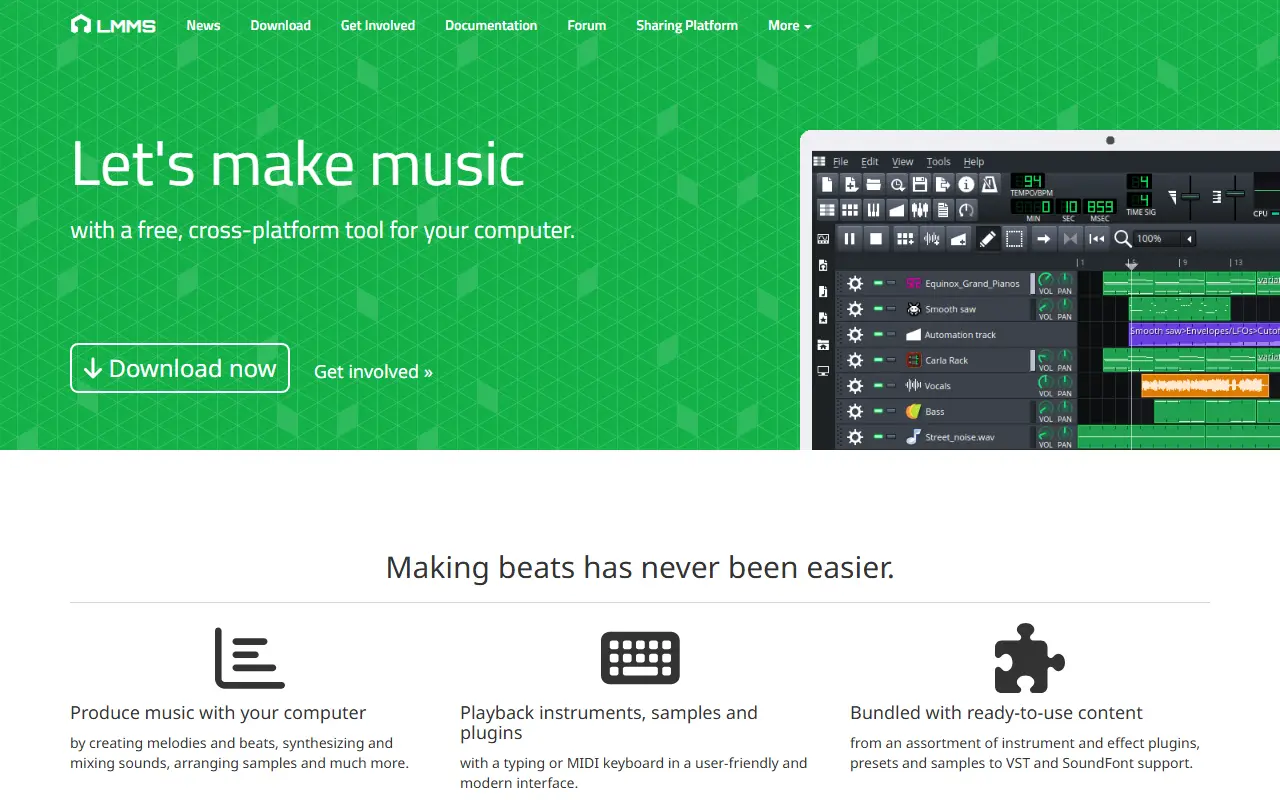
lmms.ioLMMS homepage screenshot

LMMS is an open-source, cross-platform digital audio workstation made for music production. It includes a Song Editor for arranging melodies, samples, patterns and automation, a Pattern Editor for beats, a Piano Roll for editing melodies, and a Mixer for combining tracks.

More than 15 synthesizer plugins come with it by default. The mixer offers an unlimited number of channels and effects, and automation can be user-defined or driven by computer-controlled sources. It works with many standards, including SoundFont2, VST2 instruments and effects, LADSPA, LV2 and GUS Patches, and it has full MIDI support with MIDI file import and export.

LMMS is written in C++ and licensed under GPL-2.0. The project provides a user manual, a showcase, a sharing platform, a developer wiki and internal documentation. Contributors are welcome to help with programming, artwork, testing and demo songs, and are asked to file an issue or ask on Discord before building a large feature.

Key features

  • Song Editor and Pattern Editor
  • Piano Roll for melodies
  • Mixer with unlimited channels and effects
  • Built-in synthesizer plugins
  • VST2, SoundFont2, LADSPA and LV2 support
  • MIDI file import and export

Pricing: Free and open source under the GPL-2.0 license.

DeepSearcher

DeepSearcher from Zilliz is an open-source deep research tool that uses LLMs and vector databases like Milvus to reason over private data and write reports.

GitHub stars
8.3k
Last commit
10 days ago
Licence
Apache-2.0
Self-hosted
Yes
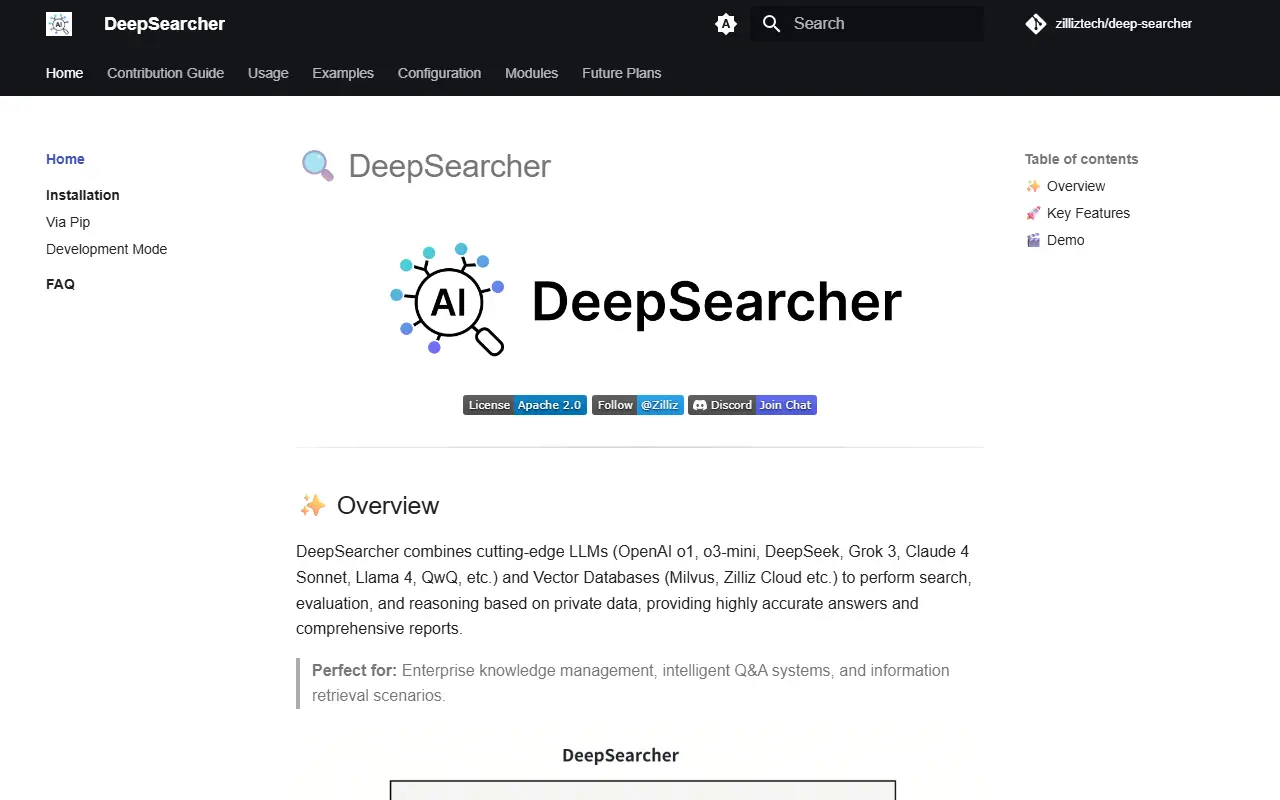
zilliztech.github.ioDeepSearcher homepage screenshot

This entry covers DeepSearcher, the open-source project from Zilliz, the company behind the Milvus vector database. It is pitched as an alternative to deep research services for reasoning and searching over private data, and it is written in Python.

DeepSearcher pairs large language models, including OpenAI models, Qwen3, DeepSeek, Grok, Claude and Llama, with vector databases such as Milvus and Zilliz Cloud to search, evaluate and reason over your documents and produce an answer or a comprehensive report. Listed features are private data search that can also bring in online content, vector database management with data partitioning, a choice of embedding models, support for multiple LLMs, and a document loader for local files, with web crawling in development.

It installs with pip, using a virtual environment and Python 3.10, or in development mode with uv, and the quick-start demo needs an OpenAI API key in the environment. The project is licensed under Apache-2.0 and suits enterprise knowledge management, question answering and information retrieval experiments.

Key features

  • Deep research over private data
  • Milvus and Zilliz Cloud vector storage
  • Multiple LLM provider support
  • Choice of embedding models
  • Local file document loader
  • Reports generated from retrieved evidence

Pricing: Free and open source under the Apache-2.0 licence; LLM and vector database providers may charge separately.

Ardour

A free, open-source digital audio workstation for Windows, Linux and macOS, used to record, edit and mix audio and MIDI projects.

GitHub stars
5.3k
Last commit
today
Self-hosted
Yes
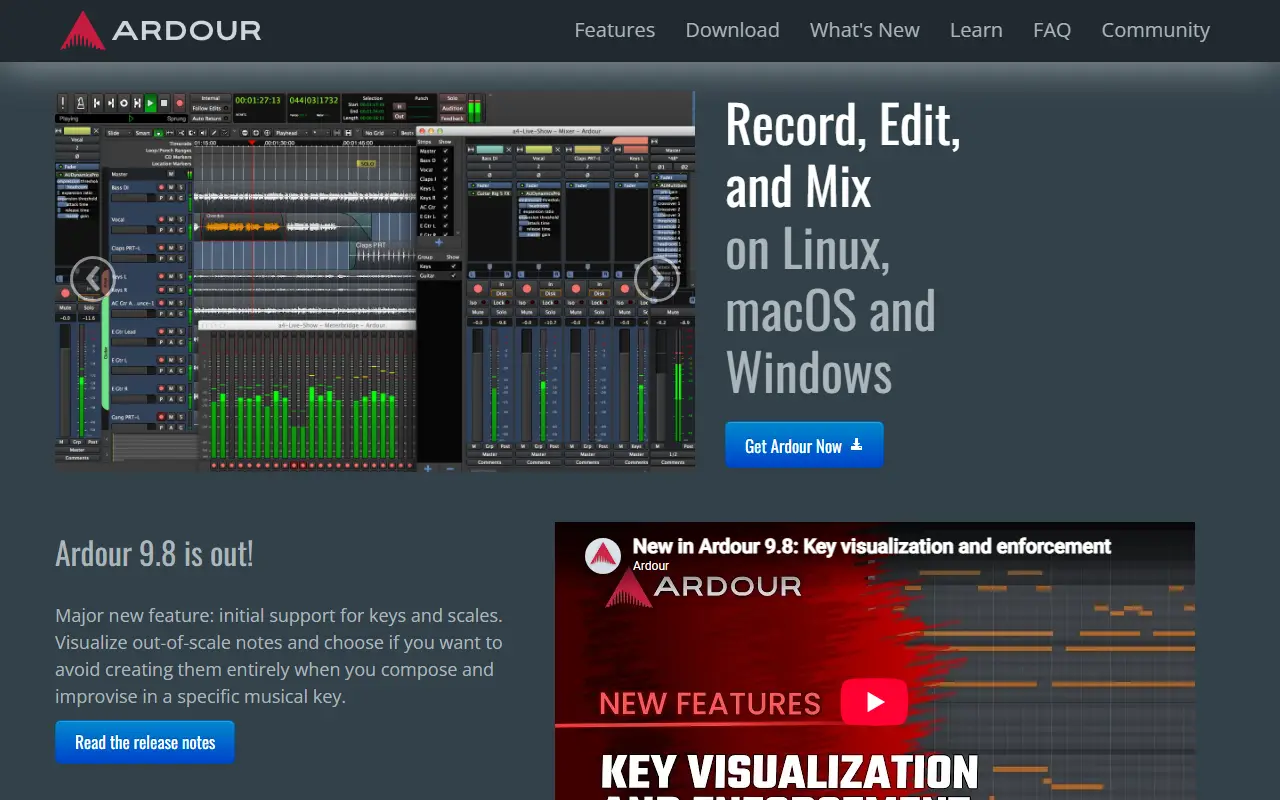
ardour.orgArdour homepage screenshot

Ardour is a digital audio workstation, free and open source, that runs on Windows, Linux and macOS. It is built for recording, editing, mixing and mastering audio and MIDI projects, from capturing vocals and live instruments to producing beats and preparing tracks for streaming.

Recording starts from an audio interface, microphone or keyboard, and material can be imported from a hard drive or the Freesound database. Editing tools include cutting, moving, stretching, trimming, crossfading, transposing and quantizing with unlimited undo and redo, while the mixer offers faders, automation, EQ, dynamics, sends, inserts and support for external control surfaces.

Its core audience is audio engineers who want full control of their tools for long sessions, along with musicians who record real instruments. Ardour supports plugin formats such as LV2 and VST and connects through JACK. It is written in C++, and the GitHub repository is a mirror of the project's source code.

Key features

  • Multitrack audio and MIDI recording
  • Editing with unlimited undo and redo
  • Mixer with automation, EQ and dynamics
  • LV2 and VST plugin support
  • JACK audio connectivity
  • External control surface support
  • Audio and MIDI import including Freesound

Pricing: Distributed as free, open-source software.

Reason alternatives: questions

What is the best open-source alternative to Reason?
LMMS is the top-ranked open-source alternative to Reason on Enlisted: Cross-platform digital audio workstation for composing, arranging and mixing music, with a piano roll, beat sequencer and built-in synths. Other strong options are DeepSearcher and Ardour.
Are these Reason alternatives free?
All 3 are open source, so the code is free to use under its licence, and all of them can be self-hosted on your own server or computer.
How is this list of Reason alternatives ranked?
By a score built from GitHub stars, star growth over the last 30 days and how recently the code changed. 3 of these projects shipped code in the last 30 days. Data is refreshed daily, and nobody can pay to move up.

People also look for alternatives to…

View all