7,363 open-source and SaaS tools, with GitHub stats refreshed every day.

3 alternatives ranked by real activity

Open-source Pusher alternatives

A curated, ranked list of the 3 best open-source alternatives to Pusher.

The best open-source alternative to Pusher is Centrifugo. If that doesn't suit you, other good options are Deepstream.io and Mercure.

Pusher alternatives are mainly backend-as-a-service tools. 3 of them shipped code in the last 30 days, 3 can be self-hosted, and 2 use a permissive licence.

Last updated October 2, 2026 · ranked by GitHub stars, growth and recent commits

Centrifugo

Centrifugo is a self-hosted, language-agnostic real-time messaging server that pushes messages to browsers and apps over WebSocket and other transports, an alternative to Pusher and Ably.

GitHub stars
11k
Last commit
2 days ago
Latest release
v6.9.7
Licence
Apache-2.0
Self-hosted
Yes
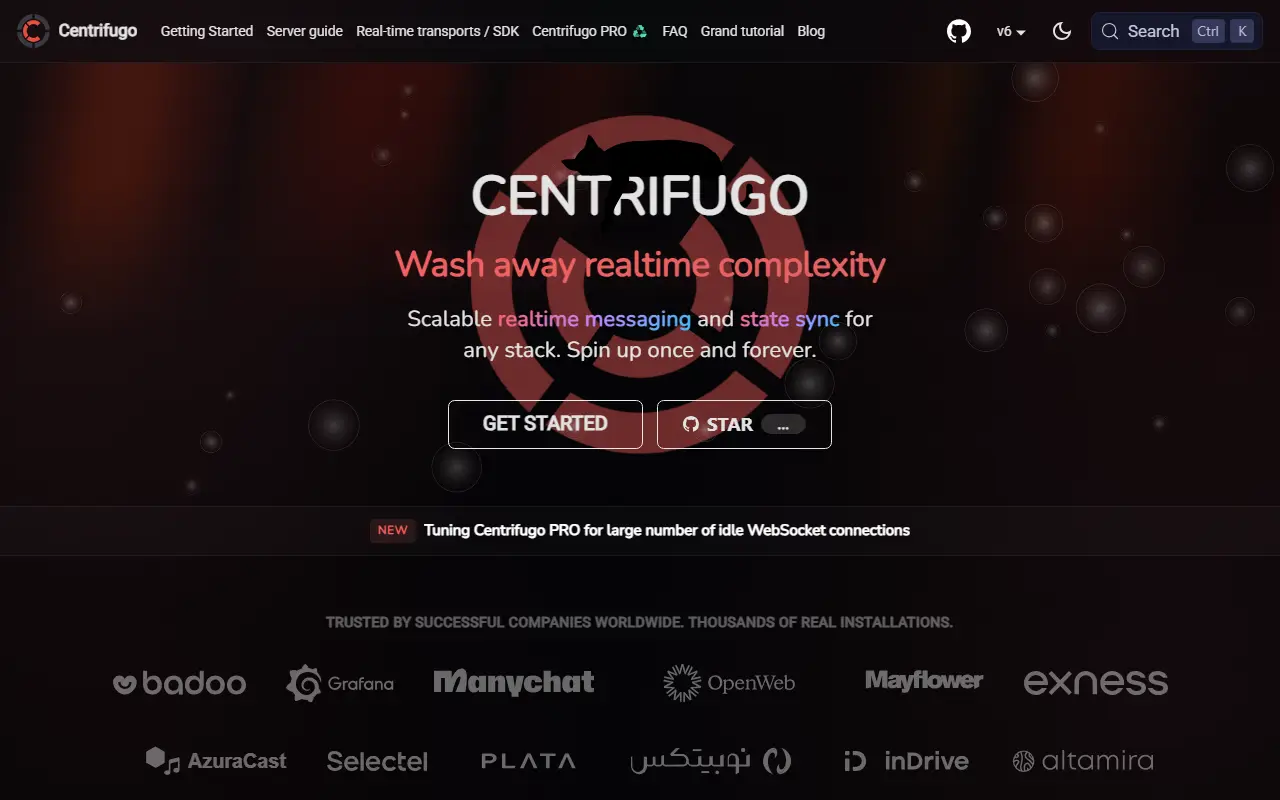
centrifugal.devCentrifugo homepage screenshot

This entry covers Centrifugo, the real-time messaging server from the Centrifugal project. It is an open-source PUB/SUB server for user-facing messaging: your backend publishes into channels through a simple HTTP or gRPC API, and clients subscribe to those channels using official SDKs, or a unidirectional approach that needs no SDK.

Messages reach online users over WebSocket, HTTP streaming, Server-Sent Events, gRPC and WebTransport. Because it is language-agnostic, it can sit beside any backend and separates the business logic from the real-time transport. It is used for chat apps, live comments, multiplayer games, data visualizations, collaborative tools and streaming AI responses. An embedded admin UI shows live connections and lets you publish test messages, and Redis support allows scaling out.

Centrifugo is written in Go and licensed under Apache-2.0. It is pitched as a self-run replacement for hosted services like Pusher, Ably and PubNub and for libraries such as socket.io, Phoenix.PubSub and SignalR, and a Docker command starts it in a minute for local trials. The README warns that the insecure flags used in the quick start must never be used in production.

Key features

  • Channel-based PUB/SUB messaging
  • WebSocket, SSE, HTTP streaming and gRPC transports
  • WebTransport support for browsers
  • HTTP and gRPC publish API
  • Official client SDKs
  • Embedded admin UI
  • Scaling out with Redis

Pricing: Free and open source under the Apache-2.0 licence.

Deepstream.io

An open realtime server for syncing data, publishing events and making remote procedure calls at scale, with built-in authentication and a permission language.

GitHub stars
7.2k
Last commit
22 days ago
Latest release
v10.2.2
Licence
MIT
Self-hosted
Yes
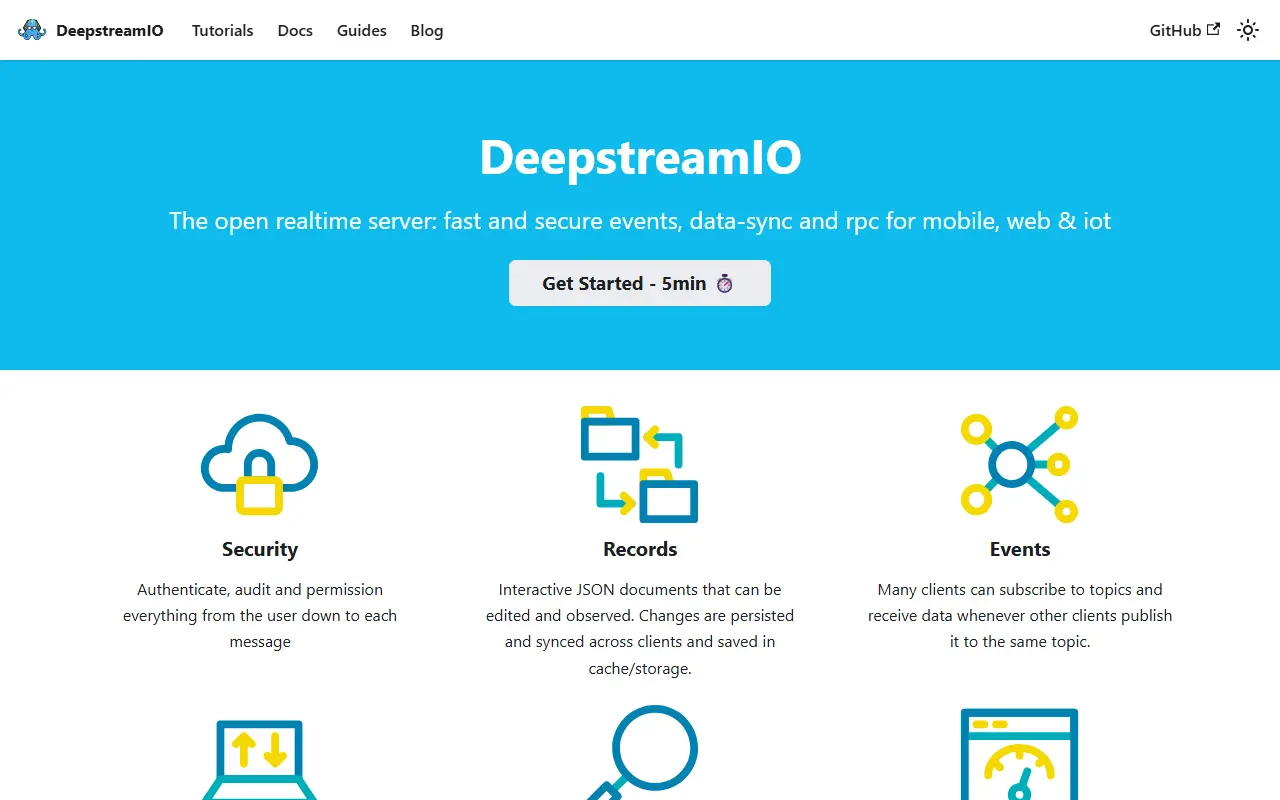
deepstreamio.github.ioDeepstream.io homepage screenshot

deepstream is an open-source realtime server inspired by ideas from financial trading technology. It lets clients and backend services sync data, exchange messages and make remote procedure calls at high speed and scale, and it is written in TypeScript for Node.js.

It is built on three core concepts. Records are schema-less, persistent documents that clients can edit and observe, with changes synchronized to all connected clients and backend processes in milliseconds and links between records to model relational data. Events provide publish-subscribe messaging with topic-based routing and subscription listening. RPCs offer request-response workflows with load balancing, failover and message routing handled by the server.

Security combines several authentication mechanisms with a permission language called Valve that specifies which user can do which action on which data. deepstream is licensed under MIT and hosted by you, with tutorials, a quickstart and documentation, plus community support on Stack Overflow and GitHub Discussions. It suits developers building collaborative or live-updating applications.

Key features

  • Realtime synced records
  • Publish-subscribe events with topic routing
  • RPCs with load balancing and failover
  • Pluggable authentication mechanisms
  • Valve permission language
  • WebSocket-based realtime transport

Pricing: Free and open source under the MIT licence.

Mercure

A protocol and Go reference hub for pushing real-time updates to browsers and other HTTP clients, for apps built on web APIs.

GitHub stars
5.3k
Last commit
7 days ago
Latest release
v1.0.2
Licence
AGPL-3.0
Self-hosted
Yes
Hosted version
Available
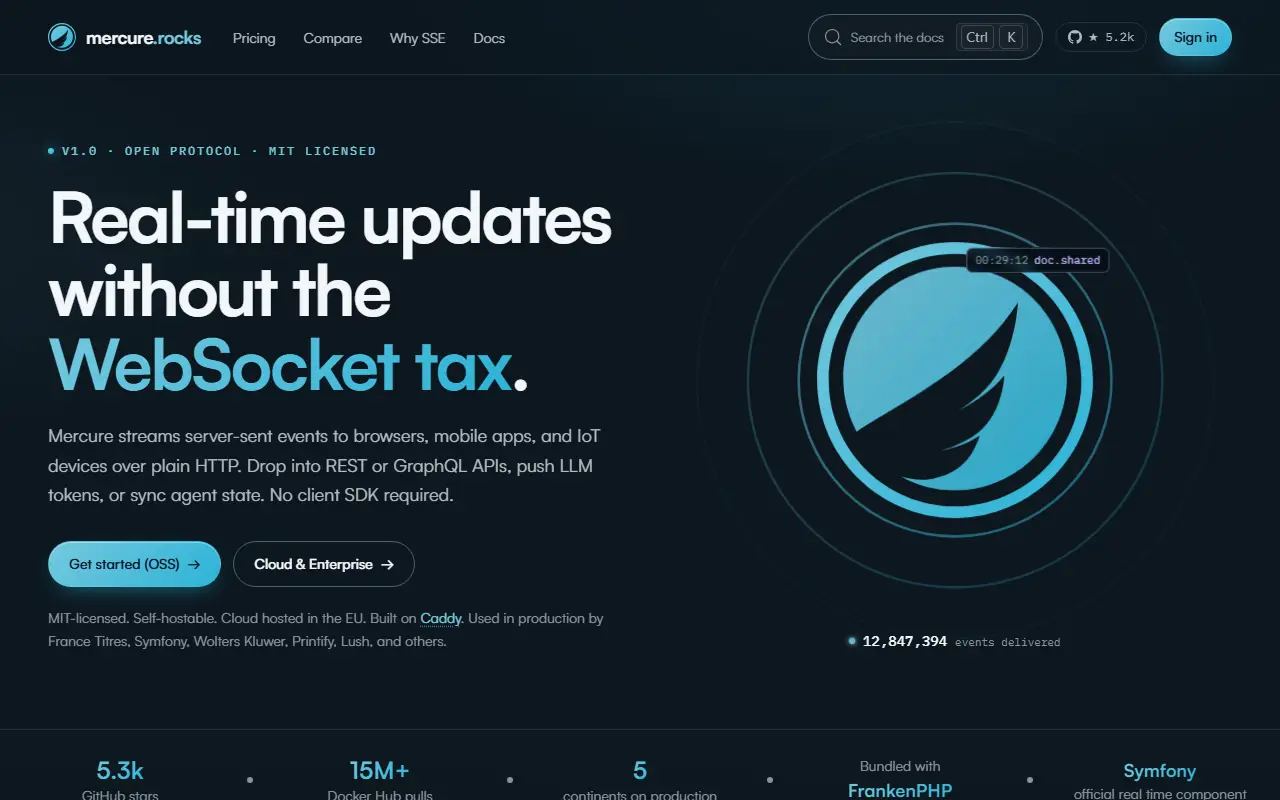
mercure.rocksMercure homepage screenshot

Mercure is a protocol that lets servers push updates to browsers and other HTTP clients without polling, while staying light on battery. It is especially useful for publishing asynchronous, real-time updates to resources served through web APIs, so reactive web and mobile apps can react as data changes.

The repository contains both the protocol, which is also published as an Internet-Draft, and a production-grade reference implementation of a Mercure hub, the server component. The hub is written in Go and is built around Server-Sent Events. A Go library lets applications implement the protocol directly without running a hub, and an official Docker image is provided.

Mercure is free software under AGPL-3.0, created by Kévin Dunglas and sponsored by Les-Tilleuls.coop. Teams that prefer not to operate the hub can use the managed, high-scalability version offered through Mercure.rocks, and the project provides a getting-started guide, full documentation and a demo.

Key features

  • Real-time push updates over HTTP
  • Reference hub server written in Go
  • Go library to embed the protocol
  • Official Docker image
  • Server-Sent Events support
  • Internet-Draft protocol specification

Pricing: The open-source hub is free. Managed Cloud costs €30, €100, €250 or €500 per month; commercial self-hosted tiers run €1,500, €5,000 and €12,000 per year. No Cloud free trial.

Pusher alternatives: questions

What is the best open-source alternative to Pusher?
Centrifugo is the top-ranked open-source alternative to Pusher on Enlisted: Centrifugo is a self-hosted, language-agnostic real-time messaging server that pushes messages to browsers and apps over WebSocket and other transports, an alternative to Pusher and Ably. Other strong options are Deepstream.io and Mercure.
Are these Pusher alternatives free?
All 3 are open source, so the code is free to use under its licence, and all of them can be self-hosted on your own server or computer. 1 also offers a paid or managed cloud version if you'd rather not host it yourself.
How is this list of Pusher alternatives ranked?
By a score built from GitHub stars, star growth over the last 30 days and how recently the code changed. 3 of these projects shipped code in the last 30 days. Data is refreshed daily, and nobody can pay to move up.

People also look for alternatives to…

View all