#1
An open-source platform for visualizing metrics, logs and traces from many data sources, with dashboards, alerting and ad-hoc exploration.
- GitHub stars
- 78k
- Last commit
- today
- Latest release
- v13.3.1
- Licence
- AGPL-3.0
- Self-hosted
- Yes
- Hosted version
- Available
grafana.com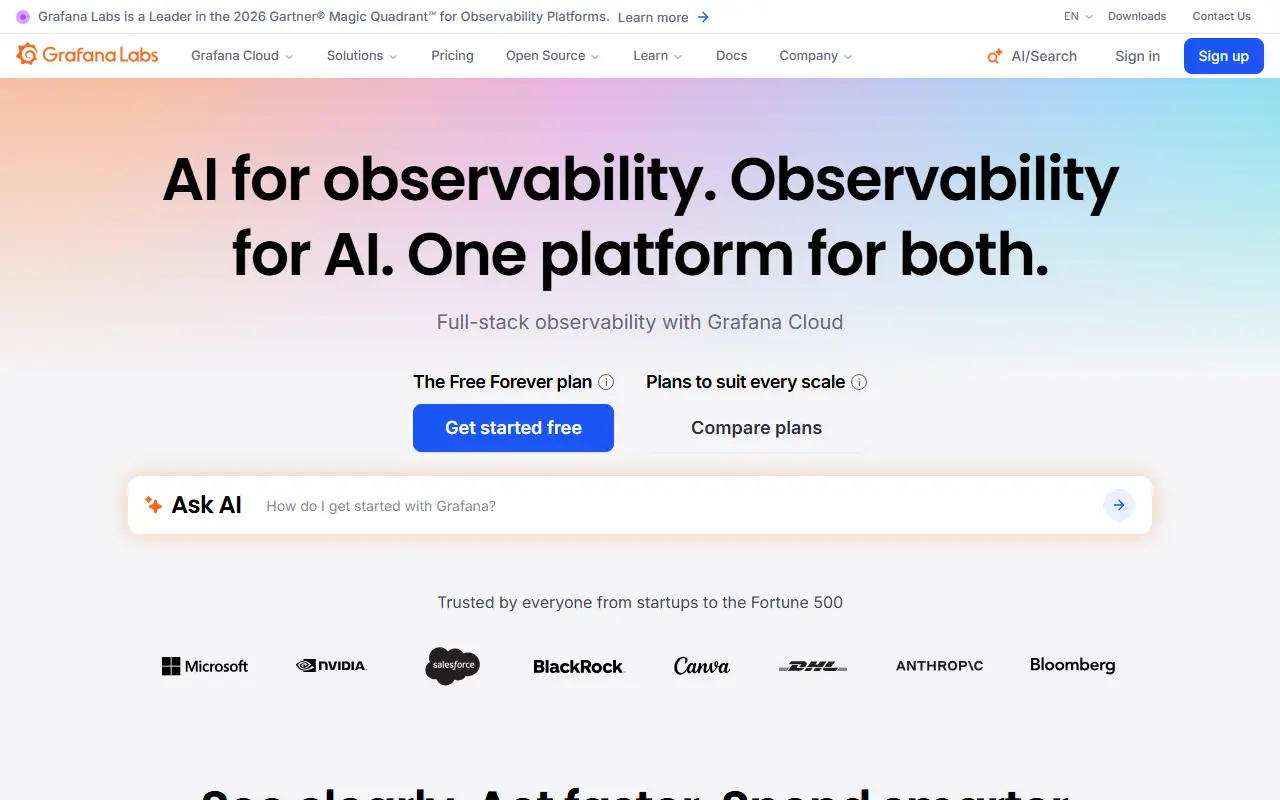
Grafana is a visualization and observability platform that lets you query, chart and alert on data wherever it is stored. It does not hold your data itself; it connects to sources such as Prometheus, Loki, Elasticsearch, InfluxDB, MySQL and PostgreSQL and brings their results together in shared dashboards.
Dashboards can be made reusable with template variables that appear as dropdowns, and a single graph may mix queries against different data sources. Explore views support ad-hoc queries, side-by-side comparison of time ranges and a jump from metrics to logs while keeping label filters. Alert rules are defined visually, and notifications go to systems like Slack, PagerDuty, VictorOps and OpsGenie. Panel plugins add further visualization types.
Grafana is AGPL-3.0 licensed, written in Go and TypeScript, and can be installed on your own servers; Grafana Labs also runs a hosted offering. It is common in DevOps and SRE teams as the dashboard layer on top of Prometheus-style monitoring, and a public demo site lets you try it first.
Key features
- Dashboards with template variables
- Mixed data sources in a single graph
- Visual alert rules with Slack and PagerDuty
- Explore view for ad-hoc metric and log queries
- Panel plugins for extra visualizations
- Connects to Prometheus, Loki and SQL databases
Pricing: Grafana Cloud has an always-free tier with usage limits. Pro starts at $19 per month plus usage; Enterprise starts at a $25,000 annual spend commit and is sold through sales.
#2
A web-based business intelligence platform from the Apache project with a no-code chart builder, SQL editor and dashboards that connects to most SQL databases.
- GitHub stars
- 75k
- Last commit
- today
- Latest release
- 6.1.0
- Licence
- Apache-2.0
- Self-hosted
- Yes
superset.apache.org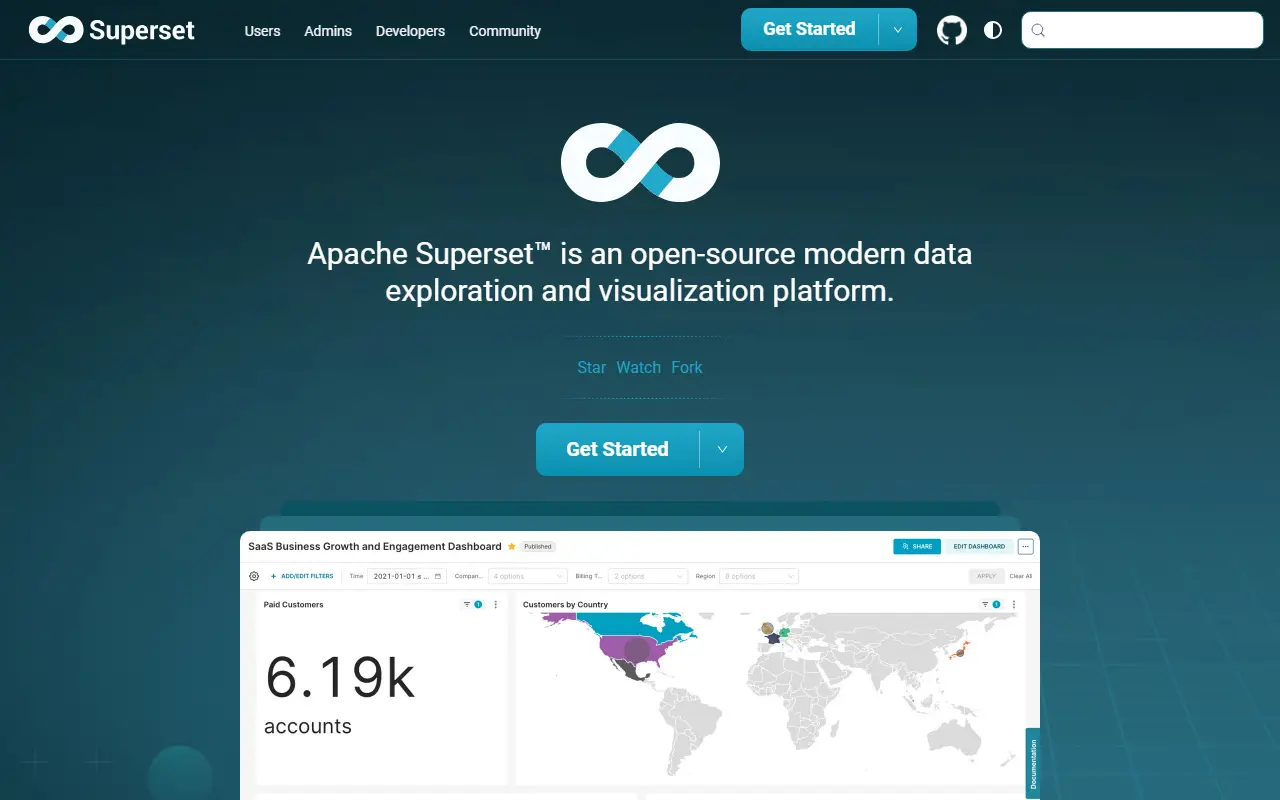
Apache Superset is a data exploration and visualization platform that runs as a web application. Analysts and business users can connect it to a database, build charts without code, assemble them into dashboards and share them, so it can augment or replace proprietary business intelligence tools for many teams.
The no-code chart builder sits next to a web-based SQL editor for advanced queries, and a lightweight semantic layer lets teams define reusable dimensions and metrics. Visualizations range from simple bar charts to geospatial views. Superset can query any SQL datastore or engine provided a matching Python database driver and SQLAlchemy dialect exist, including Presto, Trino and Athena. A configurable caching layer reduces database load, and security roles and authentication options are extensible.
The stack is Python with Flask on the back end and React on the front end, under the Apache-2.0 license. A REST API and extension framework allow programmatic control and customization. Documentation is split into guides for users, administrators and developers, and it is a typical choice for organizations that want a self-managed BI layer.
Key features
- No-code chart builder
- Web-based SQL editor
- Shareable interactive dashboards
- Lightweight semantic layer for metrics
- Connects to any SQL database with a driver
- Caching layer and security roles
- REST API for programmatic customization
Pricing: Free and open source under the Apache-2.0 license.
#3
An open-source BI and embedded analytics tool for exploring data, building dashboards and asking questions without SQL, self-hosted or through Metabase Cloud.
- GitHub stars
- 50k
- Last commit
- today
- Latest release
- v0.65.3
- Self-hosted
- Yes
- Hosted version
- Available
metabase.com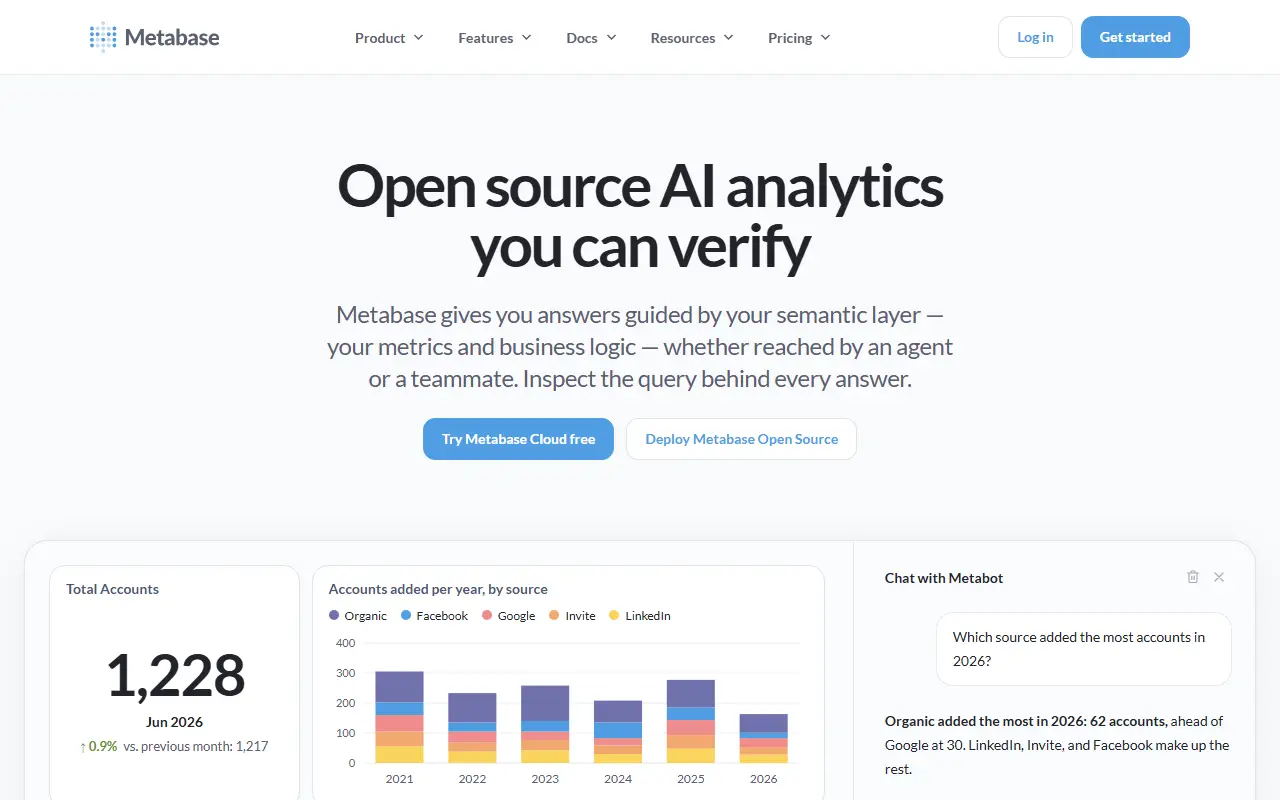
Metabase is an open-source business intelligence and embedded analytics tool meant for everyone in a company, not only analysts. People can ask questions about their data without knowing SQL, while an SQL editor is available for more complex queries. Written in Clojure, it connects to databases such as PostgreSQL and MySQL.
Its features include interactive dashboards with filters, auto-refresh and custom click behavior, plus documents for long-form analysis that colleagues can comment on. An AI assistant called Metabot helps answer questions and write queries, and you can build your own AI agent against your data. Data Studio supports transforming raw data into analytics-ready tables and defining canonical metrics. Alerts and scheduled dashboard subscriptions go to email, Slack or a webhook, and a Library plus Git integration help version your work.
Metabase can also be embedded in your own product with components for charts, dashboards, a data browser and AI chat, and granular permissions work for internal teams and embedded customers. You can self-host it or use Metabase Cloud, which the project says includes support, backups, upgrades and a free trial. The repository license is listed as 'Other', so review its terms.
Key features
- Question builder that needs no SQL
- SQL editor for complex queries
- Interactive dashboards with filters and auto-refresh
- Alerts and scheduled subscriptions to email or Slack
- Embedding of charts and dashboards in apps
- Granular permissions for teams and customers
- Metabot AI assistance for queries
Pricing: The open-source edition is free. Cloud Starter is $100 per month and Pro $575 per month with a 14-day trial; extra users cost $6 or $12 per month. Enterprise starts at $20,000 per year.
#4
An Apache workflow orchestration platform where data teams author, schedule and monitor pipelines as Python code, widely used for data engineering and ELT jobs.
- GitHub stars
- 47k
- Last commit
- today
- Latest release
- 3.4.0
- Licence
- Apache-2.0
- Self-hosted
- Yes
airflow.apache.org
Apache Airflow is a workflow platform where you write, schedule and watch over pipelines in code. Workflows are defined as Python code in the form of directed acyclic graphs, or DAGs, where each task and its dependencies are explicit, so pipelines can be versioned, tested and reviewed like any other software.
A scheduler runs tasks on a defined cadence and workers execute them, while a web interface shows the status of each run, lets you inspect logs and retry failures. Airflow is used heavily in data engineering, including data integration, ELT and ETL pipelines, data orchestration and machine learning workflows, and its topics cover data science and automation. It has a large ecosystem of providers and operators for connecting to databases, cloud services and other systems, and the 3.x line is the current series.
Airflow is an Apache Software Foundation project under the Apache-2.0 license and runs on your own infrastructure, from a single machine to Kubernetes. Several vendors offer managed Airflow services, but the project itself is self-hosted software. It suits data engineers who prefer code-first orchestration over drag-and-drop tools.
Key features
- Workflows defined as Python DAGs
- Scheduler for recurring and dependent tasks
- Web UI for monitoring runs and logs
- Retries and task dependency management
- Large provider ecosystem of integrations
- Runs on single machines or Kubernetes
Pricing: Free and open source under the Apache-2.0 license.
#5
An analytics engine for processing large datasets, with APIs in Scala, Java, Python and R and libraries for SQL, machine learning, graphs and streaming.
- GitHub stars
- 44k
- Last commit
- yesterday
- Licence
- Apache-2.0
- Self-hosted
- Yes
spark.apache.org
Apache Spark is an analytics engine that brings batch, SQL, machine learning, graph and streaming workloads together for processing data at scale. It is maintained by the Apache Software Foundation under the Apache-2.0 license. It is written mainly in Scala and offers high-level APIs in Scala, Java and Python, with an R API that is now deprecated, on top of an engine optimized to execute general computation graphs.
A set of higher-level tools is included: Spark SQL for queries and DataFrames, MLlib for machine learning, GraphX for graphs, Structured Streaming for streams, and a pandas-style API for existing pandas workloads. Together they let teams run batch analytics, machine learning and streaming jobs on a single engine and share code between them.
The README points to the project website for full documentation and programming guides, and it contains only basic setup and build instructions. Spark suits data engineers and data scientists who process datasets too large for a single machine, and organizations that want one framework for ETL, analytics and machine learning on clusters.
Key features
- High-level APIs in Scala, Java and Python
- Optimized engine for computation graphs
- Spark SQL and DataFrames
- MLlib for machine learning
- GraphX for graph analytics
- Structured Streaming for stream processing
- Pandas API on Spark
Pricing: Free and open source under the Apache-2.0 license.
#6
A Python workflow orchestration framework for turning scripts into resilient, observable data pipelines with scheduling, retries, caching and event-driven automation.
- GitHub stars
- 24k
- Last commit
- today
- Latest release
- 3.9.2
- Licence
- Apache-2.0
- Self-hosted
- Yes
- Hosted version
- Available
prefect.io
Prefect is a Python framework for orchestrating workflows and building data pipelines. It aims to be the simplest way to lift an ordinary script into a production workflow: you add flow and task decorators, and Prefect adds the machinery that makes pipelines dependable and visible.
That machinery includes scheduling, caching, retries and event-based automations, and flows can express dependencies and complex branching logic. The goal is dynamic pipelines that react to changes in the world and recover from unexpected failures. Run activity is tracked, and you can monitor it from a self-hosted Prefect server or from the managed Prefect Cloud dashboard. Prefect requires Python 3.10 or newer, and the documentation covers installation, quickstart, building and deploying workflows and agent setup.
Prefect is licensed under Apache-2.0. Topics list data engineering, ML ops and observability among its uses. It is aimed at data teams who prefer to write workflows as plain Python code, and who want a choice between running the orchestrator themselves or using a hosted control plane.
Key features
- Flows and tasks defined with Python decorators
- Scheduling and event-based automations
- Automatic retries and caching
- Complex branching and dependencies
- Self-hosted server or Prefect Cloud monitoring
- Deployment of workflows to infrastructure
Pricing: Prefect Cloud's Hobby tier is free. Starter is $100 per month and Team $100 per user per month, both billed monthly; Enterprise is custom and billed annually.
#7
An open-source data movement platform with hundreds of connectors for ELT pipelines from APIs, databases and files into warehouses, lakes and AI applications.
- GitHub stars
- 22k
- Last commit
- today
- Latest release
- v2.0.0
- Self-hosted
- Yes
- Hosted version
- Available
airbyte.com
Airbyte is an open-source data movement platform for moving data from APIs, databases and files into data warehouses, data lakes and AI applications. Its premise is that only an open-source project can reach the long tail of data sources while letting engineers tailor existing connectors, with the aim of moving data from any source to any destination.
It offers a catalog of 600 or more connectors for APIs, databases, warehouses, lakes and AI applications, with warehouse destinations such as BigQuery, Redshift and Snowflake, and topics also mention change data capture. The README distinguishes products by job: Airbyte Open Source or Airbyte Cloud for ELT and ETL into warehouses, lakes or databases, and Airbyte Agents, a managed data and context layer, plus an open-source Agent SDK for giving AI agents and MCP clients real-time access to business data.
Airbyte is written in Python and Java, and its license is listed as 'Other' on GitHub because the project uses a mix of licenses, so review the terms for your use. It can be self-hosted or run as the managed Airbyte Cloud, and suits data teams that need many integrations without writing each pipeline by hand.
Key features
- 600+ source and destination connectors
- ELT pipelines into warehouses and lakes
- Change data capture support
- Customizable open-source connectors
- Agent SDK for AI agent data access
- Self-hosted or Airbyte Cloud
Pricing: The open-source Core edition is free to self-host. Managed cloud starts at $20 a month (Standard) or $189 a month for 40 credits (Plus); Pro and Enterprise Flex are custom. 30-day trial.
#8
A browser-based tool for querying databases, visualizing results and sharing dashboards, with scheduled refreshes and alerts across many data sources.
- GitHub stars
- 29k
- Last commit
- 3 days ago
- Latest release
- v26.9.0
- Licence
- BSD-2-Clause
- Self-hosted
- Yes
redash.io
Redash is an open-source business intelligence and data exploration tool that works entirely in the browser. SQL users connect it to a data source, write queries, turn results into visualizations and share them, so that colleagues without SQL skills can use the results too.
The query editor accepts both SQL and NoSQL queries and offers a schema browser plus auto-complete. Visualizations are built by drag and drop and can be combined into dashboards, and every chart or query has a shareable URL that supports collaboration and peer review. Charts and dashboards can refresh on a schedule, and alerts can notify you when results cross a threshold. Topics mention many sources, including Redshift, BigQuery, Athena, MySQL, PostgreSQL and Databricks.
Redash is written in Python and JavaScript and licensed under BSD-2-Clause. You deploy it on your own infrastructure, commonly with Docker, and it is aimed at analysts and engineers who want a lightweight, query-first dashboard tool rather than a heavy BI suite.
Key features
- Query editor for SQL and NoSQL sources
- Schema browser with auto-complete
- Drag-and-drop chart building
- Shareable dashboards and queries
- Scheduled dashboard refreshes
- Alerts on query results
Pricing: Free and open source under the BSD-2-Clause license.
#9
A data transformation framework that lets analysts and engineers build analytics models with software-engineering practices; v2.0 is a ground-up rewrite in Rust.
- GitHub stars
- 14k
- Last commit
- today
- Latest release
- v1.12.7
- Licence
- Apache-2.0
- Self-hosted
- Yes
- Hosted version
- Available
getdbt.com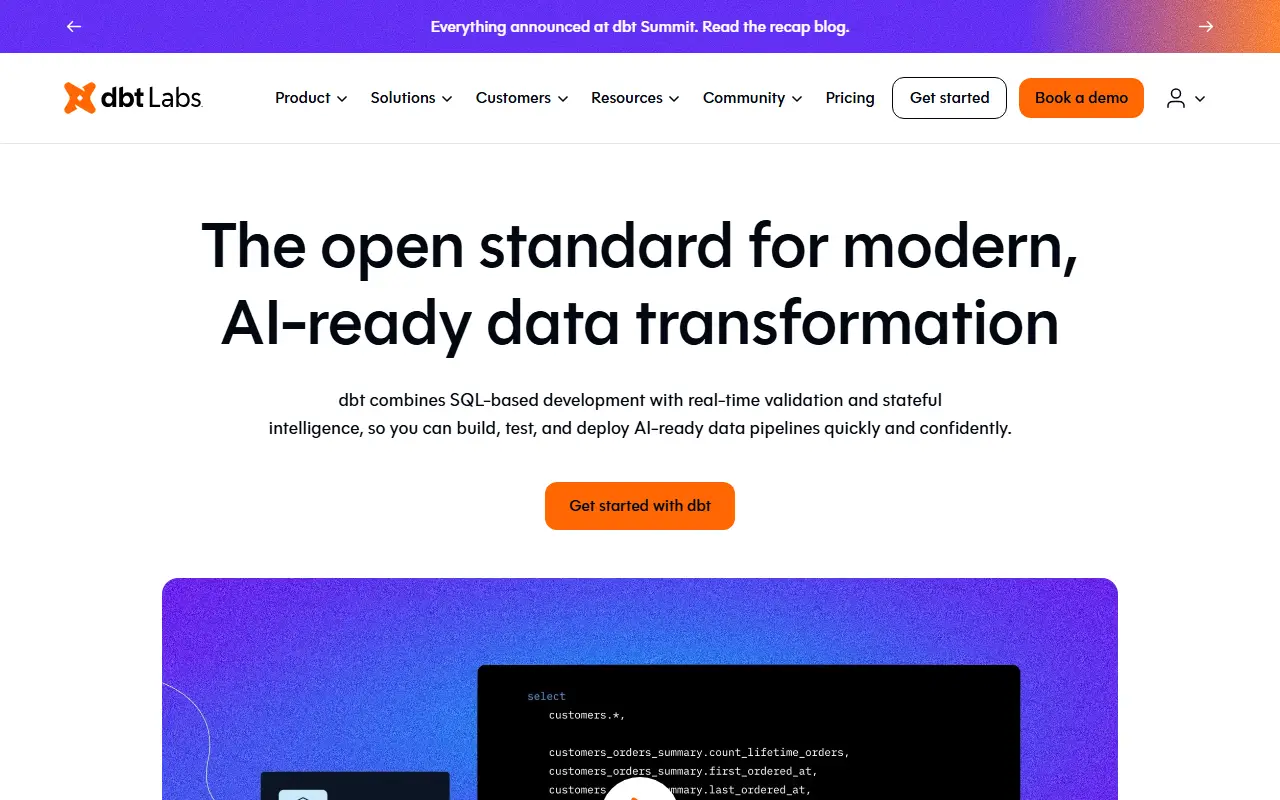
dbt is a framework for transforming data in a warehouse using the same practices that software engineers apply to applications. Analysts and analytics engineers write models, and dbt parses, compiles and runs the project so that transformations are version-controlled and repeatable.
The repository now holds the Apache 2.0 source of dbt v2.0, a ground-up rewrite in Rust. According to its README, v2.0 parses and compiles projects much faster than v1, enforces a stricter language specification at parse time, produces Parquet artifacts alongside the existing JSON ones, and ships as one standalone executable, so no Python installation is needed. The local documentation experience was rebuilt around those artifacts to handle large projects.
The Apache 2.0 code is available to everyone, while the packaged dbt distribution adds dbt-specific customizations under a separate dbt product license. v2.0 supports macOS and Linux on x86-64 and ARM. The v1 Python implementation continues on the 1.latest branch. dbt Labs also offers dbt as a commercial cloud platform.
Key features
- Data transformation using software engineering practices
- Faster parsing and compiling in v2.0
- Strict language specification checks at parse time
- Parquet artifacts for querying project metadata
- Single binary without a Python runtime
- Rebuilt local documentation experience
Pricing: A single-seat Developer plan to start free. Starter costs $100 per user per month; Enterprise and Enterprise+ are custom. A trial is available and add-ons are billed on usage.
#10
An open-source ETL and ELT platform built on DuckDB that you deploy yourself, with visual or SQL pipelines, dbt, CDC, data quality and an MCP server.
- GitHub stars
- 1.6k
- Last commit
- today
- Latest release
- v0.8.0
- Licence
- Apache-2.0
- Self-hosted
- Yes
duckle.org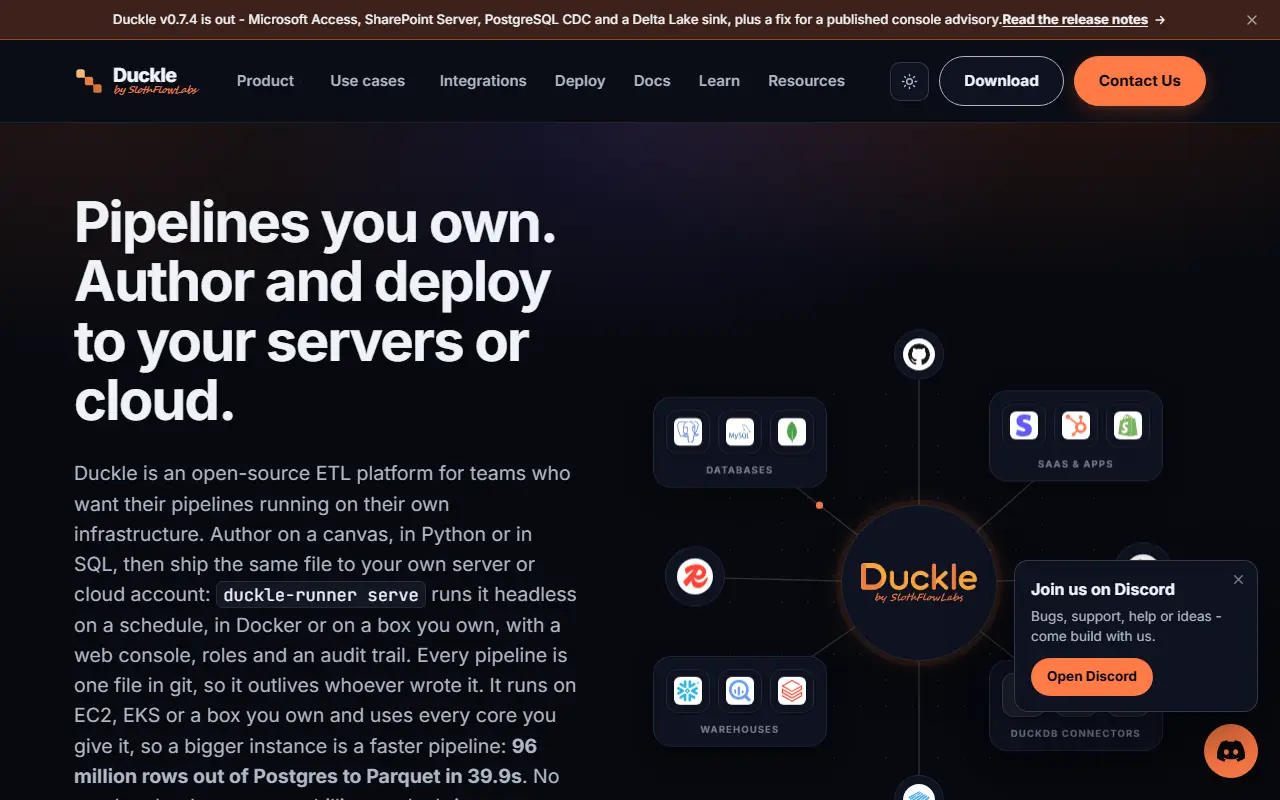
Duckle is an open-source ETL and ELT platform for teams that want their data pipelines running on their own infrastructure. You build pipelines on a visual canvas, in Python or in SQL, then ship the same file to your own server or cloud account, where a headless runner executes it on a schedule.
Pipelines compile to SQL on DuckDB and use all the cores available, so a larger machine runs them faster. The platform lists support for a large catalog of components, dbt, change data capture, data quality checks, reverse ETL and lineage, along with a web console, roles, an audit trail and an MCP server so AI agents such as Claude or Cursor can work with it. Each pipeline is a single file that can live in git.
Duckle is written in Rust and licensed under Apache-2.0, and it runs headless in Docker or on a plain server, with Kubernetes among its topics. It states there is no vendor cloud and no per-row billing. It is an independent project by SlothFlowLabs and is not affiliated with DuckDB Labs or MotherDuck. It suits data engineers who want a self-hosted alternative to managed pipeline services.
Key features
- Visual canvas, Python, or SQL pipeline authoring
- Runs on DuckDB across all CPU cores
- dbt, CDC, and reverse ETL support
- Data quality checks and lineage
- Web console with roles and audit trail
- MCP server for AI agents
Pricing: Free and open source under the Apache-2.0 licence, with no vendor cloud or per-row billing according to the README.
2 more Pentaho alternatives
Pentaho alternatives: questions
- What is the best open-source alternative to Pentaho?
- Grafana is the top-ranked open-source alternative to Pentaho on Enlisted: An open-source platform for visualizing metrics, logs and traces from many data sources, with dashboards, alerting and ad-hoc exploration. Other strong options are Superset, Metabase, Airflow and Apache Spark.
- What are the best commercial alternatives to Pentaho?
- Talend, IBM DataStage, Keboola, Azure Data Factory and Matillion are among the hosted, closed-source alternatives to Pentaho listed on Enlisted, which lists 27 in total. Compare their pricing and features on each tool page.
- Are these Pentaho alternatives free?
- All 12 are open source, so the code is free to use under its licence, and all of them can be self-hosted on your own server or computer. 6 also offer a paid or managed cloud version if you'd rather not host it yourself.
- How is this list of Pentaho alternatives ranked?
- By a score built from GitHub stars, star growth over the last 30 days and how recently the code changed. 12 of these projects shipped code in the last 30 days. Data is refreshed daily, and nobody can pay to move up.
 TrackMedia
 TrackRev