#1
A fair-code workflow automation platform that mixes a visual canvas with custom code and AI agent features, for teams connecting apps and automating processes.
- GitHub stars
- 210k
- Last commit
- today
- Latest release
- n8n@2.47.5
- Self-hosted
- Yes
- Hosted version
- Available
n8n.io
n8n is a workflow automation platform for connecting apps, moving data between them and triggering actions without writing a full integration from scratch. Workflows are built on a visual canvas, and when a step needs more logic you can drop in JavaScript or Python and use npm packages. It is often compared with Zapier and Make, but the source is public and it can run on your own infrastructure.
Recent versions put a lot of weight on AI. You can build multi-step agents and LLM workflows that call OpenAI, Anthropic, Google or open-source models, add human approval steps, and inspect what happened afterward. The project advertises over a thousand integrations and a large library of ready-made workflow templates, and you can extend it with your own nodes.
n8n is distributed under a fair-code model: the Sustainable Use License, plus a separate enterprise license for additional features. The code is always visible and can be self-hosted, for example with Docker, but it is not an OSI-approved open-source license, so commercial redistribution is restricted. A managed cloud edition is available if you would rather not run it yourself.
Key features
- Visual workflow canvas with branching logic
- JavaScript and Python code steps with npm packages
- Multi-step AI agents with human approval
- Over 1,500 integrations plus reusable templates
- Connects to OpenAI, Anthropic, Google or local models
- Role-based access and audit trails
- Self-hosting with Docker or managed cloud
Pricing: Free self-hosted Community Edition. Hosted plans cost 20€ (Starter), 50€ (Pro) and 667€ (Business) per month billed annually, scaled by workflow executions; Enterprise is custom. Free trial available.
#2
An open-source platform for building product integrations, covering auth, a proxy and TypeScript functions across more than 1,000 APIs for apps and AI agents.
- GitHub stars
- 13k
- Last commit
- today
- Latest release
- v0.72.4
- Hosted version
- Available
nango.dev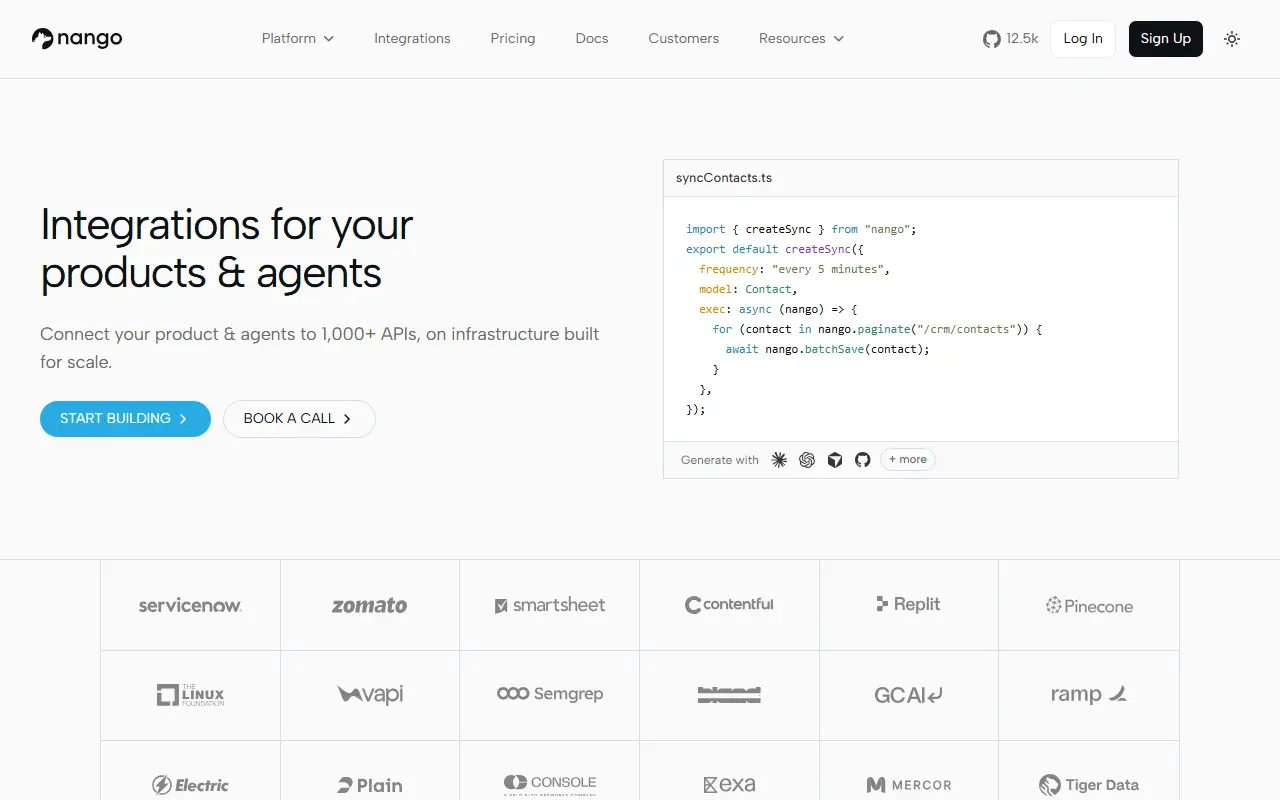
Nango is an open-source platform that helps teams build integrations into their products. It covers more than 1,000 APIs and is compatible with any backend language, AI coding tool or agent SDK. Integration logic is written as TypeScript functions, or generated by AI from a description, and deployed to Nango's production runtime, which handles authentication, execution, scaling and observability.
It is organized around three primitives. Auth provides managed OAuth, API keys and token refresh, with a white-label flow you can embed in your app, plus credential storage and multi-tenant connection management. The proxy sends authenticated requests on behalf of your users, resolving the provider, injecting credentials and handling retries and rate limits. Functions run integration code with API access, retries, storage and observability built in.
The README lists use cases including AI tool calling and MCP, one-way and two-way data syncing for RAG pipelines, webhook processing and API unification into your own schema. A hosted runtime is available, and the repository lists the licence as Other. Topics point to OAuth, access and refresh tokens and unified APIs.
Key features
- Managed OAuth and API key handling
- Token refresh and credential storage
- Authenticated proxy with retries and rate limits
- TypeScript functions on a production runtime
- AI builder for generating integrations
- Support for over 1,000 APIs
Pricing: Free plan with capped limits. Pay-as-you-go is $50 a month including $50 of credits, then $0.29 per connection plus compute and data rates; Enterprise is custom and covers self-hosting.
#3
Temporal is a durable execution platform whose server runs application workflows resiliently, retrying failed operations automatically.
- GitHub stars
- 24k
- Last commit
- yesterday
- Latest release
- v1.32.2
- Licence
- MIT
- Self-hosted
- Yes
- Hosted version
- Available
docs.temporal.io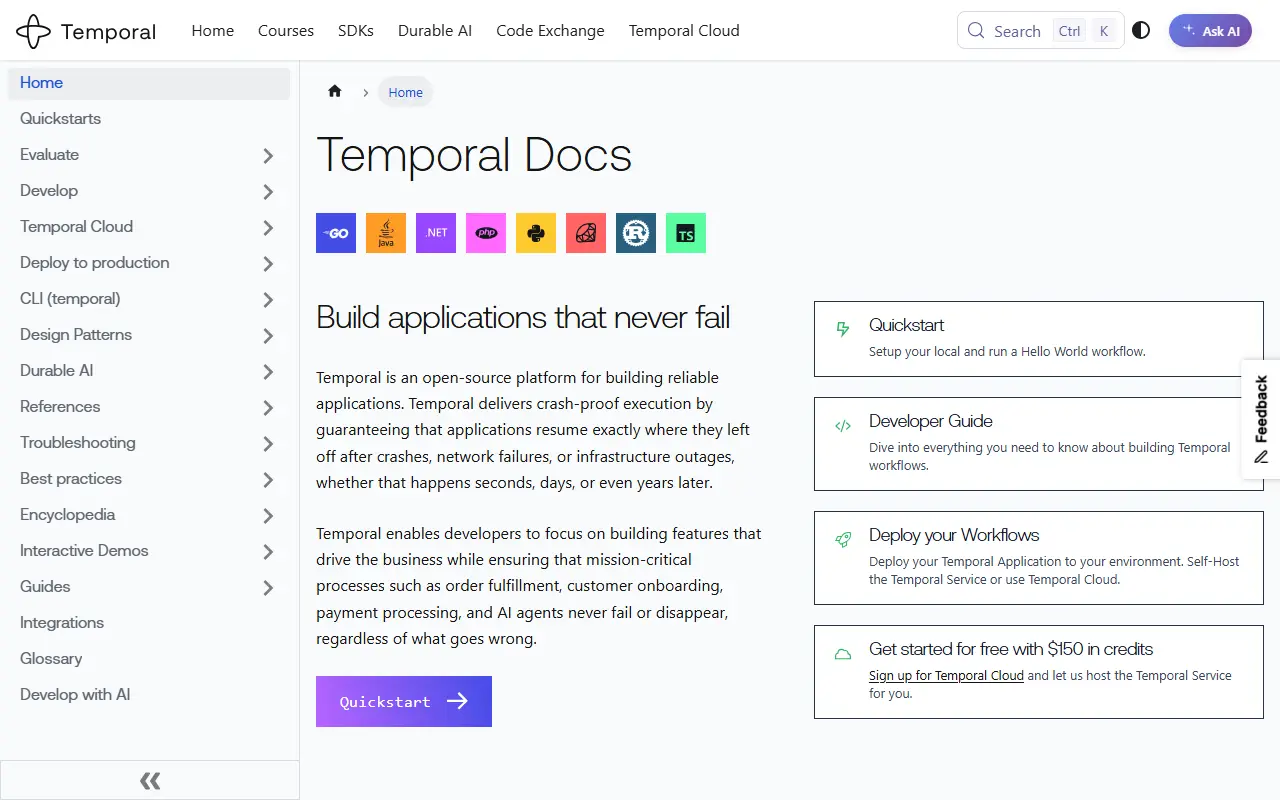
Temporal is a durable execution platform that helps developers create scalable applications while keeping both productivity and reliability. The Temporal server runs units of application logic called Workflows, handling intermittent failures and retrying failed operations automatically. It started as a fork of Uber's Cadence and is developed by Temporal Technologies, a company founded by Cadence's creators. The server is written in Go and released under the MIT license.
This repository contains the source of the server only. To implement Workflows, Activities and Workers you use one of the supported language SDKs. The getting started guide shows how to download and run a pre-built image with its dependencies locally, try samples written for Go or Java, interact with the server through the Temporal CLI, and watch workflows in the Web UI at port 8233. Repository topics cover workflow engines, distributed cron, microservice orchestration and durable execution.
Key features
- Durable execution of long-running workflows
- Automatic retries for failed operations
- SDKs for writing Workflows and Activities
- Temporal CLI for interacting with the server
- Web UI for viewing running workflows
- Distributed cron-style scheduling
Pricing: Server is free and open source under the MIT license; a managed cloud service is also offered by Temporal Technologies.
#4
A cloud-native, plugin-extensible API gateway that also handles LLM and MCP traffic, runs natively on Kubernetes and can be self-hosted or used as a cloud service.
- GitHub stars
- 44k
- Last commit
- 25 days ago
- Latest release
- 3.9.4
- Licence
- Apache-2.0
- Self-hosted
- Yes
- Hosted version
- Available
konghq.com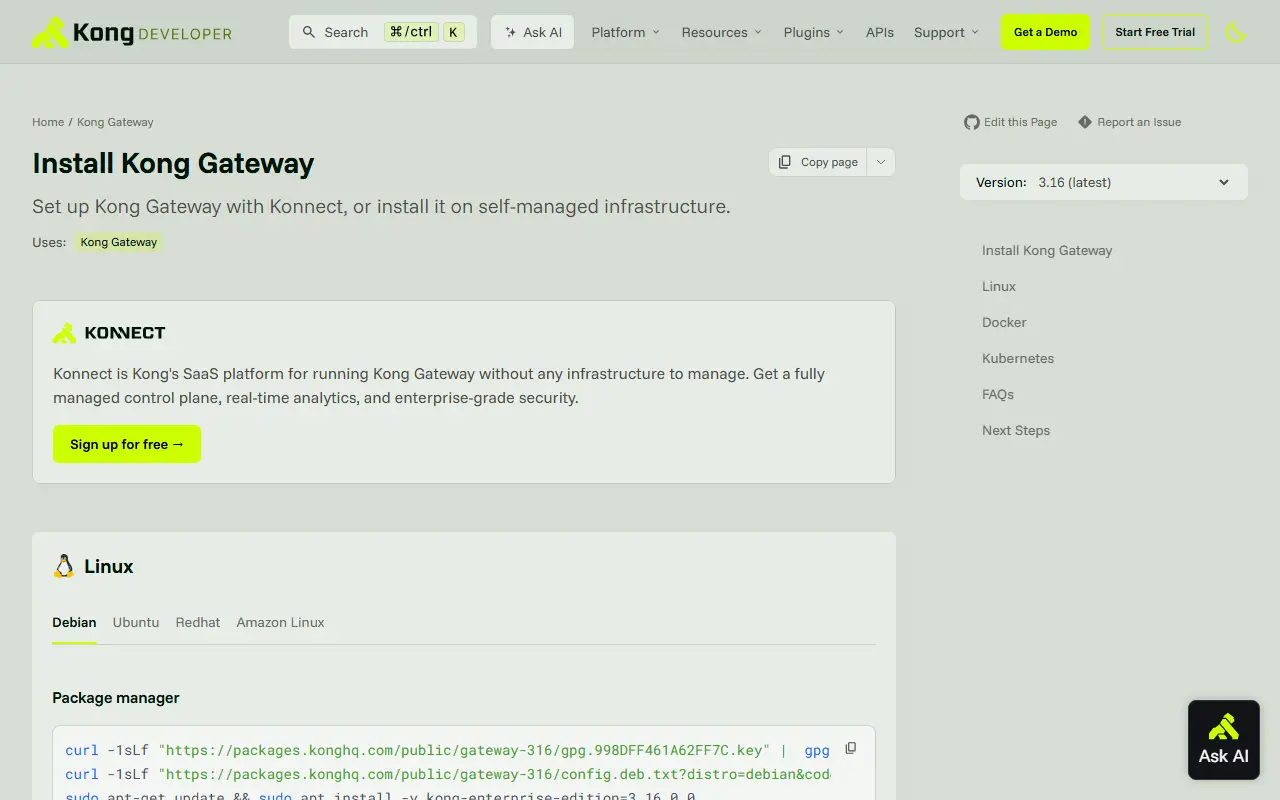
Kong, also called Kong Gateway, is a cloud-native and platform-agnostic API gateway that has expanded to cover LLM and MCP traffic. It is written in Lua, released under the Apache-2.0 license, and extended through plugins. It proxies, routes, load balances and health checks traffic and handles authentication, sitting as a central layer in front of microservices or conventional APIs.
For AI workloads it adds multi-LLM support, semantic security, and security and analytics for MCP traffic. Kong runs natively on Kubernetes through its official Ingress Controller. The quickstart uses docker-compose, adds authentication to an API in a few minutes, and a Docker procedure covers a DB-less mode, with other distributions listed on the official installation page.
You can run Kong on your own infrastructure, in the cloud, on bare metal or in containers, or sign up for a free trial of the cloud-hosted Kong Konnect. It suits platform and API teams managing many services who need a gateway with a plugin ecosystem and an upgrade path to AI traffic management.
Key features
- API gateway with routing and load balancing
- Extensible through a plugin system
- Authentication and health checking
- Multi-LLM and MCP gateway capabilities
- Kubernetes Ingress Controller
- Docker, DB-less and cloud-hosted deployment
Pricing: Kong Konnect's AI Management Plus plan starts at $25 per month plus usage, with a 30-day free trial. Enterprise is custom and billed annually; API and event management rates are not shown.
#5
Hasura GraphQL Engine gives applications a single, secure API over databases such as PostgreSQL, MongoDB, ClickHouse and SQL Server.
- GitHub stars
- 32k
- Last commit
- 2 days ago
- Latest release
- v2.51.6
- Licence
- Apache-2.0
- Self-hosted
- Yes
- Hosted version
- Available
hasura.io
Hasura GraphQL Engine is an open-source project for building applications on top of existing data through a single, composable and secure API endpoint. It creates GraphQL APIs automatically, adds fine-grained access control, and can trigger webhooks on database events. The repository holds two generations: V2, the current stable engine, and the V3 engine that powers Hasura DDN. It is released under the Apache-2.0 license.
V3 supports PostgreSQL and its flavors, MongoDB, ClickHouse and Microsoft SQL Server, and lets you write custom business logic with TypeScript, Python and Go connector SDKs. Data connectors link sources to the engine, and the connectors are available as open source from the Connector Hub. The repository's topics also mention BigQuery, REST APIs and subgraph support. The repository is a large mono-repo, so shallow clones are recommended.
Key features
- Automatic GraphQL APIs over your data
- Fine-grained access control rules
- Webhooks triggered by database events
- Support for PostgreSQL, MongoDB, ClickHouse and SQL Server
- Connector SDKs for TypeScript, Python and Go
- V2 stable engine and V3 engine in one repository
Pricing: DDN Free costs nothing. DDN Advanced starts at $30 per active model per month, with a free trial; DDN Base also has a trial but its price is not shown. Private DDN and Enterprise support are by sales.
#6
An open-source data movement platform with hundreds of connectors for ELT pipelines from APIs, databases and files into warehouses, lakes and AI applications.
- GitHub stars
- 22k
- Last commit
- today
- Latest release
- v2.0.0
- Self-hosted
- Yes
- Hosted version
- Available
airbyte.com
Airbyte is an open-source data movement platform for moving data from APIs, databases and files into data warehouses, data lakes and AI applications. Its premise is that only an open-source project can reach the long tail of data sources while letting engineers tailor existing connectors, with the aim of moving data from any source to any destination.
It offers a catalog of 600 or more connectors for APIs, databases, warehouses, lakes and AI applications, with warehouse destinations such as BigQuery, Redshift and Snowflake, and topics also mention change data capture. The README distinguishes products by job: Airbyte Open Source or Airbyte Cloud for ELT and ETL into warehouses, lakes or databases, and Airbyte Agents, a managed data and context layer, plus an open-source Agent SDK for giving AI agents and MCP clients real-time access to business data.
Airbyte is written in Python and Java, and its license is listed as 'Other' on GitHub because the project uses a mix of licenses, so review the terms for your use. It can be self-hosted or run as the managed Airbyte Cloud, and suits data teams that need many integrations without writing each pipeline by hand.
Key features
- 600+ source and destination connectors
- ELT pipelines into warehouses and lakes
- Change data capture support
- Customizable open-source connectors
- Agent SDK for AI agent data access
- Self-hosted or Airbyte Cloud
Pricing: The open-source Core edition is free to self-host. Managed cloud starts at $20 a month (Standard) or $189 a month for 40 credits (Plus); Pro and Enterprise Flex are custom. 30-day trial.
#7
A hosted integration platform for developers to connect apps and build event-driven workflows using pre-built actions plus custom Node.js, Python, Go or Bash code.
- GitHub stars
- 12k
- Last commit
- today
- Self-hosted
- No
- Hosted version
- Available
pipedream.com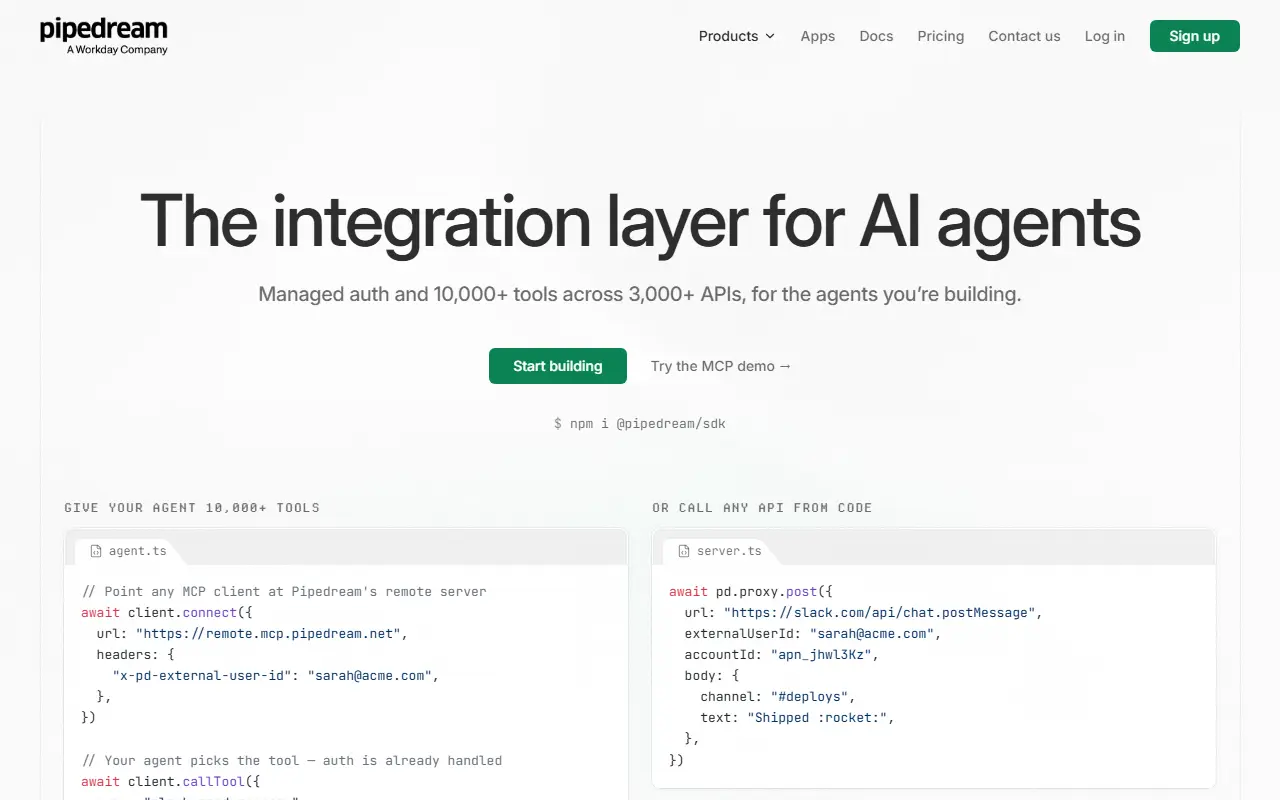
Pipedream is an integration platform for developers. It is a hosted platform, advertised as free for developers, for connecting applications and building event-driven automations. The GitHub repository holds the code for the pre-built integration components, the product roadmap and the documentation.
Workflows are sequences of steps, which can be pre-built actions or custom code, and each workflow is started by an event such as an HTTP request, a timer or a new row in a spreadsheet. Event sources emit events from services like GitHub, Slack, Airtable and RSS, while actions cover common operations such as sending a message or adding a spreadsheet row. More than 1,000 integrated applications are available, and any Node.js, Python, Go or Bash code can be run for custom logic.
The README says the company has demonstrated SOC 2 compliance. Because the platform itself is run by Pipedream, this is mostly a hosted service with an open repository of components rather than software you install, and the repository lists its license as Other. It suits developers who want webhook-driven glue code without managing servers.
Key features
- Workflows triggered by HTTP, timers or app events
- Event sources for GitHub, Slack and Airtable
- Pre-built actions across 1,000+ apps
- Custom code in Node.js, Python, Go or Bash
- Import of packages from language ecosystems
- Open repository of integration components
Pricing: Free to build and test. Startup, for production, is $150 per month ($99 billed annually) and includes 100 users and 10,000 usage credits; Business is custom.
#8
Camunda is a process orchestration platform that coordinates AI agents, people, and systems in end-to-end processes, available as SaaS or self-managed.
- GitHub stars
- 4.4k
- Last commit
- yesterday
- Latest release
- 8.10.9
- Self-hosted
- Yes
- Hosted version
- Available
camunda.com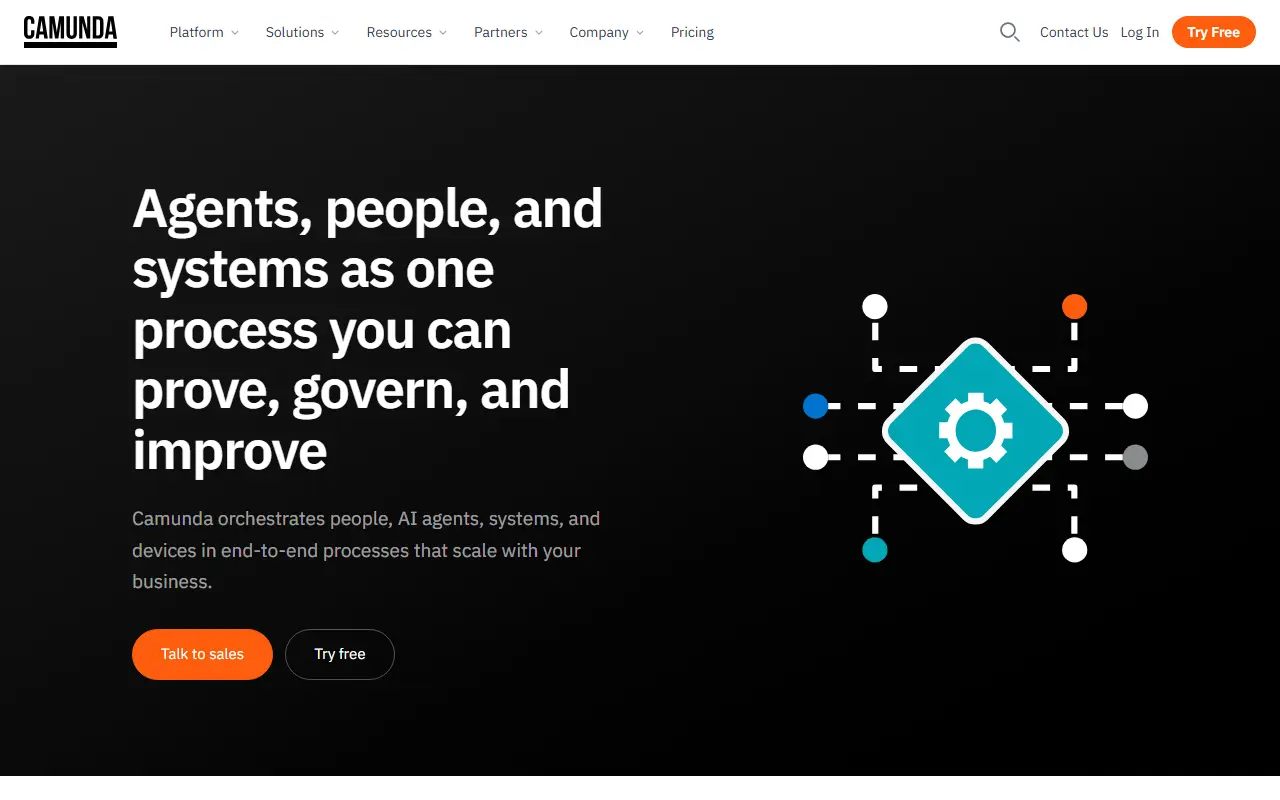
Camunda is a process orchestration platform designed for enterprise AI. It connects AI agents, people, and systems into end-to-end processes that are governed, auditable, and provable across any cloud, agent framework, or system.
The platform is vendor-agnostic, supporting any agent framework, LLM, or cloud without rewriting when the stack changes. It is available as SaaS or self-managed with the same orchestration engine and APIs. It is trusted in production by 700+ enterprises, including 9 of the top 10 US banks.
Key features
- Coordinates AI agents, humans, and systems across end-to-end business processes in one governed model.
- Supports any agent framework, any LLM, any cloud, with process logic portable as standard BPMN.
- Includes governance controls: role-based access control, policy enforcement, human-in-the-loop, audit trails, tool allow/deny lists
- Available as SaaS or self-managed with the same orchestration engine and APIs.
- Compliant with SOC 2 Type II, ISO/IEC 27001, GDPR, and offers a 99.9% SLA.

Apache Camel Karavan is a low-code platform and VS Code extension for visually designing, running and deploying Apache Camel integration microservices.
- GitHub stars
- 599
- Last commit
- 3 days ago
- Latest release
- 4.22.2
- Licence
- Apache-2.0
- Self-hosted
- Yes
camel.apache.org
Apache Camel Karavan is a low-code data integration platform that simplifies the Apache Camel experience by letting teams design integration microservices visually and deploy them quickly. It aims to give the full power of Apache Camel through a visual tool, from low-code use cases to pro-code projects, drawing on more than ten years of community experience.
The designer supports Enterprise Integration Patterns, over 300 integration components, a REST API designer with an OpenAPI to REST DSL generator, YAML for integrations with Java for custom code, a route designer and a topology view. The deployer provides shell scripts for building and deploying and predefined customizable configurations for different platforms, and a developer dashboard offers hot reload, live logs and tracing of exchange data. Architecturally, the Karavan app manages projects, a build container packages and runs integrations, a Git repository stores project files as the source of truth, and an image registry holds built container images.
A VS Code extension provides a local developer experience for designing and running integrations on a laptop and deploying to Kubernetes or OpenShift. The platform can be installed on Docker, Kubernetes or OpenShift, is part of the Apache Software Foundation and is licensed under Apache-2.0.
Key features
- Visual route and REST API designer
- 300+ Camel integration components
- Enterprise Integration Patterns
- Hot reload and live logs
- VS Code extension for local development
- Deployment to Docker, Kubernetes and OpenShift
Pricing: Free and open source under the Apache-2.0 license.
Commercial Paragon alternatives
Hosted, closed-source products that compete with Paragon. Showing 12 of 17.
- View tool
Embedded integration platform that lets SaaS vendors offer native customer integrations
SaaS
- View tool
Embedded integration platform for B2B software companies
SaaS
- View tool
Unified API platform for integrating with accounting, CRM, HRIS and file storage apps
SaaS
- View tool
Unified API for integrating with many HR, CRM and ticketing systems
SaaS
- View tool

SnapLogic
Workflow Automation
Visual iPaaS for building data pipelines and application integrations
SaaS
- View tool

Tray.ai
Workflow Automation
Low-code platform for building enterprise integrations, automations and AI agents
SaaS
- View tool
Cloud integration, API management and data automation platform for enterprises
SaaS
- View tool

Celigo
Workflow Automation
Integration platform as a service with prebuilt apps for NetSuite, Shopify and Salesforce
SaaS
- View tool

Jitterbit
Workflow Automation
Low-code integration and API platform with an automation library for mid-size firms
SaaS
- View tool

MuleSoft
Workflow Automation
Salesforce's API-led integration platform for connecting apps, data and devices
SaaS
- View tool

Workato
Workflow Automation
Enterprise integration and automation platform with recipes, connectors and AI agents
SaaS
- View tool

Zapier
Workflow Automation
Zapier is a no-code automation platform that connects thousands of apps, with AI agents, tables, forms and an MCP integration for AI tools.
SaaS
See every Paragon alternative on its tool page
Paragon alternatives: questions
- What is the best open-source alternative to Paragon?
- n8n is the top-ranked open-source alternative to Paragon on Enlisted: A fair-code workflow automation platform that mixes a visual canvas with custom code and AI agent features, for teams connecting apps and automating processes. Other strong options are Nango, Temporal, Kong and Hasura.
- What are the best commercial alternatives to Paragon?
- Cyclr, Prismatic, Apideck, Merge and SnapLogic are among the hosted, closed-source alternatives to Paragon listed on Enlisted, which lists 17 in total. Compare their pricing and features on each tool page.
- Are these Paragon alternatives free?
- All 9 are open source, so the code is free to use under its licence, and 8 of them can be self-hosted on your own server or computer. 8 also offer a paid or managed cloud version if you'd rather not host it yourself.
- How is this list of Paragon alternatives ranked?
- By a score built from GitHub stars, star growth over the last 30 days and how recently the code changed. 9 of these projects shipped code in the last 30 days. Data is refreshed daily, and nobody can pay to move up.
 TrackMedia
 TrackRev