#1
Jenkins is an open-source, Java-based automation server for building, testing and deploying software, extended through plugins.
- GitHub stars
- 27k
- Last commit
- yesterday
- Latest release
- jenkins-2.590
- Licence
- MIT
- Self-hosted
- Yes
jenkins.io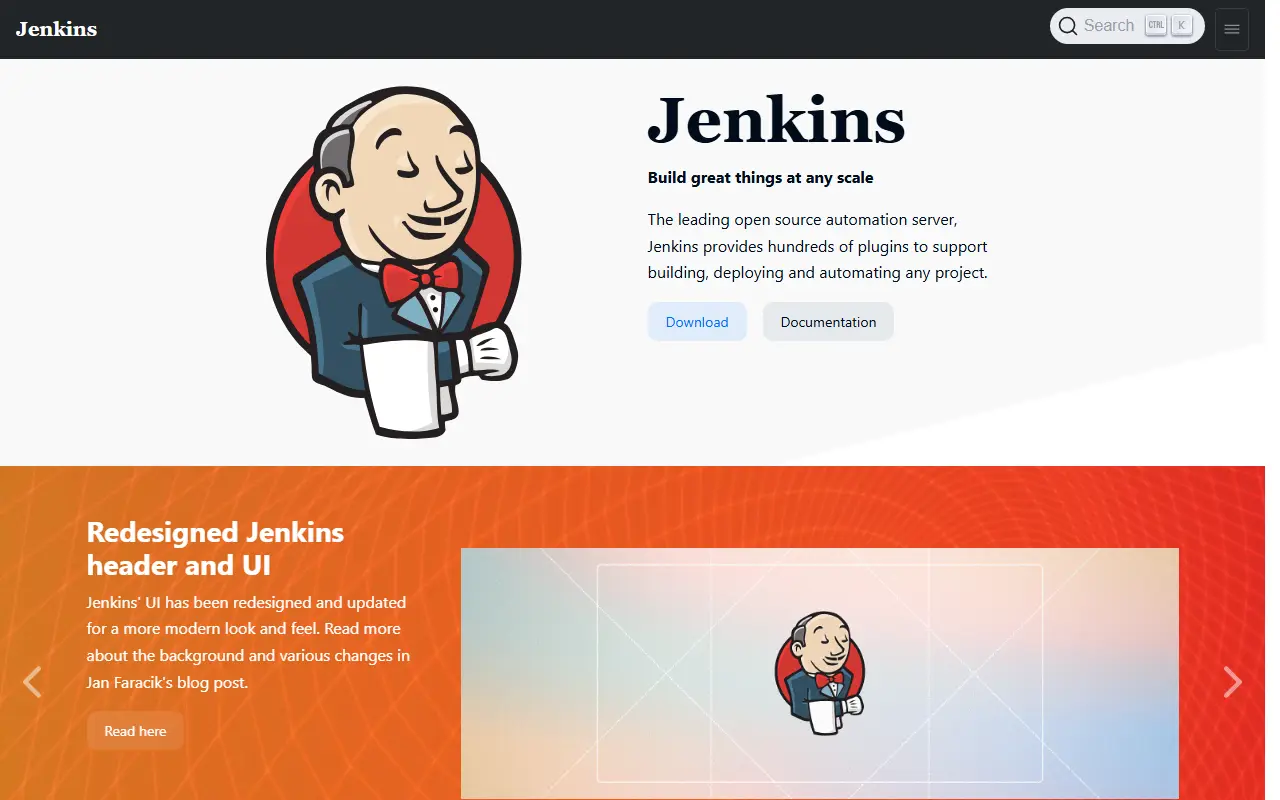
Jenkins is an open-source automation server written in Java. Teams use it to automate parts of their development workflow, including building projects, running tests to catch bugs early, performing static code analysis and deploying software. The README states that more than 2,000 plugins extend it to automate nearly any task. It is released under the MIT license, and its topics include continuous integration, delivery and pipelines as code.
The project distributes official downloads as WAR archives, Docker images, and native packages or installers for several Linux distributions and Windows. Two release lines exist: weekly releases carrying all new features and fixes, and Long-Term Support releases that receive periodic backported bug fixes. The repository links to contributing guidelines, good first issues, developer documentation, governance and adopters information. As a self-managed server, you operate and secure your own Jenkins instance.
Key features
- Automation server for build, test and deploy
- Plugin ecosystem with over 2,000 plugins
- Pipelines as code
- WAR, Docker image and native package installs
- Weekly and Long-Term Support release lines
- Static code analysis and deployment automation
Pricing: Free and open source under the MIT license.
#3
A lightweight, extensible CI/CD engine that runs pipelines in containers, using SQLite by default and used as the main CI at Codeberg.
- GitHub stars
- 8.2k
- Last commit
- yesterday
- Latest release
- v3.20.1
- Licence
- Apache-2.0
- Self-hosted
- Yes
woodpecker-ci.org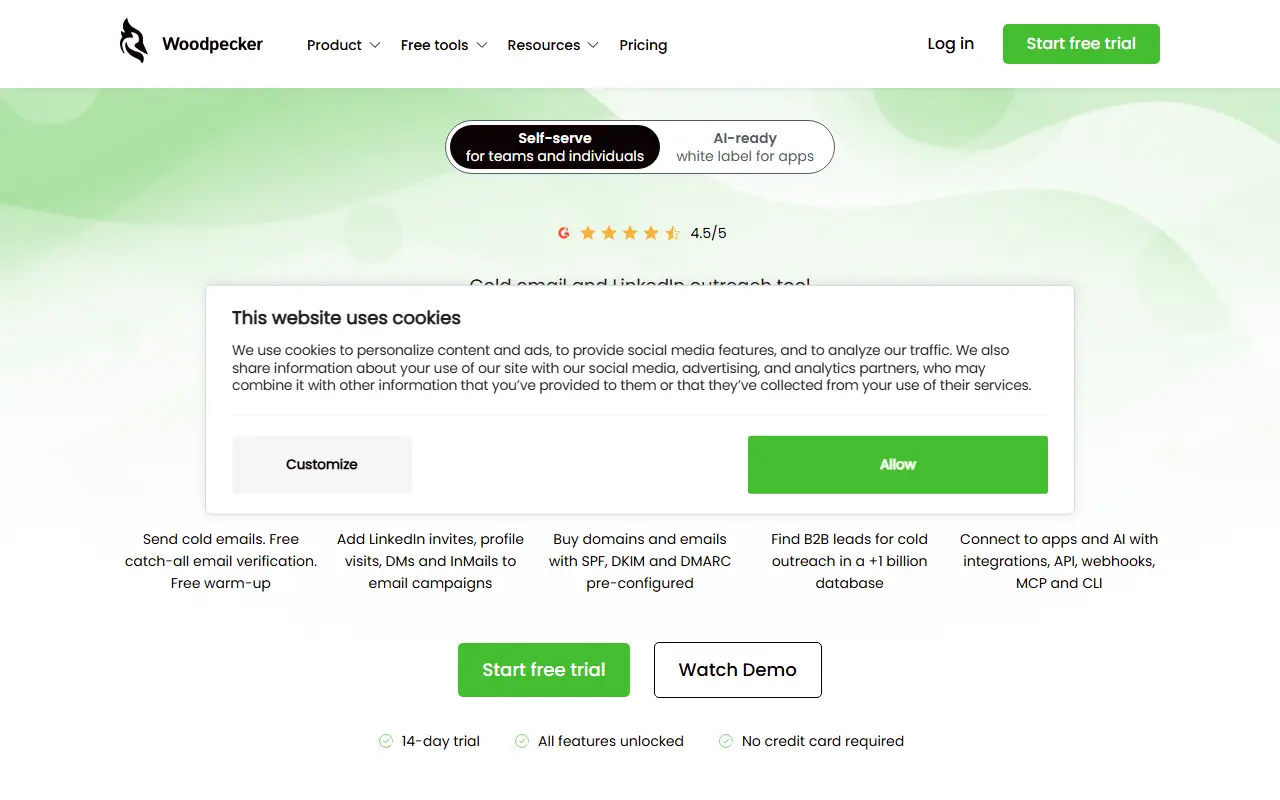
Woodpecker is a simple CI/CD engine with a plugin system for extending what pipelines can do. It can be installed in several ways, including Docker and Kubernetes, and runs with SQLite as the default database, so a small setup needs little more than a server and one or more agents.
The README says the server needs around 100 MB of memory and the agent about 30 MB when idle, which makes it suitable for modest hardware. Plugins are browsed on a dedicated overview website and include both core-team and community-maintained ones. Translations are managed on a self-hosted Weblate instance, and the project is supported through Open Collective and GitHub Sponsors.
Woodpecker is written in Go and licensed under Apache-2.0, with documentation under Creative Commons Attribution-ShareAlike. Codeberg, a Git hosting platform focused on privacy and free software, uses it as its main CI/CD engine. It suits teams and individuals who self-host Git and want a lean container-based pipeline runner.
Key features
- Container-based CI/CD pipelines
- SQLite by default for small installs
- Plugin system with community plugins
- Low idle memory for server and agent
- Docker and Kubernetes installation
- Translations managed in Weblate
Pricing: Free and open source under the Apache-2.0 licence.
#4
Build framework combining Dockerfile and Makefile ideas for repeatable, cached, containerized builds; the project is no longer actively maintained.
- GitHub stars
- 12k
- Last commit
- 17 days ago
- Latest release
- v0.8.16
- Licence
- MPL-2.0
- Self-hosted
- Yes
earthly.dev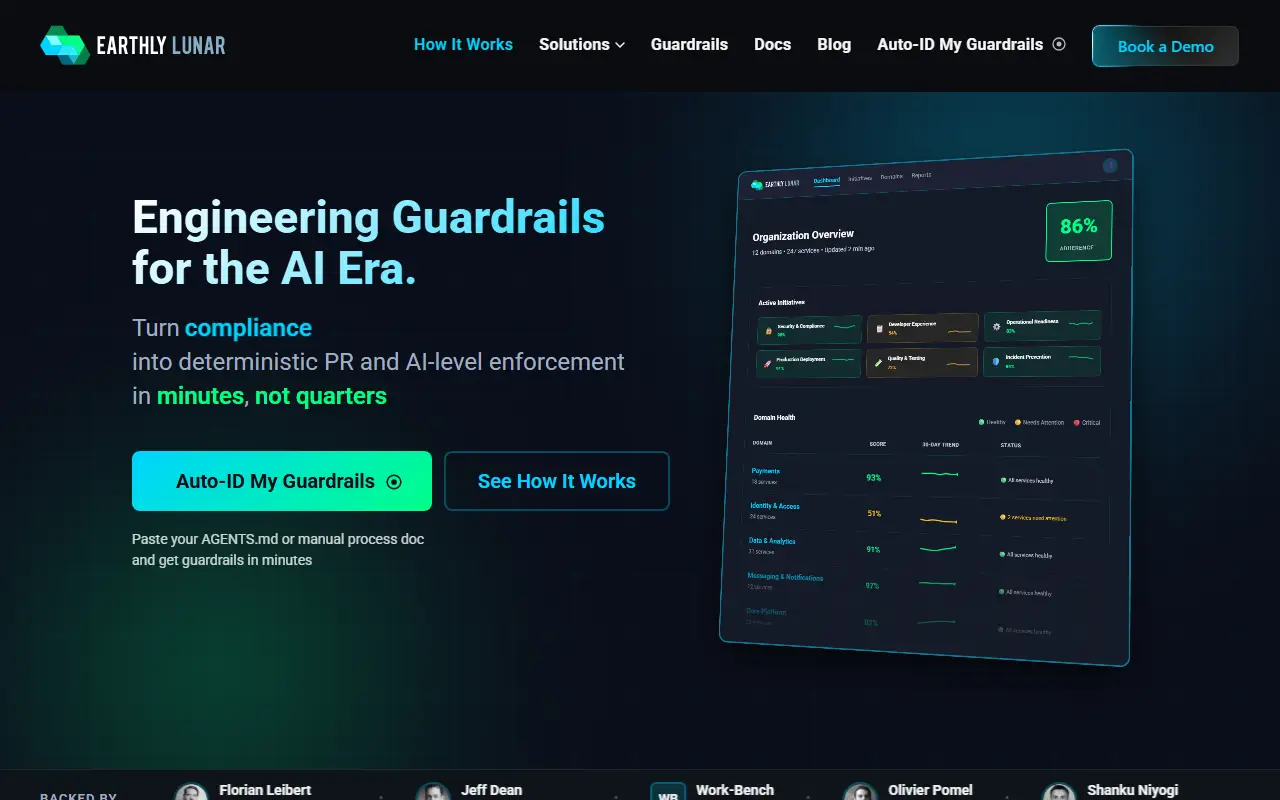
Earthly is a build framework with a syntax that resembles a mix of Dockerfile and Makefile. It describes itself as Docker for builds: you write a build once and run it on a laptop, on a remote machine, or in any CI system with the same result. It is written in Go and released under the MPL-2.0 license.
Its promises are repeatable builds, simple syntax, compatibility with any language or build tool that runs on Linux, suitability for monorepos and polyrepos, fast builds through caching and parallel execution, and reuse of build logic across projects. Containers underpin the isolation.
The README notes prominently that Earthly is no longer actively maintained, so teams considering it should weigh that against alternatives and consider community forks. It remains relevant for existing users and for those who want to study a container-based build system.
Key features
- Dockerfile-like syntax with Makefile targets
- Repeatable containerized builds
- Build caching and parallel execution
- Works with any language that runs on Linux
- Reusable build definitions for monorepos
- Same build locally and in CI
Pricing: Free and open source under the MPL-2.0 license; no longer actively maintained.
#5
A container-based automation system in Go, mostly used for CI/CD, that defines pipelines declaratively and runs them on stateless workers.
- GitHub stars
- 7.9k
- Last commit
- today
- Latest release
- v8.3.3
- Licence
- Apache-2.0
- Self-hosted
- Yes
concourse-ci.org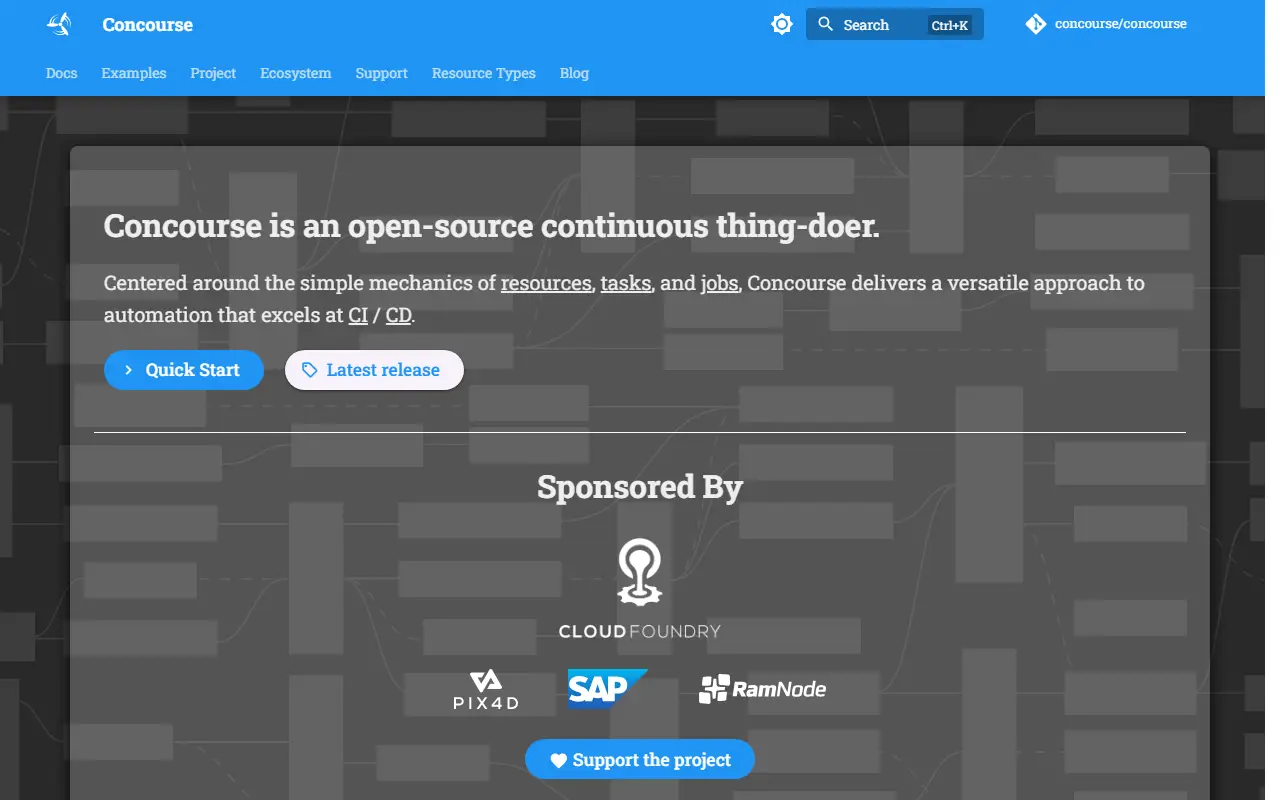
Concourse is an automation system written in Go, most often used for CI/CD and built to scale from simple to complex pipelines. It is deliberately opinionated: the project emphasizes idempotency, immutability, declarative configuration, stateless workers and reproducible builds.
It is distributed as a single concourse binary on the releases page, and other supported formats include a Docker image, a Kubernetes Helm chart and a BOSH release. A quick start walks through running it locally. Topics show that tasks run in containers using containerd and runc, and the web interface was built with Elm.
Concourse is licensed under Apache-2.0. It is run on your own infrastructure by teams that prefer pipelines described as code, with each job's inputs and outputs explicit, over scripts configured through a UI. It suits platform and DevOps teams wanting repeatable, container-isolated build and deploy pipelines.
Key features
- Declarative pipeline configuration
- Container-based task execution
- Stateless workers for scaling
- Reproducible builds by design
- Single binary distribution
- Docker, Helm and BOSH packaging
Pricing: Free and open source under the Apache-2.0 licence.
#6
GoCD is a continuous delivery server that models build, test and release pipelines, sponsored by Thoughtworks and written mainly in Java and TypeScript.
- GitHub stars
- 7.4k
- Last commit
- today
- Latest release
- 26.1.0
- Licence
- Apache-2.0
- Self-hosted
- Yes
gocd.org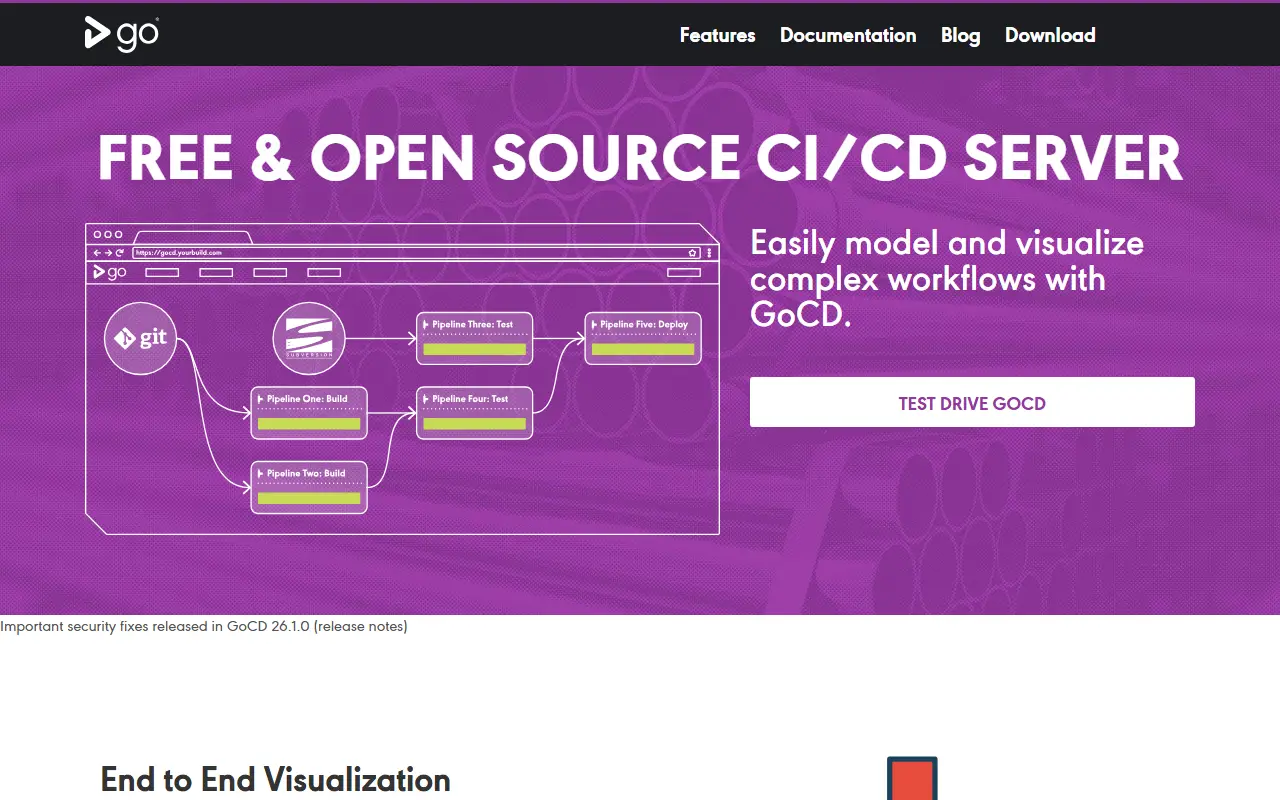
GoCD is a continuous delivery server that helps automate and streamline the build, test and release cycle so that software can be delivered continuously with fewer worries. The repository is the project's main code base, and the project is sponsored by Thoughtworks.
Newcomers can use the Test Drive GoCD page to build a first pipeline while learning the key concepts, download releases from the website and read the documentation for detailed help. It is predominantly a Java and TypeScript project that uses the Spring Framework, SparkJava and MithrilJS, is built with Gradle and Webpack and runs inside Eclipse Jetty, with a few older parts rendered server-side in JRuby on Rails. GoCD itself is built with GoCD.
The security policy explains how issues are reported, and contributing guides cover the development environment. GoCD is licensed under Apache-2.0 and is hosted by you. It suits teams that model deployment pipelines with explicit stages and dependencies across several services.
Key features
- Pipelines for build, test and release
- Test drive guide for first pipelines
- Continuous delivery server
- Java and TypeScript code base
- Security policy and responsible disclosure
- Built and released using GoCD itself
Pricing: Free and open source under the Apache-2.0 licence.
#7
A self-hosted GitHub Actions runner service for AWS that launches a fresh EC2 instance per job and scales back to zero.
- GitHub stars
- 1.4k
- Last commit
- yesterday
- Latest release
- v3.6.1
- Licence
- MIT
- Self-hosted
- Yes
runs-on.com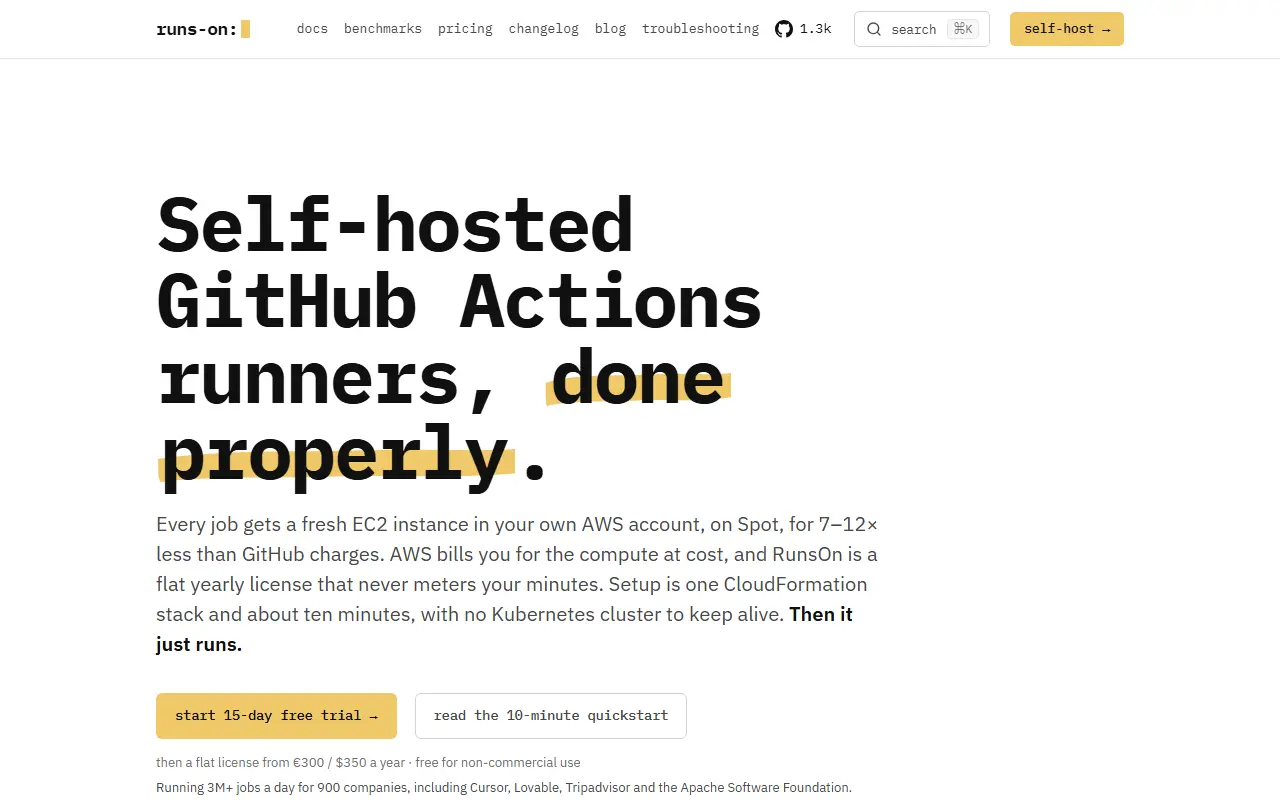
RunsOn is a control plane for self-hosted GitHub Actions runners on AWS. For every workflow job it launches an isolated EC2 instance with a runner image compatible with GitHub's own Linux images, so existing actions and toolchains keep working while the compute runs in your own AWS account.
You keep control of IAM, networking, images, caches and the AWS bill, and the project says there is no per-minute markup, only spot or on-demand EC2 rates. Setup is done with a CloudFormation stack or Terraform module, runners scale back to zero when idle, and you can pick high-frequency instance families or GPU types. It is presented as an alternative to Actions Runner Controller without needing a Kubernetes cluster.
The repository is licensed under MIT and is meant to run inside your AWS account, with documentation and a cost calculator on the project website. Its topics mention on-premise and self-hosted runners as well. It suits engineering teams with heavy GitHub Actions usage who want to cut CI spend and gain more control over runner hardware.
Key features
- Fresh EC2 runner for every job
- Compatible with GitHub Linux runner images
- CloudFormation or Terraform deployment
- Spot and on-demand instance support
- Scales to zero when idle
- Runs inside your own AWS account
Pricing: Free for non-commercial use. Commercial licenses are flat per year per legal entity: Starter from €300, Growth €900, Scale €1,800 and Enterprise €3,600, with a 15-day trial; AWS compute is billed separately.
#8
A Rust build cache and remote execution server compatible with Bazel, Buck2, Pants and other build systems that speak the remote execution protocol.
- GitHub stars
- 1.6k
- Last commit
- today
- Latest release
- v1.8.5
- Self-hosted
- Yes
nativelink.com
NativeLink is a high-performance build cache and remote execution server written in Rust. It speeds up compilation and testing by storing build artifacts so unchanged targets are not rebuilt, and by distributing build and test actions across multiple machines, which also helps reduce infrastructure costs for large projects.
It is compatible with Bazel, Soong, Pants, Buck2, Reclient and other build systems that support the remote execution API, and it supports specialized hardware for workloads such as GPU builds and simulation. The project highlights use cases including very large monorepos, robotics and autonomous vehicle stacks, semiconductor design flows and bioinformatics pipelines. It is powered by Nix, and the repository includes files for AI agents.
NativeLink is self-hosted infrastructure that teams deploy for their CI systems and developer laptops, and the README says it is used in production by the company behind it. The repository lists its licence as other, so check the project's terms before adopting it. It suits build and developer-productivity engineers who run large Bazel or Buck2 codebases.
Key features
- Shared build cache for build artifacts
- Remote execution across multiple machines
- Compatible with Bazel, Buck2, and Pants
- Support for Soong and Reclient
- Specialized hardware support
- Rust implementation with Nix tooling
Pricing: The open-source edition is free to self-host. Enterprise is priced annually through a conversation with the team, with no per-user pricing.
Namespace alternatives: questions
- What is the best open-source alternative to Namespace?
- Jenkins is the top-ranked open-source alternative to Namespace on Enlisted: Jenkins is an open-source, Java-based automation server for building, testing and deploying software, extended through plugins. Other strong options are GitLab Community Edition, Woodpecker CI, Earthly and Concourse CI.
- What are the best commercial alternatives to Namespace?
- Blacksmith, AppVeyor, Semaphore, Azure Pipelines and Buildkite are among the hosted, closed-source alternatives to Namespace listed on Enlisted, which lists 13 in total. Compare their pricing and features on each tool page.
- Are these Namespace alternatives free?
- All 8 are open source, so the code is free to use under its licence, and all of them can be self-hosted on your own server or computer. 1 also offers a paid or managed cloud version if you'd rather not host it yourself.
- How is this list of Namespace alternatives ranked?
- By a score built from GitHub stars, star growth over the last 30 days and how recently the code changed. 8 of these projects shipped code in the last 30 days. Data is refreshed daily, and nobody can pay to move up.
 TrackMedia
 TrackRev