7,363 open-source and SaaS tools, with GitHub stats refreshed every day.

11 alternatives ranked by real activity

Open-source Microsoft Teams alternatives

A curated, ranked list of the 11 best open-source alternatives to Microsoft Teams.

The best open-source alternative to Microsoft Teams is Rocket.Chat. If that doesn't suit you, other good options are Mattermost, Zulip, Element and Synapse.

Microsoft Teams alternatives are mainly team chat tools, but some are also video conferencing tools. 10 of them shipped code in the last 30 days, 11 can be self-hosted, and 4 use a permissive licence.

Last updated October 2, 2026 · ranked by GitHub stars, growth and recent commits

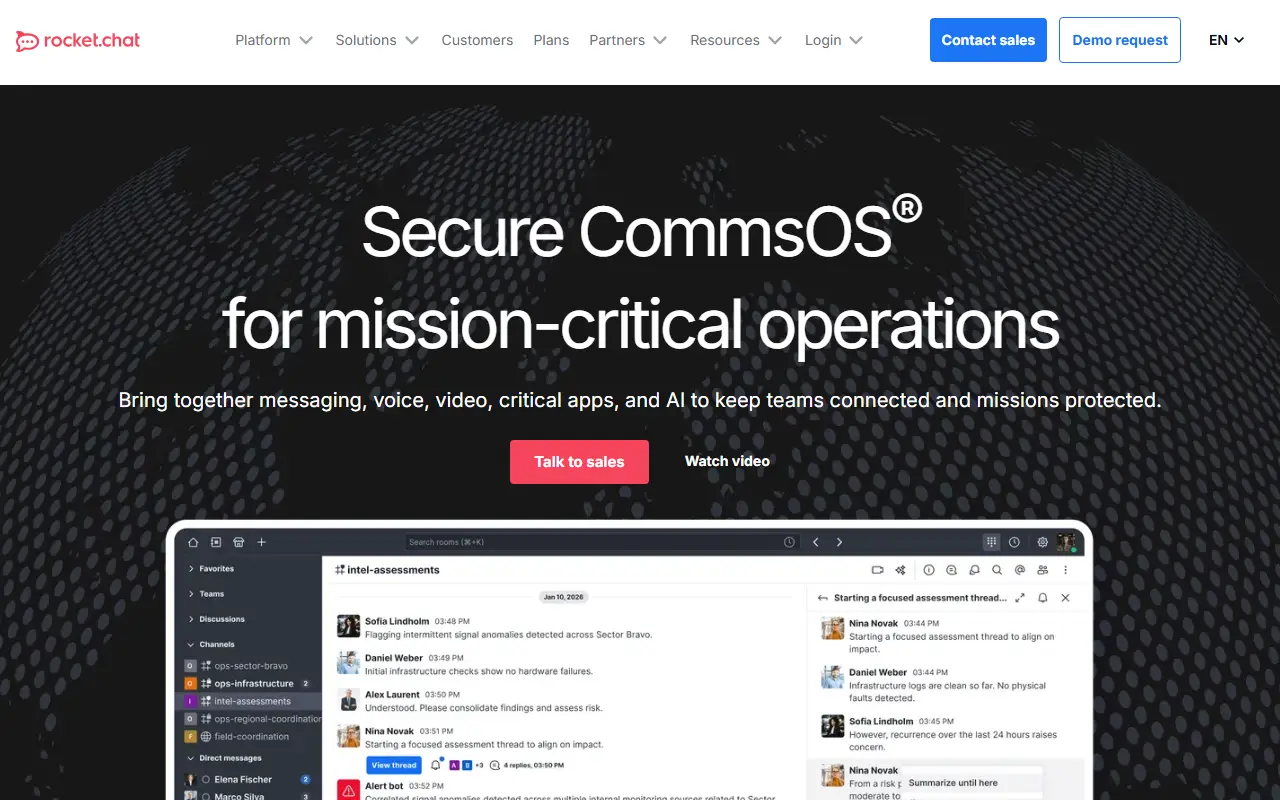
Rocket.Chat

A customizable team communications platform with real-time chat and video, aimed at organizations with strict data protection needs and offered self-hosted, cloud or air-gapped.

GitHub stars
46k
Last commit
yesterday
Latest release
8.8.1
Self-hosted
Yes
Hosted version
Available
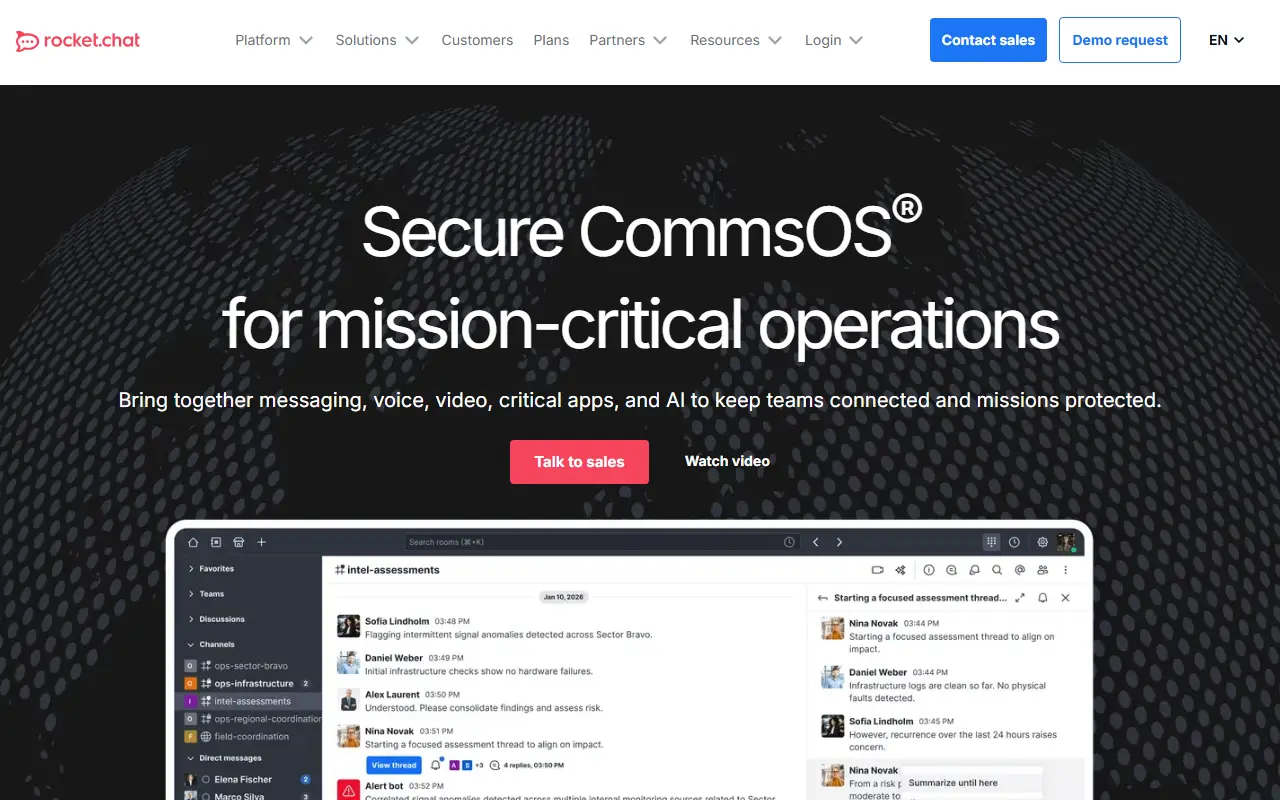
rocket.chatRocket.Chat homepage screenshot

Rocket.Chat is a communications platform written in TypeScript for teams and organizations that care about data protection. It supports real-time conversations between colleagues, with partner companies, and with customers or citizens, and its topics place it in the same space as Slack, with WebRTC for calls and meetings.

The product emphasizes control over where and how it runs. Deployment options include self-hosted servers, a managed cloud and fully air-gapped environments, with a scalable architecture and performance monitoring for workspace administration. Security and sovereignty features, including identity management, are a core part of the pitch, and the platform is built to be highly customizable, so organizations can adapt it to their own workflows and integrations.

The repository's license is listed as 'Other' on GitHub, although the topics reference an MIT-licensed community core, so confirm which components fall under which terms before relying on it commercially. It suits government bodies, enterprises and regulated industries that want a Slack-style tool they can host themselves.

Key features

  • Real-time team messaging and channels
  • Video conferencing built on WebRTC
  • Self-hosted, cloud and air-gapped deployment
  • Scalable architecture with performance monitoring
  • Identity and security controls for data sovereignty
  • Highly customizable platform

Pricing: Rocket.Chat does not publish prices. Commercial, Government and Defense plans are quoted through its sales team, with on-premise and air-gapped deployment options.


Read more about Rocket.ChatWebsite GitHub

Mattermost

A self-hosted, open-core collaboration platform combining team chat, automated workflows, voice calls, screen sharing and AI integrations.

GitHub stars
39k
Last commit
today
Latest release
v11.11.1
Self-hosted
Yes
Hosted version
Available
mattermost.comMattermost homepage screenshot

Mattermost is an open-core collaboration platform you host yourself, covering team chat, workflow automation, voice calls, screen sharing and AI integrations. This repository is the primary source for core development of the platform. The server is built with Go and React, ships as one Linux binary and depends on PostgreSQL. GitHub lists the license as 'Other'.

Each month, on the 16th, a newly compiled release is published under the MIT license. You can deploy Mattermost on-premises or try it in the cloud. The project highlights use cases such as DevSecOps, incident resolution and IT service desk, and it offers native clients for Android, iOS, Windows, macOS and Linux in addition to the web interface.

Installation options include Docker, Ubuntu, a tar archive, Kubernetes, Helm and an Omnibus package. Developers can build integrations through APIs, webhooks, slash commands, Apps and plugins, and the repository links product and developer documentation, security bulletins and contribution guides. It suits engineering, security and operations teams that want controlled, self-managed team messaging.

Key features

  • Team chat with channels and threads
  • Built-in workflow automation
  • Voice calling and screen sharing
  • Integration with AI tools
  • Single Linux binary with PostgreSQL
  • Native mobile and desktop apps
  • APIs, webhooks, slash commands and plugins

Pricing: Mattermost does not publish prices. Professional, Enterprise and Enterprise Advanced are quoted through sales; a limited-use edition and a 1-hour trial environment are offered for evaluation.

Read more about MattermostWebsite GitHub

Zulip

An open-source team chat app that organizes conversations into topic-based threads, designed for both live and asynchronous discussion, available hosted or self-hosted.

GitHub stars
26k
Last commit
today
Latest release
12.3
Licence
Apache-2.0
Self-hosted
Yes
Hosted version
Available
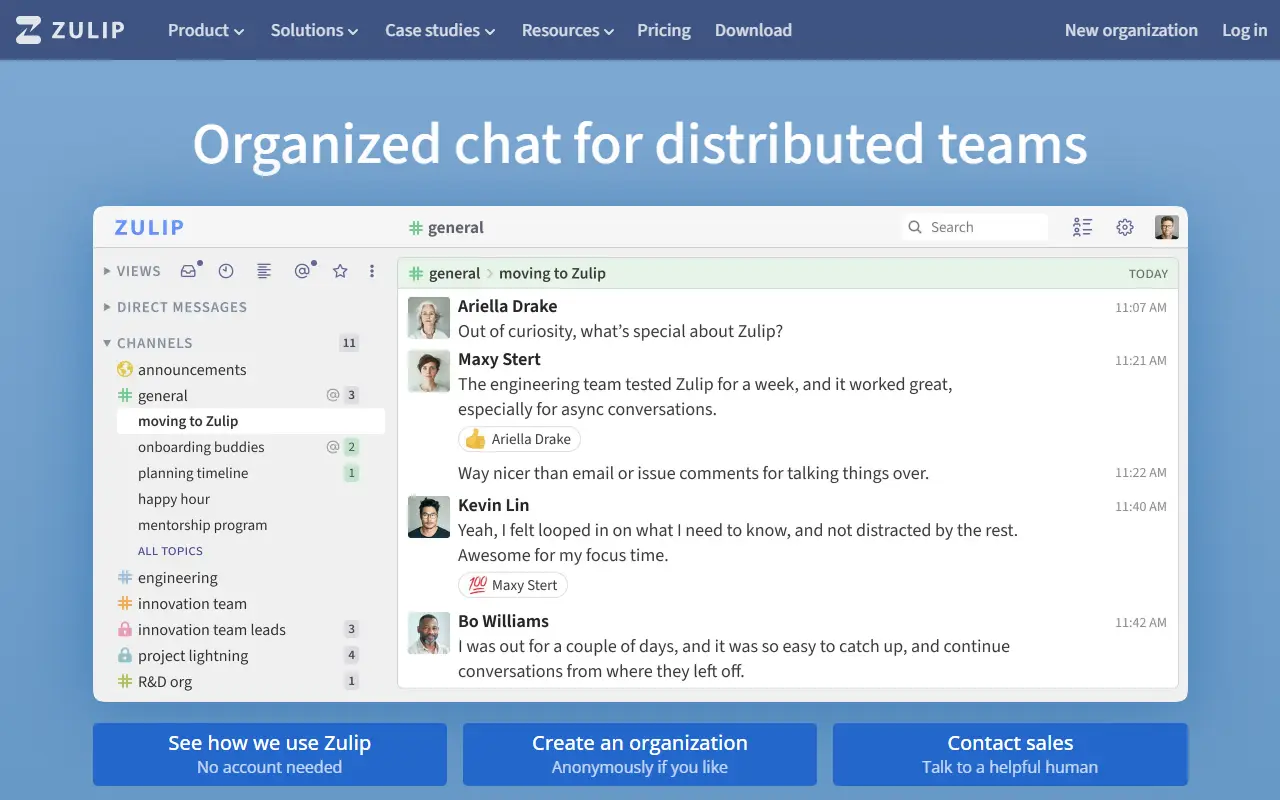
zulip.comZulip homepage screenshot

Zulip is an open-source team chat application whose defining feature is topic-based threading within channels. The idea is to blend the strengths of email and chat, so that remote and distributed teams can follow several conversations at once and catch up later without losing context. Its topics tag it as a Slack alternative.

The project is developed by a distributed community, with more than a thousand contributors and a steady flow of commits each month, and it says it has put effort into readable, tested code and extensive contributor documentation. The server is a Python web application, and there are web, desktop, built on Electron, and mobile clients, built with React Native. Zulip is used by companies and open-source projects alike, and the README says it is designed for both live and asynchronous communication.

Zulip is licensed under Apache-2.0. You can run the server on your own infrastructure, which gives full control over data, or use the hosted service operated by the project's company. It suits teams that find flat channel-based chat chaotic and want a more structured way to keep discussions organized.

Key features

  • Topic-based threading in channels
  • Live and asynchronous conversations
  • Web, desktop and mobile clients
  • Self-hosted server or hosted service
  • Extensive contributor documentation
  • Python and JavaScript codebase

Pricing: Cloud has a free plan, with Standard at $8 and Plus at $12 per user per month ($6.67 and $10 billed annually). Self-hosted is free, with Basic at $3.50 and Business at $8 per user per month; Enterprise is by contact.

Read more about ZulipWebsite GitHub

Element

Web and desktop client for the Matrix network, offering encrypted chat, rooms and collaboration built on the Matrix JS SDK.

GitHub stars
14k
Last commit
today
Latest release
v1.12.30
Licence
AGPL-3.0
Self-hosted
Yes
Hosted version
Available
element.ioElement homepage screenshot

Element Web is a client for Matrix, the open protocol for decentralized messaging. It is the web and desktop application formerly known as Vector and Riot, and it lets people join rooms, chat in teams and communities, and collaborate across Matrix servers rather than inside a single vendor's network.

The client is built with TypeScript on top of the Matrix JS SDK. The README defines support tiers for browsers, covering recent versions of Chrome, Firefox, Edge and Safari on desktop, best-effort handling for ESR and extended-stable releases, and community support for mobile web. For phones and tablets the maintainers recommend the native Element X apps for Android and iOS.

It is released under the AGPL-3.0 license and is typically served from your own web host or used through the hosted app from the vendor, Element. Related products such as Element Call and the Enterprise Server Suite are mentioned as part of the wider Element offering. Changes are tracked on GitHub with regular release cycles.

Key features

  • Matrix web client for rooms and chat
  • Desktop app built from the same code
  • Built on the Matrix JS SDK
  • Documented browser support tiers
  • Works alongside Element X mobile apps

Pricing: Element Enterprise is priced per seat per month and Sovereign per deployment, but no prices are published; buyers are directed to talk to an expert.

Read more about ElementWebsite GitHub

Synapse

Synapse is a Matrix homeserver written in Python and Rust, used to host accounts and chat rooms on the decentralized Matrix network.

GitHub stars
4.7k
Last commit
today
Latest release
v1.162.0
Licence
AGPL-3.0
Self-hosted
Yes
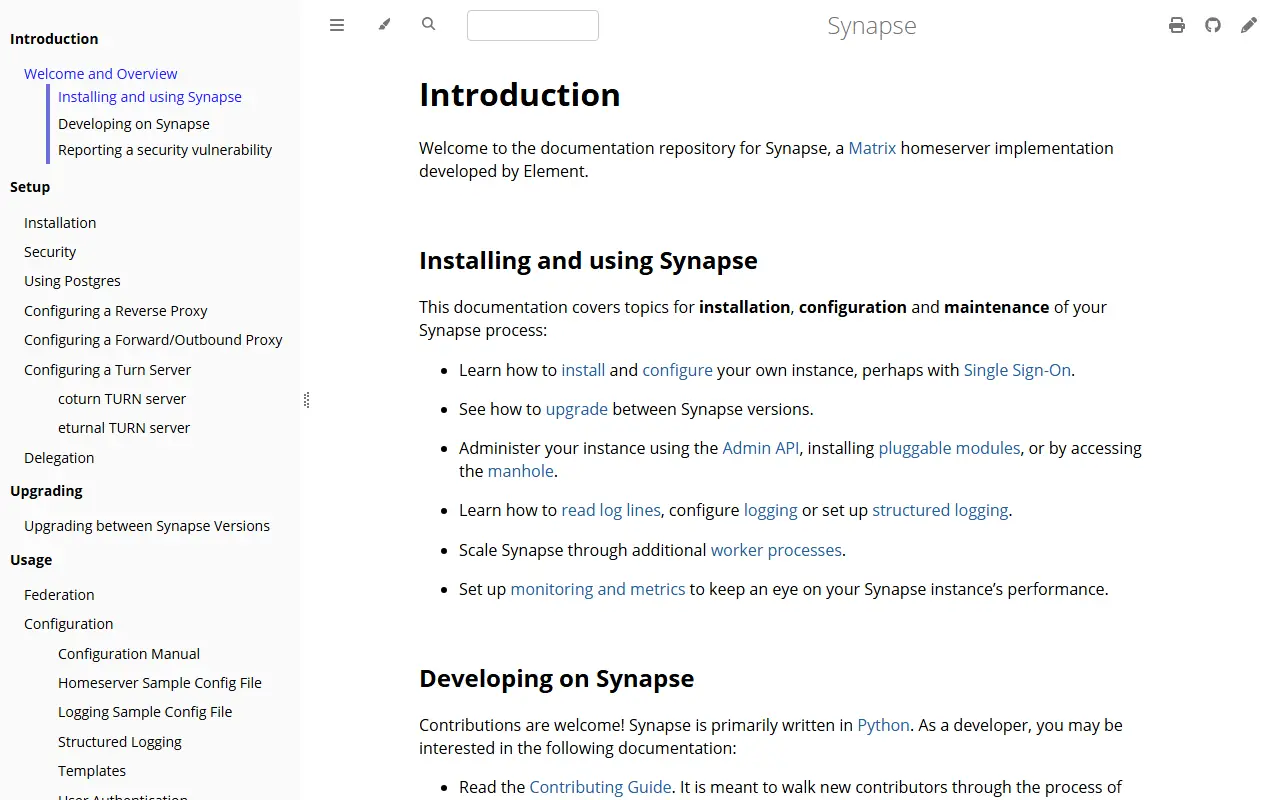
element-hq.github.ioSynapse homepage screenshot

Synapse is a homeserver for the Matrix protocol, an open standard for decentralized, federated chat and real-time communication. It is written in Python using the Twisted framework, with performance-sensitive parts implemented in Rust, and is developed under the element-hq organization.

Running a homeserver lets a person or organization host their own accounts and chat rooms while still communicating with users on other Matrix servers. Synapse is licensed under AGPL-3.0, and its documentation is published at element-hq.github.io/synapse.

Key features

  • Matrix homeserver implementation
  • Federation with other Matrix servers
  • Python and Rust codebase
  • Hosts accounts and chat rooms
  • Self-hosted chat backend

Pricing: Free and open source under the AGPL-3.0 licence.

Read more about SynapseWebsite GitHub

MiroTalk SFU

Self-hosted WebRTC video conferencing platform built on a mediasoup SFU, offered as an alternative to Zoom, Google Meet, Jitsi Meet, and Microsoft Teams.

GitHub stars
3.1k
Last commit
today
Licence
AGPL-3.0
Self-hosted
Yes
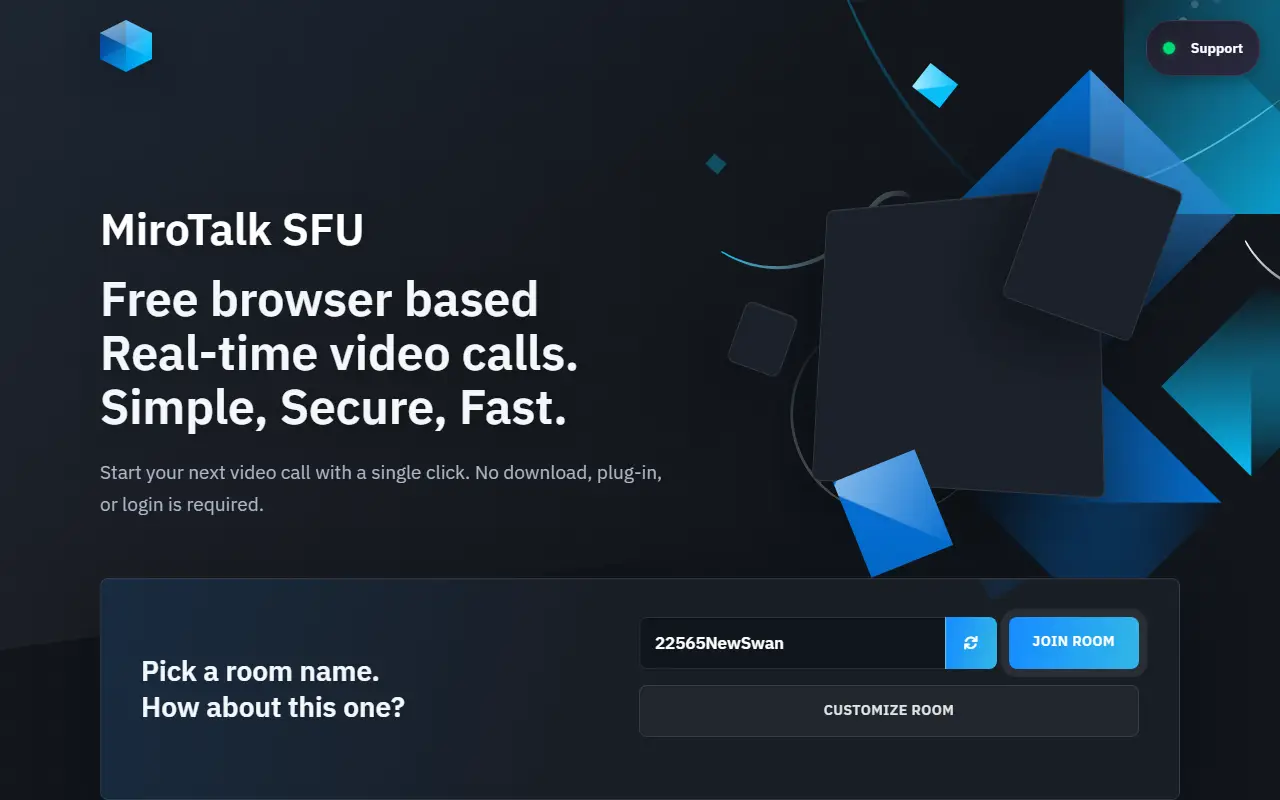
sfu.mirotalk.comMiroTalk SFU homepage screenshot

MiroTalk SFU is an open-source video conferencing platform that you deploy on your own server. It uses a mediasoup selective forwarding unit to scale real-time audio and video, and is offered as an alternative to Zoom, Google Meet, Jitsi Meet, and Microsoft Teams. It is released under the AGPL-3.0 license, and one-time commercial license fees are also available.

The platform supports video chat, screen sharing, file sharing, live streaming through RTMP, and webinar-style use cases, with real-time communication over WebRTC and WebSocket. Compared with the hosted services it replaces, the README highlights unlimited meeting duration and rooms, and full control of data and infrastructure with no vendor lock-in.

It is built on Node.js and is distributed with Docker support, so you can run it on a VPS or internal server. It suits organizations, communities, and developers who want private meetings and need to embed or customize video calls, and who are comfortable operating the media server themselves.

Key features

  • WebRTC video conferencing on a mediasoup SFU
  • Screen sharing and file sharing
  • RTMP live streaming
  • Unlimited rooms and meeting duration
  • Docker deployment on your own server
  • Self-hosted with full data control

Pricing: Free and open source under the AGPL-3.0 license; one-time commercial license fees are available.

Read more about MiroTalk SFUWebsite GitHub

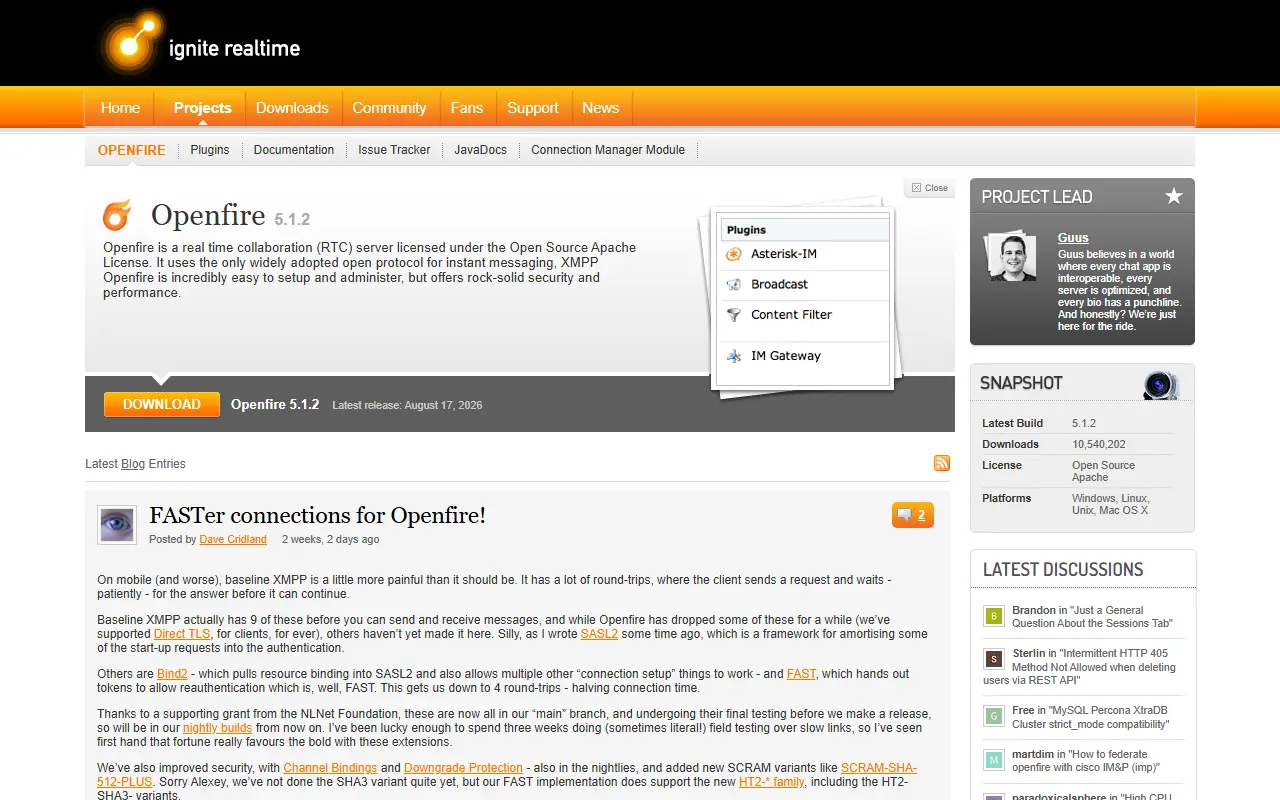
Openfire

Openfire is a Java real-time collaboration server that implements XMPP, the open instant messaging protocol, under the Apache license.

GitHub stars
3.1k
Last commit
yesterday
Latest release
v5.1.2
Licence
Apache-2.0
Self-hosted
Yes
igniterealtime.orgOpenfire homepage screenshot

Openfire is a real-time collaboration server that implements XMPP, also called Jabber, which the project describes as the only widely adopted open protocol for instant messaging. It is written in Java, released under the Apache-2.0 license and maintained as an Ignite Realtime community project.

The project says Openfire is easy to set up and administer while still offering strong security and performance. Organizations use it to run their own messaging infrastructure instead of relying on a proprietary chat vendor, and because XMPP is an open standard, any compatible client can connect to it.

Support is community-based. Documentation lives on the Ignite Realtime site, discussion happens on a Discourse forum, and bugs are tracked in an issue tracker where new users are asked to post through the forum first. Nightly builds are available, translations are managed through Transifex, and the latest release listed is v5.1.2.

Key features

  • XMPP real-time messaging server
  • Open-standard Jabber protocol support
  • Java-based and Apache licensed
  • Nightly builds and documentation
  • Community forum and issue tracker

Pricing: Free and open source under the Apache-2.0 license.

Read more about OpenfireWebsite GitHub

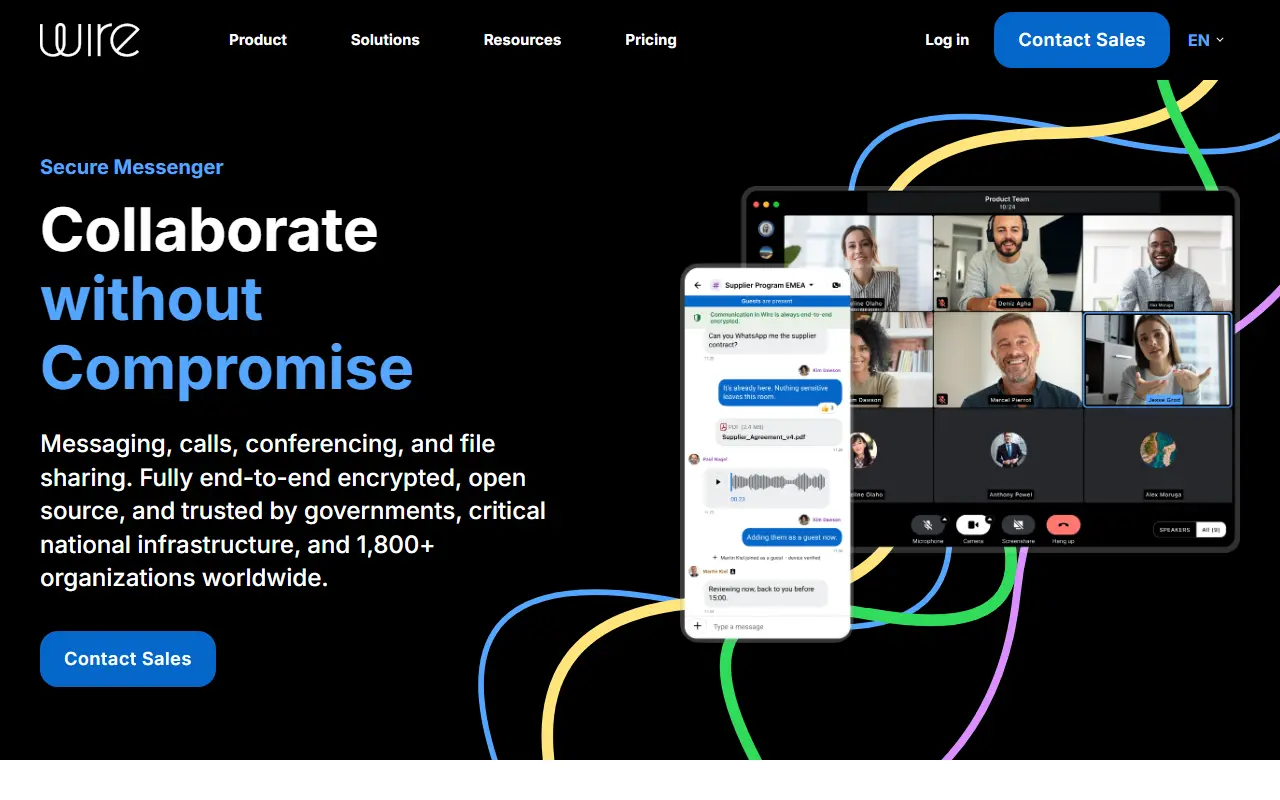
Wire

Wire Server is the open-source back end of the Wire secure messaging platform, written mainly in Haskell and Rust.

GitHub stars
2.8k
Last commit
today
Latest release
v2026-09-18
Licence
AGPL-3.0
Self-hosted
Yes
Hosted version
Available
wire.comWire homepage screenshot

This repository contains the source code for the Wire server, the back end of the Wire messaging platform. According to the README, it holds all the libraries and services needed to run Wire. The code is written mainly in Haskell and Rust and is licensed under AGPL-3.0, although the Wire trademark and logos are not licensed for use.

The server is split into services. Nginz is a public API reverse proxy, galley manages conversations and teams, brig handles accounts, gundeck is the push notification hub, cannon delivers WebSocket push notifications, cargohold stores assets such as images and files, proxy covers third-party API integration and spar provides single sign-on. Tools include database migration utilities and a Swagger-based backoffice interface called stern.

The project provides build scripts and Dockerfiles for some platforms, a work-in-progress demo mode that runs in memory and documentation that includes a guide for self-hosting your own Wire server. Federation is described as a long-term roadmap item. Wire itself is a commercial messaging product, and the source is published for transparency and self-hosting.

Key features

  • Conversation and team service
  • Account management service
  • Push notifications over WebSocket
  • Asset storage for images and files
  • Single sign-on service
  • Swagger-based backoffice tool

Pricing: Free for teams of up to 5 people. Wire for SMB costs €8.94 per person per month, or €7.45 with annual payment; Enterprise and on-premises are quoted.

Read more about WireWebsite GitHub

La Suite Meet

Open-source video conferencing app from France's La Suite numerique, built with Django and React on LiveKit and runnable entirely on your own infrastructure.

GitHub stars
2.4k
Last commit
today
Latest release
v1.32.1
Licence
MIT
Self-hosted
Yes

La Suite Meet is an open-source video conferencing application built with Django and React and powered by LiveKit. It runs in the browser, so participants join calls without installing anything. The code is released under the MIT license and is fully self-hostable. It comes from the French government's digital suite project, and a public instance runs at visio.numerique.gouv.fr.

Features include stability tuned for large meetings, multiple screen sharing streams, a non-persistent secure chat, meeting recording, transcription and summaries (currently in beta), telephony integration, authentication and access control, and a customizable front end. End-to-end encryption is listed as coming soon. LiveKit contributes speaker detection, simulcast, selective subscription, and SVC codecs.

The project has a Matrix channel where the team answers questions and helps with deployment. It suits public institutions, companies, and communities that want a sovereign, self-hosted alternative to commercial conferencing services and are prepared to operate the media infrastructure.

Key features

  • Browser-based video calls with no installation
  • Support for large meetings
  • Multiple screen sharing streams
  • Meeting recording and beta transcription
  • Non-persistent secure chat
  • Authentication and access controls
  • Customizable front end

Pricing: Free and open source under the MIT license.

Read more about La Suite MeetWebsite GitHub

Rocket.Chat Mobile

Official React Native mobile app for Rocket.Chat on iOS and Android, with white-label support for apps that connect only to your own server.

GitHub stars
2.4k
Last commit
yesterday
Latest release
4.77.0
Licence
MIT
rocket.chatRocket.Chat Mobile homepage screenshot

This repository contains the source code of the Rocket.Chat mobile app, built with React Native and TypeScript for iOS and Android. It connects to a Rocket.Chat team communication server and works with server version 0.70.0 and later. It supports iOS 16.4 and later and Android 6.0 and later, and is released under the MIT license.

Beta builds are described in the documentation, issues are tracked on GitHub, and a contribution guide helps developers who want to fix bugs or add features. For organizations that want their own branded app limited to a single server, the project provides white-label documentation explaining how to build an app that runs only on your own server.

The app is a client for the Rocket.Chat platform rather than a standalone chat system, so the server is needed. It suits organizations that self-host or subscribe to Rocket.Chat and need mobile access for staff, and developers building custom branded mobile clients.

Key features

  • Mobile client for Rocket.Chat on iOS and Android
  • Built with React Native and TypeScript
  • White-label option for single-server apps
  • Beta builds available
  • Open contribution process

Pricing: Free and open source under the MIT license.

1 more Microsoft Teams alternative

Microsoft Teams alternatives: questions

What is the best open-source alternative to Microsoft Teams?
Rocket.Chat is the top-ranked open-source alternative to Microsoft Teams on Enlisted: A customizable team communications platform with real-time chat and video, aimed at organizations with strict data protection needs and offered self-hosted, cloud or air-gapped. Other strong options are Mattermost, Zulip, Element and Synapse.
Are these Microsoft Teams alternatives free?
All 11 are open source, so the code is free to use under its licence, and all of them can be self-hosted on your own server or computer. 6 also offer a paid or managed cloud version if you'd rather not host it yourself.
How is this list of Microsoft Teams alternatives ranked?
By a score built from GitHub stars, star growth over the last 30 days and how recently the code changed. 10 of these projects shipped code in the last 30 days. Data is refreshed daily, and nobody can pay to move up.

People also look for alternatives to…

View all