7,363 open-source and SaaS tools, with GitHub stats refreshed every day.

4 alternatives ranked by real activity

Open-source LM Studio alternatives

A curated, ranked list of the 4 best open-source alternatives to LM Studio.

The best open-source alternative to LM Studio is Open WebUI. If that doesn't suit you, other good options are AnythingLLM, Jan and TextGen.

LM Studio alternatives are mainly AI tools. 3 of them shipped code in the last 30 days, 4 can be self-hosted, and 1 uses a permissive licence.

Last updated October 3, 2026 · ranked by GitHub stars, growth and recent commits

Open WebUI

A self-hosted chat interface for local and cloud language models, supporting Ollama and OpenAI-compatible APIs, with RAG, user roles and a plugin system.

GitHub stars
154k
Last commit
yesterday
Latest release
v0.11.4
Self-hosted
Yes
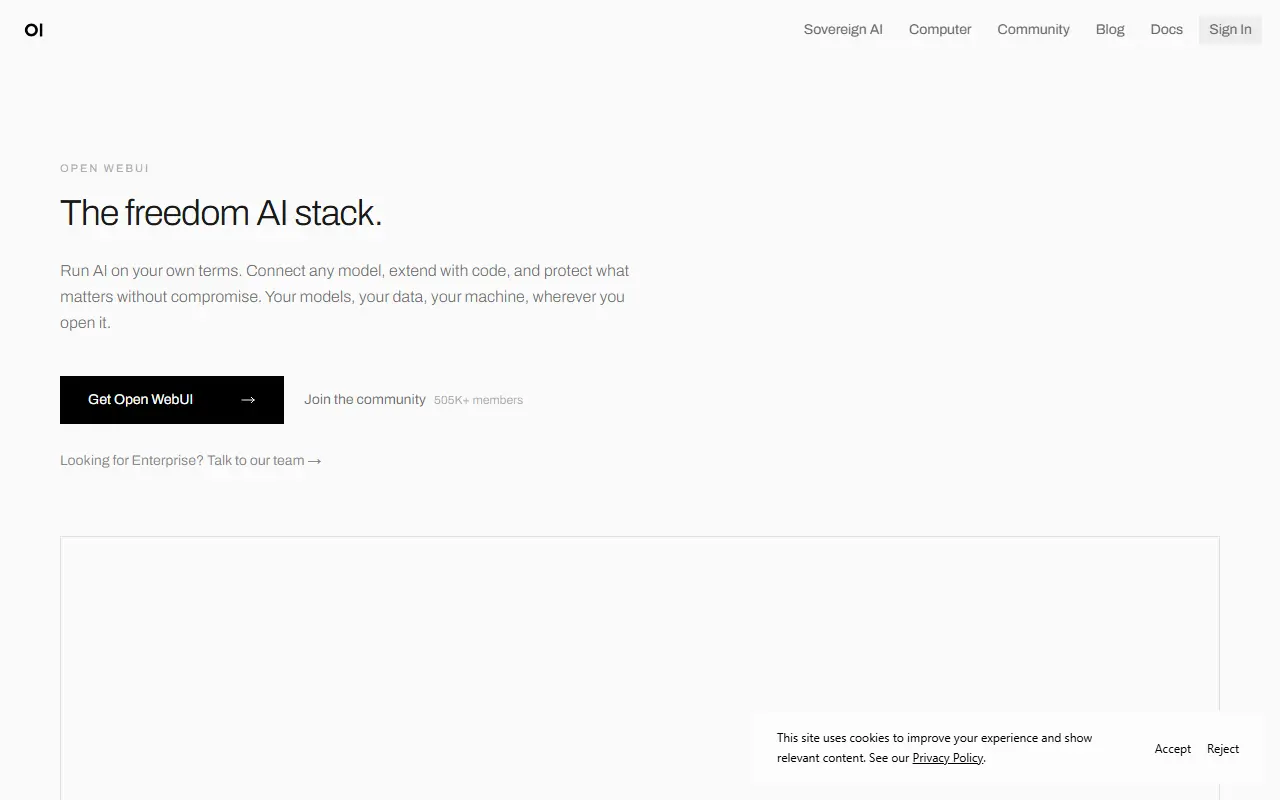
openwebui.comOpen WebUI homepage screenshot

Open WebUI is a self-hosted web interface for working with large language models. It connects to Ollama for local models and to any OpenAI-compatible endpoint, so one deployment can front LM Studio, Groq, Mistral, OpenRouter, vLLM and similar backends side by side. It is designed to keep working fully offline when you rely only on local models.

Administrators get role-based access control with user groups and per-group permissions, which suits shared team or household installs. Beyond chat there is retrieval-augmented generation over your documents, custom models that bundle instructions, tools and knowledge into agents, and an extension system made of filters, actions, pipes, tools and skills. External services attach through MCP, MCPO and OpenAPI tool servers, and an optional Open Terminal feature gives agents a filesystem to work in.

You can install it with pip, uv or Docker, or deploy it to Kubernetes using kubectl, kustomize or Helm, and container images are tagged for bundled Ollama and for CUDA. The project lists an enterprise plan for organizations that want vendor support. Its license is listed as custom rather than a standard one, so review the terms before reselling or rebranding it.

Key features

  • Connects to Ollama and OpenAI-compatible APIs
  • Role-based access control with user groups
  • Retrieval-augmented generation over your own documents
  • Plugin system with filters, tools and pipes
  • MCP and OpenAPI tool server support
  • Custom agents combining models, tools and knowledge
  • Install via pip, Docker or Kubernetes

Pricing: Free to self-host; an enterprise plan is available through the vendor's sales team.

AnythingLLM

An all-in-one AI application for chatting with your documents and running AI agents locally, with multi-user support and desktop and Docker versions.

GitHub stars
67k
Last commit
yesterday
Latest release
v1.17.0
Licence
MIT
Self-hosted
Yes
Hosted version
Available
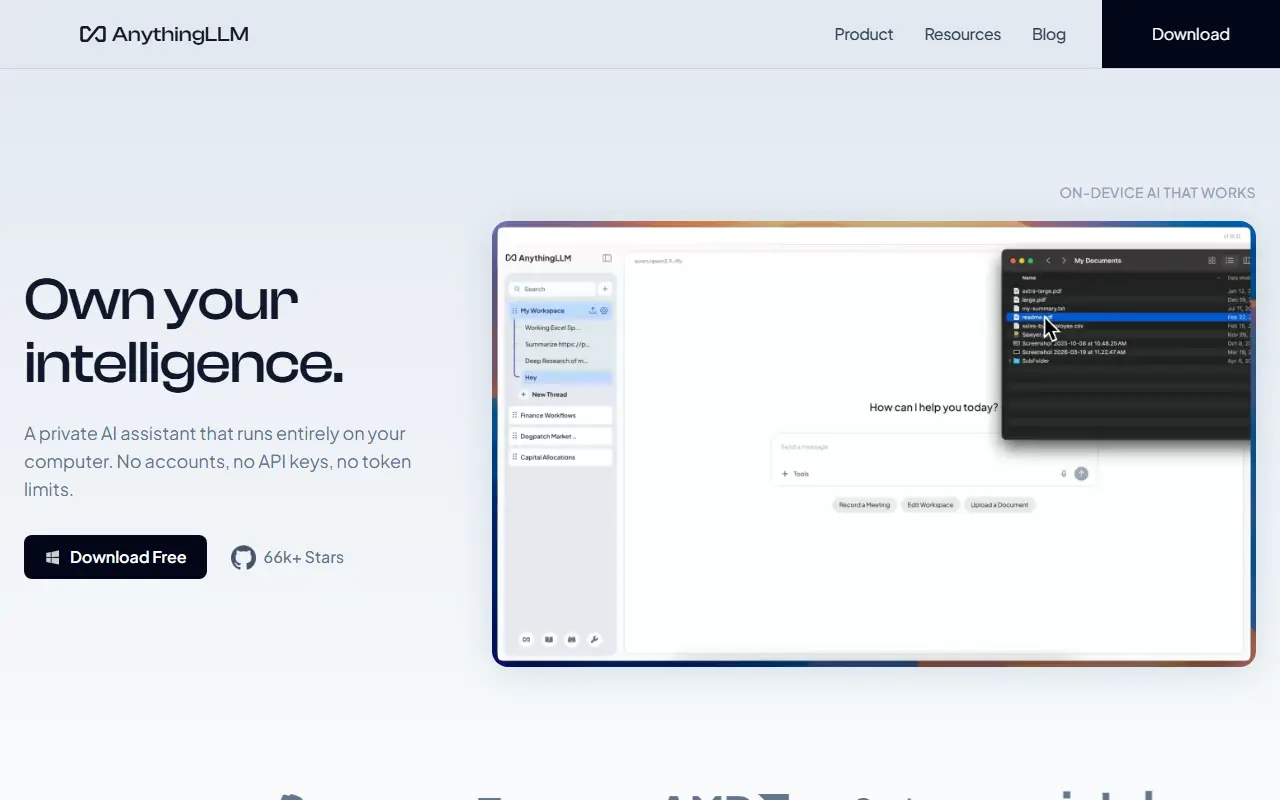
anythingllm.comAnythingLLM homepage screenshot

AnythingLLM is an all-in-one AI application for chatting with your own documents and automating work with AI agents. It runs locally by default, lets you connect local or cloud language models, and is written in JavaScript under the MIT license. The README describes it as a way to build a private, fully featured assistant in the style of ChatGPT.

Vector databases, document processing pipelines, multi-user support and agents all come included. Newer features listed include dynamic model routing based on rules you define, automatic and user-managed memories, scheduled tasks with agent capabilities, skill selection, a no-code agent builder, MCP compatibility and multi-modal support for both closed and open-source models.

It is available as a desktop app for Mac, Windows and Linux, as a Docker version that adds multi-user access control, and as a hosted instance, and there is an open-source Android app. Administrators can control access and experience per user. It suits individuals and teams who want a private document-chat and agent workspace without much setup.

Key features

  • Chat with your documents using RAG
  • Built-in AI agents and no-code agent builder
  • Multi-user access control in Docker version
  • Connects to local or cloud LLMs
  • Vector database and document pipeline support
  • MCP compatibility and scheduled tasks
  • Desktop apps for Mac, Windows and Linux

Pricing: Self-hosting with Docker is free. Hosted Cloud costs $50 per month (Basic) or $99 per month (Pro); Enterprise with on-premise deployment is quoted on request.

Jan

An open-source desktop app that acts as a ChatGPT replacement, running local language models offline or connecting to cloud providers, with an OpenAI-compatible local server.

GitHub stars
45k
Last commit
yesterday
Latest release
v0.8.4
Self-hosted
Yes
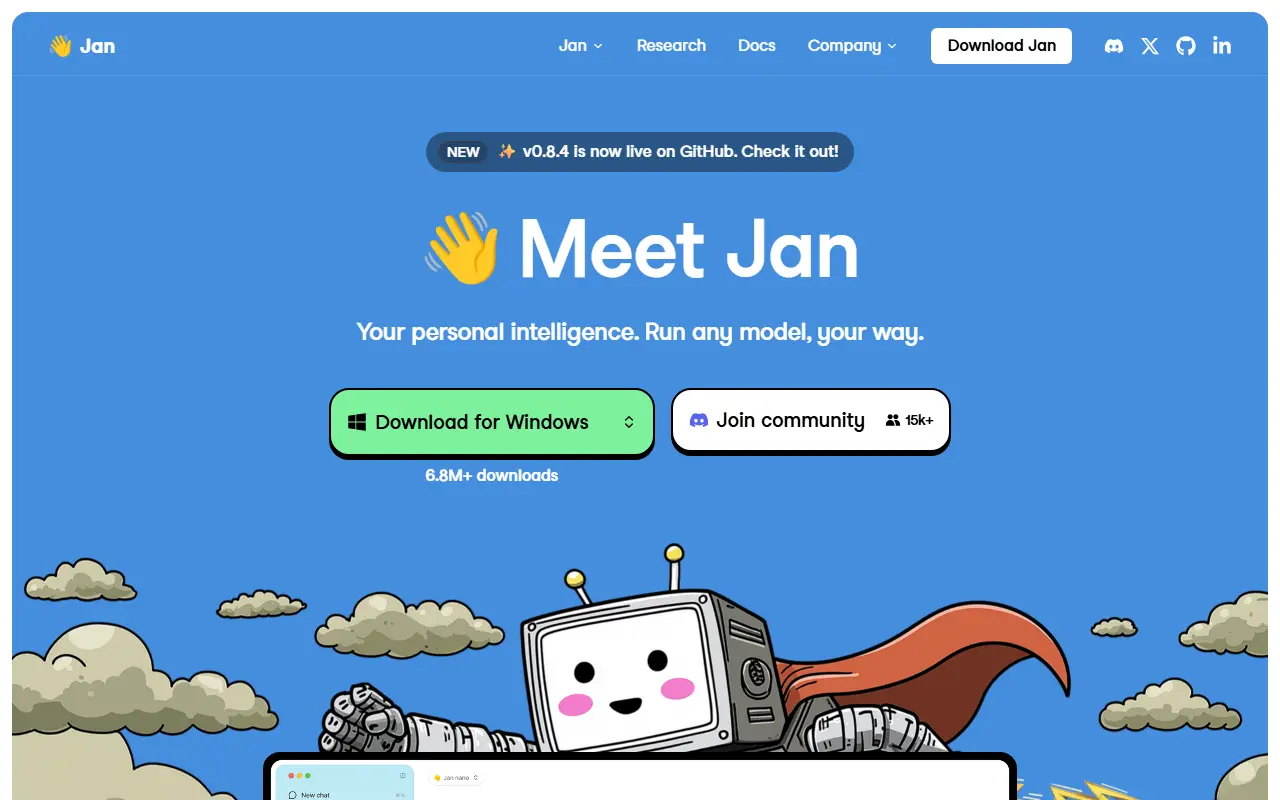
jan.aiJan homepage screenshot

Jan is an open-source desktop application that serves as a ChatGPT alternative you control. It can download and run language models such as Llama, Gemma, Qwen and GPT-oss from Hugging Face entirely on your own computer, so conversations stay private and work without an internet connection.

When you want more capability than local hardware allows, Jan can connect to cloud models from OpenAI, Anthropic, Mistral, Groq, MiniMax and others from the same interface. You can create custom assistants for specific tasks, and Model Context Protocol support adds agentic abilities. A built-in local server on localhost port 1337 exposes an OpenAI-compatible API, so other applications can use your local models as a drop-in backend.

Jan is built with Rust and Tauri and ships installers for Windows, macOS and Linux in deb and AppImage form. Its license is listed as 'Other' on GitHub, so check the repository terms before redistributing it. It is meant for people who want local AI with a polished interface rather than a command line.

Key features

  • Download and run local LLMs from Hugging Face
  • Connect to OpenAI, Anthropic, Mistral and Groq
  • Custom assistants for specific tasks
  • OpenAI-compatible local server
  • Model Context Protocol integration
  • Installers for Windows, macOS and Linux

Pricing: Free and open source; running local models costs nothing beyond your own hardware, and cloud providers bill you separately.

Read more about JanWebsite GitHub

TextGen

TextGen is an open-source desktop app for running large language models locally, with chat, vision, tool-calling and an OpenAI-compatible API.

GitHub stars
48k
Last commit
1 mo ago
Latest release
v4.9
Licence
AGPL-3.0
Self-hosted
Yes

TextGen is a desktop application for running large language models on your own machine. It provides a chat interface and an API, collects no telemetry, and keeps conversations on the local computer. Portable builds for Linux, Windows and macOS include all dependencies and come in CUDA, Vulkan, ROCm and CPU-only variants, so a user can download, unzip and launch it.

Chat modes include instruction-following, chat-instruct and character chat, with prompts formatted by Jinja2 templates. The app handles vision input, file attachments such as PDFs and .docx documents, message editing and conversation branching, plus a notebook tab for free-form generation. It supports several backends, including llama.cpp, Transformers, ExLlamaV3 and TensorRT-LLM, and models can be switched without restarting.

An OpenAI- and Anthropic-compatible API with tool calling lets it stand in locally for those services. Tools are single Python files, and MCP servers are supported. Additional features include LoRA fine-tuning and image generation. TextGen is released under the AGPL-3.0 license.

Key features

  • Runs large language models locally
  • Vision input and file attachments
  • OpenAI- and Anthropic-compatible API
  • Tool calling with Python tools and MCP
  • Multiple backends including llama.cpp
  • LoRA fine-tuning and image generation

Pricing: Free and open source under the AGPL-3.0 license.

Read more about TextGenGitHub

LM Studio alternatives: questions

What is the best open-source alternative to LM Studio?
Open WebUI is the top-ranked open-source alternative to LM Studio on Enlisted: A self-hosted chat interface for local and cloud language models, supporting Ollama and OpenAI-compatible APIs, with RAG, user roles and a plugin system. Other strong options are AnythingLLM, Jan and TextGen.
Are these LM Studio alternatives free?
All 4 are open source, so the code is free to use under its licence, and all of them can be self-hosted on your own server or computer. 1 also offers a paid or managed cloud version if you'd rather not host it yourself.
How is this list of LM Studio alternatives ranked?
By a score built from GitHub stars, star growth over the last 30 days and how recently the code changed. 3 of these projects shipped code in the last 30 days. Data is refreshed daily, and nobody can pay to move up.

People also look for alternatives to…

View all