3 open-source alternatives ranked by real activity

Open-source Linode alternatives

A curated, ranked list of the 3 best open-source alternatives to Linode.

The best open-source alternative to Linode is Kubernetes. If that doesn't suit you, other good options are Ubicloud and Apache CloudStack.

Commercial alternatives to Linode include Vultr, DigitalOcean, Hetzner Cloud and Amazon Web Services. See all 68.

Linode alternatives are mainly infrastructure & container tools, but some are also hosting & PaaS tools. 3 of them shipped code in the last 30 days, 3 can be self-hosted, and 2 use a permissive licence.

Last updated November 12, 2026 · ranked by GitHub stars, growth and recent commits

Kubernetes

An open-source system for deploying, scaling and managing containerized applications across clusters of hosts, hosted by the CNCF.

GitHub stars
129k
Last commit
yesterday
Latest release
v1.37.2
Licence
Apache-2.0
Self-hosted
Yes
Hosted version
Available
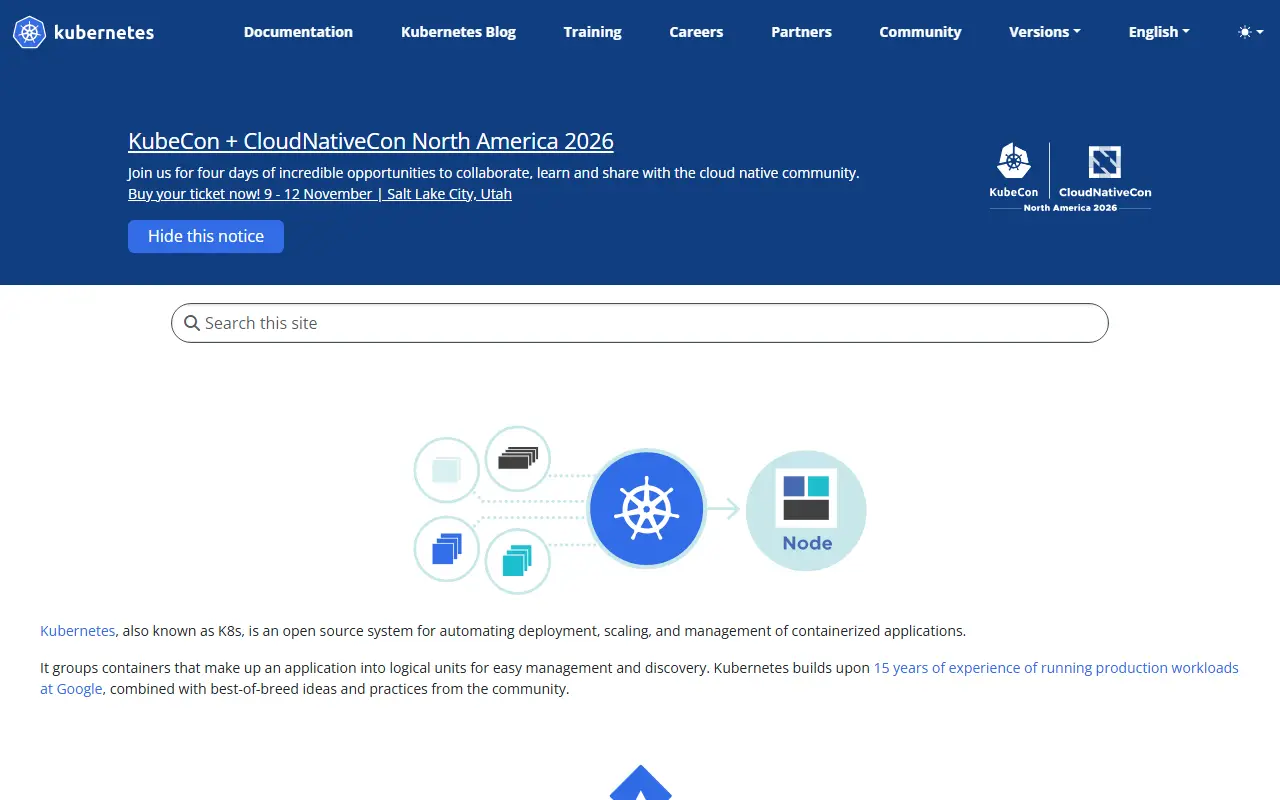
kubernetes.ioKubernetes homepage screenshot

Kubernetes, also written K8s, is an open-source system that manages containerized applications across multiple hosts. It provides the basic mechanisms for deploying, maintaining and scaling applications, so teams can run containers reliably without scheduling each one by hand. It is written in Go and released under the Apache-2.0 license.

The project builds on years of experience running production workloads at Google with an internal system called Borg, combined with practices from the wider community. The Cloud Native Computing Foundation hosts the project. Users interact with it through declarative configuration and the documentation on kubernetes.io, which includes tutorials and a free course on scalable microservices.

Kubernetes can be run on your own infrastructure, and major cloud providers also offer managed Kubernetes services. The README adds that the k8s.io/kubernetes module is not supported for use as a library. It suits platform and DevOps teams running microservices that need scheduling, scaling and automatic recovery.

Key features

  • Container scheduling across multiple hosts
  • Automated application deployment and rollouts
  • Scaling of containerized workloads
  • Maintenance and self-healing of applications
  • Declarative configuration of desired state
  • CNCF-hosted with extensive documentation

Pricing: Free and open source under the Apache-2.0 license; cloud providers sell managed services built on it.

Ubicloud

An open-source cloud platform that turns bare-metal Linux servers into an AWS-style cloud with compute, storage, networking, managed Postgres, Kubernetes and AI inference.

GitHub stars
12k
Last commit
today
Licence
AGPL-3.0
Self-hosted
Yes
Hosted version
Available
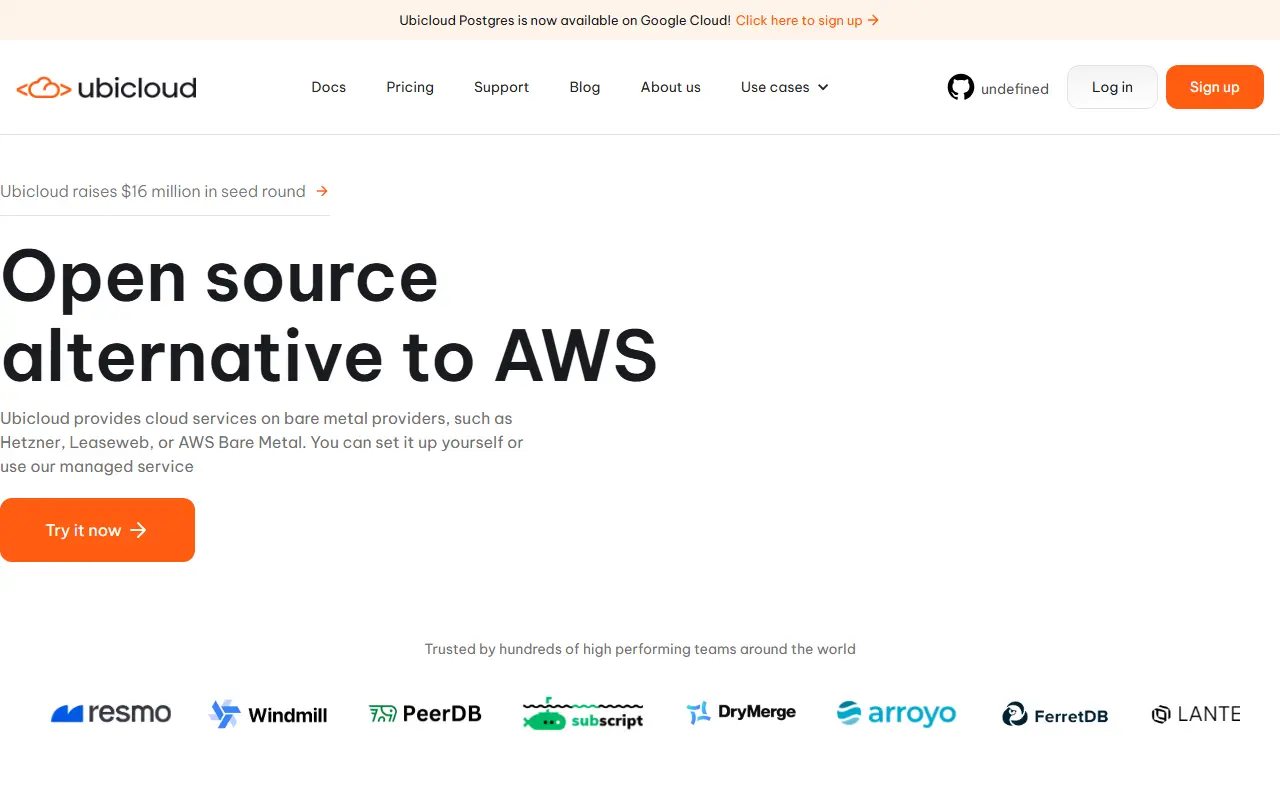
ubicloud.comUbicloud homepage screenshot

Ubicloud is an open-source cloud platform designed to run on any infrastructure, described by its authors as an open alternative to cloud providers in the way Linux is to proprietary operating systems. It delivers infrastructure-as-a-service capabilities on top of bare-metal hosts, for example Hetzner, Leaseweb and AWS Bare Metal.

Its services include elastic compute, non-replicated block storage, firewalls and load balancers, managed Postgres, Kubernetes, AI inference and IAM. A control plane takes leased bare-metal Linux machines, prepares them for cloud use, and then lets you provision and manage resources through a cloud console. The project is written in Ruby and topics also mention GitHub Actions runners.

You can use the managed platform at console.ubicloud.com without installing anything, where the underlying provider's price and location benefits are passed on to you, or build your own cloud by leasing servers and running the control plane yourself. Ubicloud is licensed under AGPL-3.0. The quick-start flow is currently described for Hetzner machines running Ubuntu 24.04.

Key features

  • Elastic compute on bare-metal servers
  • Block storage, firewalls and load balancers
  • Managed PostgreSQL databases
  • Managed Kubernetes clusters
  • AI inference services
  • IAM and cloud console

Pricing: Pay-as-you-go, billed per minute: runners from $0.00125 a minute, burstable VMs from $10.47 a month, managed PostgreSQL from $19.54 and Kubernetes from $71.82 a month. You can also self-host.

Apache CloudStack

Apache CloudStack is an open-source infrastructure-as-a-service platform for deploying and managing large networks of virtual machines.

GitHub stars
3.1k
Last commit
yesterday
Latest release
4.23.0.0
Licence
Apache-2.0
Self-hosted
Yes
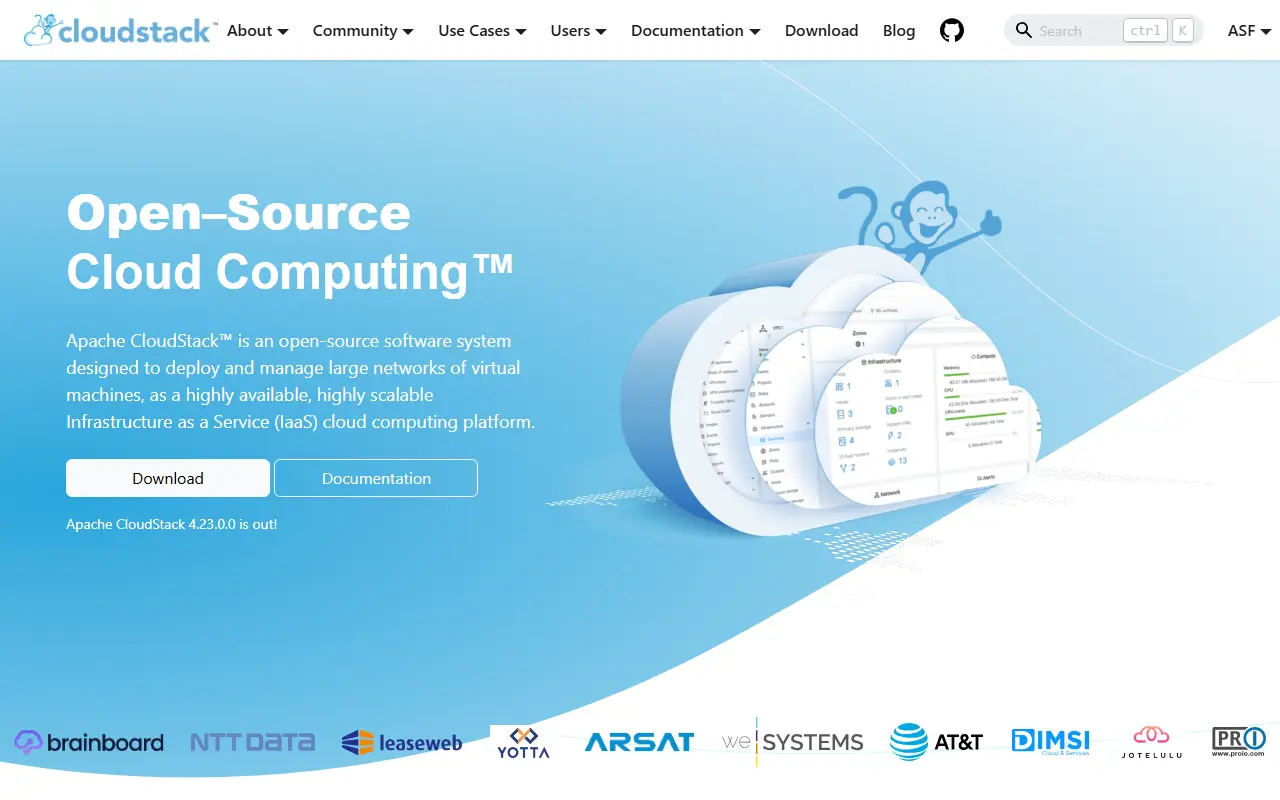
cloudstack.apache.orgApache CloudStack homepage screenshot

Apache CloudStack is open source software for deploying and managing large networks of virtual machines as a highly available, scalable infrastructure-as-a-service cloud. Service providers use it to offer public cloud services, while companies use it for private on-premises clouds or as part of a hybrid setup. It is written mainly in Java and Python.

The project describes it as a turnkey solution that includes the full stack most organizations want from an IaaS cloud: compute orchestration, network-as-a-service, user and account management, resource accounting, a complete native API and a user interface. Administrators can manage the cloud through a web interface, command-line tools or a query-based API.

CloudStack supports a range of hypervisors, including VMware vSphere, KVM, XenServer, XenProject and Hyper-V, as well as OVM and LXC containers. Topics also mention Kubernetes, XCP-ng and libvirt. It is an Apache Software Foundation project licensed under Apache-2.0, with documentation, a demo, news and events pages and security reporting procedures on its website.

Key features

  • Infrastructure-as-a-service cloud orchestration
  • Supports VMware, KVM, XenServer and Hyper-V
  • Network-as-a-service capabilities
  • User and account management
  • Web interface, command line and native API
  • Resource accounting

Pricing: Free and open source under the Apache-2.0 license.

Commercial Linode alternatives

Hosted, closed-source products that compete with Linode. Showing 12 of 68.

See every Linode alternative on its tool page

Linode alternatives: questions

What is the best open-source alternative to Linode?
Kubernetes is the top-ranked open-source alternative to Linode on Enlisted: An open-source system for deploying, scaling and managing containerized applications across clusters of hosts, hosted by the CNCF. Other strong options are Ubicloud and Apache CloudStack.
What are the best commercial alternatives to Linode?
Vultr, DigitalOcean, Hetzner Cloud, Amazon Web Services and Azure Virtual Machines are among the hosted, closed-source alternatives to Linode listed on Enlisted, which lists 68 in total. Compare their pricing and features on each tool page.
Are these Linode alternatives free?
All 3 are open source, so the code is free to use under its licence, and all of them can be self-hosted on your own server or computer. 2 also offer a paid or managed cloud version if you'd rather not host it yourself.
How is this list of Linode alternatives ranked?
By a score built from GitHub stars, star growth over the last 30 days and how recently the code changed. 3 of these projects shipped code in the last 30 days. Data is refreshed daily, and nobody can pay to move up.

People also look for alternatives to…

View all