6,598 open-source and SaaS tools, with GitHub stats refreshed every day.

4 alternatives ranked by real activity

Open-source Julius AI alternatives

A curated, ranked list of the 4 best open-source alternatives to Julius AI.

The best open-source alternative to Julius AI is DB-GPT. If that doesn't suit you, other good options are DeepAnalyze, Nao and Pretzel.

Julius AI alternatives are mainly AI Tools tools, but some are also BI & Dashboards and Analytics. 3 of them shipped code in the last 30 days, 4 can be self-hosted, and 2 use a permissive licence.

Last updated October 2, 2026 · ranked by GitHub stars, growth and recent commits

DB-GPT

An open-source agentic AI data assistant that connects to databases and files, writes SQL and code from natural language, and produces charts, reports and insights.

GitHub stars
20k
Last commit
3 days ago
Latest release
v0.8.2
Licence
MIT
Self-hosted
Yes
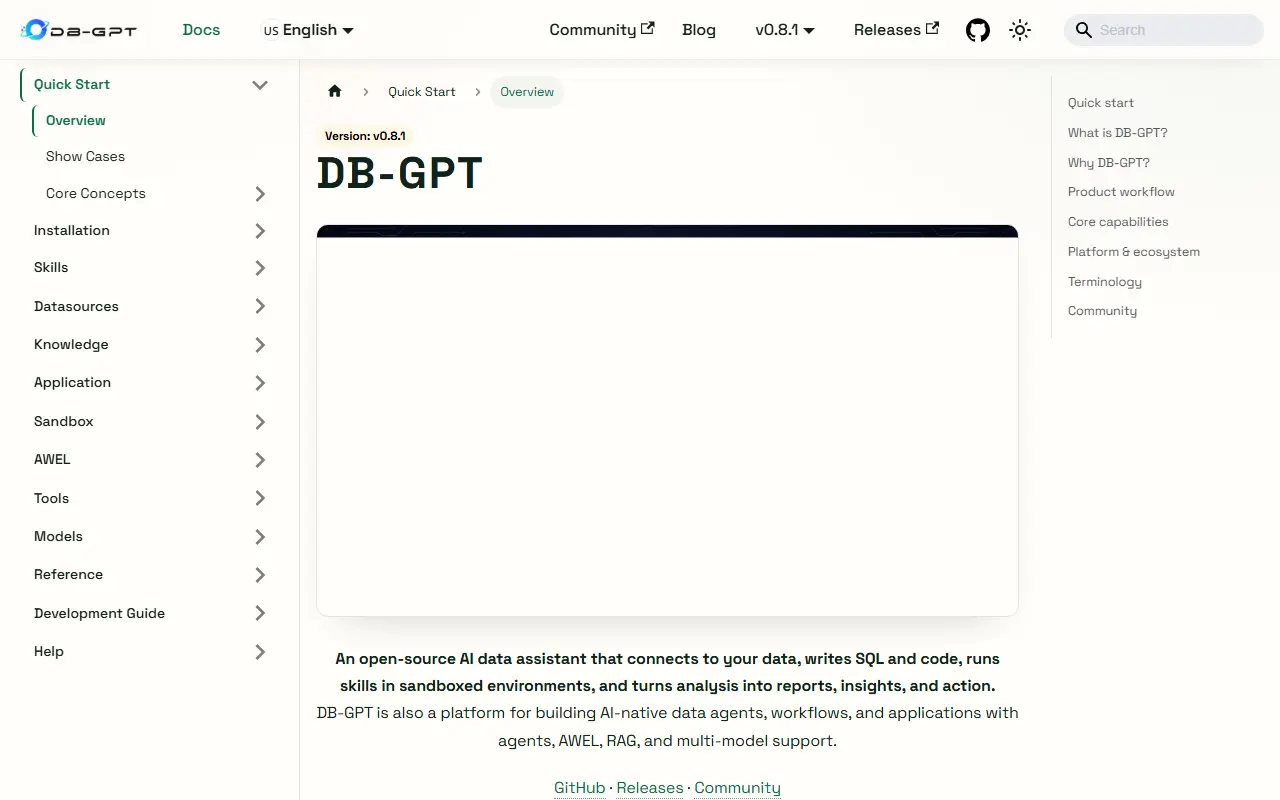
docs.dbgpt.cnDB-GPT homepage screenshot

DB-GPT is an open-source AI data assistant for the next generation of products that combine AI and data. It connects to databases, CSV and Excel files, data warehouses and knowledge bases, then lets people ask questions in natural language while the AI writes SQL and code to answer them.

Beyond question answering, it supports agentic data analysis: planning a task, breaking it into steps, calling tools and finishing the analysis end to end. It can run Python and code-driven workflows, load reusable skills for domain-specific tasks, and generate charts, dashboards, HTML reports and summaries. Tasks run in sandboxed environments for safety. Beyond the assistant, it serves as a platform for building AI-native data agents and applications with its AWEL workflow language, retrieval-augmented generation and multi-model support, with topics naming models such as DeepSeek and Vicuna.

It is written in Python and licensed under MIT, with documentation, a community and a research paper. Privacy and security are highlighted in the topics, and it can run on your own infrastructure with local models. It suits data teams that want natural-language access to databases while keeping data in-house.

Key features

  • Natural-language questions answered with generated SQL
  • Connects to databases, spreadsheets and warehouses
  • Agentic multi-step analysis workflows
  • Sandboxed code and skill execution
  • Chart, dashboard and report generation
  • AWEL, RAG and multi-model support

Pricing: Free and open source under the MIT license.

DeepAnalyze

DeepAnalyze is a research project for an agentic LLM that autonomously handles data science tasks from preparation to modeling, charts and written reports.

GitHub stars
4.7k
Last commit
9 days ago
Licence
MIT
Self-hosted
Yes
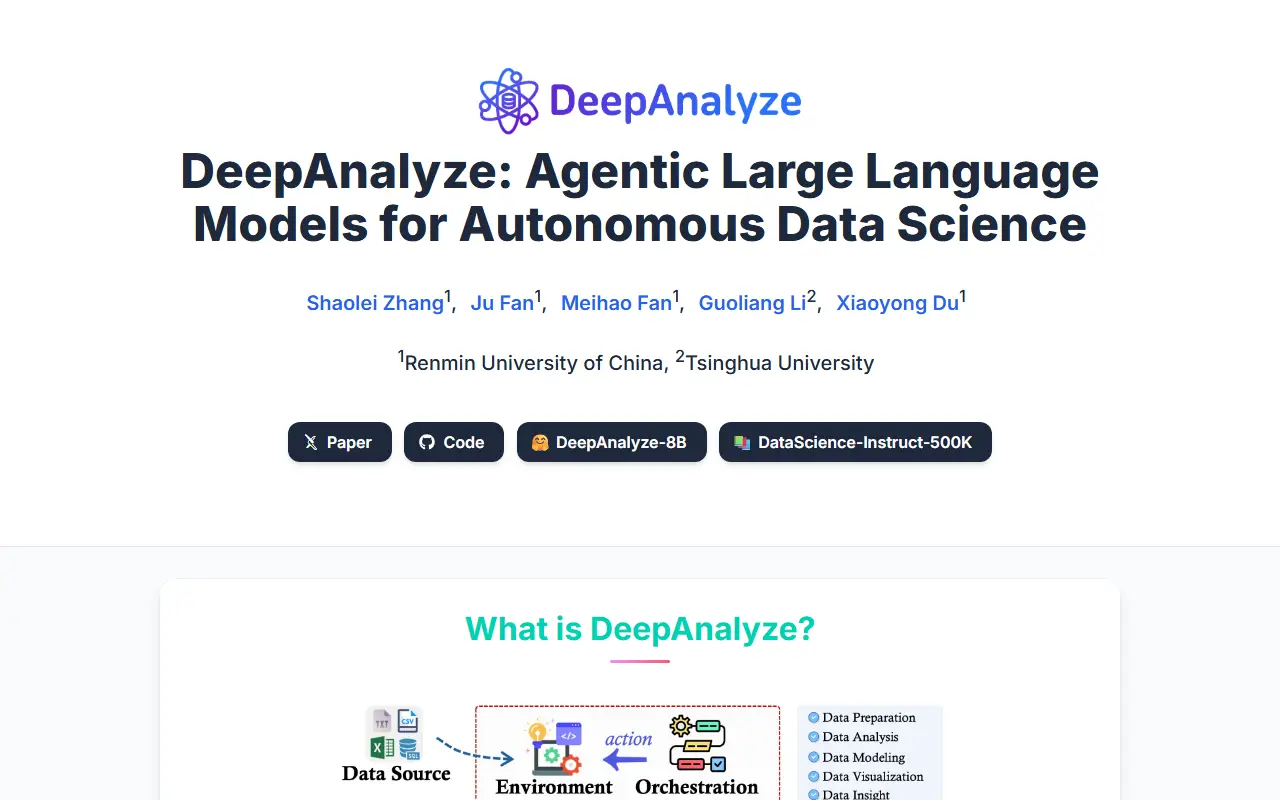
ruc-deepanalyze.github.ioDeepAnalyze homepage screenshot

DeepAnalyze is an agentic large language model for autonomous data science, developed by researchers at Renmin University of China and Tsinghua University. The goal is for it to complete data-centered tasks without step-by-step human guidance, acting as an AI data analyst that takes in large amounts of data and produces a professional analysis report.

According to the README it can run the whole data science pipeline, including data preparation, analysis, modeling, visualization and report generation. It also supports open-ended data research across different data sources, from structured data such as databases, CSV files and Excel sheets to other formats. Repository topics mention Qwen, Jupyter, deep research and data visualization, and the code is Python.

DeepAnalyze is released under the MIT license. It is a research-oriented project you run yourself with the provided model and code, rather than a hosted product. It suits data scientists, analysts and researchers exploring autonomous analysis agents.

Key features

  • Autonomous end-to-end data science pipeline
  • Data preparation and analysis
  • Modeling and visualization
  • Automatic report generation
  • Open-ended deep research on data
  • Works with databases, CSV and Excel data

Pricing: Free and open source under the MIT license.
Nao

An open-source framework for building and deploying a chat-based analytics agent that answers questions about your data warehouse in plain English.

GitHub stars
1.7k
Last commit
today
Latest release
v0.3.19
Self-hosted
Yes
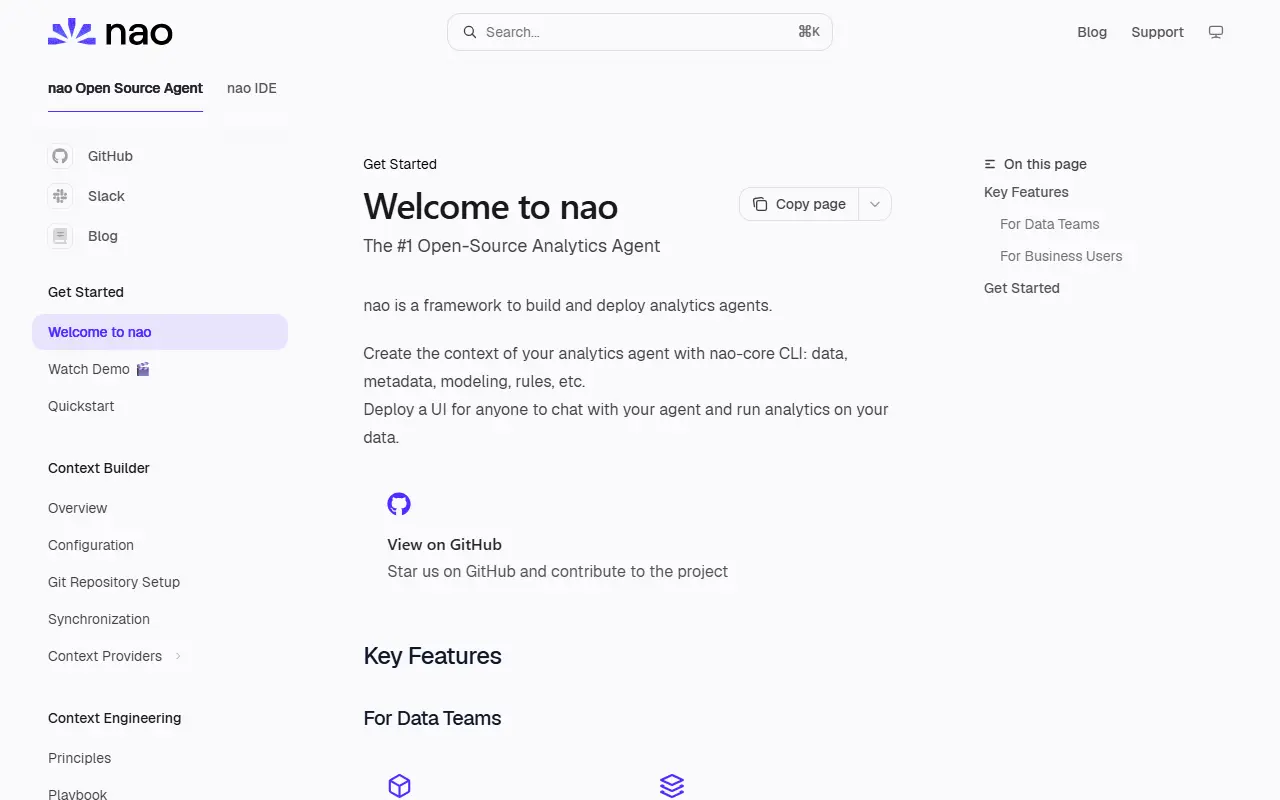
docs.getnao.ioNao homepage screenshot

nao is an open-source framework for building an analytics agent and deploying it as a chat interface. Data teams assemble the agent's context with the nao-core command-line tool, then give business users a UI where they can ask questions in natural language and receive analysis, charts and the reasoning behind each answer.

On the data team side, the context builder works like a file system and can include data, metadata, documentation, tools and MCP servers. The framework is described as stack-agnostic, with topics pointing to BigQuery, Snowflake, Databricks and PostgreSQL. Teams can unit test the agent's performance before release, version the context, track usage and collect feedback from users who mark answers right or wrong.

nao is written in TypeScript and is designed to be self-hosted with your own LLM keys, which keeps data under your control. A Slack connection is available as an option during setup. It suits data and analytics engineering teams who want a governed text-to-SQL assistant for the rest of the company rather than ad hoc prompts.

Key features

  • Chat interface for natural-language analytics
  • Context builder for data, docs, and MCPs
  • Agent unit tests and performance tracking
  • Built-in data visualization in chat
  • Optional Slack connection
  • Bring your own LLM keys
Read more about NaoWebsite GitHub

Pretzel

Pretzel is a free, open-source fork of Jupyter that adds AI code generation, inline completion, sidebar chat and error fixing, positioned as a modern Jupyter replacement.

GitHub stars
2.2k
Last commit
1 yr ago
Latest release
v4.2.11
Self-hosted
Yes
Hosted version
Available
withpretzel.comPretzel homepage screenshot

Pretzel is a fork of Jupyter aimed at data scientists and analysts who want the familiar notebook experience enhanced with AI assistance. Because it is built directly on Jupyter, existing configuration, settings, keybindings and extensions carry over automatically when switching from plain Jupyter.

On top of standard notebooks, Pretzel adds inline tab completion as you type in a cell, an 'Ask AI' prompt triggered from a cell or a keyboard shortcut, and an AI sidebar for chatting, generating code and asking questions, with an @ trigger for autocompleting function and variable names. Users can bring their own model from OpenAI, Anthropic/Claude, Ollama or Groq. The project's roadmap includes native AI code generation similar to Cursor, realtime collaboration features, SQL support inside notebooks, a visual analysis builder, and one-click dashboard creation from notebooks.

Pretzel is written in TypeScript and installed with pip, after which the pretzel lab command opens the web interface; a free hosted version is also available at pretzelai.app. The repository metadata lists its license as Other, so check the license file for exact terms.

Key features

  • AI code generation and inline completion
  • AI sidebar chat for code and questions
  • Compatible with existing Jupyter config and extensions
  • Bring-your-own-model support (OpenAI, Claude, Ollama, Groq)
  • Planned SQL and dashboard-building support

Pricing: Free hosted version available at pretzelai.app, and self-hostable via pip. The repository lists its license as Other, so check the license file for exact terms.

Julius AI alternatives: questions

What is the best open-source alternative to Julius AI?
DB-GPT is the top-ranked open-source alternative to Julius AI on Enlisted: An open-source agentic AI data assistant that connects to databases and files, writes SQL and code from natural language, and produces charts, reports and insights. Other strong options are DeepAnalyze, Nao and Pretzel.
Are these Julius AI alternatives free?
All 4 are open source, so the code is free to use under its licence, and 4 of them can be self-hosted on your own server. 1 also offer a paid or managed cloud version if you'd rather not host it yourself.
How is this list of Julius AI alternatives ranked?
By a score built from GitHub stars, star growth over the last 30 days and how recently the code changed. 3 of these projects shipped code in the last 30 days. Data is refreshed daily, and nobody can pay to move up.

People also look for alternatives to…

View all