#1
GDevelop is an open-source, no-code game engine with a free plan and paid Silver, Gold and Pro plans that add AI credits, cloud storage and publishing options.
- GitHub stars
- 29k
- Last commit
- yesterday
- Latest release
- v5.6.287
gdevelop.io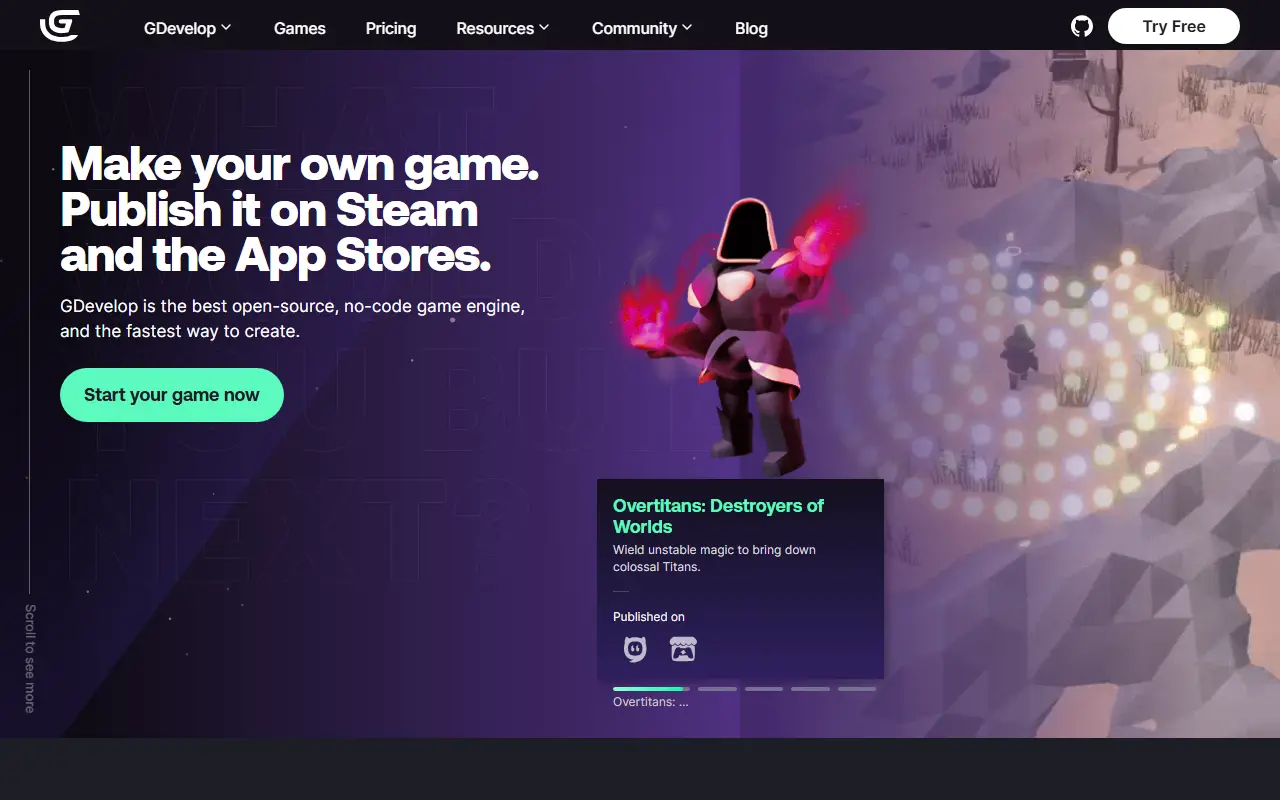
GDevelop describes itself as an open-source, no-code game engine for making games and publishing them on Steam and app stores. The free plan includes the fully featured engine, publishing to Android and desktop once per day, multiplayer and online services to try, and an asset store with thousands of free assets.
Paid plans add AI credits, credits for the Asset Store, and cloud storage for projects. Silver adds publishing on Google Play, desktop and the web. Gold adds publishing on iOS and leaderboards, and Pro adds unlimited cloud projects, version history and sharing projects with teammates.
The site shows a long list of published games made with the engine, including promotional games and titles that reached mobile and web audiences. There is also a separate education plan with student accounts and teaching resources.
Key features
- No-code game creation
- Publish to Steam and app stores
- Free plan with the fully featured engine
- Multiplayer and online services to try
- Asset Store with thousands of free assets
- AI credits included with paid plans
- Cloud storage and version history on higher plans
Pricing: Plans are Free, Silver, Gold and Pro, billed monthly or yearly, with up to 40% saved by paying yearly. A company with more than $50,000 USD revenue per year must use the Pro membership.
#2
A free, cross-platform 2D and 3D game engine with a unified editor and one-click export to desktop, mobile, web and consoles.
- GitHub stars
- 120k
- Last commit
- 2 days ago
- Latest release
- 4.7.2-stable
- Licence
- MIT
godotengine.org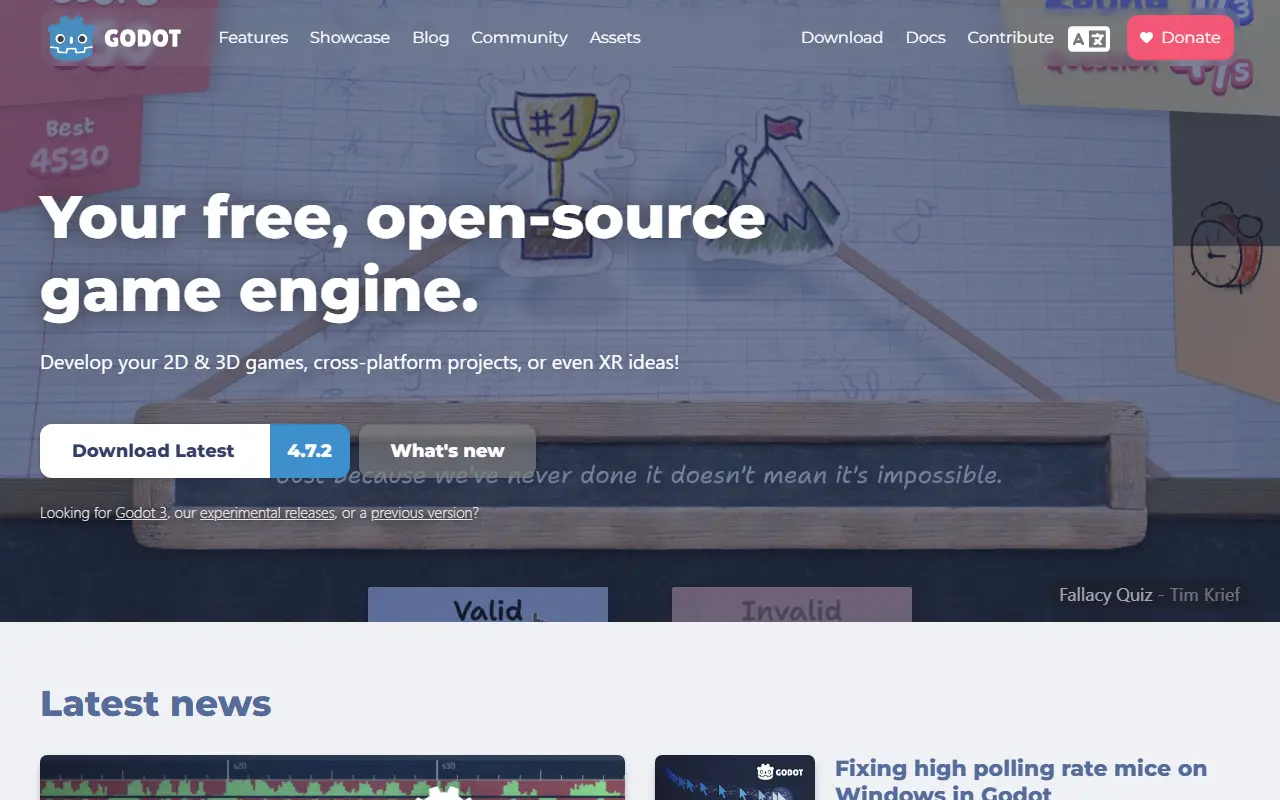
Godot Engine is an open-source game engine for making 2D and 3D games from one unified editor. Common game-development tools are included, so developers can concentrate on their game rather than rebuilding basic engine features. The engine is written in C++ and distributed under the MIT license.
Projects export in one click to Linux, macOS and Windows, to Android and iOS, to the web and to consoles. Official binaries for the editor and export templates are available on the Godot website, and the engine can also be compiled from source by following the official documentation, which also hosts demos and guides.
Godot's development is community-driven and independent, supported by the not-for-profit Godot Foundation. The license carries no royalties, and the games users make remain theirs. The engine began as an in-house project of Juan Linietsky and Ariel Manzur, who worked on it for several years before it was open sourced in February 2014. It suits hobbyists, indie studios and educators.
Key features
- 2D and 3D game development in one editor
- One-click export to desktop, mobile, web and consoles
- Built-in common game-development tools
- Official editor binaries and export templates
- Compile from source on supported platforms
- MIT license with no royalties
Pricing: Free and open source under the MIT license, with no royalties.
#3
Visual novel engine for building interactive stories and life simulation games for desktop, mobile and web, free for commercial use.
- GitHub stars
- 7k
- Last commit
- yesterday
- Latest release
- 8.5.3.26051504
renpy.org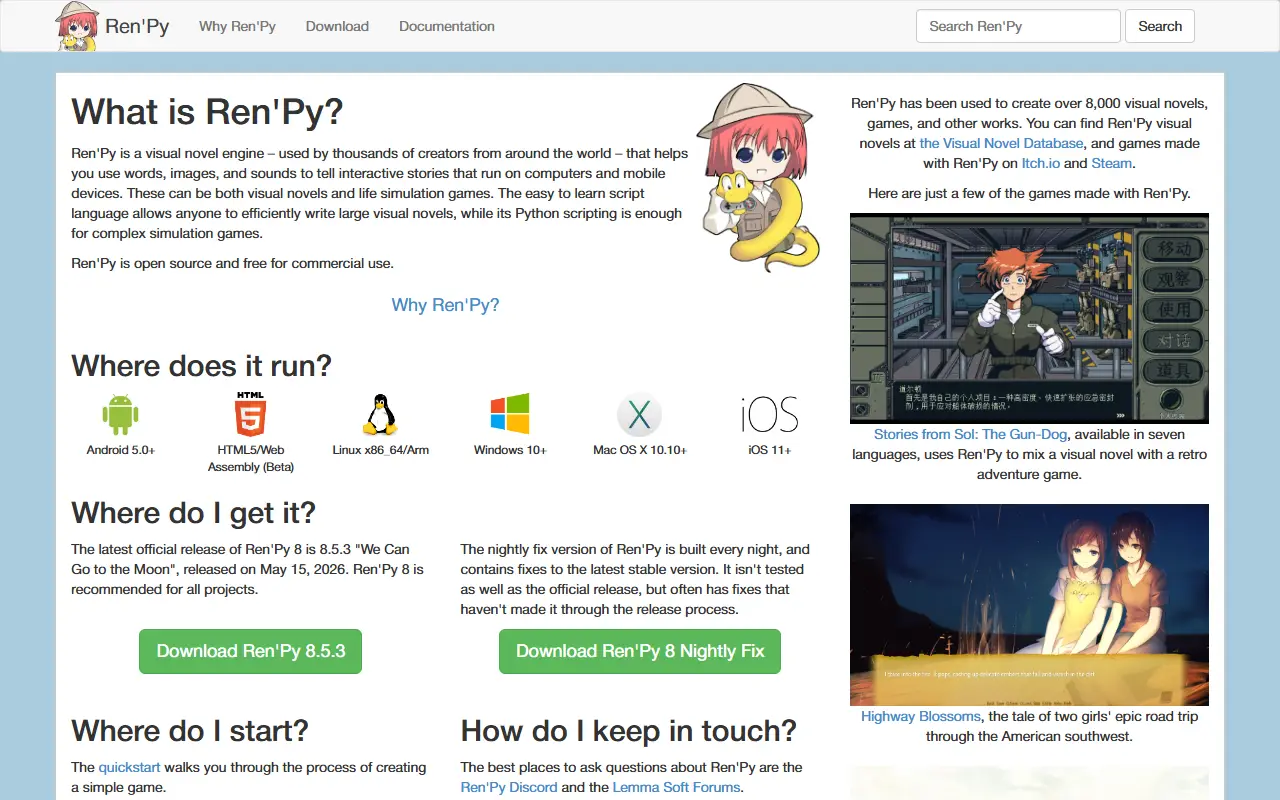
Ren'Py is a visual novel engine used to tell interactive stories with words, images and sounds. Games run on computers and mobile devices, and the site says it suits both visual novels and life simulation games.
Writing happens in an easy-to-learn script language meant for long visual novels, and Python scripting is available for more complex simulation games. A quickstart walks through making a simple game, community tutorials cover customisation, and the reference manual is also available in Japanese and Chinese.
Targets listed are Android 5.0+, HTML5/WebAssembly (listed as beta), Linux on x86_64 and Arm, Windows 10+, Mac OS X 10.10+ and iOS 11+. The current Ren'Py 8 release is 8.5.3, with a nightly fix build and a legacy Ren'Py 7 line. The site says the engine is open source and free for commercial use, and more than 8,000 works have used it.
Key features
- Interactive stories from words, images and sounds
- Supports visual novels and life simulation games
- Easy script language with Python for complex games
- Quickstart tutorial for a first game
- Nightly fix builds between releases
Pricing: Open source and free for commercial use, as stated on the site.
#4
TIC-80 is a free and open source fantasy computer with built-in development tools for creating mini retro games.
- GitHub stars
- 6.2k
- Last commit
- yesterday
- Latest release
- v1.4.1
- Licence
- MIT
- Hosted version
- Available
tic80.com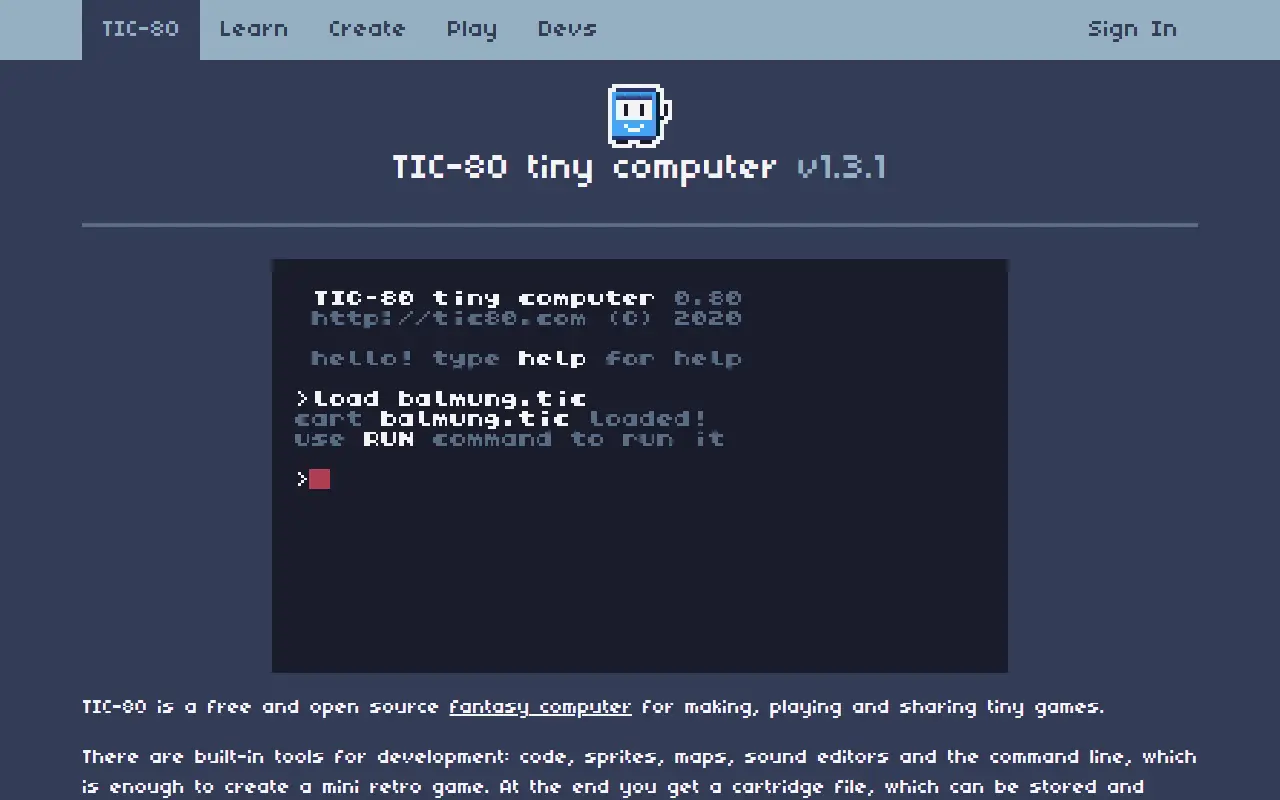
TIC-80 is a free and open source fantasy computer for making, playing and sharing tiny games. It includes built-in tools for development such as code, sprites, maps, sound editors and a command line, which are sufficient to create a mini retro game. The final output is a cartridge file that can be stored and played on the website.
Key features
- Built-in tools for code, sprites, maps, and sound editing
- Command line interface for development
- Produces cartridge files that can be stored and played on the website
- Games can be packed into a player that works on all popular platforms
- Technical limitations for retro-style games: 240x136 pixel display, 16-color palette, 256 8x8 color sprites, 4-channel sound

Twine is an open-source tool for creating interactive, nonlinear stories that can be published directly to HTML without coding, but supports variables, conditional logic, images, CSS, and JavaScript.
- GitHub stars
- 681
- Last commit
- 4 yr ago
- Latest release
- v1.4.3
- Hosted version
- Available
twinery.org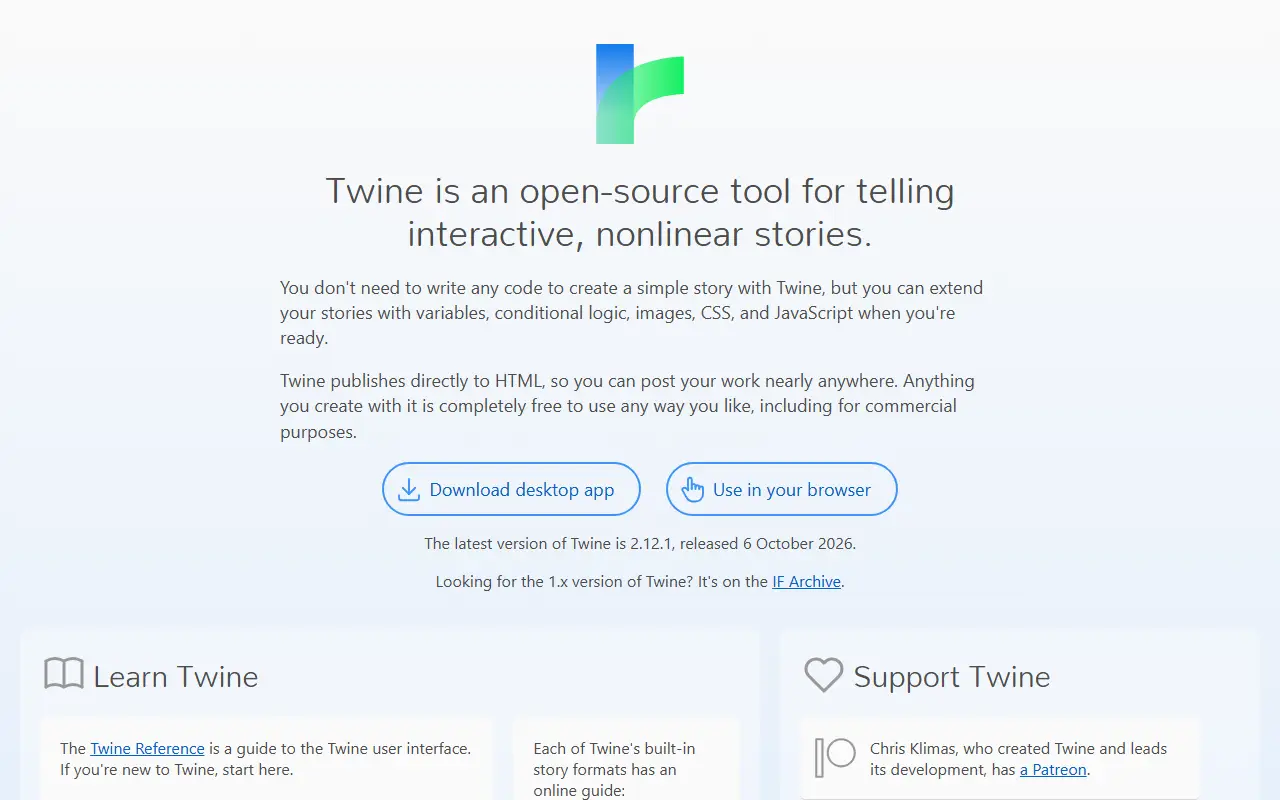
Twine is an open-source tool for telling interactive, nonlinear stories. It allows users to create simple stories without writing code, and can be extended with variables, conditional logic, images, CSS, and JavaScript. Twine publishes directly to HTML, so stories can be posted nearly anywhere, and anything created with it is free to use in any way, including for commercial purposes.
Twine is available as a desktop app and in a browser. The latest version is 2.12.1, released 6 October 2026. It includes built-in story formats such as Chapbook, Harlowe, Snowman, and SugarCube, each with online guides. The Twine Reference provides a guide to the user interface, and the Twine Cookbook offers advice on choosing a story format and examples of common tasks.
Key features
- Create interactive, nonlinear stories without writing code
- Extend stories with variables, conditional logic, images, CSS, and JavaScript
- Publish directly to HTML
- Available as a desktop app and in a browser
- Built-in story formats: Chapbook, Harlowe, Snowman, SugarCube
- Free to use for any purpose, including commercial
GameMaker alternatives: questions
- What is the best open-source alternative to GameMaker?
- GDevelop is the top-ranked open-source alternative to GameMaker on Enlisted: GDevelop is an open-source, no-code game engine with a free plan and paid Silver, Gold and Pro plans that add AI credits, cloud storage and publishing options. Other strong options are Godot, Renpy, tic80 and Twine.
- What are the best commercial alternatives to GameMaker?
- Construct 3, RPG Maker, Perro Engine, Unity and Unreal Engine are among the hosted, closed-source alternatives to GameMaker listed on Enlisted, which lists 6 in total. Compare their pricing and features on each tool page.
- Are these GameMaker alternatives free?
- All 5 are open source, so the code is free to use under its licence, and all of them can be self-hosted on your own server or computer. 2 also offer a paid or managed cloud version if you'd rather not host it yourself.
- How is this list of GameMaker alternatives ranked?
- By a score built from GitHub stars, star growth over the last 30 days and how recently the code changed. 4 of these projects shipped code in the last 30 days. Data is refreshed daily, and nobody can pay to move up.
 TrackMedia
 TrackRev