7,363 open-source and SaaS tools, with GitHub stats refreshed every day.

7 alternatives ranked by real activity

Open-source FACT-Finder alternatives

A curated, ranked list of the 7 best open-source alternatives to FACT-Finder.

The best open-source alternative to FACT-Finder is Elasticsearch. If that doesn't suit you, other good options are Meilisearch, Typesense, Manticore Search and Vespa.

FACT-Finder alternatives are mainly search tools. 6 of them shipped code in the last 30 days, 7 can be self-hosted, and 2 use a permissive licence.

Last updated October 3, 2026 · ranked by GitHub stars, growth and recent commits

Elasticsearch

A distributed, RESTful search and analytics engine written in Java, used for full-text search, log analysis and vector search across large datasets.

GitHub stars
78k
Last commit
today
Latest release
v9.5.4
Self-hosted
Yes
Hosted version
Available

Elasticsearch is a distributed, RESTful search engine written in Java. It stores documents as JSON, indexes them so they can be searched quickly, and exposes everything through an HTTP API, which makes it a common backbone for site search, application search and log analytics. It is built on the Apache Lucene library.

Beyond full-text queries it supports filtering, aggregations for analytics and, in recent versions, vector search for semantic and AI-assisted retrieval. Data is spread across nodes in a cluster using shards and replicas, so capacity and resilience grow by adding machines. It is the core of the Elastic Stack, usually paired with Kibana for exploration and with ingestion tools for logs and metrics.

The repository describes the project as free and open source, while its license metadata is listed as 'Other', so review the current license terms before relying on it commercially. It can be self-managed on your own servers or used as a managed service through Elastic Cloud.

Key features

  • Distributed full-text search over JSON documents
  • RESTful HTTP API
  • Aggregations for analytics
  • Vector search for semantic retrieval
  • Clustering with shards and replicas
Meilisearch

A fast search engine API written in Rust that adds typo-tolerant, filterable and hybrid semantic search to websites and apps, available self-hosted or as a cloud service.

GitHub stars
59k
Last commit
yesterday
Latest release
v1.54.3
Self-hosted
Yes
Hosted version
Available
meilisearch.comMeilisearch homepage screenshot

Meilisearch is a search engine exposed through an API, written in Rust and designed to be dropped into applications and websites. It aims to give developers a good search experience quickly, with features that work out of the box rather than needing extensive tuning.

Its capabilities include hybrid search that combines semantic and full-text results, search-as-you-type with a target response time under 50 milliseconds, typo tolerance, filtering and faceted search, sorting and geosearch. The topics also describe it as a vector database for AI use cases. The project maintains example applications for movies, ecommerce with facets and filters, conversational home booking, personalization and a multi-tenant CRM, which show how the features fit together.

The license is listed as 'Other', so confirm the terms for your use case. Meilisearch can be run on your own infrastructure, and Meilisearch Cloud offers it as a managed service. It is a common pick for site search, product catalogs and in-app search where a lighter alternative to a large cluster is attractive.

Key features

  • Hybrid semantic and full-text search
  • Instant search-as-you-type results
  • Typo tolerance and fuzzy matching
  • Filtering and faceted search
  • Sorting and geosearch
  • Vector storage for AI search
  • REST API with example demo apps

Pricing: Self-hosting is free under the MIT license. Meilisearch Cloud starts at $20 per month with a 14-day free trial, billed by usage or instance resources; Enterprise is quoted on request.

Typesense

A fast, typo-tolerant, in-memory search engine for site and app search, pitched as an open-source Algolia alternative and an easier-to-run Elasticsearch alternative.

GitHub stars
27k
Last commit
yesterday
Latest release
v30.2
Licence
GPL-3.0
Self-hosted
Yes
Hosted version
Available
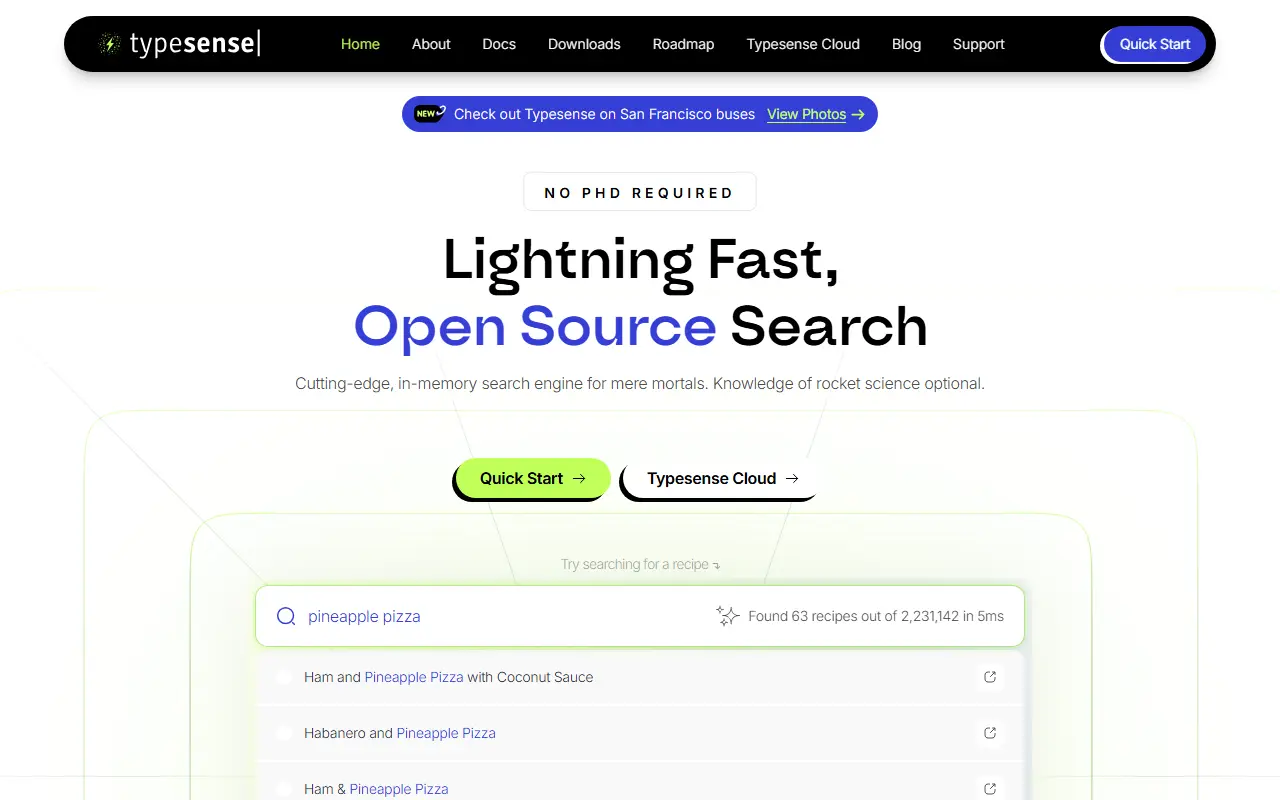
typesense.orgTypesense homepage screenshot

Typesense is an open-source search engine for building fast, typo-tolerant search experiences in websites and applications. It is pitched as an open-source substitute for Algolia and Pinecone, and as a simpler option than Elasticsearch. It keeps its index in memory and is written in C++.

The project's feature topics include typo tolerance and fuzzy matching, full-text search, faceting, geosearch, synonyms, merchandising rules and instant search, and it supports semantic and hybrid search. Public demos let you try it on large datasets, such as 32 million songs from MusicBrainz, 28 million books from OpenLibrary, a recipe set, Linux kernel commit messages, an ecommerce store experience, a geosearch listing browser and semantic search over Hacker News comments.

Typesense is licensed under GPL-3.0 and can be run on your own servers, and a managed Typesense Cloud service is also available. Documentation, a roadmap, a Slack community and video introductions are provided. It suits developers who want Algolia-style search with the option to self-host and keep costs predictable.

Key features

  • Typo-tolerant, in-memory search
  • Faceting, filtering and synonyms
  • Geosearch for location-based results
  • Semantic and hybrid search
  • Merchandising controls for ranking
  • Self-hosted or Typesense Cloud

Vespa

An open-source platform for search, recommendation and personalization that serves vectors, tensors, text and structured data with machine-learned ranking at any scale.

GitHub stars
7.1k
Last commit
today
Latest release
v8.753.16
Licence
Apache-2.0
Self-hosted
Yes
Hosted version
Available

Vespa is a platform for applications that must pick a subset of data from a large, changing corpus, evaluate machine-learned models over it, organize and aggregate the results and return them quickly. Typical examples are search, recommendation and personalization, and the platform adds vector search and retrieval-augmented generation as well, as shown in its topics.

Doing this over large data sets distributed across many nodes and evaluated in parallel is hard, and Vespa handles it with high availability and performance. It handles searching, running inference over and organizing vectors, tensors, text and structured data while serving. According to the README, Vespa has been developed over many years and runs behind several large internet services.

The repository contains all the code needed to build and run Vespa yourself under the Apache 2.0 licence, and new releases are made from the master branch on weekday mornings. You can deploy applications to the Vespa Cloud service, which offers a free trial, or run your own instance following the getting started guide. It is written in Java and C++ and suits teams building large-scale search and recommendation systems.

Key features

  • Search over text, vectors and tensors
  • Machine-learned model inference at serving time
  • Structured data filtering and aggregation
  • Distributed, highly available serving
  • Real-time updates while serving queries
  • Cloud service with a free trial

Pricing: Free and open source under Apache 2.0; Vespa Cloud is a managed service with a free trial.

Read more about VespaWebsite GitHub

Marqo

Marqo is an AI-native ecommerce search and discovery platform, with an open-source multi-modal search engine repository maintained alongside it.

GitHub stars
5k
Last commit
1 mo ago
Latest release
2.26.0
Licence
Apache-2.0
Self-hosted
Yes
Hosted version
Available
marqo.aiMarqo homepage screenshot

Marqo builds AI-native search and product discovery for online brands in categories such as fashion, beauty, electronics and home goods. Using semantic search and personalization, it learns from browsing clicks, orders and other events to infer what shoppers want and return relevant search results and recommendations.

The vendor says its platform helps commerce teams improve search relevance, raise conversion and order value, and reduce manual merchandising through automated ranking and optimization. The repository also hosts the open-source search engine project, with topics covering multi-modal search and machine learning. A notice at the top of the README clarifies the status of the open-source project relative to the commercial platform, so read it before adopting the code.

The code is written in Python under the Apache-2.0 license. You can run the open-source engine yourself, or buy the managed ecommerce platform from the vendor. It suits online retailers and developers evaluating vector search for product catalogs.

Key features

  • Semantic product search
  • Personalized search results and recommendations
  • Clickstream and purchase data learning
  • Automated ranking and merchandising
  • Multi-modal search support
  • Open-source engine in Python
Read more about MarqoWebsite GitHub

ElasticSuite

ElasticSuite is a Magento 2 module that replaces the default catalog search with an Elasticsearch-based engine and merchandising tools.

GitHub stars
804
Last commit
today
Latest release
2.12.2
Licence
OSL-3.0
Self-hosted
Yes
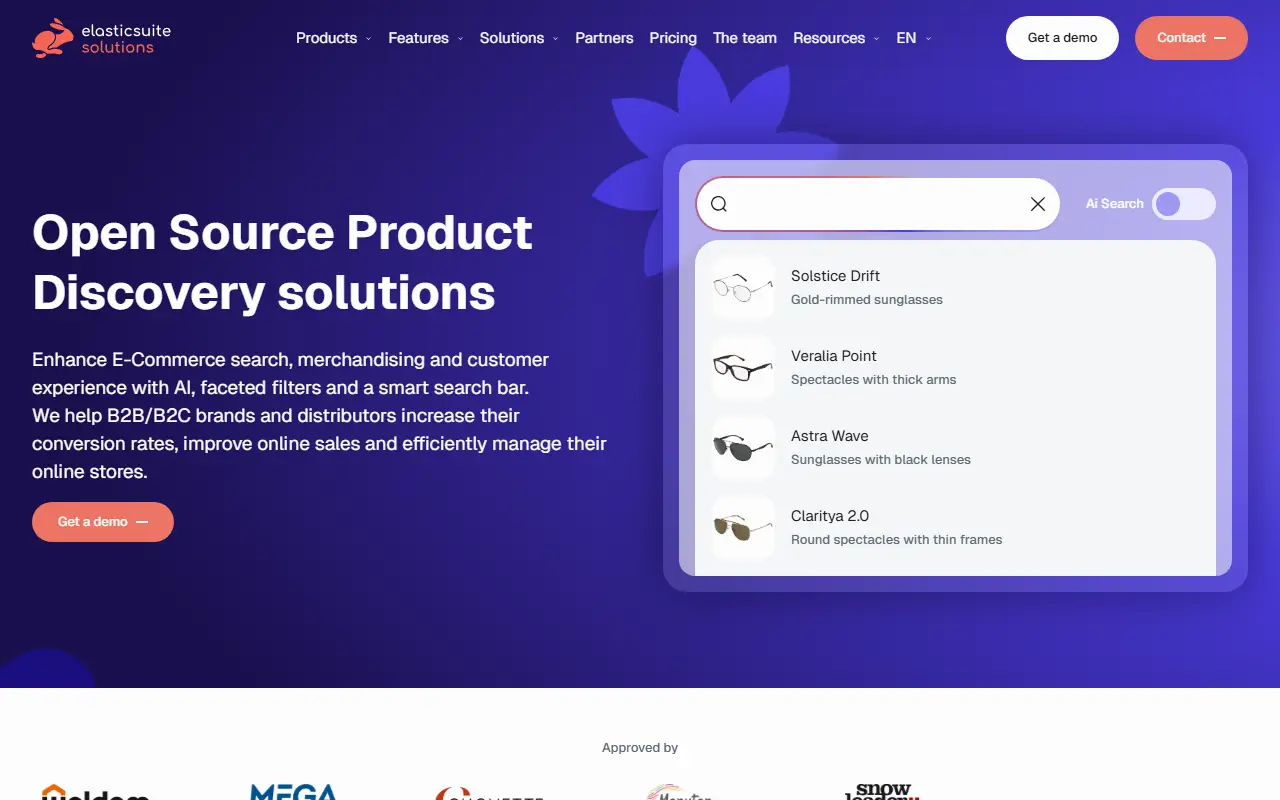
elasticsuite.ioElasticSuite homepage screenshot

ElasticSuite, from Smile, is a search and merchandising module for Magento 2 built on Elasticsearch. It is installed into a Magento store to power catalog search, autocomplete and faceted navigation, and to give merchandisers tools for controlling how products are ranked and displayed.

The project maintains a compatibility matrix because Magento 2.4.6 introduced Elasticsearch 8 and OpenSearch 2: different ElasticSuite releases line up with different Magento versions, from the 2.9.x line for older stores up to 2.12.x for the newest, and with Elasticsearch 7 and 8 or OpenSearch 1 to 3. Stores using Magento Commerce B2B features need separate Shared Catalog and Quick Order modules.

A set of free additional modules is also published on GitHub, including CMS page search, rating filters and sorting, a retail suite with a store locator and per-store price segmentation, and target rules computed through Elasticsearch. ElasticSuite is written in PHP and licensed under OSL-3.0, and it needs your own Magento and search cluster.

Key features

  • Elasticsearch-powered Magento 2 search
  • Autocomplete and faceted navigation
  • Merchandising controls for product ranking
  • CMS page search module
  • Rating filter and sort module
  • Retail modules with store locator

Pricing: The self-hosted Free plan costs nothing. Growth starts from €415 and Business from €999 per month as a fixed license, with lower rates on longer commitments; Enterprise is quoted on request.

FACT-Finder alternatives: questions

What is the best open-source alternative to FACT-Finder?
Elasticsearch is the top-ranked open-source alternative to FACT-Finder on Enlisted: A distributed, RESTful search and analytics engine written in Java, used for full-text search, log analysis and vector search across large datasets. Other strong options are Meilisearch, Typesense, Manticore Search and Vespa.
Are these FACT-Finder alternatives free?
All 7 are open source, so the code is free to use under its licence, and all of them can be self-hosted on your own server or computer. 5 also offer a paid or managed cloud version if you'd rather not host it yourself.
How is this list of FACT-Finder alternatives ranked?
By a score built from GitHub stars, star growth over the last 30 days and how recently the code changed. 6 of these projects shipped code in the last 30 days. Data is refreshed daily, and nobody can pay to move up.

People also look for alternatives to…

View all