7,363 open-source and SaaS tools, with GitHub stats refreshed every day.

5 alternatives ranked by real activity

Open-source Disqus alternatives

A curated, ranked list of the 5 best open-source alternatives to Disqus.

The best open-source alternative to Disqus is Discourse. If that doesn't suit you, other good options are Remark42, Isso, Waline and Talkyard.

Disqus alternatives are mainly forum & community tools, but some are also CMS tools. 4 of them shipped code in the last 30 days, 5 can be self-hosted, and 2 use a permissive licence.

Last updated October 2, 2026 · ranked by GitHub stars, growth and recent commits

Discourse

An open-source community discussion platform with topics, built-in chat, themes and plugins, available to self-host or through official hosting.

GitHub stars
48k
Last commit
today
Licence
GPL-2.0
Self-hosted
Yes
Hosted version
Available
discourse.orgDiscourse homepage screenshot

Discourse is a fully open-source platform for online community discussion. It is aimed at those who prefer to decide for themselves how and where their site runs, and it is written mainly in Ruby on Rails with a JavaScript front end and PostgreSQL. It is released under the GPL-2.0 license.

Discourse lets you start discussion topics, talk live through its integrated chat, change the look with official and community themes, and extend the site with plugins, ranging from chatbots powered by Discourse AI to the Data Explorer plugin for SQL analysis. Current stable versions of the major browsers are supported across desktops, tablets and phones.

You can self-host it on your own infrastructure by following the install guide, or choose the official Discourse hosting if you would rather skip setup and server management. Development setups use Docker or a VS Code dev container and need Ruby, PostgreSQL and Redis. It suits companies, open-source projects and groups running forums and support communities.

Key features

  • Threaded discussion topics
  • Built-in real-time chat
  • Official and community themes
  • Plugins including Discourse AI and Data Explorer
  • Self-hosting or official hosting
  • Works on all major browsers and devices

Pricing: A free hosted plan is available for exploring. Pro is $100 per month and Business $500 per month, both with a free trial; Enterprise is custom-priced.

Remark42

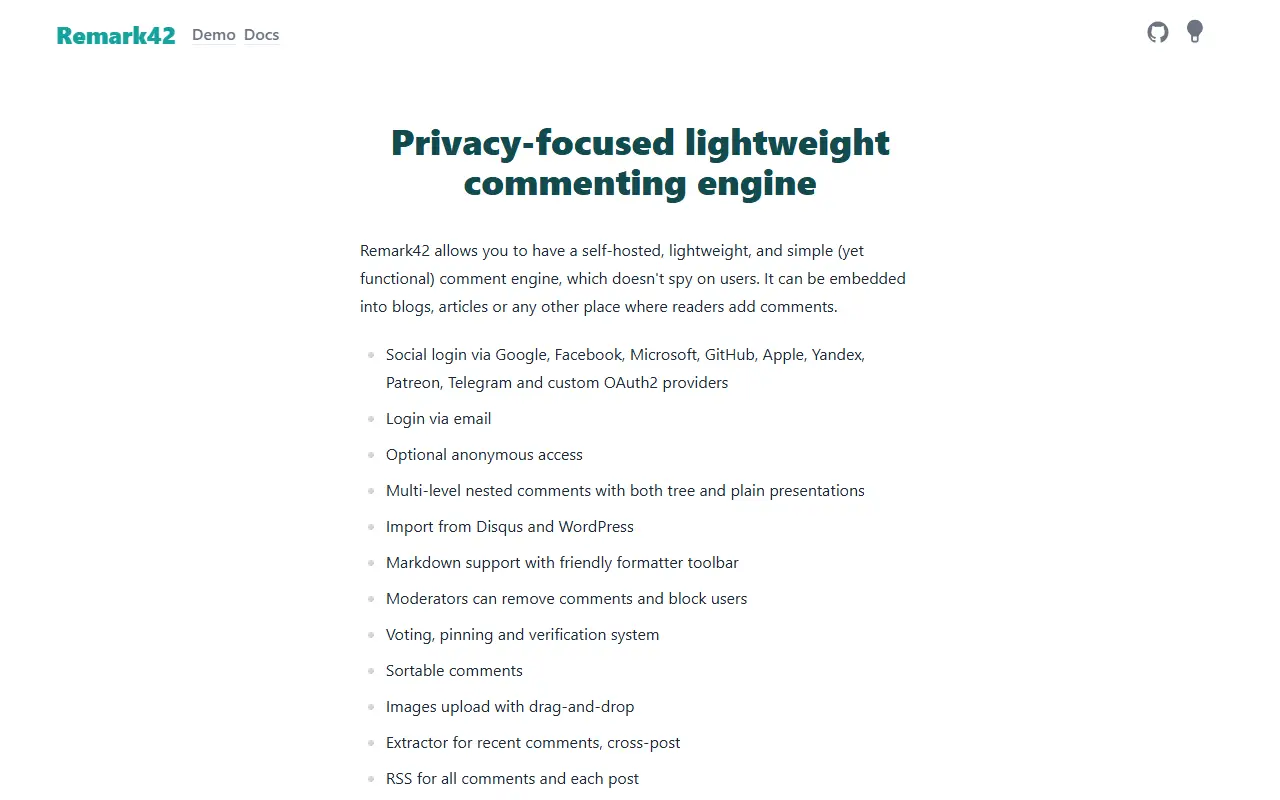
Remark42 is a self-hosted, lightweight comment engine for blogs and articles that supports social login, threading, moderation and imports from Disqus.

GitHub stars
5.6k
Last commit
yesterday
Latest release
v1.17.1
Licence
MIT
Self-hosted
Yes
remark42.comRemark42 homepage screenshot

Remark42 is a comment engine you run yourself and embed into blogs, articles or any page where readers leave comments. It is built to be lightweight and simple while staying functional, and it does not track its users, which makes it a privacy-friendly alternative to hosted commenting widgets. It is written in Go.

Readers can sign in through social providers such as Google, Facebook, Microsoft, GitHub, Apple, Yandex, Patreon, Discord and Telegram, through custom OAuth2 providers, or by email, with optional anonymous access. Comments support multi-level nesting in tree or plain views, Markdown with a formatting toolbar, drag-and-drop image upload, voting, pinning and verification. Moderators can remove comments and block users, and administrators can import data from Disqus and WordPress and receive notifications.

Remark42 is MIT-licensed and typically deployed as a Docker container next to your site. It suits bloggers and small publications that want control over comment data without relying on a third-party service.

Key features

  • Social, email and anonymous login
  • Nested comments in tree or plain view
  • Markdown with formatting toolbar
  • Moderation, blocking and pinning tools
  • Import from Disqus and WordPress
  • RSS feeds and notification channels

Pricing: Free and open source under the MIT license.

Isso

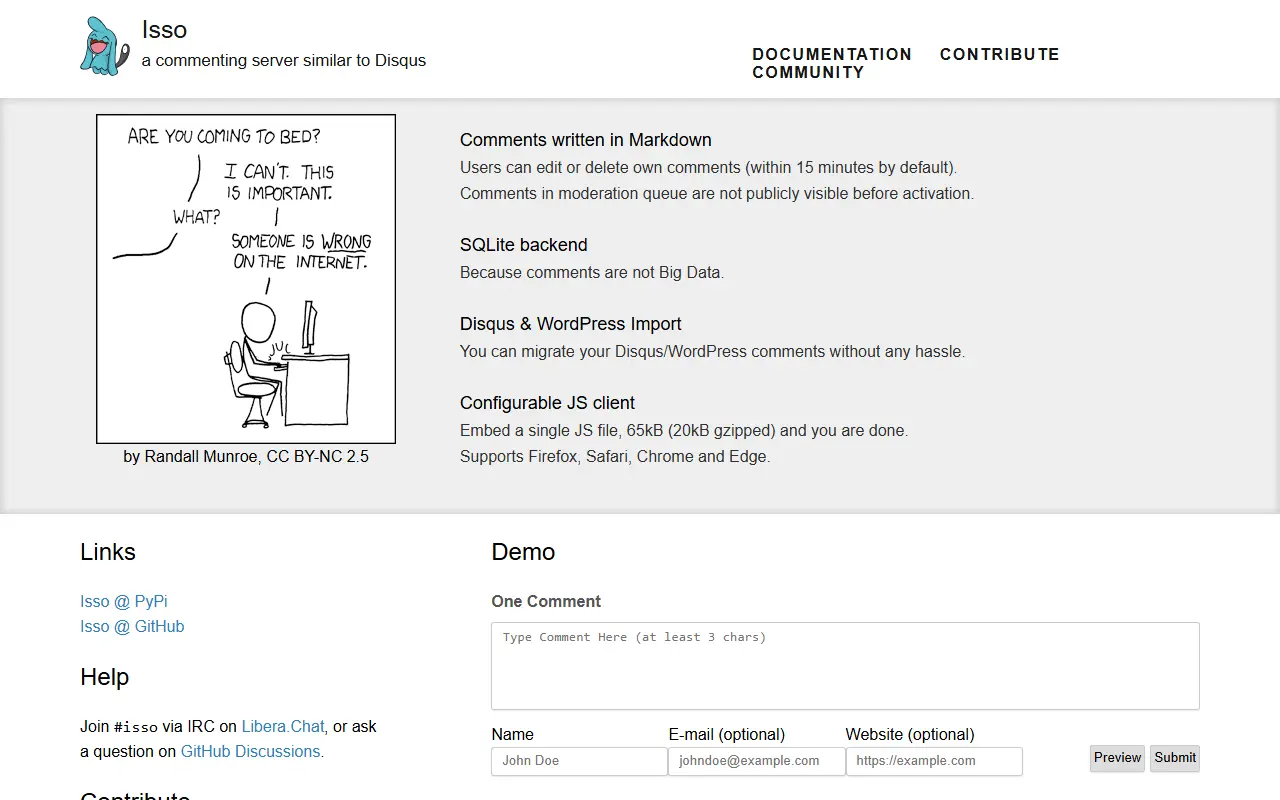
A lightweight self-hosted commenting server written in Python and JavaScript, designed as a drop-in alternative to Disqus for websites.

GitHub stars
5.3k
Last commit
18 days ago
Latest release
0.14.0
Licence
MIT
Self-hosted
Yes
isso-comments.deIsso homepage screenshot

Isso is a lightweight commenting server that lets you add a discussion section to your own website without relying on a third-party service. It is written in Python and JavaScript and aims to be a drop-in replacement for Disqus, with comments stored in a local SQLite database.

Visitors write comments in Markdown, and can edit or delete their own comments within a time window that is 15 minutes by default. Comments can be held in a moderation queue so they stay hidden until approved. Existing discussions can be brought over by importing from Disqus or WordPress, and the site embeds a single configurable JavaScript file of about 20 kB gzipped.

Isso is licensed under MIT and requires Python 3.8 or later and SQLite. It can be installed from PyPI or run from a Docker image published on GitHub's container registry, with a quickstart guide and full documentation online. A live demo is available on the project website.

Key features

  • Markdown comments
  • Moderation queue for new comments
  • Edit and delete own comments within a time limit
  • Disqus and WordPress comment import
  • SQLite storage
  • Single embeddable JavaScript client

Pricing: Free and open source under the MIT licence.

Waline

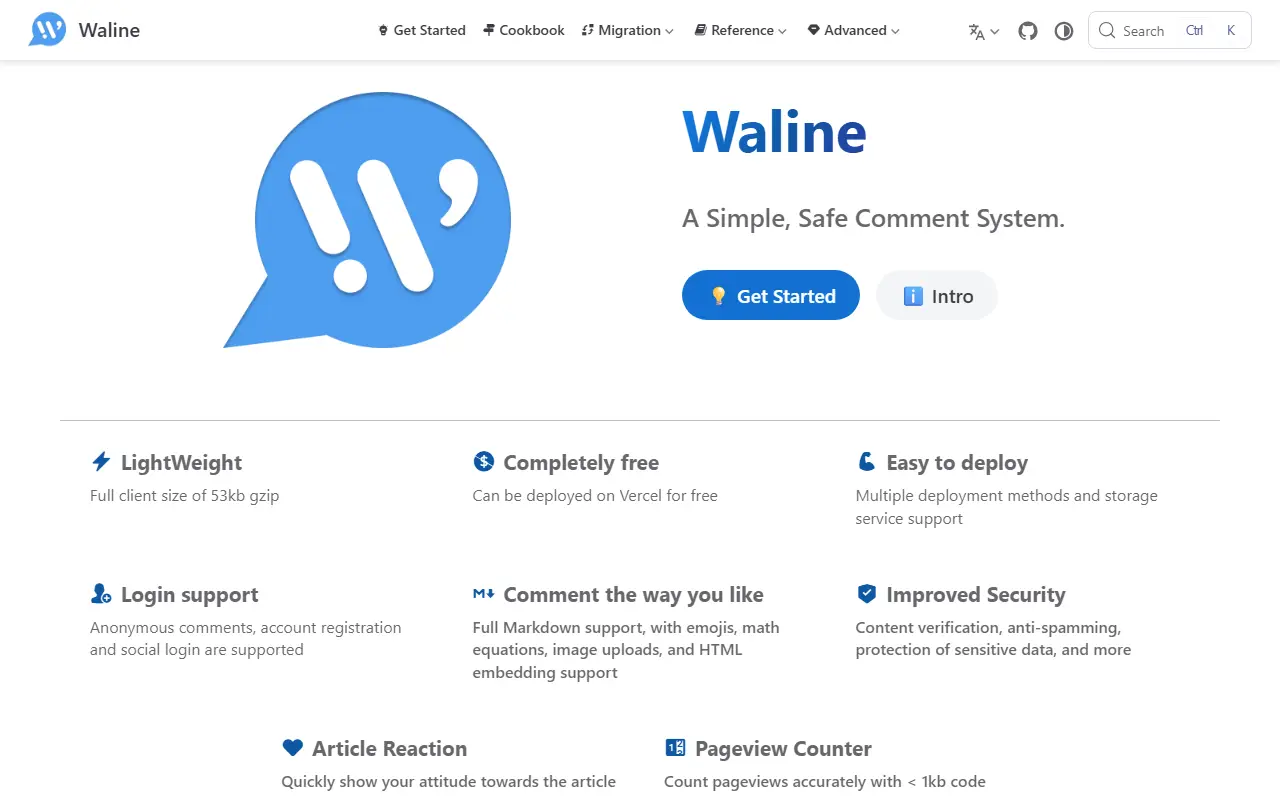
Waline is a lightweight comment system with a backend, designed for blogs and static sites and deployable on many platforms and databases.

GitHub stars
3.1k
Last commit
today
Latest release
@waline/vercel@1.43.4
Licence
GPL-2.0
Self-hosted
Yes
waline.js.orgWaline homepage screenshot

Waline is a simple, lightweight comment system with its own backend, aimed at blogs and similar websites. It supports full Markdown syntax in comments and emphasizes safety, including spam and abuse controls. Its topics reference Disqus, so it is often considered by sites looking for a self-managed alternative to hosted commenting services.

A client library, @waline/client, is embedded in the page, while the server can run on Vercel, CloudBase, Railway, Render, Zeabur, Netlify, Alibaba Cloud ComputeNest or in Docker on your own machine. Storage options include PostgreSQL, MySQL, SQLite, TiDB, MongoDB, CloudBase and GitHub. The project advertises a very large number of deployment combinations.

Moderation and engagement features include email, WeChat, QQ and Telegram notifications, Akismet spam checking, IP-based rate limits, keyword restrictions, an IP disallow list, duplicate content checks, sticky comments, comment likes and comment management with deletion. Login support covers social accounts, there is an article counter, and the interface is internationalized with custom language support. It is licensed under GPL-2.0.

Key features

  • Comment system with Markdown support
  • Deploys to Vercel, Netlify, Railway or Docker
  • Storage on PostgreSQL, MySQL, SQLite or MongoDB
  • Akismet spam checking and IP rate limits
  • Email, Telegram, WeChat and QQ notifications
  • Sticky comments and comment likes
  • Social login and comment management

Pricing: Free and open source under GPL-2.0.

Talkyard

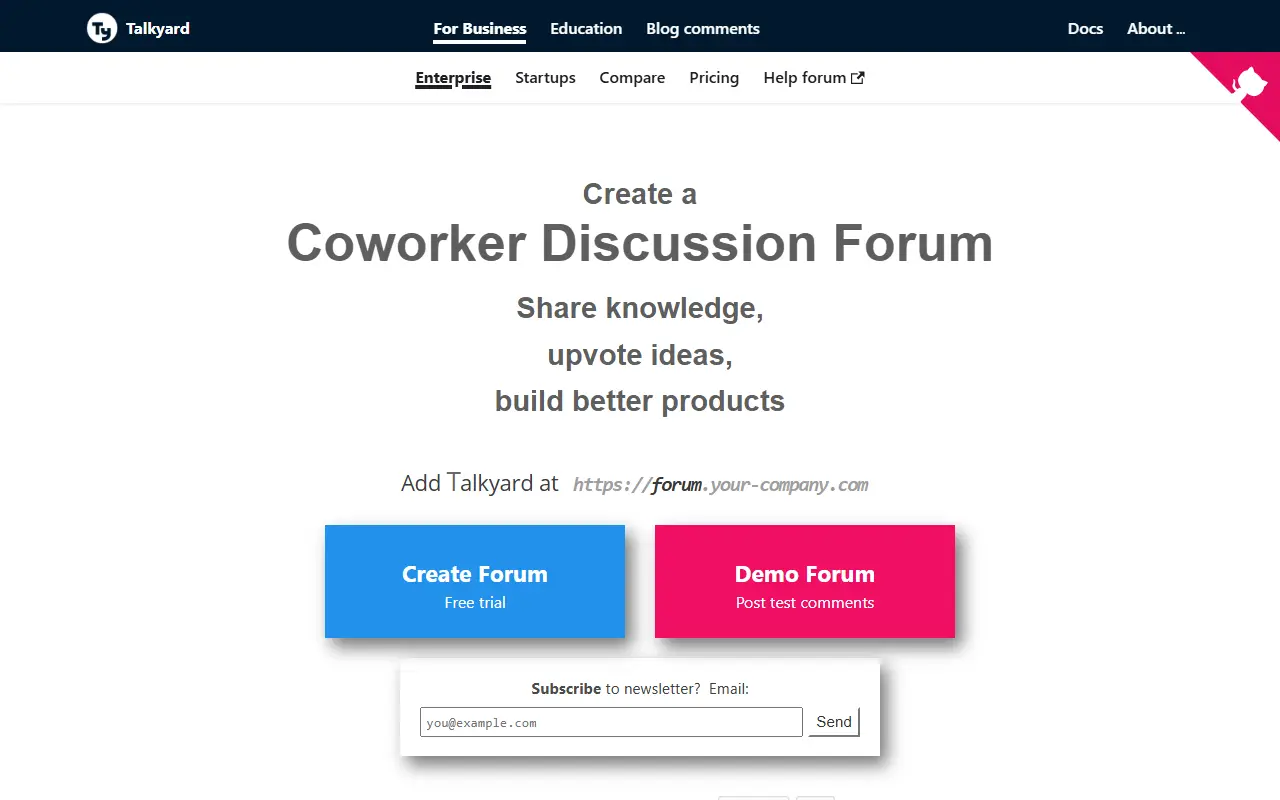
Talkyard is open-source community discussion software that combines forum topics, question-and-answer threads, chat channels and embeddable blog comments.

GitHub stars
1.8k
Last commit
2 mo ago
Latest release
tyse-v1.2026.003-f220a7d9f-regular
Licence
AGPL-3.0
Self-hosted
Yes
talkyard.ioTalkyard homepage screenshot

Talkyard is a community discussion platform that brings together features from several kinds of tools. Its description names StackOverflow, Slack, Discourse, Reddit and Disqus as the sources, so one installation can host a forum, question-and-answer boards, chat channels and comments for a blog.

The platform emphasizes thoughtful discussion, with insightful comments rising to the top and the ability to upvote ideas and sort by votes. Question topics let participants select an accepted answer, chat channels offer fairly basic real-time messaging, and an embedding option lets website owners collect anonymous blog comments. The project provides a comparison page against other software, a demo forum, a discussion forum for the project and documentation that it describes as incomplete.

Talkyard is written mainly in TypeScript and Scala with a React front end, and is licensed under AGPL-3.0. Self-hosting is supported through the separate talkyard-prod-one repository, and this repository is where development takes place.

Key features

  • Forum topics with votes and sorting
  • Question and answer topics with accepted answers
  • Chat channels
  • Embeddable blog comments
  • Anonymous commenting
  • Self-hosting setup repository

Pricing: Standard costs €4 and Business €12 per active coworker per month (Business has a €300 monthly minimum); external members are unlimited and the first month is a free trial. Enterprise is by email.

Disqus alternatives: questions

What is the best open-source alternative to Disqus?
Discourse is the top-ranked open-source alternative to Disqus on Enlisted: An open-source community discussion platform with topics, built-in chat, themes and plugins, available to self-host or through official hosting. Other strong options are Remark42, Isso, Waline and Talkyard.
Are these Disqus alternatives free?
All 5 are open source, so the code is free to use under its licence, and all of them can be self-hosted on your own server or computer. 1 also offers a paid or managed cloud version if you'd rather not host it yourself.
How is this list of Disqus alternatives ranked?
By a score built from GitHub stars, star growth over the last 30 days and how recently the code changed. 4 of these projects shipped code in the last 30 days. Data is refreshed daily, and nobody can pay to move up.

People also look for alternatives to…

View all