#1
A fair-code workflow automation platform that mixes a visual canvas with custom code and AI agent features, for teams connecting apps and automating processes.
- GitHub stars
- 210k
- Last commit
- today
- Latest release
- n8n@2.47.5
- Self-hosted
- Yes
- Hosted version
- Available
n8n.io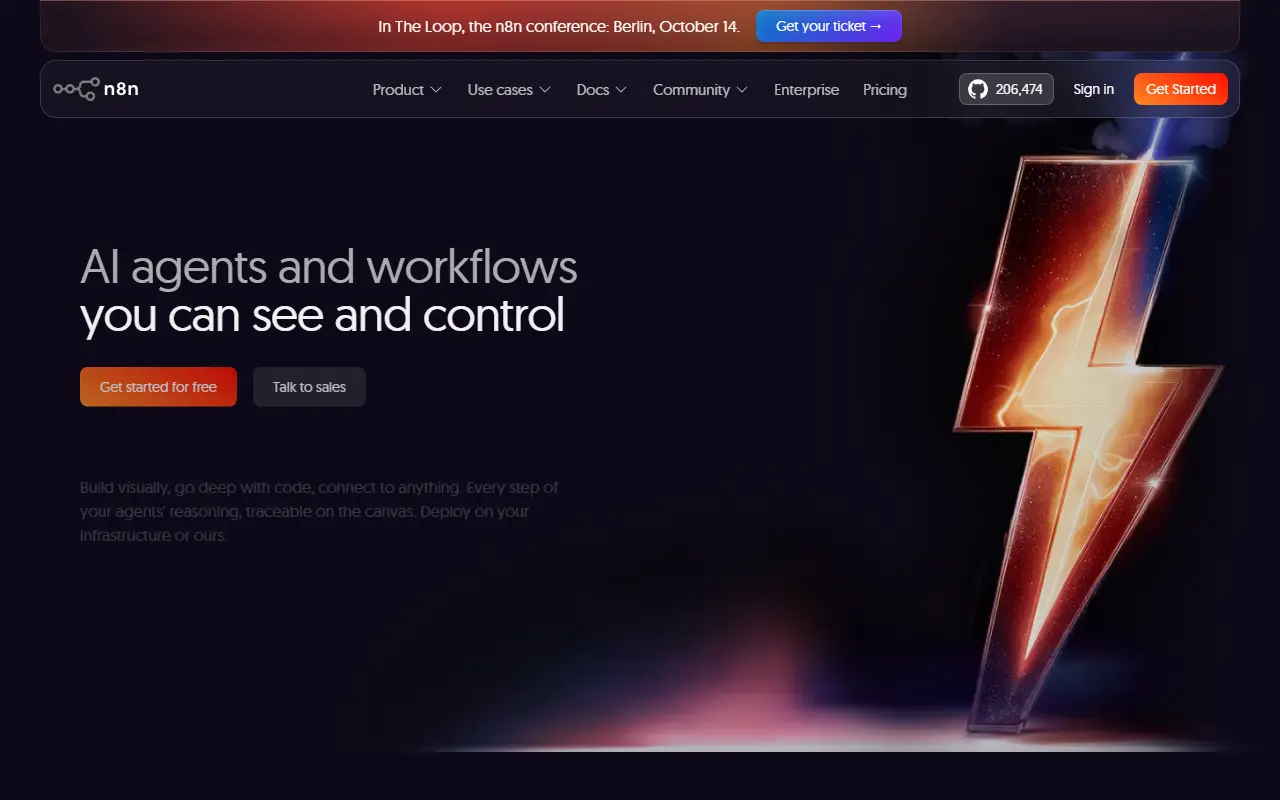
n8n is a workflow automation platform for connecting apps, moving data between them and triggering actions without writing a full integration from scratch. Workflows are built on a visual canvas, and when a step needs more logic you can drop in JavaScript or Python and use npm packages. It is often compared with Zapier and Make, but the source is public and it can run on your own infrastructure.
Recent versions put a lot of weight on AI. You can build multi-step agents and LLM workflows that call OpenAI, Anthropic, Google or open-source models, add human approval steps, and inspect what happened afterward. The project advertises over a thousand integrations and a large library of ready-made workflow templates, and you can extend it with your own nodes.
n8n is distributed under a fair-code model: the Sustainable Use License, plus a separate enterprise license for additional features. The code is always visible and can be self-hosted, for example with Docker, but it is not an OSI-approved open-source license, so commercial redistribution is restricted. A managed cloud edition is available if you would rather not run it yourself.
Key features
- Visual workflow canvas with branching logic
- JavaScript and Python code steps with npm packages
- Multi-step AI agents with human approval
- Over 1,500 integrations plus reusable templates
- Connects to OpenAI, Anthropic, Google or local models
- Role-based access and audit trails
- Self-hosting with Docker or managed cloud
Pricing: Free self-hosted Community Edition. Hosted plans cost 20€ (Starter), 50€ (Pro) and 667€ (Business) per month billed annually, scaled by workflow executions; Enterprise is custom. Free trial available.
#2
Temporal is a durable execution platform whose server runs application workflows resiliently, retrying failed operations automatically.
- GitHub stars
- 24k
- Last commit
- yesterday
- Latest release
- v1.32.2
- Licence
- MIT
- Self-hosted
- Yes
- Hosted version
- Available
docs.temporal.io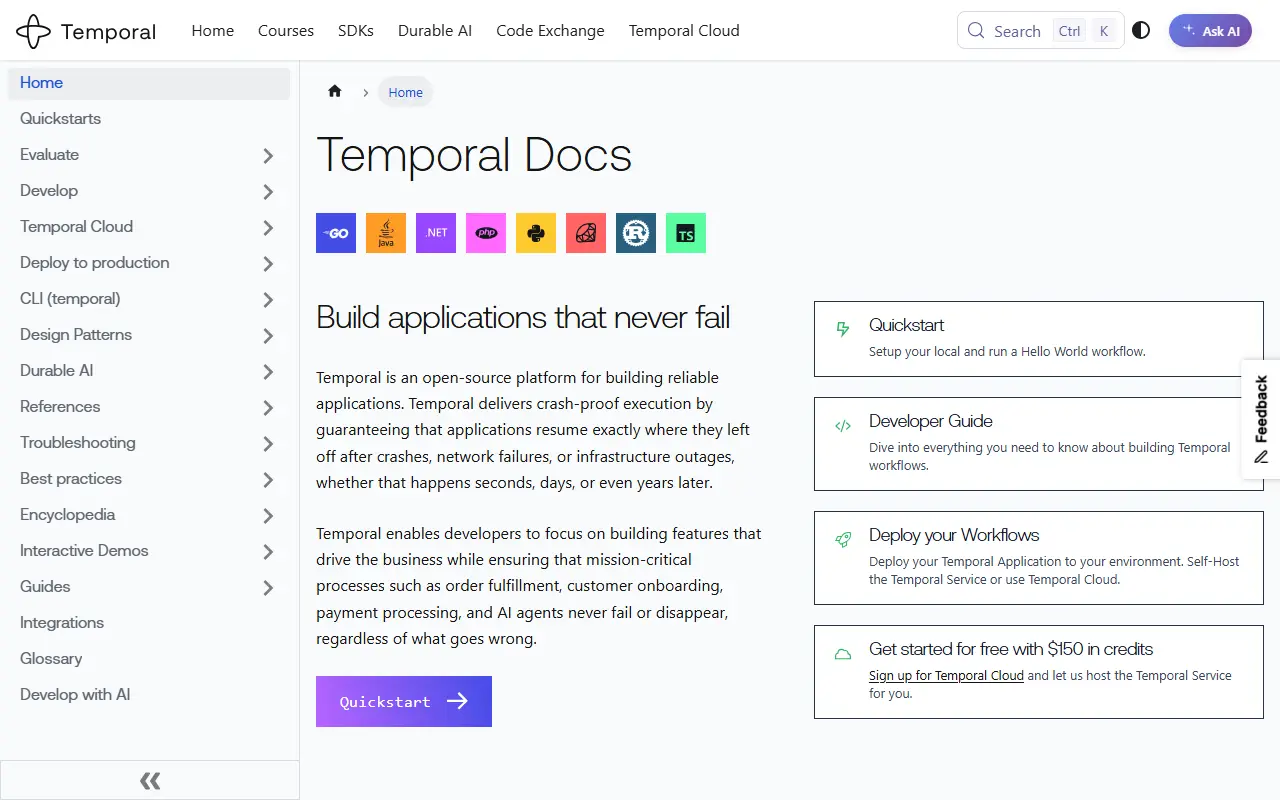
Temporal is a durable execution platform that helps developers create scalable applications while keeping both productivity and reliability. The Temporal server runs units of application logic called Workflows, handling intermittent failures and retrying failed operations automatically. It started as a fork of Uber's Cadence and is developed by Temporal Technologies, a company founded by Cadence's creators. The server is written in Go and released under the MIT license.
This repository contains the source of the server only. To implement Workflows, Activities and Workers you use one of the supported language SDKs. The getting started guide shows how to download and run a pre-built image with its dependencies locally, try samples written for Go or Java, interact with the server through the Temporal CLI, and watch workflows in the Web UI at port 8233. Repository topics cover workflow engines, distributed cron, microservice orchestration and durable execution.
Key features
- Durable execution of long-running workflows
- Automatic retries for failed operations
- SDKs for writing Workflows and Activities
- Temporal CLI for interacting with the server
- Web UI for viewing running workflows
- Distributed cron-style scheduling
Pricing: Server is free and open source under the MIT license; a managed cloud service is also offered by Temporal Technologies.
#3
An open-source developer platform that turns scripts into APIs, background jobs, workflows and auto-generated UIs, positioned against Retool, Pipedream and Temporal.
- GitHub stars
- 19k
- Last commit
- today
- Latest release
- v1.871.1
- Self-hosted
- Yes
- Hosted version
- Available
windmill.dev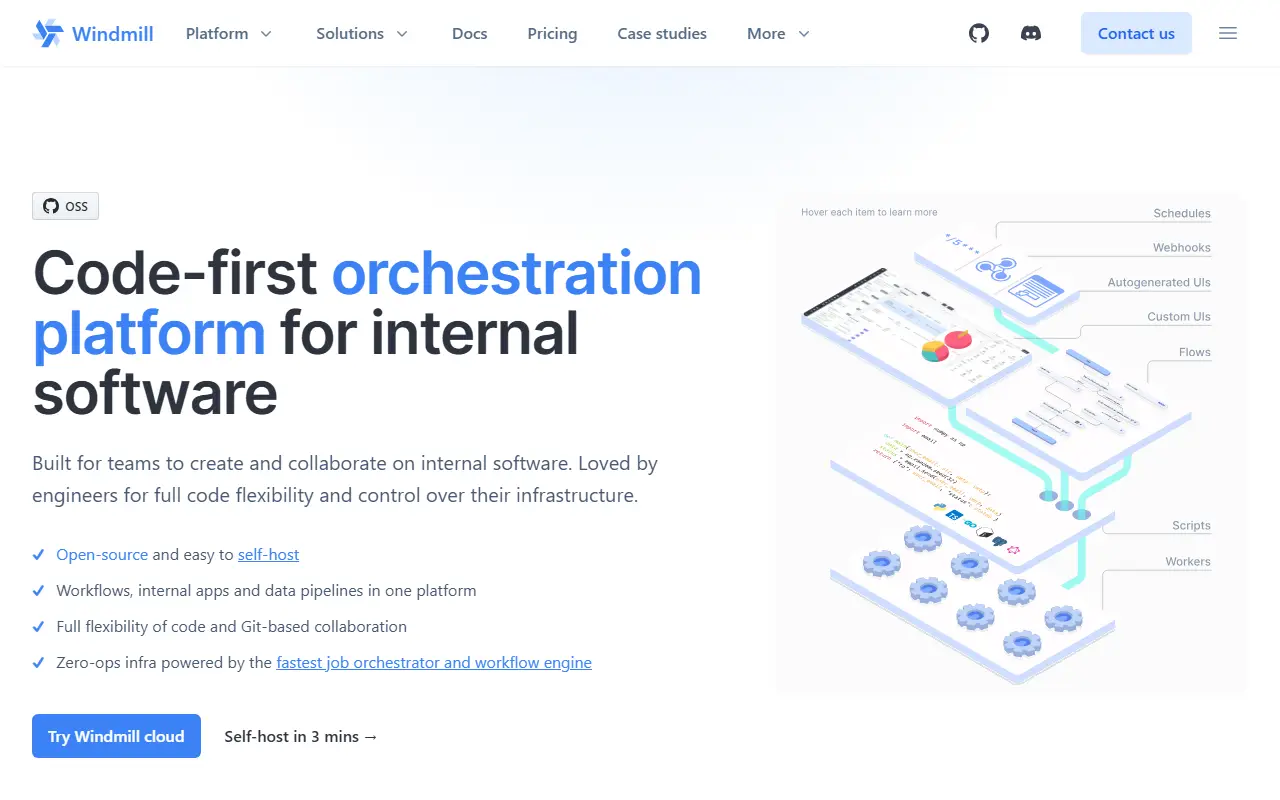
Windmill is an open-source platform for developers to run internal code as APIs, background jobs, workflows and user interfaces. It is pitched as a self-hostable alternative to Retool, Pipedream and Superblocks and as a simplified version of Temporal, and it automatically generates UIs so a script can be shared and triggered as an internal app.
Scripts can be written in languages including Python, TypeScript, Go, Bash, SQL, PowerShell, Rust and GraphQL. They can be composed into flows or used within richer apps built with its low-code builder. The backend is written in Rust on PostgreSQL, and the README describes it as a very fast self-hosted workflow engine, citing a comparison with Airflow. Sections of its documentation cover main concepts, local development, architecture, security, performance and self-hosting with Docker Compose.
Windmill is open source under AGPLv3, and Windmill Labs sells dedicated instances, commercial support and licenses, so the repository license is listed as 'Other' on GitHub. It suits engineering teams that want to turn existing scripts into reliable internal tools and automations without building each interface by hand.
Key features
- Scripts turned into APIs and auto-generated UIs
- Multi-language support including Python and TypeScript
- Workflows composed from scripts
- Low-code builder for internal apps
- Rust workflow engine on PostgreSQL
- Self-hosting with Docker Compose
Pricing: The Community Edition is free to self-host. Team is $10 per seat per month; Enterprise is $20 per developer and $10 per operator per month, with a one-month trial.
#4
Open source Java engines for BPMN business processes, CMMN cases and DMN decisions, usable embedded in an app or as a standalone service.
- GitHub stars
- 9.6k
- Last commit
- 9 days ago
- Latest release
- flowable-8.0.0
- Licence
- Apache-2.0
- Self-hosted
- Yes
flowable.org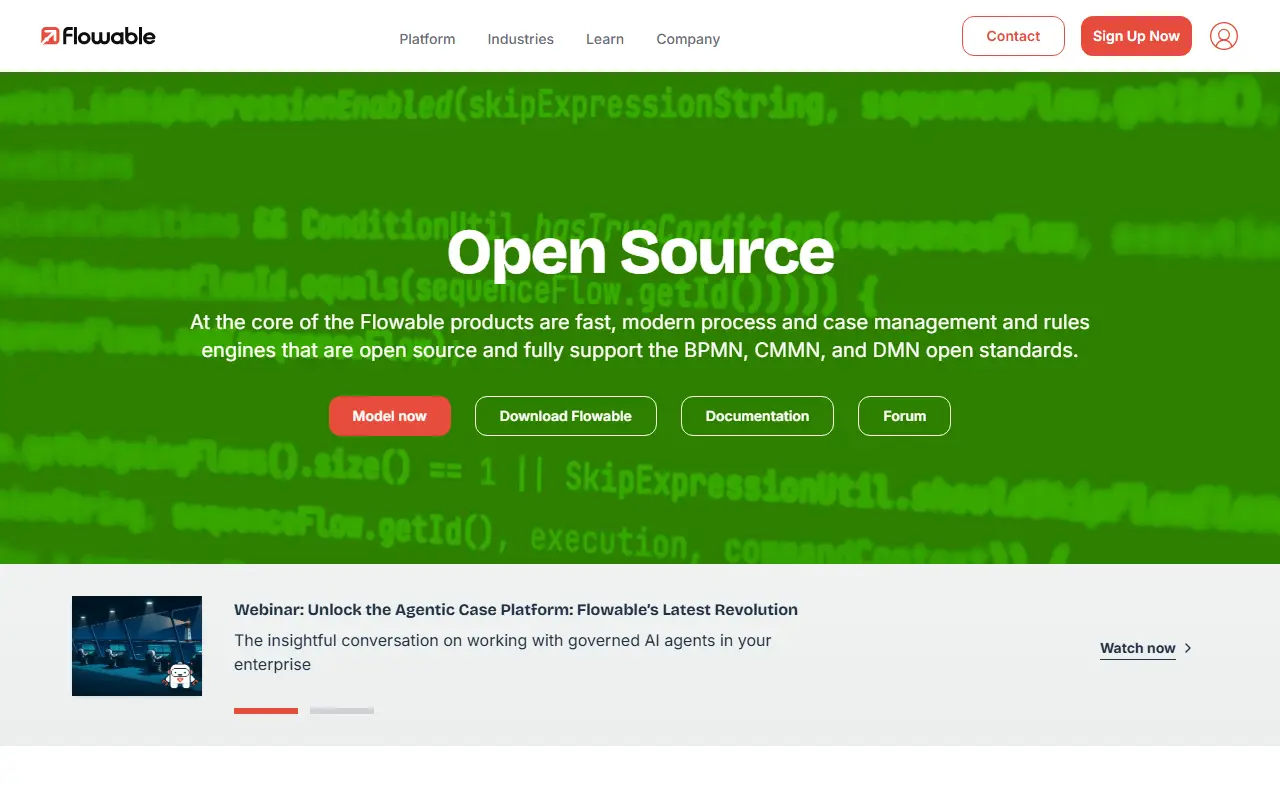
Flowable Engine is the open source core of the Flowable products: a set of process, case and rules engines written in Java. They support the BPMN, CMMN and DMN standards and serve as a workflow and business process management platform for developers, system administrators and business users. The code is licensed under Apache 2.0.
The engines can run embedded in a Java application, or as a service on a server, a cluster or in the cloud. They work as independent engines or together with applications such as Spring, and each exposes Java and REST APIs. Flowable also offers an enterprise runtime, the Agentic Case Platform, built on the same engines, and a cloud modelling tool called Flowable Design.
Key features
- BPMN process engine with Java and REST APIs
- CMMN case engine for case management
- DMN rules and decision engine
- Embedded in Java apps or run as a server or cluster service
- Integration with Spring applications
- Cloud modelling with Flowable Design

Lightweight Java workflow and BPM platform with a BPMN 2 process engine, plus Activiti Cloud building blocks for distributed infrastructure.
- GitHub stars
- 11k
- Last commit
- 2 days ago
- Latest release
- 8.8.1
- Licence
- Apache-2.0
- Self-hosted
- Yes
activiti.org
Activiti is a workflow and Business Process Management platform aimed at business people, developers and system administrators. Its core is a BPMN 2 process engine for Java. It is open source under the Apache license and can run inside any Java application, on a server, on a cluster or in the cloud.
The project describes the engine as lightweight and built on simple concepts, and says it integrates with Spring. The current generation, Activiti Cloud, is presented as a set of cloud-native building blocks meant to run on distributed infrastructure rather than as a single monolithic server.
Those building blocks are a Runtime Bundle for process and decision runtimes, Audit and Query services, Cloud Connectors, an Application Service, and a Notification Service that handles WebSocket and subscriptions through GraphQL. A quickstart guide describes getting an Activiti Cloud application running on Kubernetes in three steps.
Key features
- BPMN 2 process engine for Java
- Integrates with Spring
- Runtime Bundle for process and decision runtimes
- Separate audit service
- Separate query service
- Cloud connectors for system-to-system interactions
- WebSocket notifications through GraphQL

Camunda is a process orchestration platform that coordinates AI agents, people, and systems in end-to-end processes, available as SaaS or self-managed.
- GitHub stars
- 4.4k
- Last commit
- yesterday
- Latest release
- 8.10.9
- Self-hosted
- Yes
- Hosted version
- Available
camunda.com
Camunda is a process orchestration platform designed for enterprise AI. It connects AI agents, people, and systems into end-to-end processes that are governed, auditable, and provable across any cloud, agent framework, or system.
The platform is vendor-agnostic, supporting any agent framework, LLM, or cloud without rewriting when the stack changes. It is available as SaaS or self-managed with the same orchestration engine and APIs. It is trusted in production by 700+ enterprises, including 9 of the top 10 US banks.
Key features
- Coordinates AI agents, humans, and systems across end-to-end business processes in one governed model.
- Supports any agent framework, any LLM, any cloud, with process logic portable as standard BPMN.
- Includes governance controls: role-based access control, policy enforcement, human-in-the-loop, audit trails, tool allow/deny lists
- Available as SaaS or self-managed with the same orchestration engine and APIs.
- Compliant with SOC 2 Type II, ISO/IEC 27001, GDPR, and offers a 99.9% SLA.

Open-source low-code platform for building CRM, business process, and structured data apps, with workflows, RBAC, privacy features, and data integrations.
- GitHub stars
- 2.2k
- Last commit
- 24 days ago
- Latest release
- 2026.9.0
- Licence
- Apache-2.0
- Self-hosted
- Yes
- Hosted version
- Available
cortezaproject.org
Corteza is a low-code platform that lets teams build and iterate on CRM, business process, and other structured data applications quickly. It also supports intelligent business process workflows and connects to almost any data source. It is written in Go, with a Vue front end, and released under the Apache-2.0 license. It is maintained by Planet Crust, its founder.
Key characteristics include a standards-oriented approach using established data formats, flat role-based access control that supports complex internal security policies, privacy features that help comply with data protection regulations, accessibility following WCAG 2.1, and an API-centric design that makes integration with external services and other Corteza instances straightforward. Applications can be customized from translations and terminology up to entirely new low-code apps.
Planet Crust offers hosted Corteza cloud instances as the easiest way to start, and a DevOps guide covers self-hosting along with backup, restore, and email relay topics. Corteza suits organizations that want an open-source alternative to proprietary low-code CRM platforms and need control over their data.
Key features
- Low-code builder for CRM and data apps
- Workflow automation for business processes
- Role-based access control
- Privacy and data protection features
- API-centric integration with data sources
- WCAG 2.1 accessibility
Pricing: Free and open source under the Apache-2.0 license; Planet Crust offers hosted instances.
#8
Open-source no-code and low-code platform for building business apps, workflows and process automation visually, with community and commercial editions.
- GitHub stars
- 620
- Last commit
- 2 days ago
- Self-hosted
- Yes
- Hosted version
- Available
joget.org
Joget is an application platform that combines rapid application development, business process automation and workflow management in a visual, web-based builder. Business and technical teams can use it together to build full enterprise applications without much hand coding, aiming to shorten delivery from months to weeks or days. Apps built on it are mobile ready and cloud ready, and the platform offers APIs for integration and a plugin architecture for extension.
The README describes a marketplace where ready-made apps, plugins and templates can be downloaded, along with a community Q&A forum, a knowledge base, video tutorials, an online academy and translations in more than twenty languages. Deployment is flexible: on-premise, on-demand cloud, Docker, Kubernetes, Cloud Foundry, OpenShift and several cloud marketplaces are listed.
Licensing is split. Joget Community Edition is released under GPL version 3, while the Professional, Enterprise and Large Enterprise editions are covered by a commercial end-user license agreement. The core is written in Java. It suits organizations that want to digitize processes such as approvals and forms with a platform they can run themselves.
Key features
- Visual no-code and low-code app builder
- Workflow and business process automation
- APIs and plugin architecture
- Marketplace of ready-made apps and plugins
- Docker, Kubernetes and on-premise deployment
- Mobile-ready apps
Pricing: Community Edition is free under GPL-3.0. Professional, Enterprise and Large Enterprise editions are commercial; see the vendor for pricing.
#9
Nussknacker is a low-code visual tool that lets domain experts build, run and monitor real-time decision algorithms on streaming or request data.
- GitHub stars
- 746
- Last commit
- 1 mo ago
- Latest release
- v1.18.0
- Licence
- Apache-2.0
- Self-hosted
- Yes
- Hosted version
- Available
nussknacker.io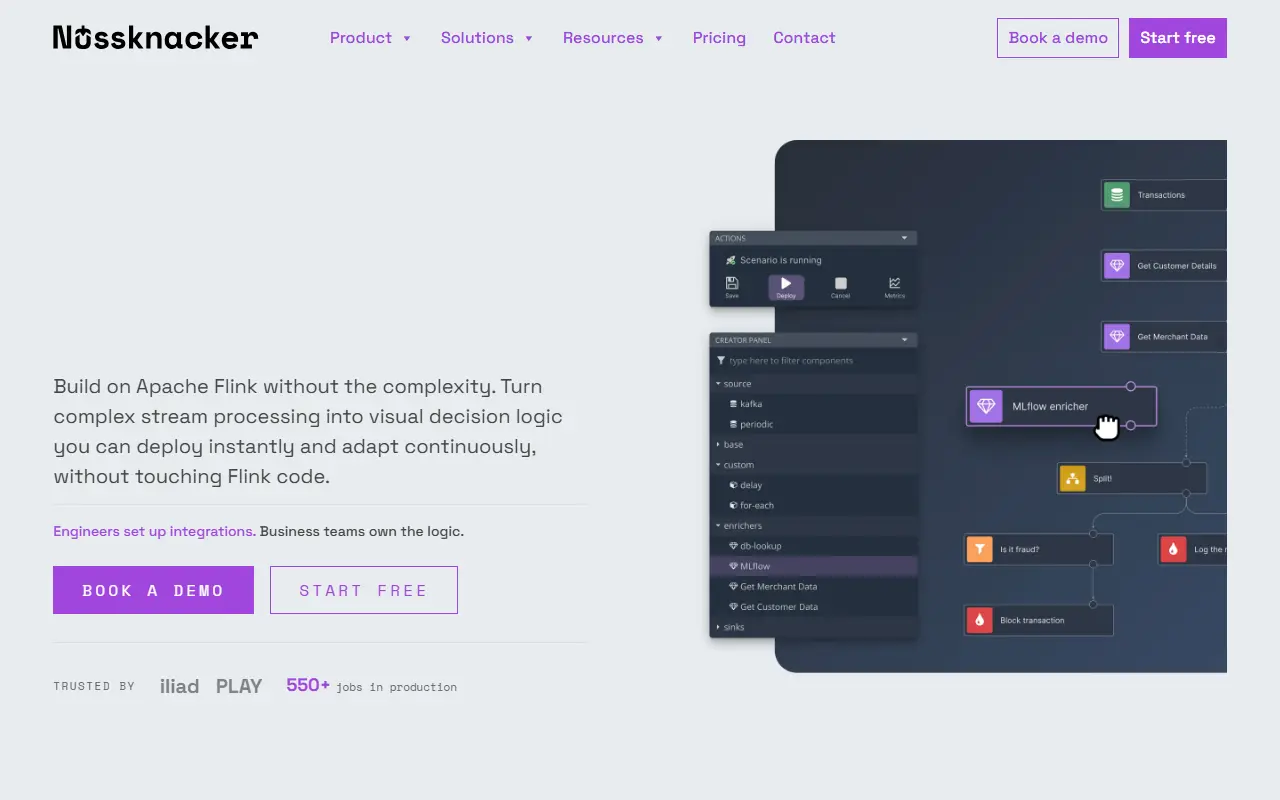
Nussknacker is a low-code visual tool for domain experts to build, run and monitor real-time decision algorithms instead of implementing them in code. Decisions such as which offer a customer gets, who receives a marketing message, whether a device needs servicing or whether something is fraud can be authored and deployed without involving IT.
Authors design scenarios in a visual tool using prebuilt components for routing, filtering, data transformation, time-window aggregations in the Flink engine, enrichments from external databases or OpenAPI endpoints and applying ML models. With one click a scenario is deployed, and it can be changed and redeployed later. Two processing modes are supported: streaming, with Kafka as the main interface for input streams and output decisions, and request-response, which exposes HTTP endpoints with OpenAPI definitions. Batch support is in development.
Nussknacker is written in Scala, licensed under Apache-2.0, and can be installed on your own infrastructure, with a managed Nu Cloud offering also referenced in the README. A demo, documentation and quickstart are linked.
Key features
- Visual scenario designer for decisions
- Prebuilt components for filters and aggregations
- Streaming mode with Kafka
- Request-response mode with OpenAPI
- Enrichment from databases and APIs
- One-click deployment of scenarios
Pricing: A free hosted plan covers one active scenario and 1 million events per month. Enterprise, with unlimited scenarios and self-hosted or on-premise options, has no listed price and is arranged through sales.
Decisions alternatives: questions
- What is the best open-source alternative to Decisions?
- n8n is the top-ranked open-source alternative to Decisions on Enlisted: A fair-code workflow automation platform that mixes a visual canvas with custom code and AI agent features, for teams connecting apps and automating processes. Other strong options are Temporal, Windmill, Flowable Engine and Activiti.
- What are the best commercial alternatives to Decisions?
- Bizagi, Nintex, Pega, Appian and Kissflow are among the hosted, closed-source alternatives to Decisions listed on Enlisted, which lists 14 in total. Compare their pricing and features on each tool page.
- Are these Decisions alternatives free?
- All 9 are open source, so the code is free to use under its licence, and all of them can be self-hosted on your own server or computer. 7 also offer a paid or managed cloud version if you'd rather not host it yourself.
- How is this list of Decisions alternatives ranked?
- By a score built from GitHub stars, star growth over the last 30 days and how recently the code changed. 8 of these projects shipped code in the last 30 days. Data is refreshed daily, and nobody can pay to move up.
 TrackMedia
 TrackRev