#1
An open-source AI coding agent for the terminal, with a beta desktop app and separate agents for building and read-only planning.
- GitHub stars
- 226k
- Last commit
- yesterday
- Latest release
- v1.19.5
- Licence
- MIT
opencode.ai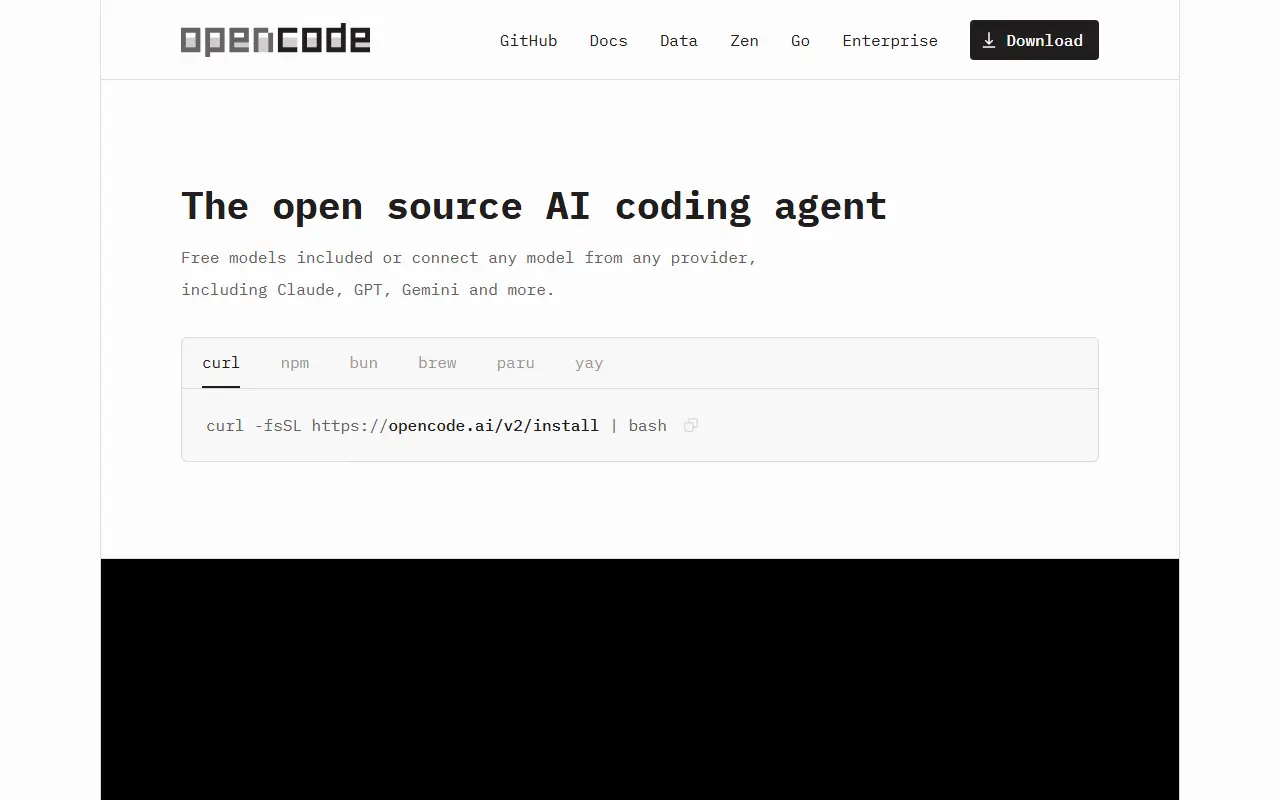
OpenCode is an open-source coding agent that helps developers write, change and understand code using AI models. It is built in TypeScript, released under the MIT license, and installed through an install script or, in beta, as a desktop application for macOS, Windows and Linux.
It ships with two built-in agents that you switch between with the Tab key. The build agent has full access for everyday development work, while the plan agent is read-only: it denies file edits by default and asks permission before running shell commands, which suits exploring an unfamiliar codebase or planning a change. A general subagent handles complex searches and multistep tasks and can be called with @general in messages.
Configuration is covered in the project documentation, and the install location can be controlled with environment variables. OpenCode suits developers who prefer working from the command line and want an agent whose source code they can read and modify.
Key features
- Built-in build agent with full development access
- Read-only plan agent for code exploration
- Permission prompts before running shell commands
- General subagent for multistep searches
- Desktop app in beta for macOS, Windows and Linux
- Tab key to switch between agents
Pricing: Free and open source under the MIT license.
#2
OpenAI's Apache-2.0 coding agent written in Rust that runs locally in your terminal, with IDE, desktop and cloud counterparts.
- GitHub stars
- 135k
- Last commit
- yesterday
- Latest release
- rust-v0.167.1
- Licence
- Apache-2.0
Codex CLI is a coding agent from OpenAI that runs on your own computer from the terminal. The repository describes it as lightweight and written mainly in Rust. Once installed, you start it by running the codex command.
Installation on Mac or Linux uses a curl script, and on Windows a PowerShell script. The installers download from releases.openai.com and fall back to GitHub Releases, and an environment variable can force GitHub Releases. It can also be installed with npm or Homebrew, or from release archives for Apple Silicon and Intel macOS and for x86_64 and arm64 Linux.
For sign-in, the README recommends choosing Sign in with ChatGPT so Codex counts as part of a Plus, Pro, Business, Edu or Enterprise plan. An API key also works but needs extra setup. Related products are named too: an IDE install for VS Code, Cursor and Windsurf, a desktop app opened with codex app, and the cloud agent Codex Web.
Key features
- Coding agent that runs locally in a terminal
- Install script for Mac and Linux
- Install script for Windows via PowerShell
- Also installable with npm and Homebrew
- Sign in with a ChatGPT account
- Available in editors such as VS Code, Cursor and Windsurf
- Desktop app launched with the codex app command

A performance-focused, multiplayer code editor written in Rust by the creators of Atom and Tree-sitter, available on macOS, Linux and Windows.
- GitHub stars
- 95k
- Last commit
- yesterday
- Latest release
- v1.28.1
zed.dev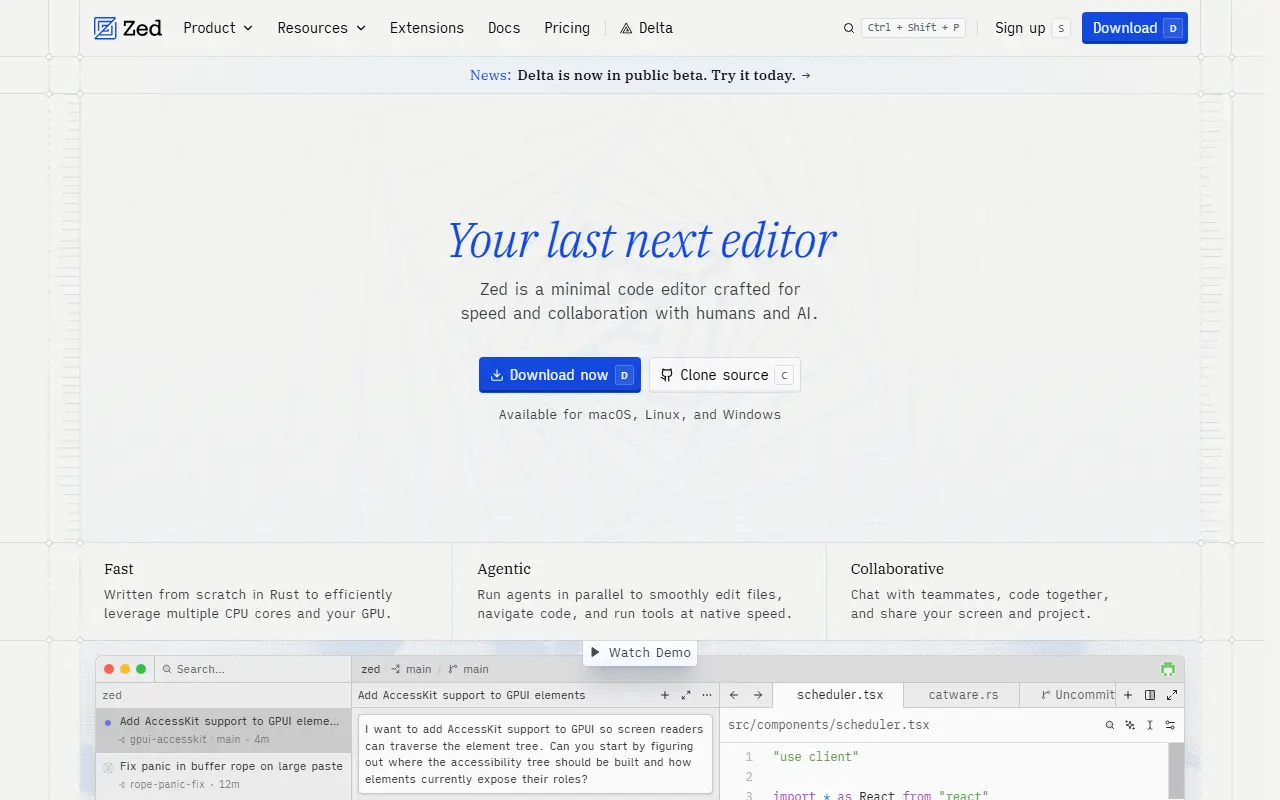
Zed is a code editor built for speed and for editing together with other people, created by the team behind Atom and Tree-sitter. It is written in Rust and available for macOS, Linux and Windows, with a web version still only under discussion. It is developed by Zed Industries, a for-profit company.
The code is mostly GPL-3.0-or-later, with some Apache-2.0 components that are labeled as such, and the project uses tooling to keep third-party license information correct. Installation is by direct download or through local package managers on each platform, and the repository documents how to build Zed for each operating system.
Zed suits developers who want a fast native editor with collaboration built in and are comfortable with a GPL-licensed codebase. Sponsorship donations through GitHub Sponsors go directly to the company, and contributions are welcome through the guidelines in CONTRIBUTING.md.
Key features
- Native code editor written in Rust
- Multiplayer editing with collaborators
- Available on macOS, Linux and Windows
- Built on the GPUI framework
- Buildable from source on each platform
Pricing: Free Personal plan. Pro costs $10 per month with $5 of tokens included and a 14-day free trial; Business costs $30 per seat per month.
#4
An open-source autonomous coding agent available as a CLI, desktop app, VS Code extension, JetBrains plugin and SDK.
- GitHub stars
- 72k
- Last commit
- yesterday
- Latest release
- v4.1.26
- Licence
- Apache-2.0
cline.bot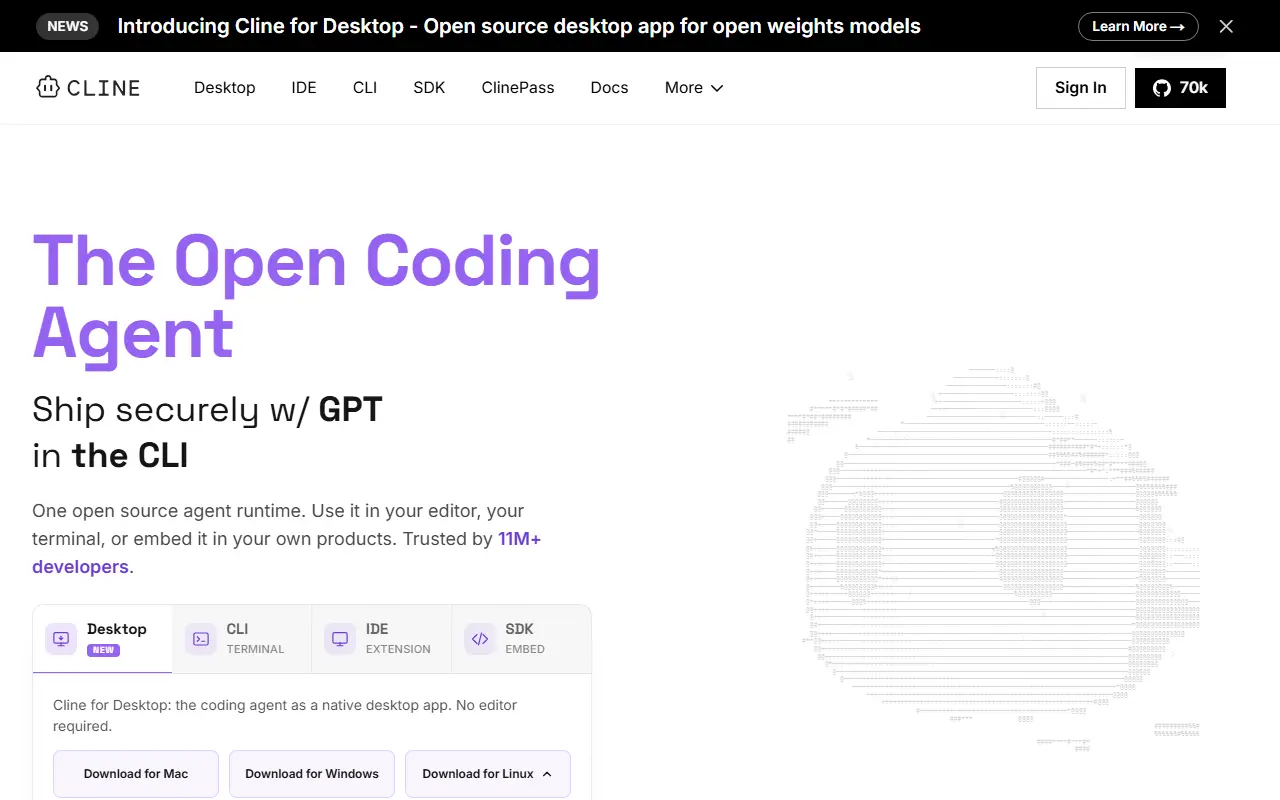
Cline is an open-source coding agent that works in your IDE, terminal and desktop. It can edit code across a project, create files, run commands and browse the web, with human-in-the-loop approval for tools in the editor. It is written in TypeScript and released under the Apache-2.0 license.
The same agent engine is offered in several forms: a CLI with an interactive mode and a headless mode for CI/CD and scripting, a native desktop app for macOS and Windows that works from any folder, schedules recurring routines and manages models, plugins and MCP servers, a VS Code extension, a JetBrains plugin for IntelliJ IDEA, PyCharm, WebStorm, GoLand and others, and an SDK.
The SDK is a Node.js programmatic API for building custom agents with custom tools, multi-agent teams, connectors and scheduled automations. The README notes that the JetBrains plugin is not open-sourced. Cline suits developers who want one coding agent across their editor, terminal and automation pipelines.
Key features
- CLI with interactive and headless modes
- VS Code extension with approval prompts
- JetBrains plugin for the IntelliJ family
- Desktop app for macOS and Windows
- Node.js SDK for custom agents
- Scheduled routines and MCP server management
Pricing: The open-source extension is free for individual developers, who pay only for AI inference or use their own API keys. Enterprise adds SSO, SLA and dedicated support at custom pricing.
#5
An open-source, general-purpose AI agent written in Rust, available as a desktop app, CLI and API, that works with many model providers and MCP extensions.
- GitHub stars
- 56k
- Last commit
- yesterday
- Latest release
- v1.59.0
- Licence
- Apache-2.0
goose-docs.ai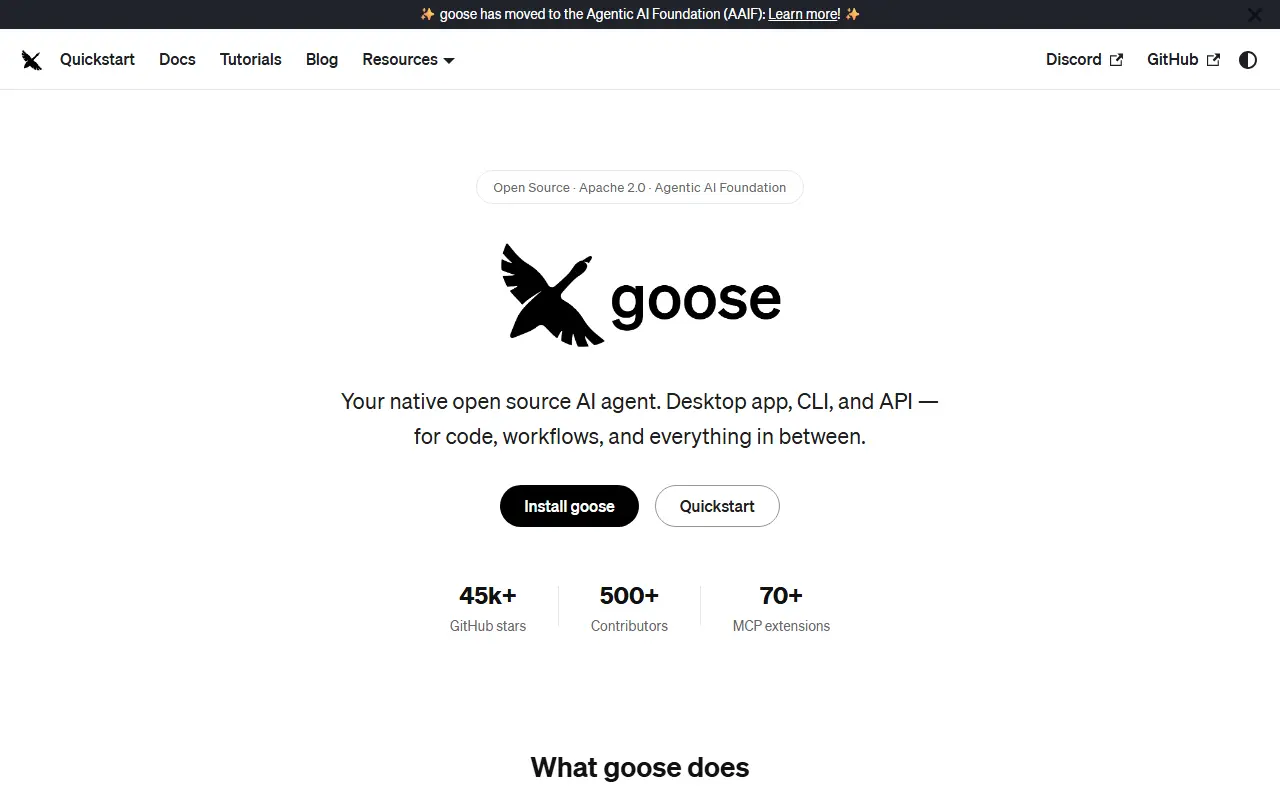
goose is an AI agent for general tasks that runs locally on your own machine. It is not limited to coding: the project suggests using it for research, writing, automation, data analysis and similar tasks. It is built in Rust, released under the Apache-2.0 license, and available as a desktop application on Windows, Linux and macOS, a full CLI for terminal workflows, and an API for embedding it elsewhere.
goose works with more than a dozen model providers, including Anthropic, OpenAI, Google, Ollama, OpenRouter, Azure and Bedrock, and can use existing Claude, ChatGPT or Gemini subscriptions through ACP as an alternative to API keys. It connects to many extensions through the Model Context Protocol open standard, and custom distributions let teams ship their own goose build with preconfigured providers, extensions and branding.
The project is part of the Agentic AI Foundation at the Linux Foundation, and its documentation covers a quickstart, installation, tutorials and governance. It suits developers and knowledge workers who want a configurable local agent that is not tied to a single model vendor.
Key features
- Desktop app for Windows, Linux and macOS
- Full CLI for terminal workflows
- API for embedding the agent elsewhere
- Works with many model providers
- Extensions through the Model Context Protocol
- Custom distributions with preset providers and branding
Pricing: Free and open source under the Apache-2.0 license; model usage depends on the provider or subscription you connect.
#6
An open-source coding agent in Rust, forked from OpenAI's Codex, tuned to get good results from low-cost open models such as Kimi, GLM and Qwen.
- GitHub stars
- 69k
- Last commit
- 2 days ago
- Latest release
- rust-v0.0.61
- Licence
- Apache-2.0
openinterpreter.com
Open Interpreter is a coding agent aimed at open and low-cost models. It is a fork of OpenAI's Codex CLI, written mainly in Rust with some Python, and released under the Apache-2.0 license. After installing on macOS, Linux or Windows, you start a session by typing interpreter, or i, in your terminal.
Its distinguishing idea is harness emulation: it reproduces the agent harness that suits a given model and lets you switch the active harness with a slash command. A recent update reimplemented the Kimi Code harness in Rust for Kimi K3 while keeping a Codex-like interface. Its topics also mention DeepSeek and Qwen models.
Open Interpreter works in editors and clients that support ACP and speaks the same Codex exec protocol, so projects using the Codex SDK can switch with a one-line binary override. It aims to be portable, reusing shared standards such as AGENTS.md, .agents/skills directories, MCP and ACP, and keeps user data in readable files. It suits developers who want a terminal coding agent for cheaper models.
Key features
- Terminal coding agent for open, low-cost models
- Switchable agent harness emulation
- Codex-compatible exec protocol and SDK override
- ACP support for compatible editors
- Reuses AGENTS.md, skills directories and MCP
- Interpreter Workstation client for desktop, browser or headless use
Pricing: Free and open source under the Apache-2.0 license; model costs depend on the provider you choose.
#7
Kilo Code is an open-source AI coding agent for VS Code, JetBrains and the command line that works with hundreds of models.
- GitHub stars
- 28k
- Last commit
- yesterday
- Latest release
- v7.8.27
- Licence
- MIT
- Hosted version
- Available
kilo.ai
Kilo Code is an AI coding agent that you can use in VS Code, in JetBrains IDEs or from the CLI. It is open source under the MIT license and written in TypeScript. According to the README, you can pick from more than 500 models and switch between them in the middle of a task, and you pay the model provider's rate with no markup. No API keys are needed to start.
Besides the local extensions, a Cloud Agent runs Kilo from the web without a local machine, and automated AI code reviews can be set up for pull requests. The CLI is started with the kilo command in a project directory and can be installed from release binaries for Windows, macOS on Apple Silicon and Intel, and Linux on x64 and ARM, with variants for older CPUs and Alpine-style images. The repository started in 2025 and its README is translated into many languages.
Key features
- Agent for VS Code, JetBrains and CLI
- Choice of hundreds of AI models
- Switch models mid-task
- Cloud Agent that runs from the web
- Automated AI reviews for pull requests
- CLI binaries for Windows, macOS and Linux
Pricing: The open-source extensions are free, with AI inference billed separately. Teams costs $15 per user per month with a 14-day trial; Enterprise is custom. Optional Kilo Pass credits start at $19 per month.
#8
Continue is an open-source coding agent for the command line, VS Code and JetBrains; the repository is now read-only and no longer maintained.
- GitHub stars
- 36k
- Last commit
- 8 days ago
- Latest release
- v2.0.0-vscode
- Licence
- Apache-2.0
continue.dev
Continue is an open-source coding agent that was offered as a command-line tool, a VS Code extension and a JetBrains plugin. It is written in TypeScript and released under the Apache-2.0 license. According to the README, the project's GitHub repository has stopped receiving active maintenance and is now read-only, so new features and fixes should not be expected from it.
The team shipped a final 2.0.0 release for the VS Code extension, the CLI and the JetBrains plugin. That release removed anonymous telemetry and authentication, and fixed a batch of bugs. The maintainers recommend the CLI over the JetBrains plugin, and they point to the documentation for configuration and customization. The project describes the codebase as a foundation that others can build on, which makes it relevant as reference code more than as an actively developed product.
Key features
- Agent-style assistant usable from a terminal CLI
- VS Code extension and JetBrains plugin
- Configurable through project documentation
- Final release removed telemetry and authentication
- Apache-2.0 codebase open for reuse
- Repository archived as read-only
Pricing: Free and open source under the Apache-2.0 license.
#9
Aider is an open-source command-line tool for pair programming with large language models, editing your codebase and committing changes through git.
- GitHub stars
- 50k
- Last commit
- 5 mo ago
- Latest release
- v0.86.0
- Licence
- Apache-2.0
aider.chat
Aider is AI pair programming in your terminal. It lets you work with large language models to start a new project or build on an existing codebase, asking for changes in plain language and letting the model edit the files in your repository.
It builds a map of the whole codebase to help in larger projects, supports more than 100 programming languages and commits changes to git with descriptive messages, so you can diff or undo AI edits with familiar tools. It can connect to cloud models and local models, accept images and web pages as context, take voice instructions, and run linters and tests after each change, attempting to fix problems they report. It can also be used from an IDE through code comments, or via copy and paste with a model's web chat.
Aider is written in Python and licensed under Apache-2.0. The README names a handful of commercial models it has been used with most, but says it can connect to almost any model, and installation and usage guides are available in the documentation.
Key features
- Codebase map for larger projects
- Works with cloud and local LLMs
- Automatic git commits with clear messages
- Support for 100+ programming languages
- Image and web page context
- Voice-to-code requests
- Automatic linting and testing after edits
Pricing: Free and open source under the Apache-2.0 licence; model usage is billed by whichever LLM provider you connect.
macOS Xcode Source Editor Extension that adds code suggestions, chat and code modification using GitHub Copilot, Codeium and ChatGPT.
- GitHub stars
- 8.2k
- Last commit
- 20 days ago
- Latest release
- 0.38.0
- Licence
- MIT
copilotforxcode.intii.com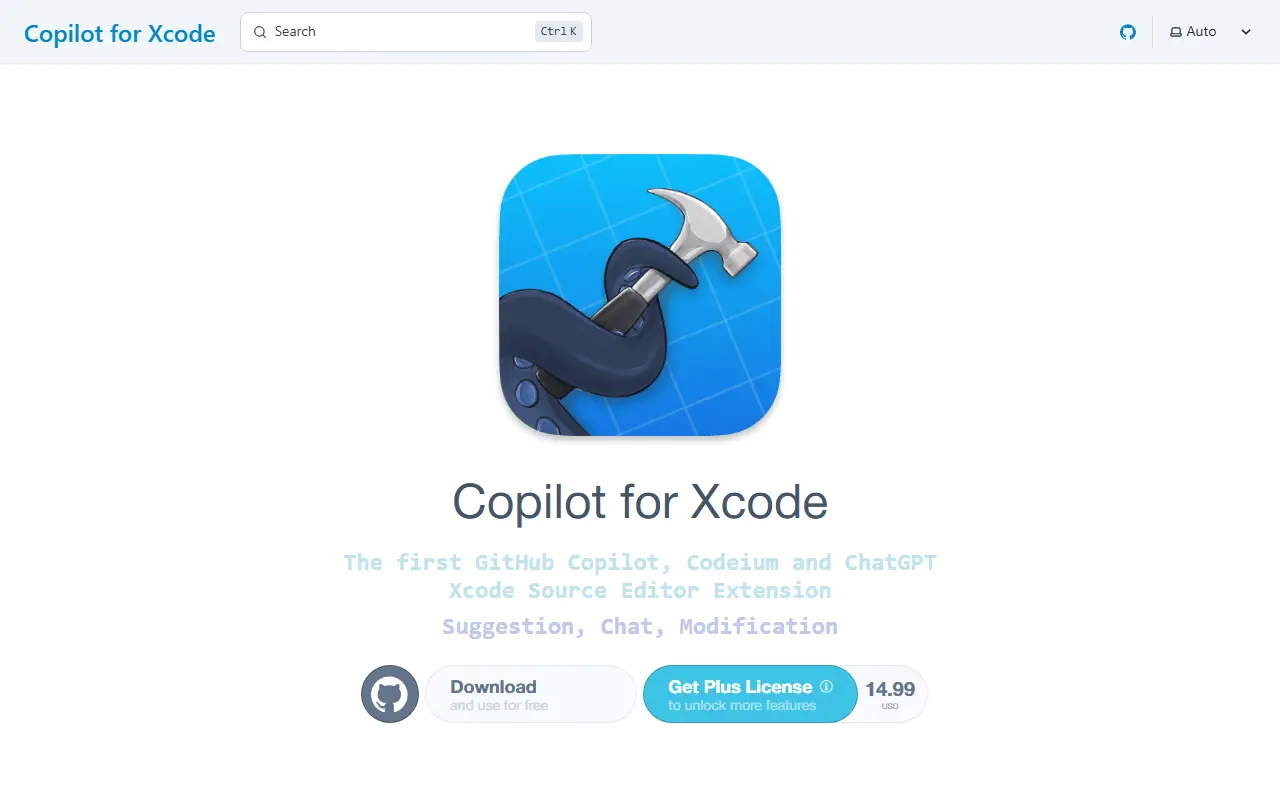
Copilot for Xcode is an Xcode Source Editor Extension for macOS, written in Swift and MIT licensed. It adds three things to Xcode: code suggestions, a chat panel and a modification feature, and custom commands can extend chat and modification.
Suggestions come from GitHub Copilot or Codeium, so Copilot users need Node.js installed for the Copilot language server and an active subscription, while Codeium users need a Codeium account. Chat and prompt-to-code features need a valid OpenAI API key or access to other LLMs.
The app is free to download. The home page describes a Plus License that unlocks more features, priced at 14.99 USD, covering Plus features released before purchase and within one year after, with those features staying usable afterwards. It installs via Homebrew or a manual download and needs Accessibility permission and folder access.
Key features
- Code suggestions, chat and modification inside Xcode
- Custom commands extend chat and modification
- Install through Homebrew
- Suggestion shortcuts configurable in Xcode key bindings
- Chat models and embedding models set up in the host app
Pricing: Free to download and use. A Plus License that unlocks more features is listed at 14.99 USD.
3 more Cursor alternatives
Cursor alternatives: questions
- What is the best open-source alternative to Cursor?
- OpenCode is the top-ranked open-source alternative to Cursor on Enlisted: An open-source AI coding agent for the terminal, with a beta desktop app and separate agents for building and read-only planning. Other strong options are Codex CLI, Zed, Cline and Goose.
- What are the best commercial alternatives to Cursor?
- Devin, Augment Code, Bolt.new, Lovable and Replit are among the hosted, closed-source alternatives to Cursor listed on Enlisted, which lists 55 in total. Compare their pricing and features on each tool page.
- Are these Cursor alternatives free?
- All 13 are open source, so the code is free to use under its licence, and all of them can be self-hosted on your own server or computer. 1 also offers a paid or managed cloud version if you'd rather not host it yourself.
- How is this list of Cursor alternatives ranked?
- By a score built from GitHub stars, star growth over the last 30 days and how recently the code changed. 10 of these projects shipped code in the last 30 days. Data is refreshed daily, and nobody can pay to move up.
 TrackMedia
 TrackRev