7,363 open-source and SaaS tools, with GitHub stats refreshed every day.

6 alternatives ranked by real activity

Open-source Copilot Money alternatives

A curated, ranked list of the 6 best open-source alternatives to Copilot Money.

The best open-source alternative to Copilot Money is Actual Budget. If that doesn't suit you, other good options are Sure, Ghostfolio, Wealthfolio and Cashew.

Copilot Money alternatives are mainly finance & accounting tools. 5 of them shipped code in the last 30 days, 6 can be self-hosted, and 2 use a permissive licence.

Last updated October 2, 2026 · ranked by GitHub stars, growth and recent commits

Actual Budget

Actual is a local-first personal finance and envelope budgeting app that syncs between devices and can be self-hosted or run locally.

GitHub stars
29k
Last commit
today
Latest release
v26.10.0
Licence
MIT
Self-hosted
Yes
Hosted version
Available
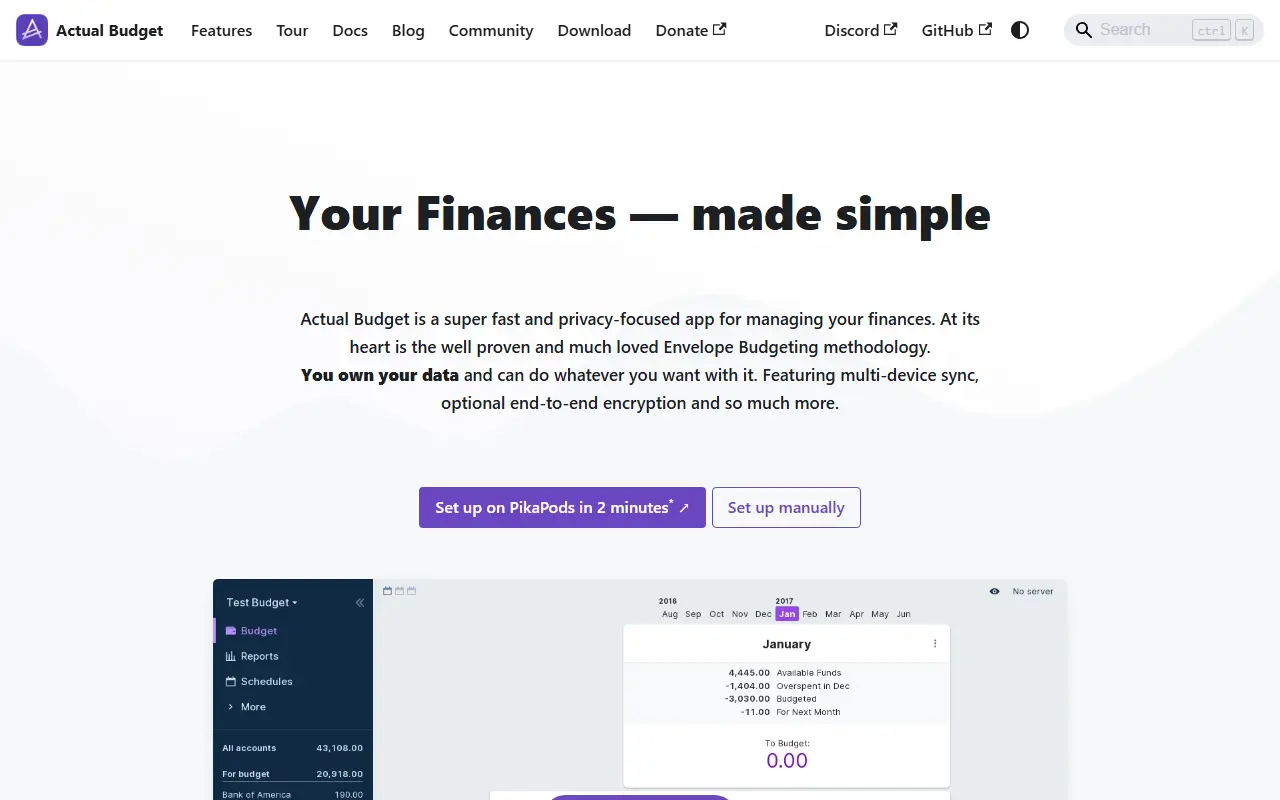
actualbudget.orgActual Budget homepage screenshot

Actual is a personal finance tool built around a local-first design. It is free and open source under the MIT license, written in TypeScript on NodeJS, and includes a synchronization layer so changes move between your devices without much effort. Its budgeting approach follows the envelope method, and the community documentation covers budgeting, account management and tips.

There are four ways to run it: a one-click deployment on PikaPods, managed hosting on Fly.io, self-hosting with a Docker image, or local-only apps for Windows, macOS and Linux that run on your own device. The code is organized into packages such as loot-core for the cross-platform core, desktop-client for the user interface and desktop-electron for the desktop app. The community offers guides for starting fresh and for migrating from other budgeting apps.

Key features

  • Local-first personal finance and budgeting
  • Envelope budgeting method
  • Sync of changes between devices
  • Docker image for self-hosting
  • Desktop apps for Windows, macOS and Linux
  • Migration and starting-fresh community guides

Pricing: Free and open source under the MIT license; optional paid managed hosting through third-party providers is listed in the README.


Sure

Self-hostable personal finance app, maintained by the community as a continuation of the abandoned Maybe Finance project.

GitHub stars
10k
Last commit
today
Latest release
v0.7.5-hotfix.1
Licence
AGPL-3.0
Self-hosted
Yes
sure.amSure homepage screenshot

Sure is a personal finance application that can be self-hosted with Docker. It is a community-maintained fork of Maybe Finance, a project whose team built a full-featured personal finance and wealth management app and then stopped development after the business did not work out. Sure keeps that codebase alive.

The app can be accessed from a browser, a macOS desktop app, a mobile app, API clients and LLM agents, and the README points to an overview of Sure Clients. It is a fully working finance app for tracking money, and the maintainers invite contributors to join through Discord, GitHub issues and the project website. The README is translated into several languages.

Sure is written in Ruby and released under the AGPL-3.0 license. Anyone may fork it under that license, but forks are asked to include the original license and state that they are based on Maybe Finance and not affiliated with it, to stay compliant and avoid trademark problems.

Key features

  • Personal finance tracking
  • Self-hosting with Docker
  • Browser, macOS and mobile access
  • API access for clients and LLM agents
  • Community fork of Maybe Finance

Pricing: Free Good tier keeps 90 days of data. Better costs $5 and Best $9 per month, or $50 and $90 per year. The app can also be self-hosted.

Read more about SureWebsite GitHub

Ghostfolio

Ghostfolio, an open-source wealth management app for tracking stocks, ETFs and cryptocurrencies, available as a cloud service or self-hosted.

GitHub stars
9.4k
Last commit
yesterday
Latest release
3.77.0
Licence
AGPL-3.0
Self-hosted
Yes
Hosted version
Available
ghostfol.ioGhostfolio homepage screenshot

Ghostfolio is open-source wealth management software built with web technology. It helps people keep track of stocks, ETFs and cryptocurrencies held across several platforms and is designed for personal use in continuous operation. Its pitch is data ownership and privacy for people who would rather not manage investments in spreadsheets.

Features include creating, editing and deleting transactions, managing multiple accounts, portfolio performance based on Return on Average Investment over several time ranges, various charts, a static analysis that points out potential portfolio risks, and import and export of transactions. It also has dark and zen modes and works as a progressive web app with a mobile-first design.

The project is a TypeScript web application organized as an Nx workspace, using Angular, NestJS and Prisma. An official cloud offering called Ghostfolio Premium is the simplest way to start, with revenue covering hosting and data provider costs, and instructions exist for running it on your own infrastructure. It is licensed under AGPL-3.0, and the slug here is a truncated form of the name Ghostfolio.

Key features

  • Track stocks, ETFs and cryptocurrencies
  • Multi-account portfolio management
  • Performance metrics over several time ranges
  • Portfolio risk analysis
  • Transaction import and export
  • Progressive web app with dark mode

Pricing: Free and open source under AGPL-3.0 for self-hosting; an official Ghostfolio Premium cloud offering is available.

Read more about GhostfolioWebsite GitHub

Wealthfolio

A private, local-first desktop and mobile app for tracking investments, net worth, spending and simulations, with optional paid broker sync.

GitHub stars
9.1k
Last commit
yesterday
Latest release
v3.9.1
Licence
AGPL-3.0
Self-hosted
Yes
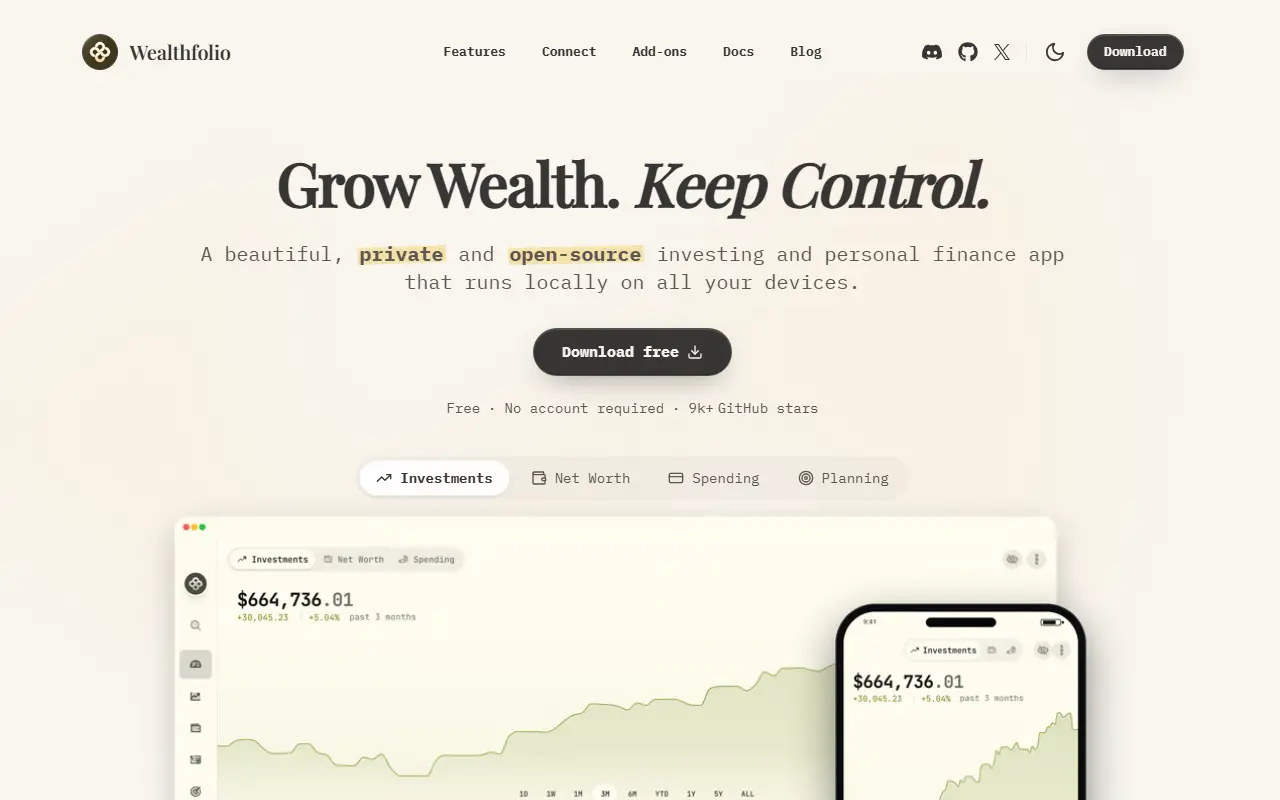
wealthfolio.appWealthfolio homepage screenshot

Wealthfolio is an open-source portfolio tracker and personal finance app that keeps all data on your own device, with no cloud database and no account required. It covers investments, net worth, spending and simulations, and manual tracking and CSV import are free, according to the project.

Key capabilities include tracking portfolios across multiple accounts and asset types, performance analytics covering money-weighted and time-weighted returns, comparison against benchmarks and historical analysis, importing and managing trading activities, goal planning with allocation management, multi-currency support with exchange rates and an add-on system for custom functionality. It runs on desktop for Windows, macOS and Linux, on iOS, and as a self-hosted Docker web app.

For automatic read-only brokerage syncing across more than 30 institutions and encrypted multi-device sync there is Wealthfolio Connect, an optional subscription that the project says covers the real cost of the data connections. The app is written in Rust with Tauri and licensed under AGPL-3.0. It suits privacy-minded individual investors who prefer local data over a hosted aggregator.

Key features

  • Portfolio tracking across accounts and assets
  • Time-weighted and money-weighted returns
  • Goal planning with allocation tracking
  • Multi-currency with exchange rates
  • CSV import of trading activities
  • Add-on system for extensions
  • Desktop, iOS and Docker versions

Pricing: The app is free and open source under AGPL-3.0; the optional Wealthfolio Connect subscription adds broker sync and multi-device sync.

Read more about WealthfolioWebsite GitHub

Cashew

Cross-platform budgeting app built with Flutter for tracking spending, setting custom budgets and monitoring savings goals.

GitHub stars
4.7k
Last commit
6 mo ago
Latest release
5.3.4+396
Licence
GPL-3.0
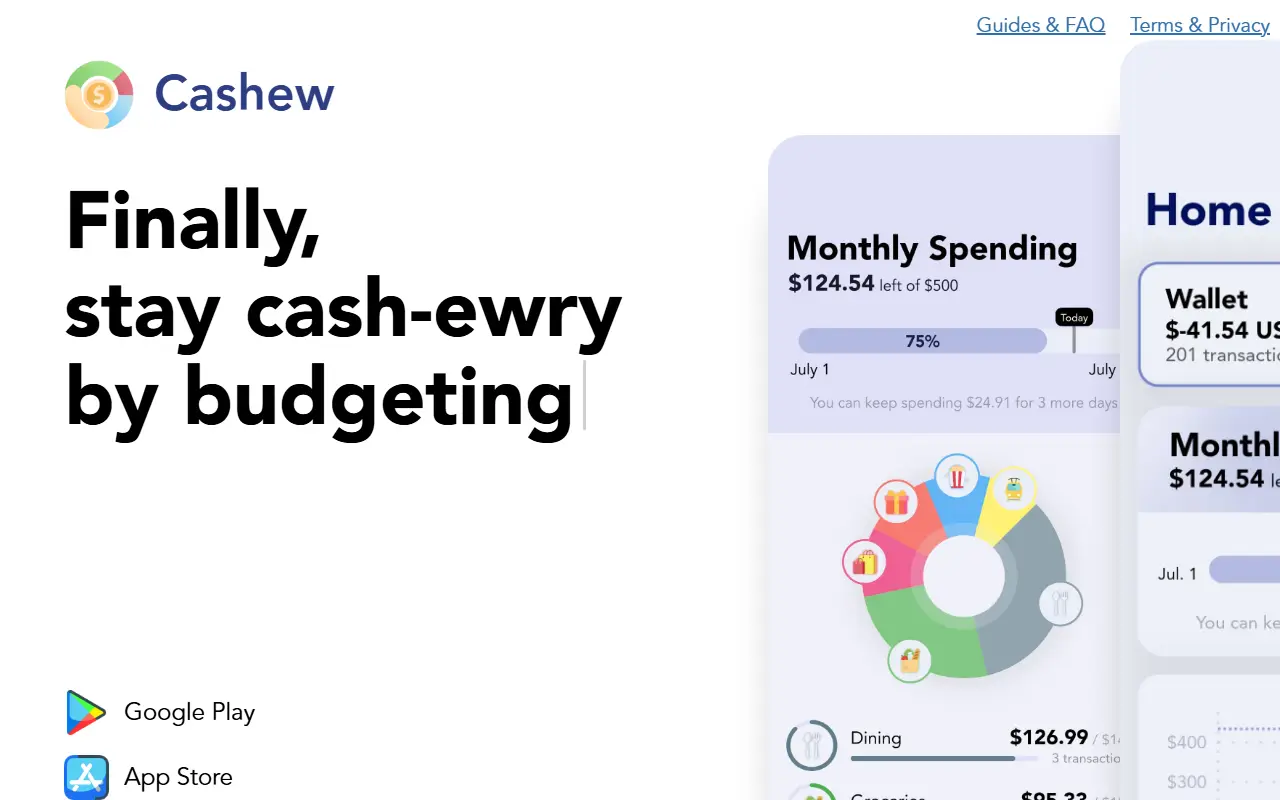
cashewapp.web.appCashew homepage screenshot

Cashew is a personal finance app that helps you plan a budget and keep track of purchases. It is built with Flutter, using Drift for local SQL storage and Firebase, and runs on Android and iOS. A web version is available as a progressive web app, and releases are also distributed through GitHub.

Budgets can use flexible time periods such as monthly, weekly, daily or any custom range, which suits one-off cases like a trip. Transactions can be added to specific budgets, each category within a budget can have its own spending limit, and past budgets can be reviewed to compare how spending changed over time. Goals let you plan spending or saving targets and assign transactions towards them.

The app is open source under the GPL-3.0 license and its development is documented in the repository's commits and changelog. The interface follows Material You styling, and there is a beta testing program for early builds.

Key features

  • Budgets with custom time periods
  • Selected transactions assigned to specific budgets
  • Category spending limits within each budget
  • Past budget history for comparison
  • Spending and savings goals
  • Available on Android, iOS and web
Read more about CashewWebsite GitHub

Financial Management

Self-hosted household wealth tracker that builds a family-wide net worth view from monthly snapshots, with true annualized returns and AI-assisted portfolio checkups.

GitHub stars
358
Last commit
yesterday
Latest release
v1.28.4
Licence
Apache-2.0
Self-hosted
Yes
beta.dixi-token.topFinancial Management homepage screenshot

Financial Management, published under the name Family Ledger (the README is written in Chinese), is a self-hosted app for tracking a household's assets across banks, payment apps, brokerages, property and mortgages. Instead of logging every transaction, it asks for a monthly snapshot of account balances plus external cash flows, a routine meant to take about ten minutes for a couple filling it in at different times. The data stays on your own server.

From those snapshots it shows a net worth trend with inflation and money-supply reference lines, asset allocation, and real annualized returns calculated with XIRR and TWR so that savings and investment gains can be told apart. It can look through funds to their underlying holdings and industries, aggregated across the whole family. AI features can read screenshots to import individual holdings and produce a checkup covering allocation, risk, liquidity and returns; the README says the numbers are computed by the app and the language model only interprets them.

The app has nine account types grouped by family member, multi-dimensional tagging, preset dashboards, one-click export, and a responsive interface that can be installed as an iOS web app. It is licensed under Apache-2.0 and written in Java. It is deliberately not a daily expense tracker, budgeting tool or trading client, and a public demo with synthetic data is available.

Key features

  • Monthly account snapshots instead of daily bookkeeping
  • Real annualized returns using XIRR and TWR
  • Fund look-through to underlying holdings and industries
  • AI screenshot import of holdings
  • AI portfolio checkup across risk and liquidity
  • Family members tracked across nine account types
  • Installable web app for iOS

Copilot Money alternatives: questions

What is the best open-source alternative to Copilot Money?
Actual Budget is the top-ranked open-source alternative to Copilot Money on Enlisted: Actual is a local-first personal finance and envelope budgeting app that syncs between devices and can be self-hosted or run locally. Other strong options are Sure, Ghostfolio, Wealthfolio and Cashew.
Are these Copilot Money alternatives free?
All 6 are open source, so the code is free to use under its licence, and all of them can be self-hosted on your own server or computer. 2 also offer a paid or managed cloud version if you'd rather not host it yourself.
How is this list of Copilot Money alternatives ranked?
By a score built from GitHub stars, star growth over the last 30 days and how recently the code changed. 5 of these projects shipped code in the last 30 days. Data is refreshed daily, and nobody can pay to move up.

People also look for alternatives to…

View all