7,363 open-source and SaaS tools, with GitHub stats refreshed every day.

3 alternatives ranked by real activity

Open-source Cognito Forms alternatives

A curated, ranked list of the 3 best open-source alternatives to Cognito Forms.

The best open-source alternative to Cognito Forms is HeyForm. If that doesn't suit you, other good options are Form.io and FormsLab.

Cognito Forms alternatives are mainly form & survey tools. 2 of them shipped code in the last 30 days, 3 can be self-hosted, and 1 uses a permissive licence.

Last updated October 2, 2026 · ranked by GitHub stars, growth and recent commits

HeyForm

HeyForm is an open-source form builder for creating conversational forms, surveys, quizzes and polls, with conditional logic, integrations and analytics.

GitHub stars
9k
Last commit
23 days ago
Latest release
v3.0.3
Licence
AGPL-3.0
Self-hosted
Yes
Hosted version
Available
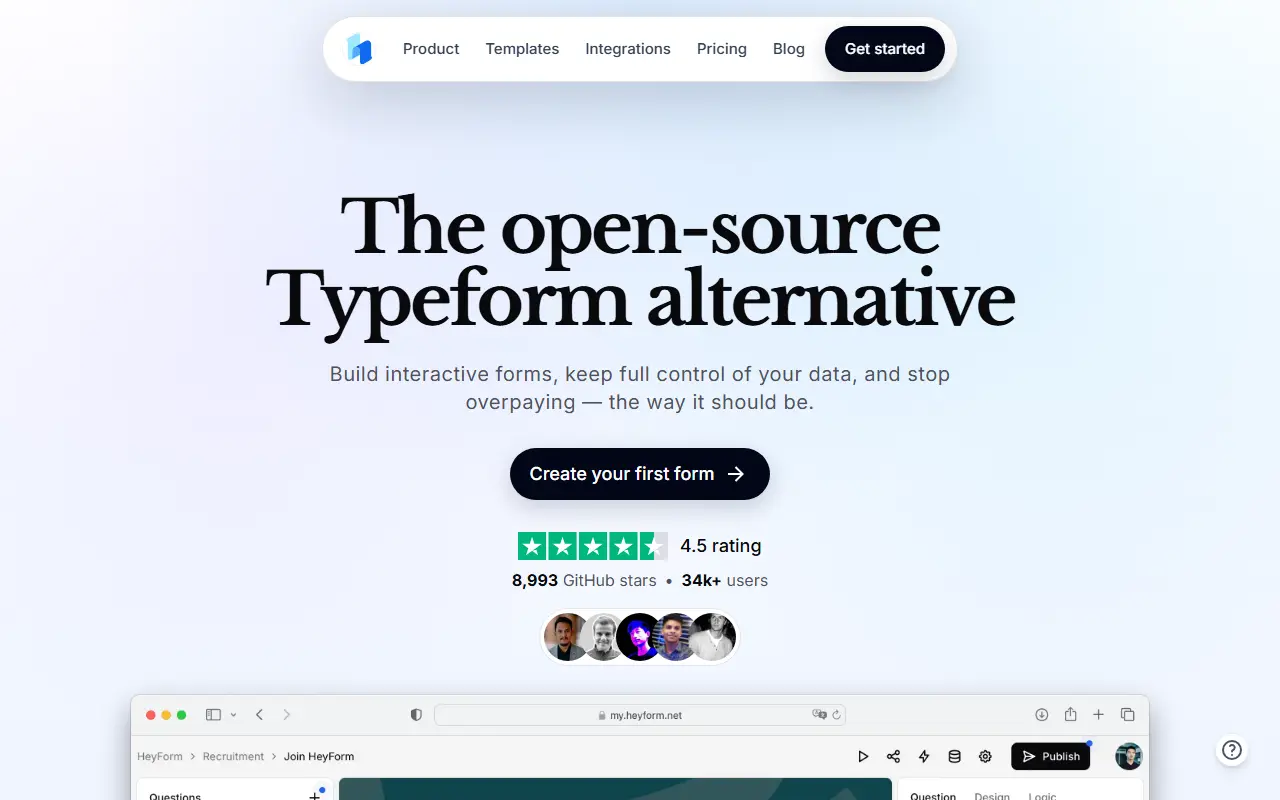
heyform.netHeyForm homepage screenshot

HeyForm is an open-source form builder aimed at small businesses and teams that need to collect information or feedback. It focuses on conversational forms, which cover surveys, quizzes and polls, and lets people build them without writing code.

Forms can use many input types, from text, email and phone number fields to picture choices, date pickers and file uploads. Conditional logic and URL redirects make forms adapt to answers. Integrations include webhooks, analytics and marketing tools, plus Zapier and Make.com. Themes control fonts, colors and backgrounds, and custom CSS allows deeper branding. Analytics report drop-off and completion rates, and results can be exported to CSV.

HeyForm is written in TypeScript and released under the AGPL-3.0 licence. The maintainers recommend their official hosted service for reliability, automatic backups and no maintenance, and the open-source code remains available for teams that prefer to run it themselves.

Key features

  • Conversational forms, surveys, quizzes and polls
  • Wide range of input types
  • Conditional logic and URL redirects
  • Webhook, Zapier and Make.com integrations
  • Custom themes with custom CSS
  • Drop-off and completion analytics
  • CSV export of responses

Pricing: No free plan is listed; a 7-day free trial is offered. Basic is $15, Premium $24 and Business $40 per month billed annually; Enterprise is custom.

Read more about HeyFormWebsite GitHub

Form.io

Form.io's core form and API engine, a drag-and-drop form builder and data management platform for embedding forms in Angular, React, and Vue applications.

GitHub stars
2.3k
Last commit
yesterday
Licence
OSL-3.0
Self-hosted
Yes
Hosted version
Available

Form.io is a combined form and API platform for building data management applications. This repository is the core form and API engine behind the Form.io service. It lets you design forms with a drag-and-drop builder and then embed them in your applications, and it generates the API that stores the submissions. It runs on Node.js and is released under the OSL-3.0 license.

Forms can be rendered in Angular, React, Vue, or plain JavaScript applications, and the platform was designed for serverless architectures. The official documentation, release information, and guides are at help.form.io, and a walkthrough video shows how to build an application on the open-source platform.

A commercial hosted service is run by the vendor on form.io, while the open-source engine can be self-hosted. Form.io suits teams that need configurable, form-driven applications such as intake, workflows, and internal data collection, and want to avoid hand-coding each form and API endpoint.

Key features

  • Drag-and-drop form builder
  • Auto-generated API for submissions
  • Embeddable in Angular, React, and Vue apps
  • Node.js open-source engine
  • Serverless-oriented architecture
  • Official documentation and tutorials
Read more about Form.ioWebsite GitHub

FormsLab

FormsLab is an MIT-licensed, open-source form builder for surveys, polls and feedback collection, built with Next.js, React, MongoDB and Prisma.

GitHub stars
545
Last commit
7 mo ago
Latest release
v0.13.2
Licence
MIT
Self-hosted
Yes
Hosted version
Available
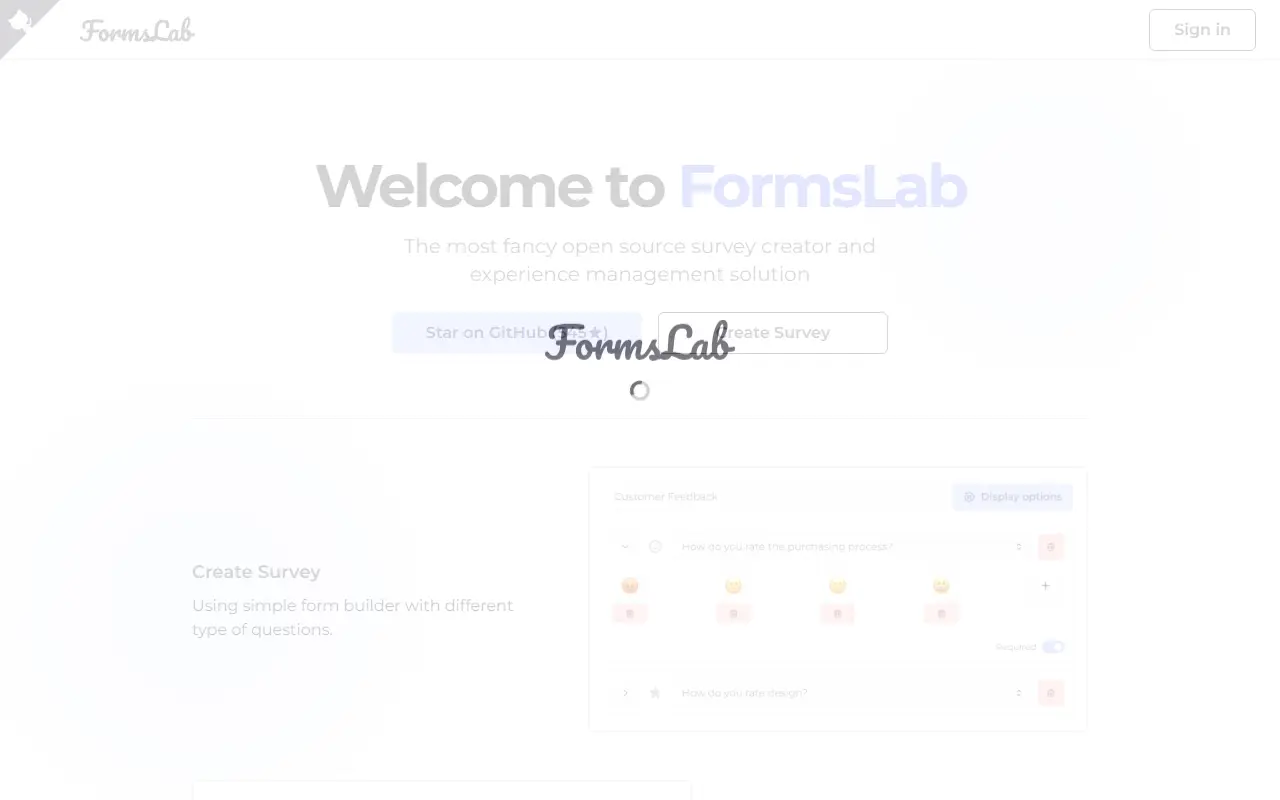
formslab.vercel.appFormsLab homepage screenshot

FormsLab is an open-source tool for building surveys, polls and feedback forms. It can serve as a feedback app for collecting customer opinions, as a poll creator for voting, or as a general survey builder, and it sits in the same space as hosted form services such as Typeform.

Forms can include many types of questions, so layouts are not limited to a fixed template and can be made to look distinct. Surveys can be anonymous, which suits feedback gathering, and the project calls itself an experience management solution. The stack is TypeScript, Next.js, React, TailwindCSS, MongoDB, Prisma and Auth.js.

Developers can run it locally with npm commands for installing, running, testing and linting, and the project welcomes contributions. A live instance is linked from the README for trying it out. FormsLab is released under the MIT license.

Key features

  • Survey and poll builder with many question types
  • Anonymous feedback collection
  • Customizable form layouts
  • Authentication through Auth.js
  • MongoDB storage via Prisma
  • Live hosted instance for trying it out

Pricing: Free and open source under the MIT license; a live hosted instance is linked from the project.

Read more about FormsLabWebsite GitHub

Cognito Forms alternatives: questions

What is the best open-source alternative to Cognito Forms?
HeyForm is the top-ranked open-source alternative to Cognito Forms on Enlisted: HeyForm is an open-source form builder for creating conversational forms, surveys, quizzes and polls, with conditional logic, integrations and analytics. Other strong options are Form.io and FormsLab.
Are these Cognito Forms alternatives free?
All 3 are open source, so the code is free to use under its licence, and all of them can be self-hosted on your own server or computer. 3 also offer a paid or managed cloud version if you'd rather not host it yourself.
How is this list of Cognito Forms alternatives ranked?
By a score built from GitHub stars, star growth over the last 30 days and how recently the code changed. 2 of these projects shipped code in the last 30 days. Data is refreshed daily, and nobody can pay to move up.

People also look for alternatives to…

View all