6,598 open-source and SaaS tools, with GitHub stats refreshed every day.

4 alternatives ranked by real activity

Open-source ChatGPT Atlas alternatives

A curated, ranked list of the 4 best open-source alternatives to ChatGPT Atlas.

The best open-source alternative to ChatGPT Atlas is Ego Lite. If that doesn't suit you, other good options are BrowserOS, Nanobrowser and Browser Operator.

ChatGPT Atlas alternatives are mainly AI Tools tools. 2 of them shipped code in the last 30 days, 4 can be self-hosted, and 3 use a permissive licence.

Last updated October 2, 2026 · ranked by GitHub stars, growth and recent commits

Ego Lite

A browser built for sharing with AI agents, where agents run automation in isolated Spaces while you keep browsing, using your real logged-in sessions.

GitHub stars
17k
Last commit
9 days ago
Latest release
v2.0.0
Licence
MIT
Self-hosted
Yes
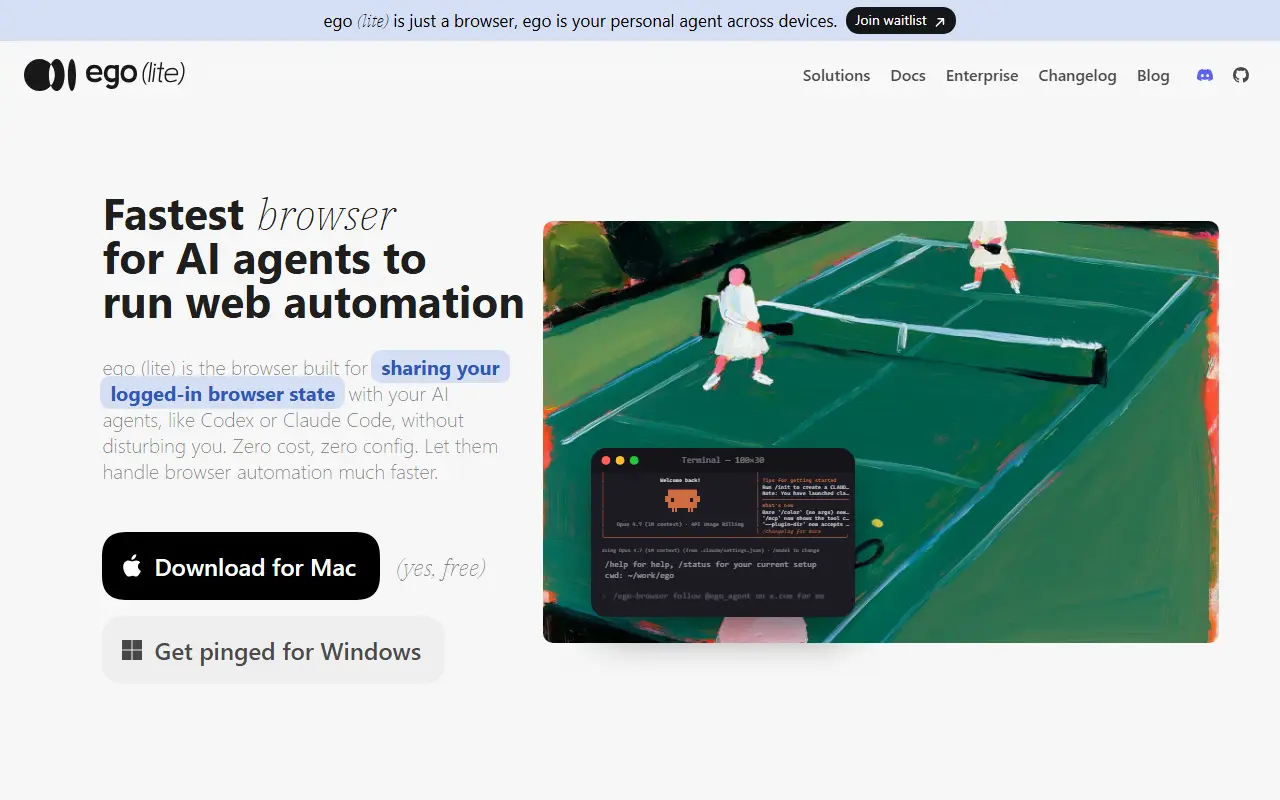
lite.ego.appEgo Lite homepage screenshot

ego lite is a browser designed so that you and your AI agents can work in parallel. Agents carry out browser tasks in their own Spaces, which are isolated workspaces inside the same browser, while you carry on browsing in yours, so an agent never takes control of the window you are using. The project claims the automation itself finishes faster and with fewer tokens.

The pitch contrasts with tools like browser-use and agent-browser, which it describes as bridges to a browser rather than browsers in their own right: they need a separate browser to drive, your data rarely carries over intact, connections can be unstable, and you and the agent may fight over control. With ego lite, an agent can use your real logins and open tabs by way of ego-browser, so it works with your existing sessions. It is meant for agents such as Codex, Claude Code and Hermes, and ships agent skills.

ego lite runs on macOS today, with a Windows closed beta coming and Linux on the roadmap. It is MIT licensed and written in JavaScript, and it is described as zero cost and zero config. It suits developers automating web tasks with coding agents.

Key features

  • Isolated Spaces for each agent
  • Shares your logged-in browser state with agents
  • Works with Codex and Claude Code
  • Agent skills included
  • Runs on macOS today
  • No extra setup or cost

Pricing: Free and open source under the MIT license.

Read more about Ego LiteWebsite GitHub

BrowserOS

An open-source, Chromium-based browser built for AI agents, letting tools like Claude Code and Codex run web tasks in parallel with your logged-in accounts on your own machine.

GitHub stars
14k
Last commit
today
Latest release
v0.50.5
Licence
AGPL-3.0
Self-hosted
Yes
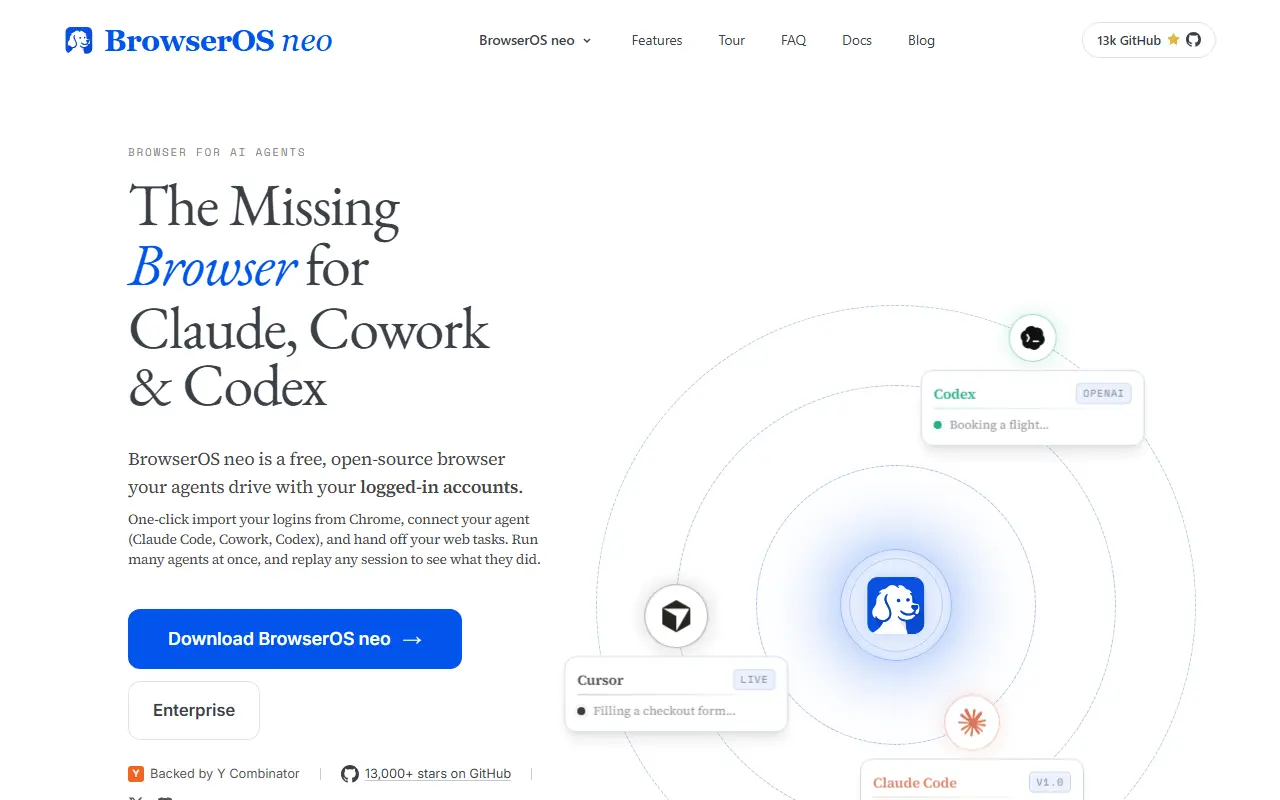
browseros.comBrowserOS homepage screenshot

BrowserOS is an open-source browser designed to be used by AI agents. It is positioned as a secondary browser that sits alongside Chrome rather than replacing it, giving agents a place to carry out web tasks while you keep browsing normally. The project presents itself as an alternative to AI browsers such as ChatGPT Atlas, Perplexity Comet and Dia.

You can import logins, bookmarks and extensions from Chrome in one click so agents work with your real accounts, then connect agents such as Claude Code, Codex, Cursor or VS Code, which BrowserOS detects on your machine. Agents run in parallel in their own tabs. A live dashboard on the new tab page shows which site each agent is on, and every session is saved as a replayable video with a step-by-step action timeline.

Everything runs locally on your machine and the project is free under the AGPL-3.0 licence. Its topics point to local model tooling such as Ollama and LM Studio and it exposes tools through the Model Context Protocol. Typical tasks include posting to social media, clearing an inbox, updating a CRM or filing expenses. An enterprise offering is linked from the repository.

Key features

  • Chromium-based browser for AI agents
  • One-click import of Chrome logins and extensions
  • Auto-connects to Claude Code, Codex and Cursor
  • Parallel agents in separate tabs
  • Live dashboard of running agent tasks
  • Replayable session recordings with action timeline
  • Runs locally with MCP tools

Pricing: Free and open source under AGPL-3.0; the project also links to an Enterprise offering.

Read more about BrowserOSWebsite GitHub

Nanobrowser

Nanobrowser is an open-source Chrome extension that runs multi-agent AI web automation in your browser using your own LLM API key.

GitHub stars
14k
Last commit
1 mo ago
Latest release
v0.1.13
Licence
Apache-2.0
Self-hosted
Yes
nanobrowser.aiNanobrowser homepage screenshot

Nanobrowser is an AI web automation tool delivered as a Chrome extension. You describe a task, and a team of AI agents carries it out in your browser. The project presents itself as a free, open-source alternative to OpenAI Operator, with the flexibility of choosing which language model provider you use.

Its multi-agent design splits the work: a Planner analyzes the task and corrects course when it runs into obstacles, while a Navigator carries out the steps on web pages. Everything runs locally in the browser, and you supply your own LLM API key, so there is no required vendor account. Topics mention browser automation, Playwright and n8n. It is available from the Chrome Web Store and is written in TypeScript.

Nanobrowser is licensed under Apache-2.0. It suits people who want agentic browsing and web task automation with their own model keys, without handing control to a hosted browser agent. Support comes from community sponsorship and a Discord server.

Key features

  • Chrome extension for AI web automation
  • Multi-agent Planner and Navigator system
  • Bring your own LLM API key
  • Runs locally in your browser
  • Self-correcting task execution
  • Available from Chrome Web Store

Pricing: Free and open source under Apache-2.0; you pay your own LLM provider for API usage.

Read more about NanobrowserWebsite GitHub

Browser Operator

Browser Operator is an open-source, privacy-focused AI browser with a multi-agent platform that automates web research and tasks using cloud or local models.

GitHub stars
508
Last commit
6 mo ago
Latest release
v0.6.0
Licence
BSD-3-Clause
browseroperator.ioBrowser Operator homepage screenshot

Browser Operator is an open-source AI browser that runs agents on the web on your behalf. It is a desktop application for macOS and Windows built to support research, analysis and automation, with processing done locally on your machine. The project describes itself as an open alternative to AI browsers such as ChatGPT Atlas, Perplexity Comet, Dia and the Microsoft Copilot Edge browser.

Its multi-agent platform uses specialized agents that work together on complex web tasks. You choose an AI provider in the settings, including OpenRouter, OpenAI, Groq or LiteLLM, and local models through Ollama allow fully offline operation. Through LiteLLM it is compatible with more than 100 models from OpenAI, Claude, Gemini, Llama and others. The repository topics also mention MCP client support and LangGraph.

Listed use cases include literature reviews and market research, shopping comparison and price monitoring, and business automation such as talent sourcing, lead generation and compliance audits. The system requirements list macOS 10.15 or Windows 10 (64-bit), 8 GB of RAM and 2 GB of free disk space. It is released under the BSD-3-Clause license.

Key features

  • Multi-agent automation for web tasks
  • Privacy-first local processing
  • Works with OpenRouter, OpenAI, Groq and LiteLLM
  • Offline operation with local Ollama models
  • Desktop builds for macOS and Windows
  • MCP client support

Pricing: Free and open source under the BSD-3-Clause license; cloud AI providers bill separately, while local models need no provider account.

ChatGPT Atlas alternatives: questions

What is the best open-source alternative to ChatGPT Atlas?
Ego Lite is the top-ranked open-source alternative to ChatGPT Atlas on Enlisted: A browser built for sharing with AI agents, where agents run automation in isolated Spaces while you keep browsing, using your real logged-in sessions. Other strong options are BrowserOS, Nanobrowser and Browser Operator.
Are these ChatGPT Atlas alternatives free?
All 4 are open source, so the code is free to use under its licence, and 4 of them can be self-hosted on your own server.
How is this list of ChatGPT Atlas alternatives ranked?
By a score built from GitHub stars, star growth over the last 30 days and how recently the code changed. 2 of these projects shipped code in the last 30 days. Data is refreshed daily, and nobody can pay to move up.

People also look for alternatives to…

View all