7,380 open-source and SaaS tools, with GitHub stats refreshed every day.

8 alternatives ranked by real activity

Open-source Boomi alternatives

A curated, ranked list of the 8 best open-source alternatives to Boomi.

The best open-source alternative to Boomi is n8n. If that doesn't suit you, other good options are Activepieces, Node-RED, NextGen Connect and Zato.

Boomi alternatives are mainly workflow automation tools. 7 of them shipped code in the last 30 days, 8 can be self-hosted, and 2 use a permissive licence.

Last updated October 2, 2026 · ranked by GitHub stars, growth and recent commits

n8n

A fair-code workflow automation platform that mixes a visual canvas with custom code and AI agent features, for teams connecting apps and automating processes.

GitHub stars
206k
Last commit
today
Latest release
n8n@2.41.6
Self-hosted
Yes
Hosted version
Available
n8n.ion8n homepage screenshot

n8n is a workflow automation platform for connecting apps, moving data between them and triggering actions without writing a full integration from scratch. Workflows are built on a visual canvas, and when a step needs more logic you can drop in JavaScript or Python and use npm packages. It is often compared with Zapier and Make, but the source is public and it can run on your own infrastructure.

Recent versions put a lot of weight on AI. You can build multi-step agents and LLM workflows that call OpenAI, Anthropic, Google or open-source models, add human approval steps, and inspect what happened afterward. The project advertises over a thousand integrations and a large library of ready-made workflow templates, and you can extend it with your own nodes.

n8n is distributed under a fair-code model: the Sustainable Use License, plus a separate enterprise license for additional features. The code is always visible and can be self-hosted, for example with Docker, but it is not an OSI-approved open-source license, so commercial redistribution is restricted. A managed cloud edition is available if you would rather not run it yourself.

Key features

  • Visual workflow canvas with branching logic
  • JavaScript and Python code steps with npm packages
  • Multi-step AI agents with human approval
  • Over 1,500 integrations plus reusable templates
  • Connects to OpenAI, Anthropic, Google or local models
  • Role-based access and audit trails
  • Self-hosting with Docker or managed cloud

Pricing: Free self-hosted Community Edition. Hosted plans cost 20€ (Starter), 50€ (Pro) and 667€ (Business) per month billed annually, scaled by workflow executions; Enterprise is custom. Free trial available.

Activepieces

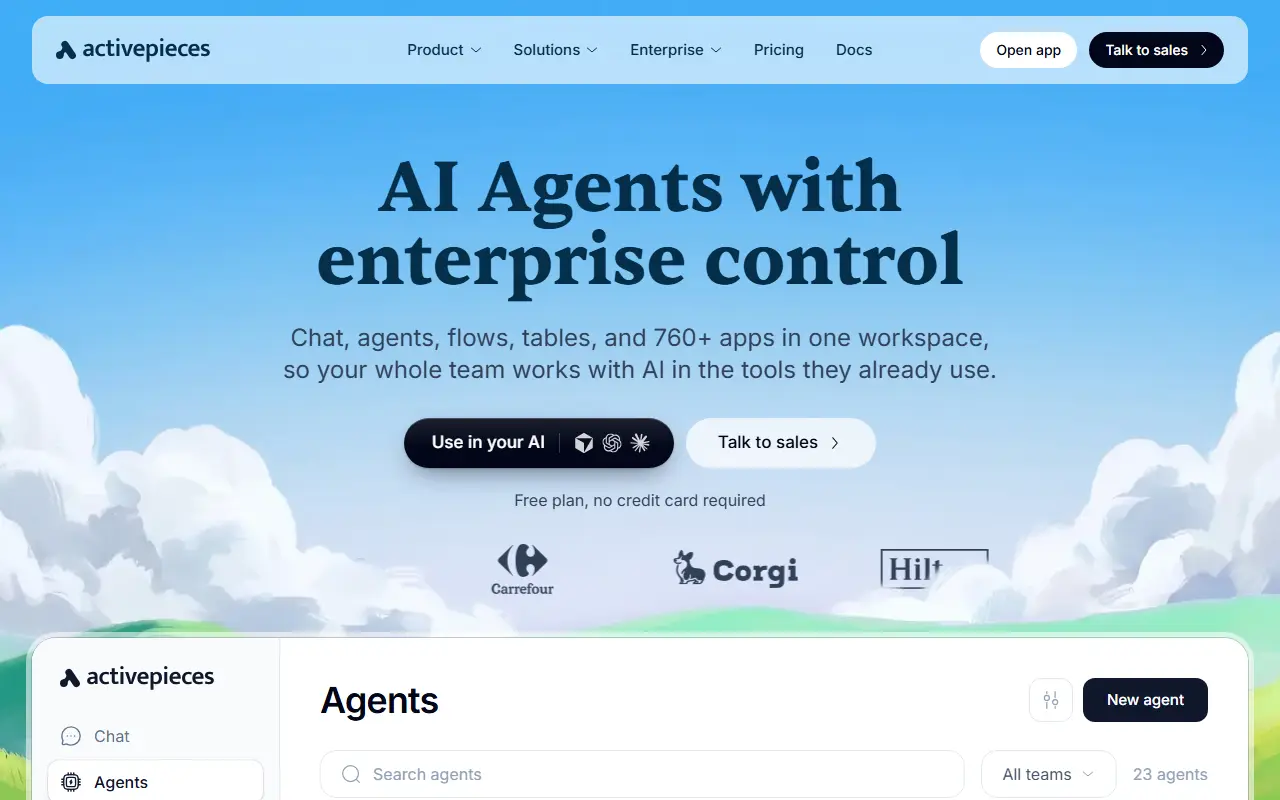
Activepieces is an open-source, self-hostable no-code automation platform with AI agents and integrations written as TypeScript pieces.

GitHub stars
25k
Last commit
today
Latest release
0.92.1
Self-hosted
Yes
Hosted version
Available
activepieces.comActivepieces homepage screenshot

Activepieces is an open-source replacement for Zapier, positioned as an all-in-one AI automation tool. Automations are built from pieces, which are type-safe TypeScript npm packages, and the interface is meant to work for both technical and non-technical users. The topics also describe it as an alternative to n8n. The repository metadata lists the license as Other.

Pieces that are contributed to the project automatically become available as MCP servers, so LLM clients such as Claude Desktop, Cursor and Windsurf can use them. The platform includes native AI pieces for working with different providers, an AI SDK for building agents inside the builder, and human-in-the-loop steps that delay execution or require approval. Developers can set up tools, then others in the organization use the no-code builder. It can be self-hosted, including in network-gapped environments, and supports branding customization.

Key features

  • No-code workflow builder
  • Integrations written as TypeScript npm packages
  • Pieces exposed as MCP servers for LLM clients
  • Native AI pieces and AI SDK
  • Human-in-the-loop delays and approvals
  • Self-hosting with branding customization

Pricing: A free plan includes 1,000 credits a month. Plus is $20 and Team $200 per month on monthly billing, with overage at $0.007 per credit; Ultimate and self-run Enterprise are custom, and Embed starts from $36k a year.

Node-RED

A low-code, flow-based programming tool for event-driven applications, where you wire together devices, APIs and services in a browser-based editor.

GitHub stars
24k
Last commit
yesterday
Latest release
5.0.7
Licence
Apache-2.0
Self-hosted
Yes
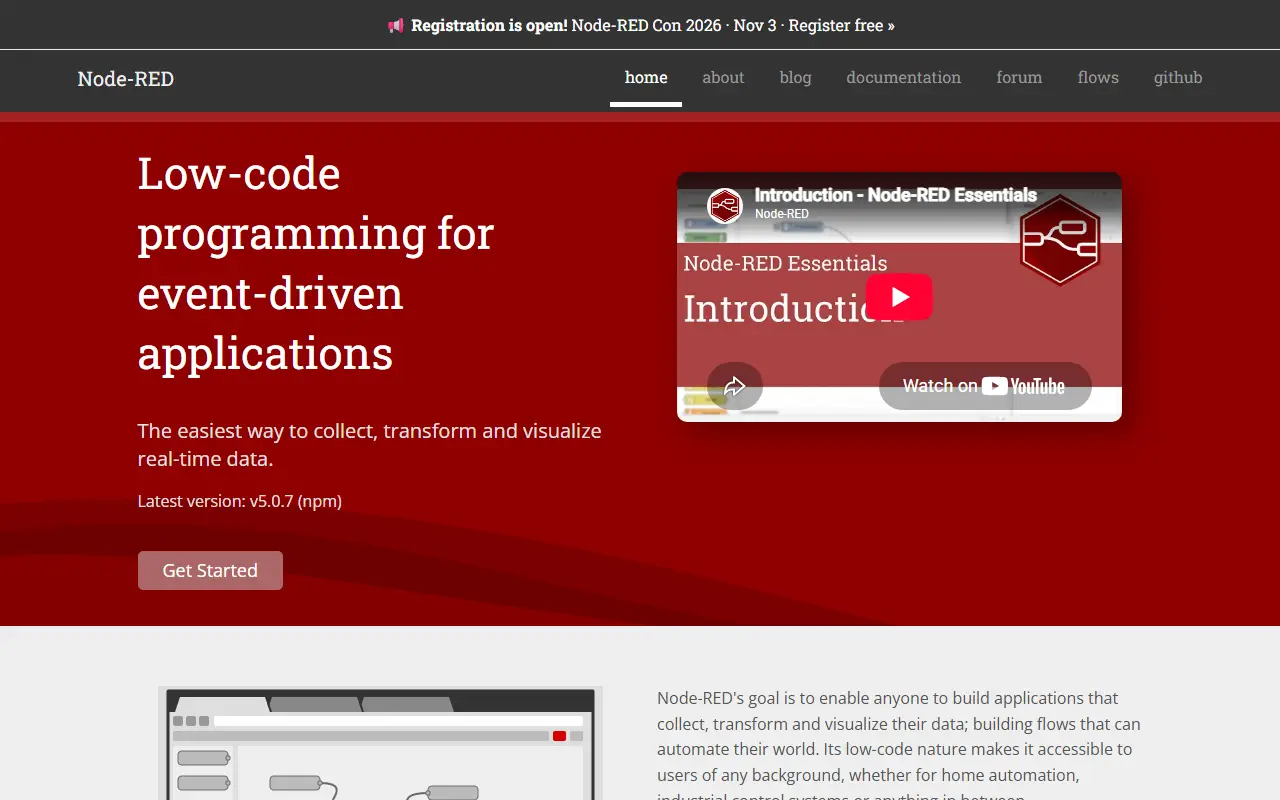
nodered.orgNode-RED homepage screenshot

Node-RED is a low-code programming tool for event-driven applications built on flow-based, visual programming. Instead of writing everything as code, you connect nodes that represent inputs, processing steps and outputs, which makes it popular for IoT projects, home automation and wiring together APIs and online services. It is a project of the OpenJS Foundation.

Getting started takes a couple of commands: install it globally with npm, start it with the node-red command, and open it in your browser. A large ecosystem sits around it, with a library of custom nodes and integrations, shared flows and node collections, plus documentation, a forum and a Slack community. Developers can also run the latest code from git by cloning the repository, installing dependencies and building it.

Node-RED is written in JavaScript on Node.js and licensed under Apache-2.0. You run it on your own computer, a Raspberry Pi, a server or in a container, so there is no hosted service to depend on. It suits makers, integrators and engineers who want to prototype and automate event-driven logic quickly.

Key features

  • Flow-based visual programming
  • Browser-based visual editor
  • Large library of community nodes
  • Shareable flows and node collections
  • Install with npm in one command
  • Runs on small devices and servers

Pricing: Free and open source under the Apache-2.0 license.

NextGen Connect

Mirth Connect is a healthcare integration engine that filters, transforms and routes messages such as HL7 between systems.

GitHub stars
1.2k
Last commit
15 days ago
Latest release
4.5.2
Self-hosted
Yes

Mirth Connect, from NextGen Healthcare, is an integration engine for healthcare data. The README likens it to an interpreter: when a foreign system sends a message, Connect translates the message standard into the one your own system understands. Project topics point to HL7 and interoperability, and the software is written in Java.

Its message processing steps include filtering, which reads message parameters and decides whether a message continues to transformation, transformation, which converts one standard to another such as HL7 to XML, extraction, which can pull data from and push data to a database, and routing to the appropriate destination systems. These steps let organizations connect applications that use different formats.

The README covers useful links to downloads, a user guide, a wiki with an FAQ, forums and a Slack channel, followed by sections on installation, upgrading, starting the server and running on Java 9 or later. It includes a Java licensing note and a license section. The latest release listed is 4.5.2, and NextGen frames the product as supporting everything from small practices to large health information exchanges.

Key features

  • Healthcare message filtering and transformation
  • HL7 and XML conversion
  • Database extraction and loading
  • Message routing between systems
  • Java-based server with documentation and forums

Zato

Zato is a Python-based open-source integration platform for building ESB, SOA and API solutions that connect business systems and workflows.

GitHub stars
1k
Last commit
today
Licence
AGPL-3.0
Self-hosted
Yes

Zato is an open-source platform written in Python for integration, automation and orchestration. It lets organizations connect business systems, APIs, workflows and even hardware assets, and is described as an enterprise service bus and API platform for service-oriented architectures.

The project lists industries such as airports, defense, health care, telecommunications, financial services and government, and its topics mention API gateway, FHIR, HL7 interoperability, low-code and iPaaS. The README is short and points to the project website for downloads, screenshots and programming examples.

Zato is licensed under AGPL-3.0 and is installed on your own infrastructure. The homepage could not be retrieved when this entry was prepared, so detailed deployment and pricing information should be checked on the project site. It suits integration engineers who prefer to write integration logic in Python.

Key features

  • Enterprise service bus capabilities
  • API gateway and API server functions
  • Python-based integration services
  • Healthcare protocol interoperability
  • Workflow orchestration and automation

ByteChef

ByteChef is an open-source platform for AI agents and workflow automation that you can self-host or embed in your SaaS product, positioned against Zapier and n8n.

GitHub stars
1k
Last commit
today
Latest release
v0.34.1
Self-hosted
Yes
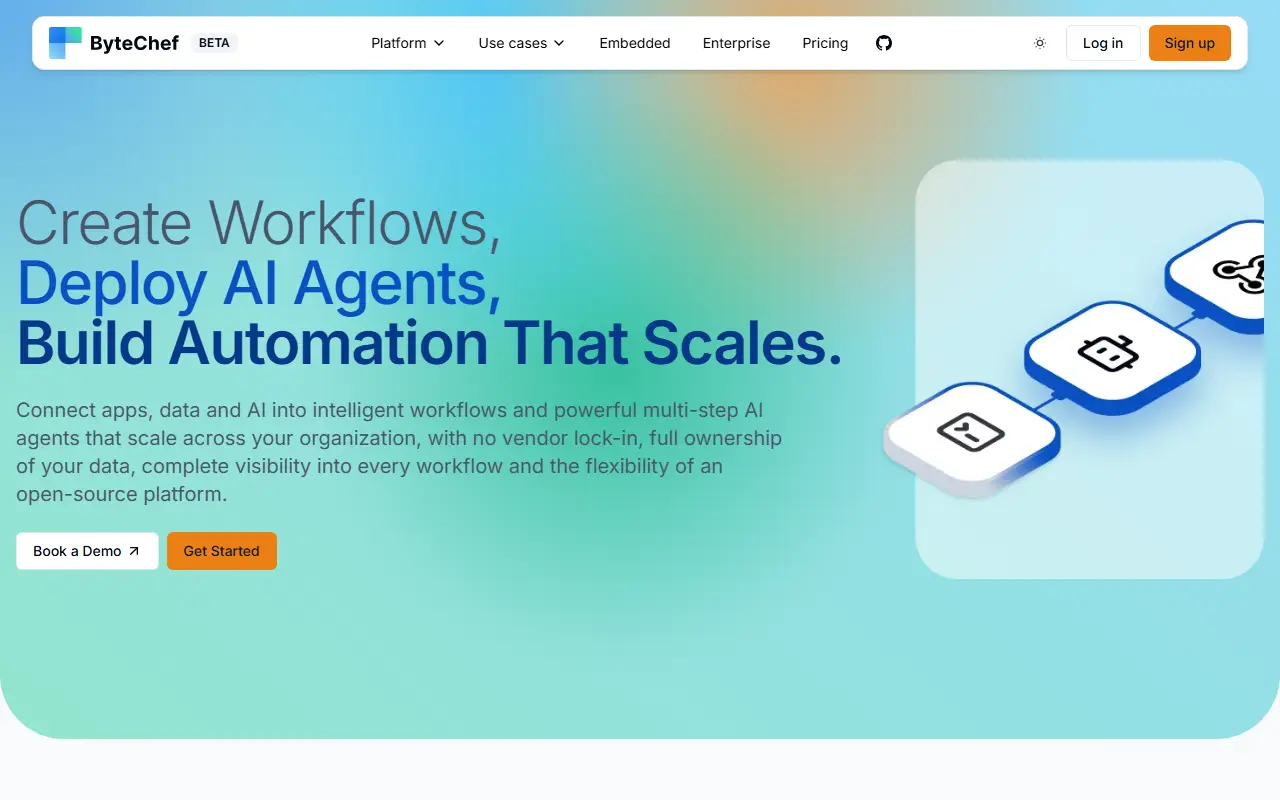
bytechef.ioByteChef homepage screenshot

ByteChef is an open-source platform that brings AI agents and workflow automation into one product. It can be self-hosted or embedded inside a SaaS application, and it is presented as an alternative to tools like Zapier and n8n, with a drag-and-drop workflow editor for building automations across APIs.

An AI Agent component runs the full agent loop of model, tool selection, execution and observation as a step in a durable workflow, so a failed or paused run resumes from that step. The README lists support for many LLM providers such as OpenAI, Anthropic, Azure OpenAI, Bedrock, Mistral, Groq, DeepSeek and Ollama, components that double as agent tools, several memory backends, and guardrails. Topics also mention MCP, embedded iPaaS and Workato-style integrations.

The core is licensed under Apache 2.0 according to the README, while the repository metadata lists the licence as other. ByteChef is written in Java and TypeScript, with an embedded edition for shipping the same agents in your own product, plus documentation, templates and a connector developer guide. It suits engineering teams that want automation and agents under their own control.

Key features

  • Drag-and-drop workflow editor
  • AI agents as workflow steps
  • Support for many LLM providers
  • Components usable as agent tools
  • Durable runs that resume after failures
  • Embedded edition for SaaS products

Pricing: An open source edition can be self-hosted for free. Automation plans cost $23 (Starter) or $135 (Growth) per month, including 5000 tasks, with a free trial; Enterprise is tailored on request.

Camel Karavan

Apache Camel Karavan is a low-code platform and VS Code extension for visually designing, running and deploying Apache Camel integration microservices.

GitHub stars
598
Last commit
2 days ago
Latest release
4.18.1
Licence
Apache-2.0
Self-hosted
Yes
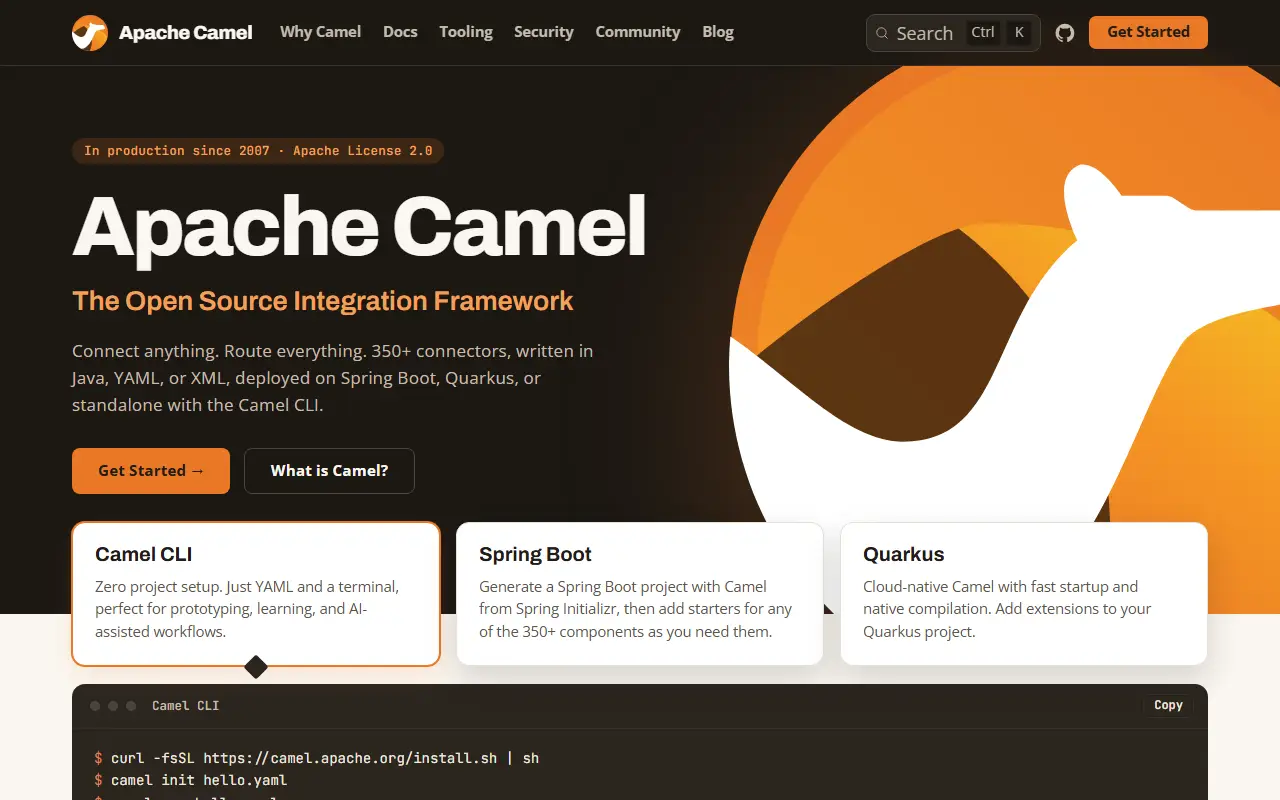
camel.apache.orgCamel Karavan homepage screenshot

Apache Camel Karavan is a low-code data integration platform that simplifies the Apache Camel experience by letting teams design integration microservices visually and deploy them quickly. It aims to give the full power of Apache Camel through a visual tool, from low-code use cases to pro-code projects, drawing on more than ten years of community experience.

The designer supports Enterprise Integration Patterns, over 300 integration components, a REST API designer with an OpenAPI to REST DSL generator, YAML for integrations with Java for custom code, a route designer and a topology view. The deployer provides shell scripts for building and deploying and predefined customizable configurations for different platforms, and a developer dashboard offers hot reload, live logs and tracing of exchange data. Architecturally, the Karavan app manages projects, a build container packages and runs integrations, a Git repository stores project files as the source of truth, and an image registry holds built container images.

A VS Code extension provides a local developer experience for designing and running integrations on a laptop and deploying to Kubernetes or OpenShift. The platform can be installed on Docker, Kubernetes or OpenShift, is part of the Apache Software Foundation and is licensed under Apache-2.0.

Key features

  • Visual route and REST API designer
  • 300+ Camel integration components
  • Enterprise Integration Patterns
  • Hot reload and live logs
  • VS Code extension for local development
  • Deployment to Docker, Kubernetes and OpenShift

Pricing: Free and open source under the Apache-2.0 license.

Titanoboa

Titanoboa is a distributed, low-code workflow orchestration platform for the JVM, aimed at integration, ETL, automation and microservice orchestration.

GitHub stars
923
Last commit
4 yr ago
Latest release
0.9.1
Licence
AGPL-3.0
Self-hosted
Yes
titanoboa.ioTitanoboa homepage screenshot

Titanoboa is a workflow orchestration platform that runs on the JVM and is designed to be distributed, scalable and fault tolerant. Workflows can be built with low-code tooling and extended with Java, Kotlin or Clojure, with Python support described as coming. It can run on-premises or in the cloud, on bare metal, virtual machines, Docker or Kubernetes.

The engine supports sequential and parallel steps, configurable retries with custom error handling, branching, conditional flow and even cyclic workflow graphs. Splitter and aggregator patterns allow larger data sets to be processed, steps are transactional so they complete even through a failover, and new workflows can be developed and deployed at runtime. Clustering can scale to many nodes, with no central master server or database.

The README lists use cases including big data and data pipeline automation, orchestrating microservices, acting as an iPaaS or integration platform, ETL, IT automation, an enterprise service bus and batch processing. Titanoboa is released under AGPL-3.0, and its design draws on immutability and functional programming principles. A wiki and predefined workflow steps are available.

Key features

  • Low-code workflow design on the JVM
  • Sequential and parallel step execution
  • Configurable retries and error handling
  • Splitter and aggregator patterns
  • Clustering with no central master
  • Runtime workflow deployment
  • Runs on Docker, Kubernetes or bare metal

Pricing: Open source under AGPL-3.0.

Boomi alternatives: questions

What is the best open-source alternative to Boomi?
n8n is the top-ranked open-source alternative to Boomi on Enlisted: A fair-code workflow automation platform that mixes a visual canvas with custom code and AI agent features, for teams connecting apps and automating processes. Other strong options are Activepieces, Node-RED, NextGen Connect and Zato.
Are these Boomi alternatives free?
All 8 are open source, so the code is free to use under its licence, and all of them can be self-hosted on your own server or computer. 2 also offer a paid or managed cloud version if you'd rather not host it yourself.
How is this list of Boomi alternatives ranked?
By a score built from GitHub stars, star growth over the last 30 days and how recently the code changed. 7 of these projects shipped code in the last 30 days. Data is refreshed daily, and nobody can pay to move up.

People also look for alternatives to…

View all