
 Tray.ai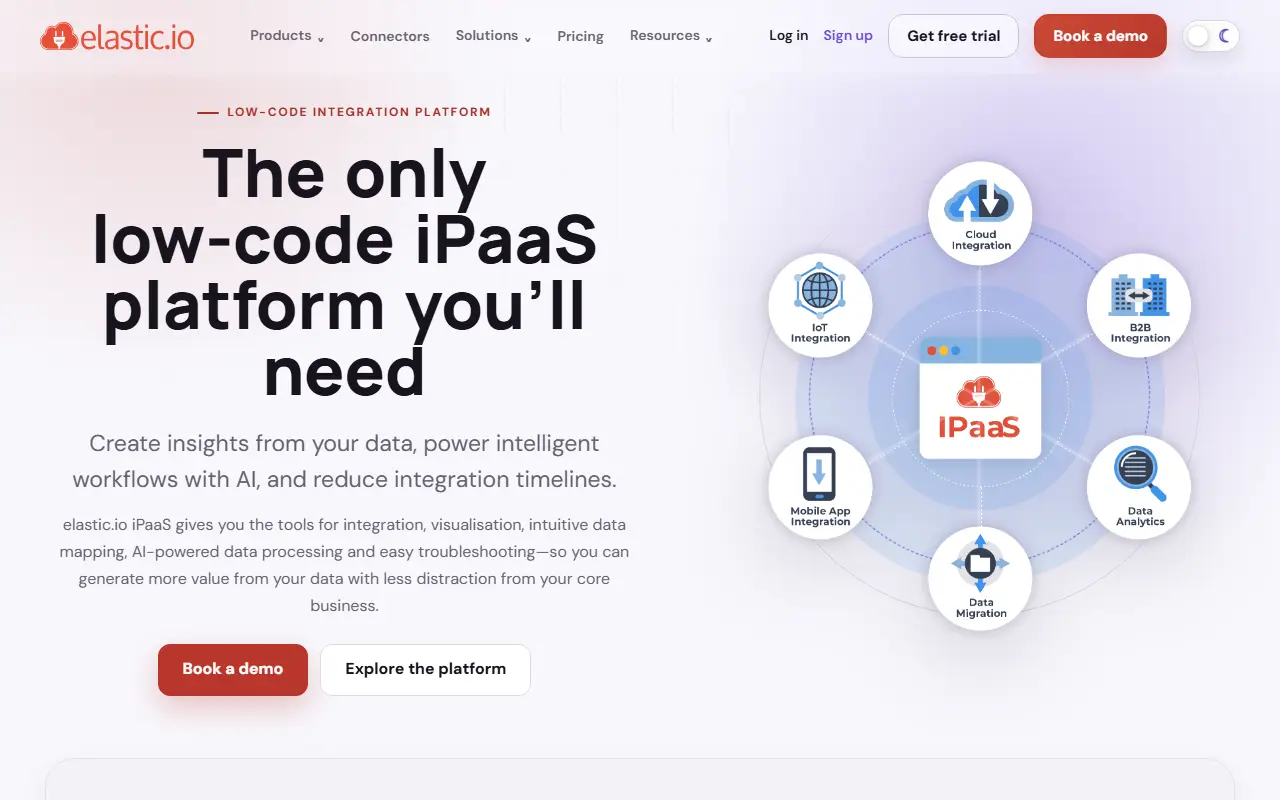
About elastic.io
elastic.io is a low-code integration platform as a service for syncing data between SaaS and enterprise applications. It offers tools for building integrations, visualizing data, mapping fields, AI-powered data processing and troubleshooting, with the aim of shortening integration projects.
The product line covers an iPaaS for general integration, an enterprise integration offering that connects cloud and on-premise systems, and embedded integration that lets SaaS vendors build native integrations into their own product. The vendor says it combines the benefits of ESB products, B2B gateway software and API tools in one solution, and it publishes solution pages for Salesforce, NetSuite and SAP as well as hybrid, API, B2B, IoT and mobile scenarios.
elastic.io is a hosted commercial service with a 14-day free trial, a demo option, a REST API, documentation and a pricing page.
Key features
- Low-code integration flow builder
- Visual data mapping
- AI-powered data processing
- Cloud-to-cloud and cloud-to-ground integration
- Embedded integration for SaaS products
- Solutions for Salesforce, NetSuite and SAP
Good fit for
- →Syncing data between a CRM and an ERP
- →Adding native integrations to a SaaS product
- Tags
- ipaas
- integration
- low-code
- data-mapping
- api
- enterprise-integration
- saas
elastic.io: questions and answers
- What is elastic.io used for?
- elastic.io is a commercial low-code iPaaS for connecting SaaS and enterprise applications, with data mapping, AI-powered processing and embedded integration for SaaS vendors. It is a good fit for syncing data between a CRM and an ERP, and adding native integrations to a SaaS product.
- How much does elastic.io cost?
- elastic.io is a paid product with no free plan. A free trial is available. Professional, Startup and Enterprise plans are priced by monthly message volume in euros, with a 14-day free trial; the amounts did not load. White-label and self-hosting are quoted on request.
- Is elastic.io open source?
- No. elastic.io is proprietary (closed-source) software. Open-source alternatives to elastic.io include Zato, ByteChef and Titanoboa.
- What are some alternatives to elastic.io?
- elastic.io competes with Workato, Celigo and Boomi. For open-source options, see Enlisted's ranked list of open-source elastic.io alternatives.
Open-source alternatives to elastic.io
See allZato
Workflow Automation
ESB, SOA, REST, APIs and Cloud Integrations in Python
AGPL-3.0vs MuleSoft★ 1k
ByteChef
Workflow Automation
Open-source AI agents and workflow automation. Self-host or embed in your SaaS. Apache 2.0
OSSvs Zapier★ 1k
Titanoboa
Workflow Automation
Titanoboa makes complex workflows easy. It is a low-code workflow orchestration platform f
AGPL-3.0vs Workato★ 923
Camel Karavan
Workflow Automation
Apache Camel Karavan a Low-code Data Integration Platform
Apache-2.0vs MuleSoft★ 598
n8n
Workflow Automation
n8n is a workflow automation platform that uniquely combines AI capabilities with business
OSSvs Zapier★ 206k
Activepieces
Workflow Automation
AI Agents & MCPs & AI Workflow Automation • (~400 MCP servers for AI agents) • AI Automati
OSSvs Zapier★ 25k
SaaS alternatives to elastic.io
See all
Workato
Workflow Automation
Enterprise integration and automation platform with recipes, connectors and AI agents
SaaS
Celigo
Workflow Automation
Integration platform as a service with prebuilt apps for NetSuite, Shopify and Salesforce
SaaS
Boomi
Workflow Automation
Cloud integration, API management and data automation platform for enterprises
SaaS
Jitterbit
Workflow Automation
Low-code integration and API platform with an automation library for mid-size firms
SaaS
SnapLogic
Workflow Automation
Visual iPaaS for building data pipelines and application integrations
SaaS
MuleSoft
Workflow Automation
Salesforce's API-led integration platform for connecting apps, data and devices
SaaS