7,363 open-source and SaaS tools, with GitHub stats refreshed every day.

8 alternatives ranked by real activity

Open-source Betty Blocks alternatives

A curated, ranked list of the 8 best open-source alternatives to Betty Blocks.

The best open-source alternative to Betty Blocks is Budibase. If that doesn't suit you, other good options are NocoBase, Corteza, Steedos and Structr.

Betty Blocks alternatives are mainly low-code & internal tools. 7 of them shipped code in the last 30 days, 8 can be self-hosted, and 1 uses a permissive licence.

Last updated October 2, 2026 · ranked by GitHub stars, growth and recent commits

Budibase

An open-source, model-agnostic operations platform for building AI agents, automations and internal apps that connect to your business systems.

GitHub stars
28k
Last commit
today
Latest release
v3.47.0
Self-hosted
Yes
Hosted version
Available
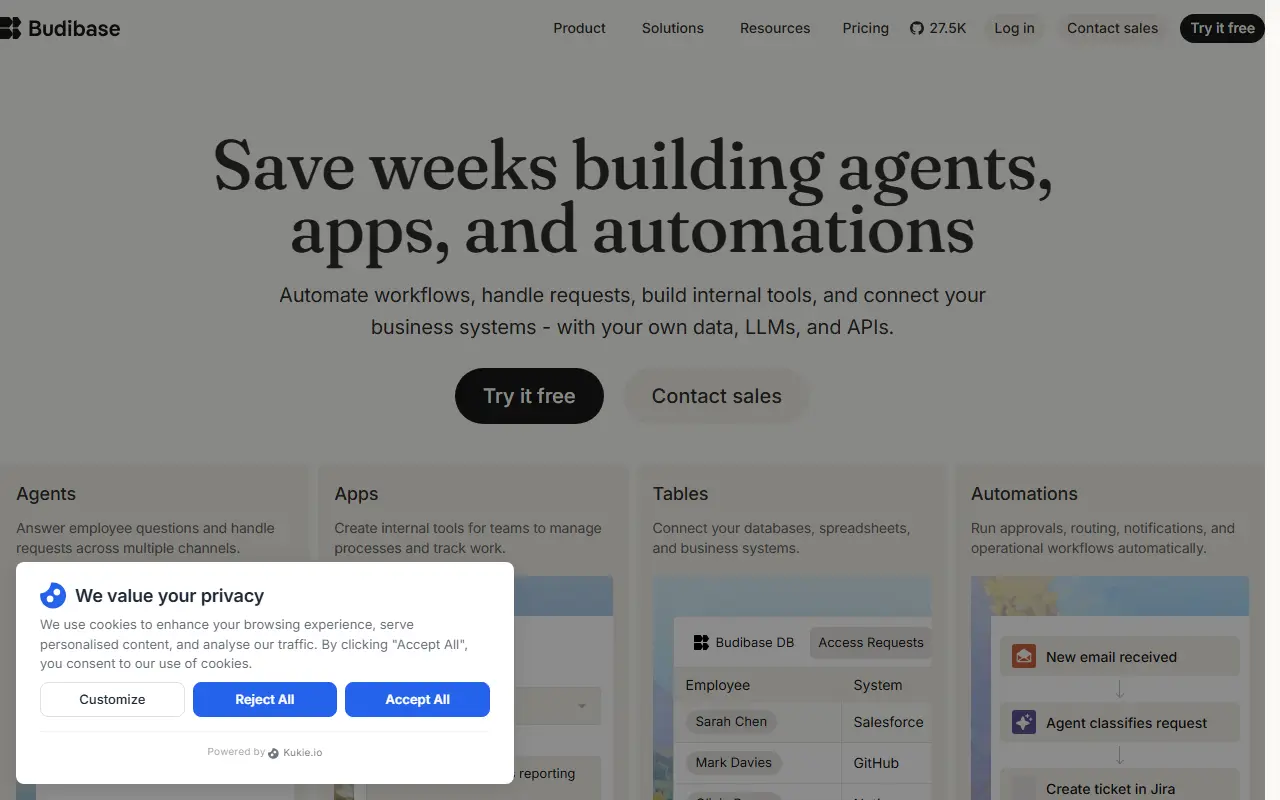
budibase.comBudibase homepage screenshot

Budibase is an open-source operations platform for building AI agents, automations and apps that run internal processes. It is model agnostic and describes itself as saving engineers many hours when building these tools, while handling security concerns. Topics place it in the low-code and no-code internal tools space, with CRUD apps and an SQL GUI.

The idea is to run requests, approvals and workflows on one platform instead of stitching several tools together. Staff constantly ask questions, request sign-offs and flag problems, and Budibase agents interpret those requests and carry out the work: creating records, sending approvals to the right people, updating apps and alerting teams. You connect the business systems your operations already rely on, and the platform also supports building data applications over databases and REST APIs.

You can use Budibase Cloud, where the vendor hosts it, or host it yourself with Docker, Kubernetes or DigitalOcean. The repository is written in TypeScript, and its license is listed as 'Other' on GitHub, so check the terms for enterprise features. It suits operations and engineering teams that want internal tools and AI automation without building everything from scratch.

Key features

  • AI agents that run workflows
  • Internal app builder for CRUD tools
  • Automations connecting business systems
  • Works with any AI model
  • Self-host with Docker or Kubernetes
  • Budibase Cloud hosting

Pricing: The open-source edition is free to self-host. Cloud plans are Pro $19, Premium $49 and Business $299 per month, each with a 14-day trial; Enterprise is custom and quoted through sales.

Read more about BudibaseWebsite GitHub

NocoBase

An open-source AI and no-code platform for building business systems such as CRMs, internal tools and workflows, where people and coding agents build together.

GitHub stars
24k
Last commit
2 days ago
Latest release
v2.2.20
Self-hosted
Yes
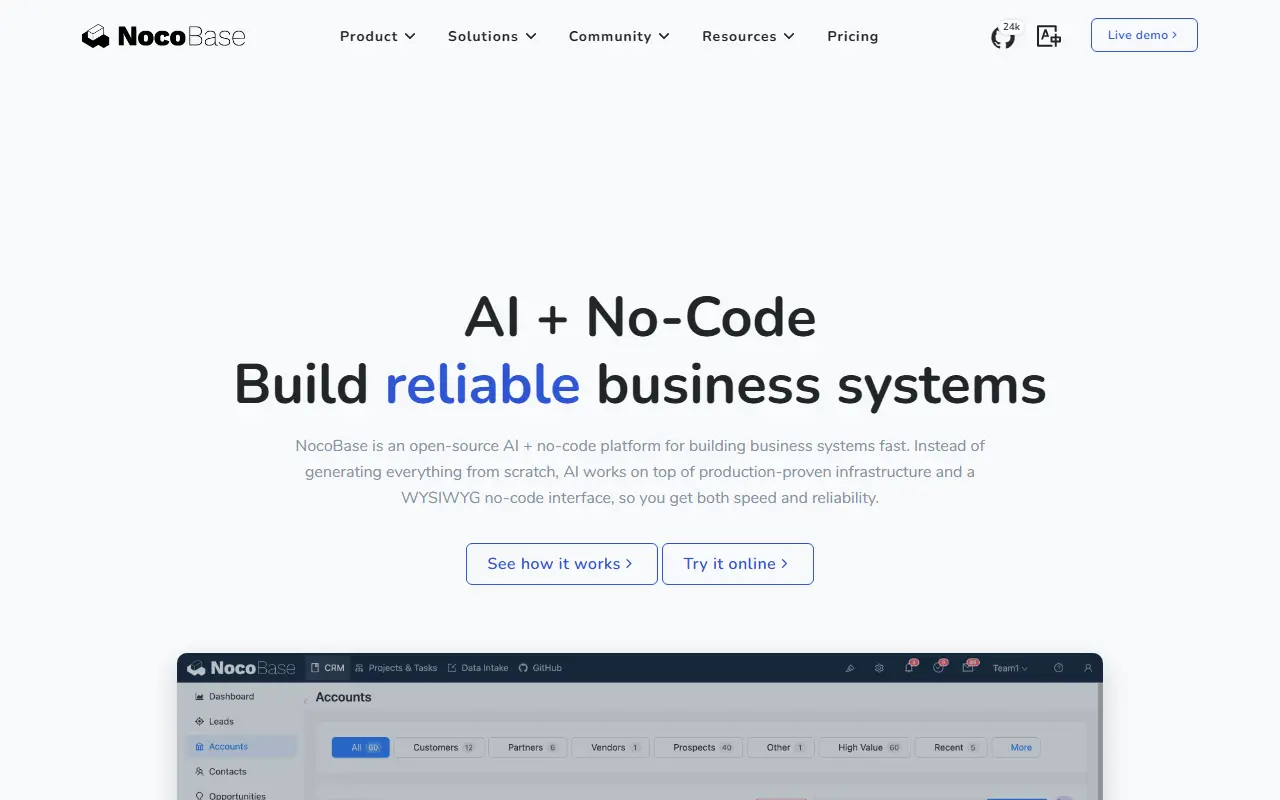
nocobase.comNocoBase homepage screenshot

NocoBase is an open-source platform that combines AI with no-code tooling to build business systems quickly. Rather than having AI generate everything from scratch, it has AI build on infrastructure already proven in production and on a visual WYSIWYG no-code editor, which the project says delivers both speed and reliability.

Its approach is collaborative: coding agents are given a complete CLI plus skills, and people use a visual interface, so both can contribute to the same system. Topics show typical uses such as internal tools, admin dashboards, CRUD apps, CRM, ERP and project management, with workflows included. An online demo, documentation, a forum and customer stories are available, and release notes are published on the blog with weekly summaries. It is written in TypeScript.

NocoBase can be installed on your own infrastructure, and its license is listed as 'Other' on GitHub, so review the terms for commercial or enterprise use. It suits teams that want flexible internal systems without maintaining a large custom codebase, and who want to use AI assistance on a stable foundation.

Key features

  • WYSIWYG no-code interface
  • CLI and skills for coding agents
  • Workflows and CRUD apps
  • Suitable for CRM, ERP and project management
  • Online demo and documentation
  • Install on your own infrastructure

Pricing: The Community Edition is free and open source. Standard is a one-time $800 lifetime license and Professional a one-time $8,000 license, each with one year of upgrades; Enterprise is by contact.

Read more about NocoBaseWebsite GitHub

Corteza

Open-source low-code platform for building CRM, business process, and structured data apps, with workflows, RBAC, privacy features, and data integrations.

GitHub stars
2.2k
Last commit
today
Latest release
2024.9.10
Licence
Apache-2.0
Self-hosted
Yes
Hosted version
Available
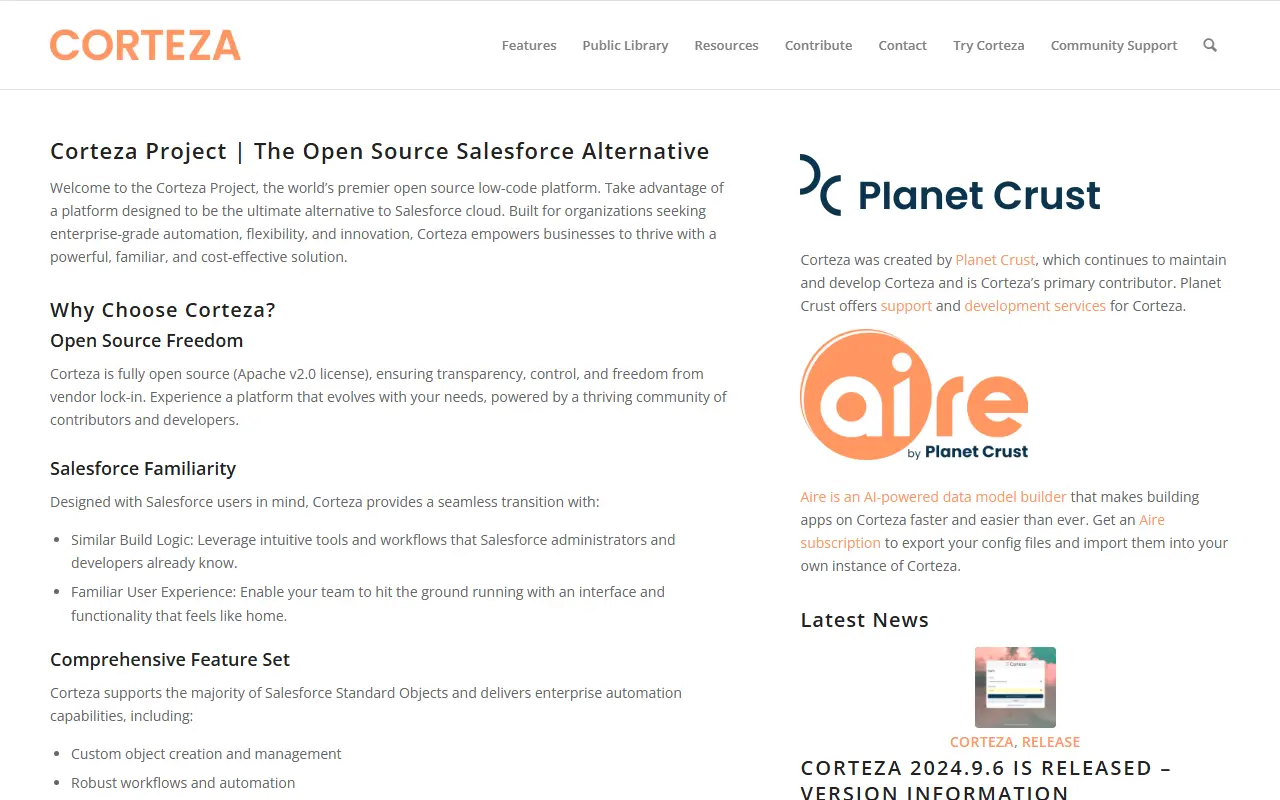
cortezaproject.orgCorteza homepage screenshot

Corteza is a low-code platform that lets teams build and iterate on CRM, business process, and other structured data applications quickly. It also supports intelligent business process workflows and connects to almost any data source. It is written in Go, with a Vue front end, and released under the Apache-2.0 license. It is maintained by Planet Crust, its founder.

Key characteristics include a standards-oriented approach using established data formats, flat role-based access control that supports complex internal security policies, privacy features that help comply with data protection regulations, accessibility following WCAG 2.1, and an API-centric design that makes integration with external services and other Corteza instances straightforward. Applications can be customized from translations and terminology up to entirely new low-code apps.

Planet Crust offers hosted Corteza cloud instances as the easiest way to start, and a DevOps guide covers self-hosting along with backup, restore, and email relay topics. Corteza suits organizations that want an open-source alternative to proprietary low-code CRM platforms and need control over their data.

Key features

  • Low-code builder for CRM and data apps
  • Workflow automation for business processes
  • Role-based access control
  • Privacy and data protection features
  • API-centric integration with data sources
  • WCAG 2.1 accessibility

Pricing: Free and open source under the Apache-2.0 license; Planet Crust offers hosted instances.

Read more about CortezaWebsite GitHub

Steedos

A metadata-driven low-code platform for building enterprise apps, evolving into the AI-native ObjectStack architecture for generating software from prompts.

GitHub stars
1.6k
Last commit
8 days ago
Latest release
v2.7.32
Licence
AGPL-3.0
Self-hosted
Yes
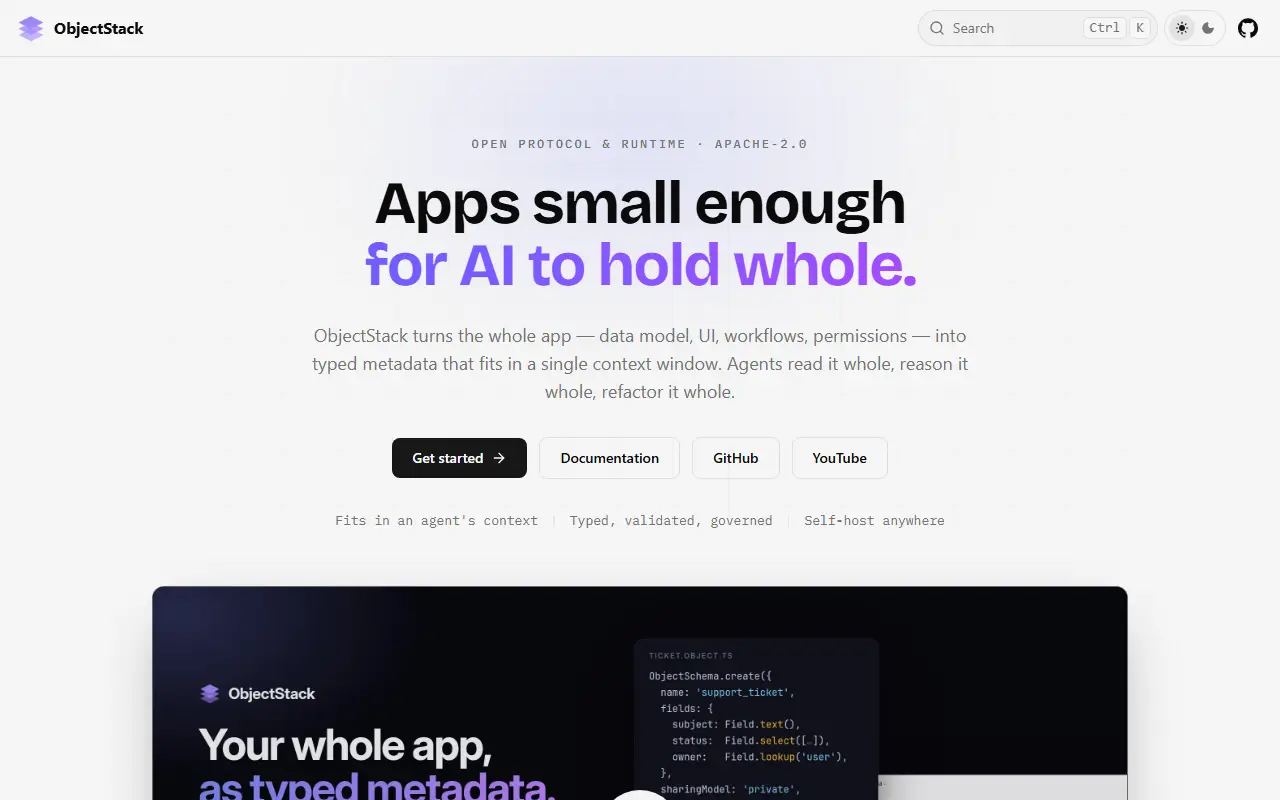
objectstack.aiSteedos homepage screenshot

Steedos Platform is an open-source low-code and no-code platform for building enterprise applications. It follows a metadata-driven architecture similar to Salesforce, where objects, fields, permissions and workflows are described as configuration instead of hand-written code, which speeds up building business apps such as CRM and ERP-style tools.

The project is evolving into ObjectStack, a modular headless stack made of ObjectQL as a protocol for data, logic and UI, ObjectOS as a runtime providing APIs, authentication, permissions and workflow automation, and Object UI as a schema-driven renderer based on React and Tailwind. The README says Steedos v2.x remains supported while future development focuses on ObjectStack and AI-generated applications.

Steedos is written in TypeScript and licensed under AGPL-3.0, with documentation, examples and a community linked from the repository. It is a self-hosted platform and its topics reference tools such as Salesforce, Appsmith, Budibase and Airtable, indicating the space it competes in. It suits development teams and agencies that want to build internal business software on a configurable, open foundation.

Key features

  • Metadata-driven object and field definitions
  • Headless runtime with APIs and permissions
  • Workflow and BPM automation
  • Schema-driven React user interface renderer
  • Prompt-to-app direction through ObjectStack
  • OpenAPI support
Read more about SteedosWebsite GitHub

Structr

Structr is an open-source low-code development and runtime platform built on the Neo4j graph database for custom web apps, backends and integrations.

GitHub stars
828
Last commit
3 days ago
Self-hosted
Yes
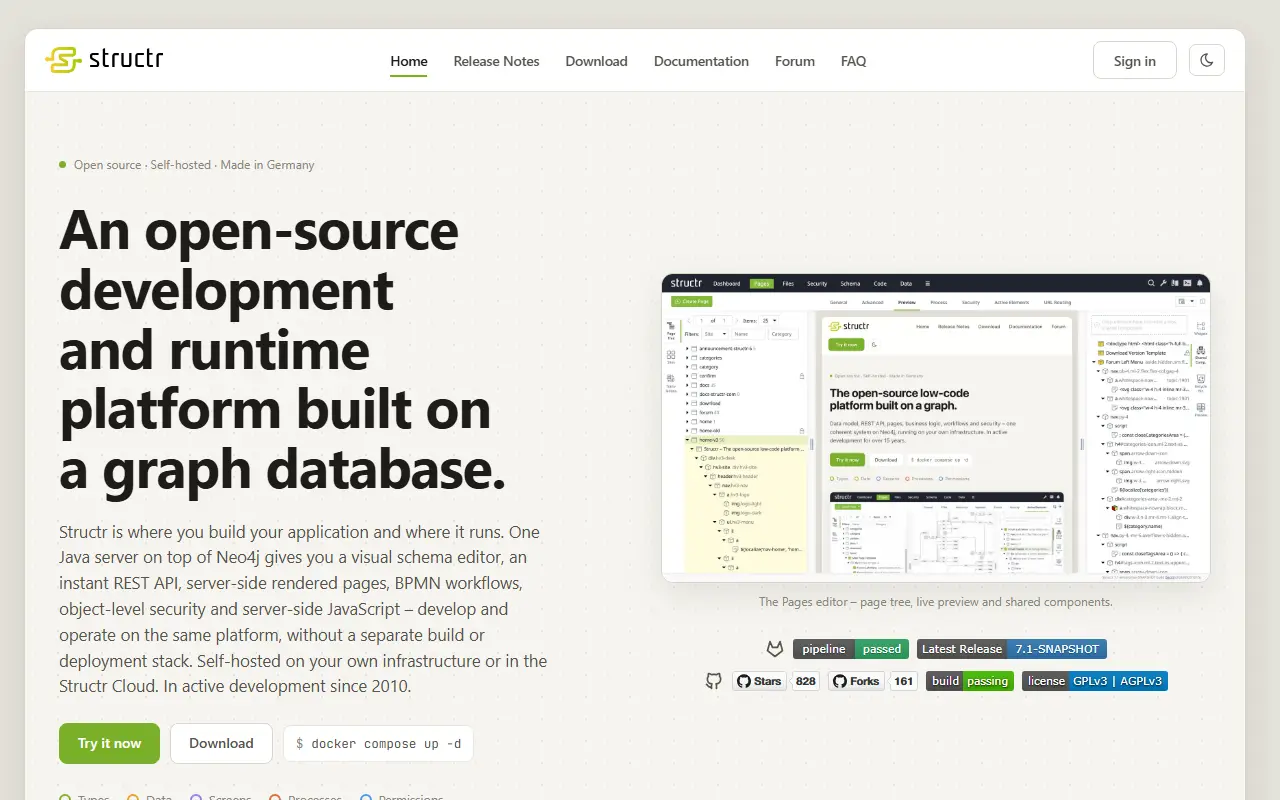
structr.orgStructr homepage screenshot

Structr is a generic low-code development and runtime platform built on graph technology. It is not tied to one use case and is meant for building fully custom applications, including web applications, graph-database-backed back ends, data-centric systems, middleware and integration components.

At its core Structr keeps both application components, such as schema, UI definitions, templates, scripts and workflows, and the application data in a graph database (Neo4j). That gives schema flexibility and expressive data modeling without join-heavy queries, and the schema can be represented as JSON Schema with import and export. A virtual file system manages files with custom metadata and can store binary content on external providers such as S3. Development happens in a web-based developer and admin UI that works as an integrated IDE.

The README is explicit about what Structr is not: it is not a prebuilt CMS, CRM or ERP, a website builder, or an industry template collection, but a set of building blocks for your own applications. The GitHub repository is a clone, and development and issue tracking have moved to gitlab.structr.com. The license is listed as Other, and the topics mention GraalVM polyglot programming.

Key features

  • Graph database storage with Neo4j
  • Web-based developer and admin IDE
  • Schema export and import as JSON Schema
  • Virtual file system with S3 support
  • Low-code builder for backends and web apps
  • Polyglot scripting with GraalVM
Read more about StructrWebsite GitHub

REI3

REI3 is a free, self-hostable low-code platform for building multi-user business applications with workflows, access policies, encryption and mobile support.

GitHub stars
581
Last commit
yesterday
Latest release
v3.12.8
Self-hosted
Yes
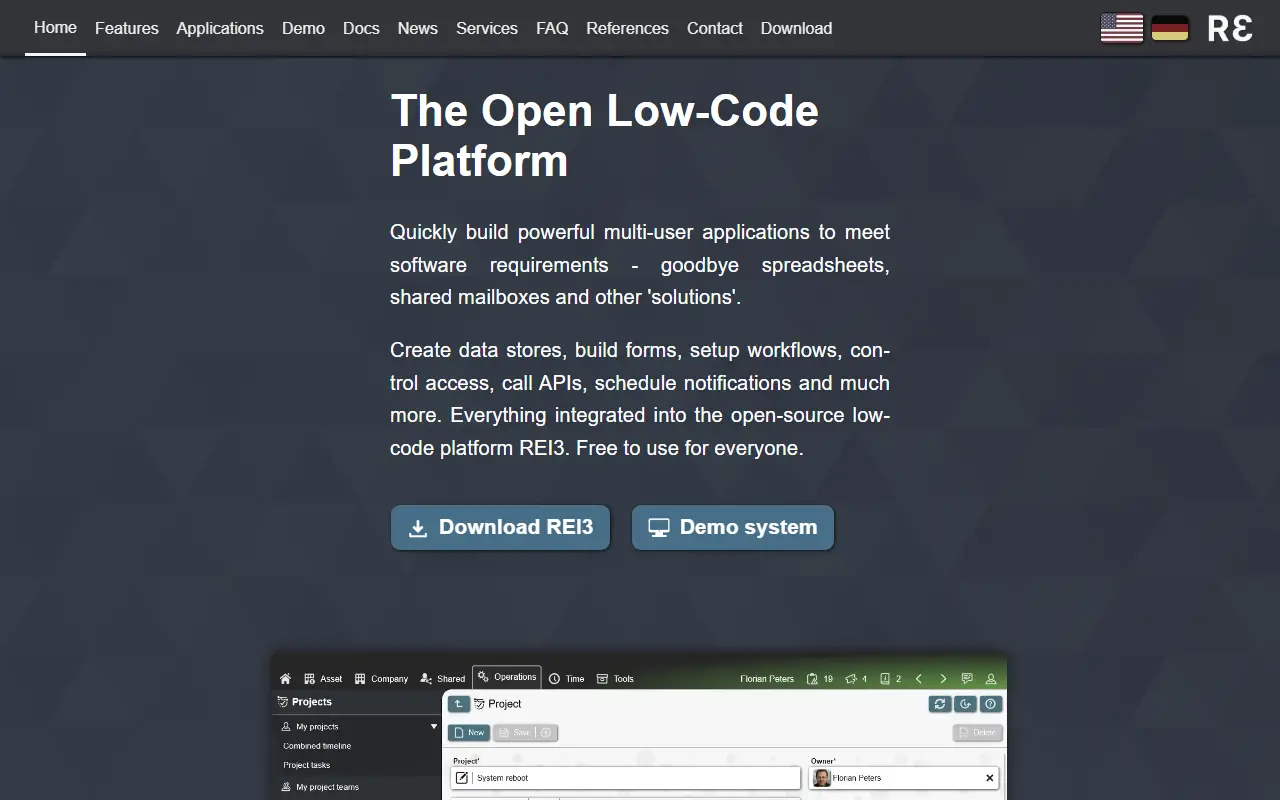
rei3.deREI3 homepage screenshot

REI3 is a free and open low-code platform for building and hosting business applications with full control and ownership. It targets organizations that want to replace spreadsheet-based solutions with proper multi-user apps, run them in the cloud or on-premise, and avoid walled gardens and cloud-only SaaS. Created applications can be used, shared or even sold.

Applications can summarize records, do date calculations and apply business rules, show tasks on Gantt charts, diagrams and dense lists, and include workflows such as forms that change with a record's state, PDF export and notifications. Roles and access policies restrict access globally or per record, and built-in end-to-end encryption comes with key management. Integration options include serving and calling REST endpoints, CSV import and export and ICS calendar access. The platform also covers mobile use with PWA features, full-text search, input types such as signatures and bar or QR code scanning, password policies and brute-force protection.

REI3 is written in Go and JavaScript, uses multi-core processing and bi-directional data channels for speed, and has downloads, documentation, a live demo and a catalog of applications. Its license is listed as Other.

Key features

  • Low-code builder for multi-user business apps
  • Roles and record-level access policies
  • Built-in end-to-end encryption
  • REST, CSV and ICS integration options
  • Gantt charts and diagrams
  • PWA support for mobile use

Pricing: The platform is free and open source for private or commercial use. Enterprise features and support services are available on request, with no prices shown.

Read more about REI3Website GitHub

Skyve

Open-source low-code Java platform where enterprise applications are declared in XML metadata and the runtime handles security, UI, persistence and schema changes.

GitHub stars
504
Last commit
yesterday
Licence
LGPL-2.1
Self-hosted
Yes
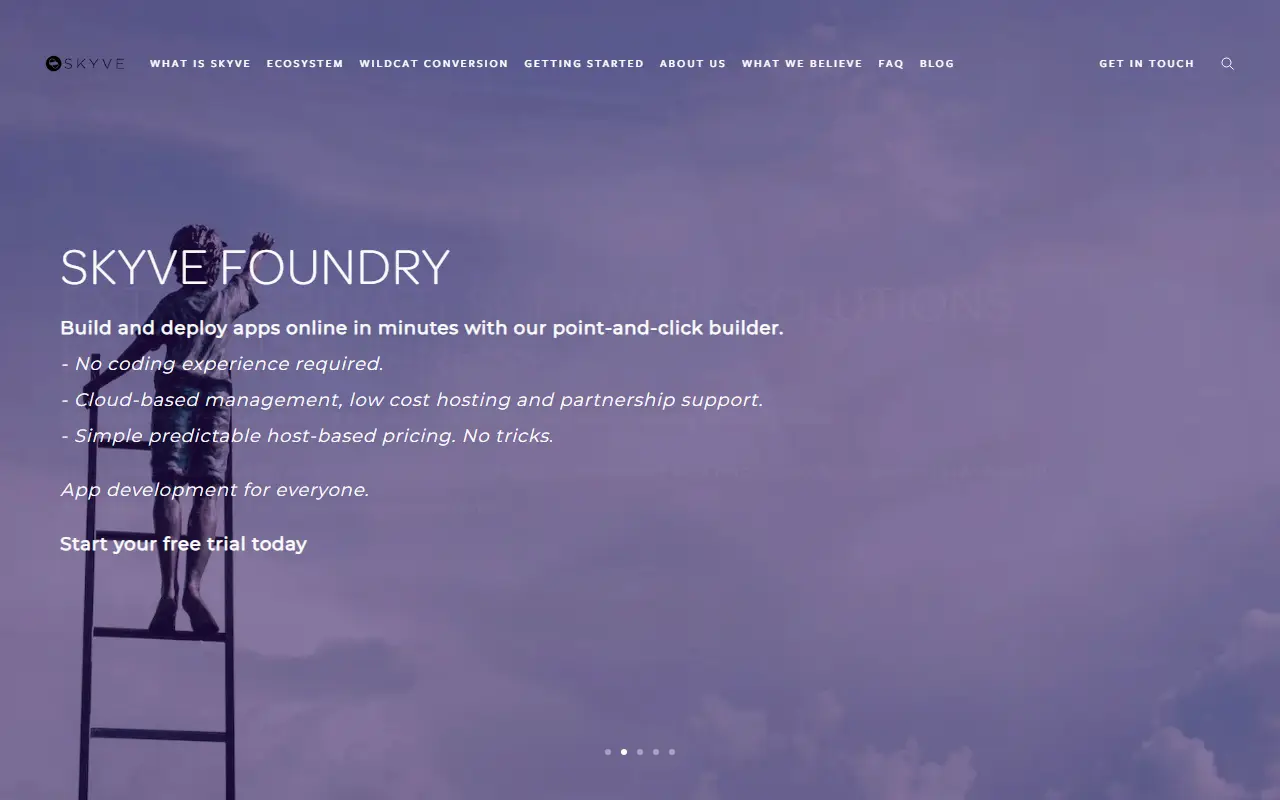
skyve.orgSkyve homepage screenshot

Skyve is an open-source low-code platform for building secure, scalable enterprise applications. Rather than generating large amounts of code, applications are described in concise XML metadata, and the platform interprets those declarations at runtime to enforce security, render user interfaces, manage persistence and evolve the database schema.

Security is declarative: permissions are set per document with role-based create, read, update and delete rules and row-level scoping, and are enforced across persistence, queries and the UI. REST and UI responses only include fields a user may see, unpermitted input is ignored, access paths are computed from roles, and REST access is blocked unless it has been explicitly allowed. The whole metadata model is validated statically on every build.

This repository is the Java implementation of the Skyve framework specification, with Maven commands for creating, building and updating projects and a tutorial, user guide, development guide and cookbook. The project presents the metadata approach as well suited to AI-assisted development, and it is licensed under LGPL-2.1.

Key features

  • Applications declared in XML metadata
  • Role-based CRUD with row-level scoping
  • Payload shaping to prevent over-posting
  • Forced-browsing prevention and fail-closed defaults
  • Static validation of the metadata model on build
  • Automatic schema evolution and persistence

Pricing: Free and open source under the LGPL-2.1 licence.

Read more about SkyveWebsite GitHub

Joget

Open-source no-code and low-code platform for building business apps, workflows and process automation visually, with community and commercial editions.

GitHub stars
618
Last commit
1 mo ago
Self-hosted
Yes
Hosted version
Available
joget.orgJoget homepage screenshot

Joget is an application platform that combines rapid application development, business process automation and workflow management in a visual, web-based builder. Business and technical teams can use it together to build full enterprise applications without much hand coding, aiming to shorten delivery from months to weeks or days. Apps built on it are mobile ready and cloud ready, and the platform offers APIs for integration and a plugin architecture for extension.

The README describes a marketplace where ready-made apps, plugins and templates can be downloaded, along with a community Q&A forum, a knowledge base, video tutorials, an online academy and translations in more than twenty languages. Deployment is flexible: on-premise, on-demand cloud, Docker, Kubernetes, Cloud Foundry, OpenShift and several cloud marketplaces are listed.

Licensing is split. Joget Community Edition is released under GPL version 3, while the Professional, Enterprise and Large Enterprise editions are covered by a commercial end-user license agreement. The core is written in Java. It suits organizations that want to digitize processes such as approvals and forms with a platform they can run themselves.

Key features

  • Visual no-code and low-code app builder
  • Workflow and business process automation
  • APIs and plugin architecture
  • Marketplace of ready-made apps and plugins
  • Docker, Kubernetes and on-premise deployment
  • Mobile-ready apps

Pricing: Community Edition is free under GPL-3.0. Professional, Enterprise and Large Enterprise editions are commercial; see the vendor for pricing.

Read more about JogetWebsite GitHub

Betty Blocks alternatives: questions

What is the best open-source alternative to Betty Blocks?
Budibase is the top-ranked open-source alternative to Betty Blocks on Enlisted: An open-source, model-agnostic operations platform for building AI agents, automations and internal apps that connect to your business systems. Other strong options are NocoBase, Corteza, Steedos and Structr.
Are these Betty Blocks alternatives free?
All 8 are open source, so the code is free to use under its licence, and all of them can be self-hosted on your own server or computer. 3 also offer a paid or managed cloud version if you'd rather not host it yourself.
How is this list of Betty Blocks alternatives ranked?
By a score built from GitHub stars, star growth over the last 30 days and how recently the code changed. 7 of these projects shipped code in the last 30 days. Data is refreshed daily, and nobody can pay to move up.

People also look for alternatives to…

View all