#1
An open-source Postgres development platform bundling a database, auth, auto-generated APIs, realtime, storage and vector tools, often chosen as a Firebase alternative.
- GitHub stars
- 115k
- Last commit
- today
- Latest release
- v1.26.08
- Licence
- Apache-2.0
- Self-hosted
- Yes
- Hosted version
- Available
supabase.com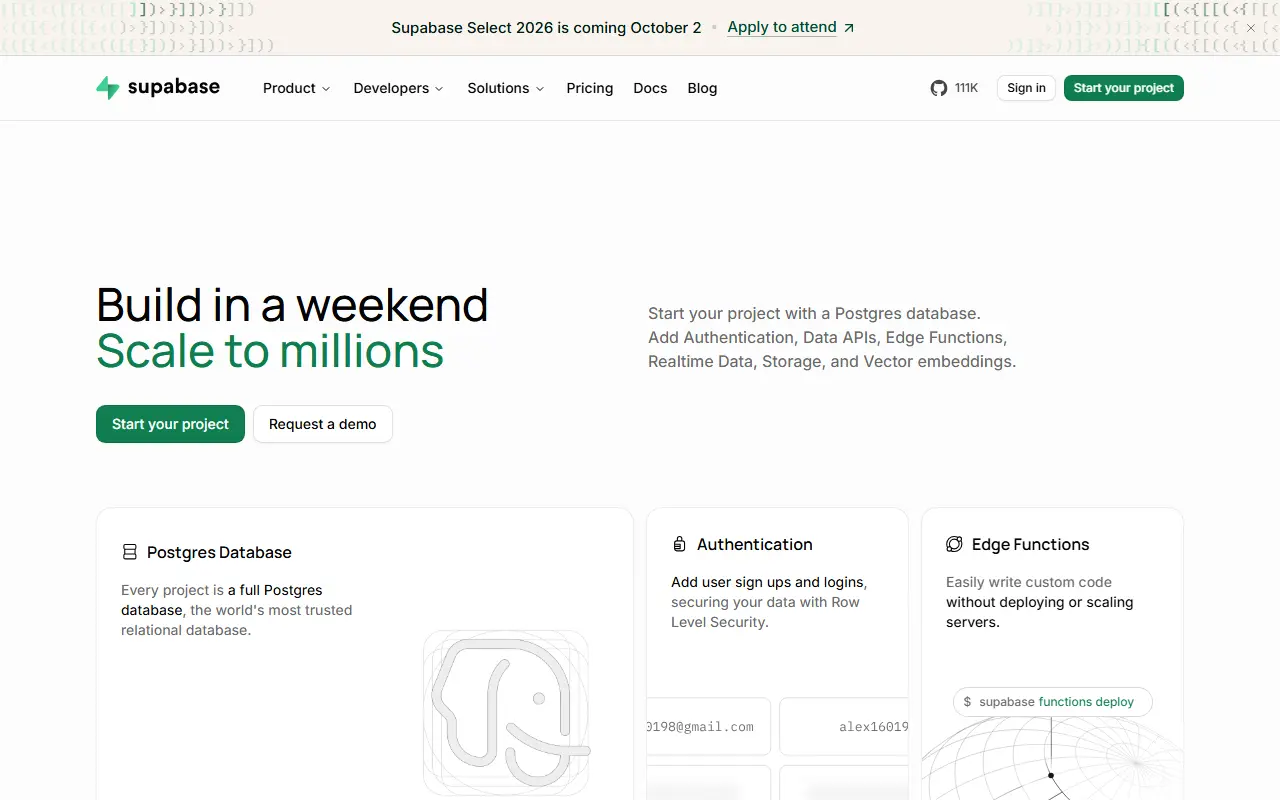
Supabase is a backend platform built around a dedicated Postgres database. It packages the pieces most web, mobile and AI apps need, including authentication and authorization, auto-generated APIs, file storage, serverless functions and a dashboard, so developers can start without assembling separate services. Its stated aim is a developer experience similar to Firebase, built from open-source components.
APIs are generated from your schema as REST and GraphQL, with realtime subscriptions over websockets. Logic can live in database functions or in Edge Functions that run on Deno. For AI work there is a toolkit for vectors and embeddings built on pgvector, and Postgres extensions such as PostGIS are available. Supabase combines existing open tools with ones it builds itself when nothing suitable exists.
The code is Apache-2.0 licensed. Supabase is offered as a hosted platform you can sign up for without installing anything, and the same stack can be self-hosted or run locally for development. It suits teams that want Postgres at the core of their app but prefer not to build the surrounding backend themselves.
Key features
- Hosted Postgres database with a dashboard
- Authentication and authorization
- Auto-generated REST and GraphQL APIs
- Realtime subscriptions over websockets
- Edge Functions and database functions
- File storage for user uploads
- Vector and embeddings toolkit with pgvector
Pricing: Free plan with 50,000 monthly active users. Pro starts at $25 and Team at $599 per month, with usage and extra compute billed on top; Enterprise is custom.
#2
An open-source backend platform offering auth, databases, storage, functions, messaging, realtime and hosting, available as a managed cloud or self-hosted with Docker.
- GitHub stars
- 58k
- Last commit
- today
- Latest release
- 2.7.2
- Licence
- BSD-3-Clause
- Self-hosted
- Yes
- Hosted version
- Available
appwrite.io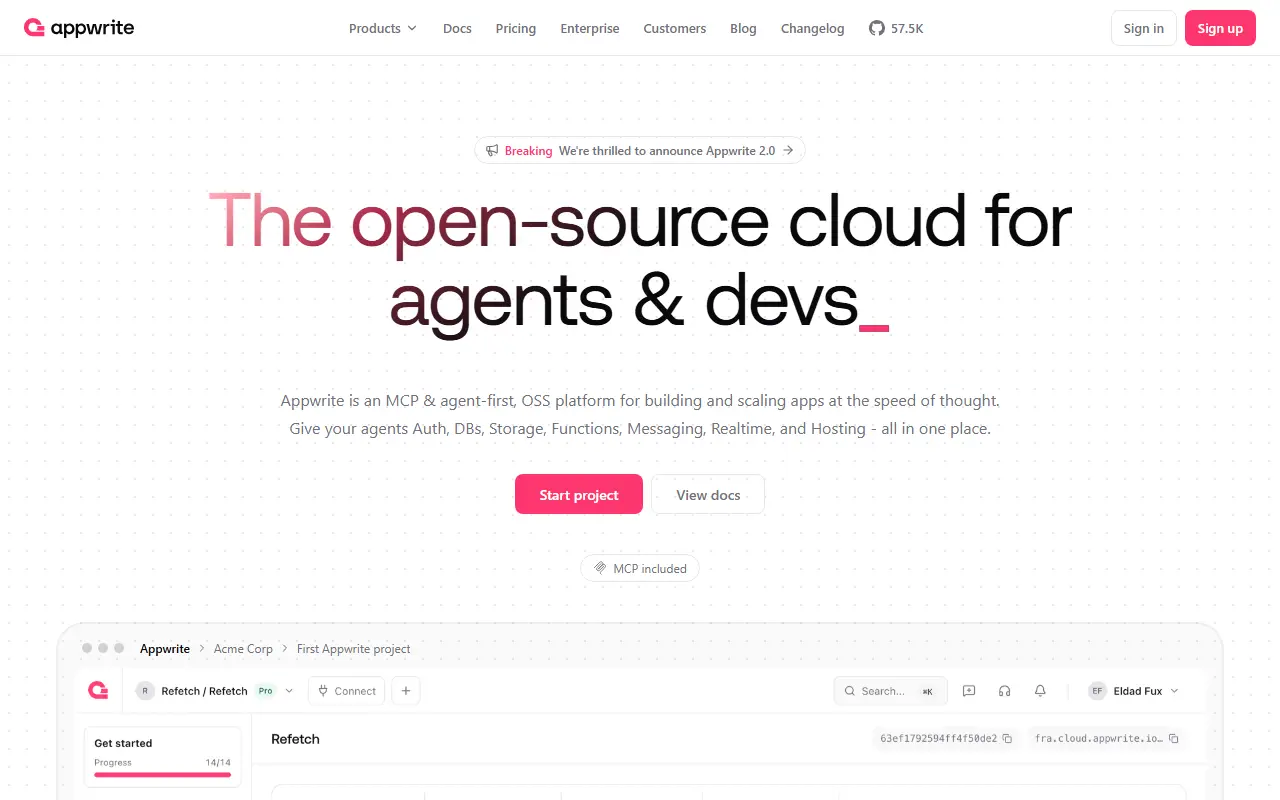
Appwrite is an open-source platform for building and scaling web, mobile and AI apps. It bundles the backend services most apps need, namely auth, databases, storage, functions, messaging, realtime and hosting, and presents them as an agent-friendly cloud with MCP support. It can run as a managed cloud platform or be self-hosted on infrastructure you control.
Auth supports email, SMS, OAuth, anonymous sessions and magic URLs. Databases can be modeled and queried through Appwrite itself or backed by managed PostgreSQL and MySQL. Storage keeps files with compression, encryption, image transformations and permission controls, and Functions run serverless code in isolated runtimes triggered by events. Sites deploys static, SSR and CSR frontends from Git with previews, and Messaging sends email, SMS and push notifications.
Developers integrate through client and server SDKs, including Flutter, Swift, React Native and JavaScript, or let coding agents such as Cursor, Claude Code and Codex operate a live project through a hosted MCP server. Appwrite is BSD-3-Clause licensed and written mainly in PHP, with Docker-based self-hosting for Unix and Windows.
Key features
- Auth with email, SMS, OAuth and magic URLs
- Databases including managed PostgreSQL and MySQL
- File storage with encryption and image transformations
- Serverless functions in isolated runtimes
- Messaging via email, SMS and push
- Realtime updates and static or SSR site hosting
- Hosted MCP server and client and server SDKs
Pricing: A free plan and a Pro plan exist, but the captured page does not show their prices. Dedicated databases start at $10 a month each and go up to $960 a month; serverless databases have no fixed fee.
#3
An open-source headless CMS written in JavaScript and TypeScript that generates REST and GraphQL APIs from content models you design.
- GitHub stars
- 73k
- Last commit
- today
- Latest release
- v5.62.0
- Self-hosted
- Yes
- Hosted version
- Available
strapi.io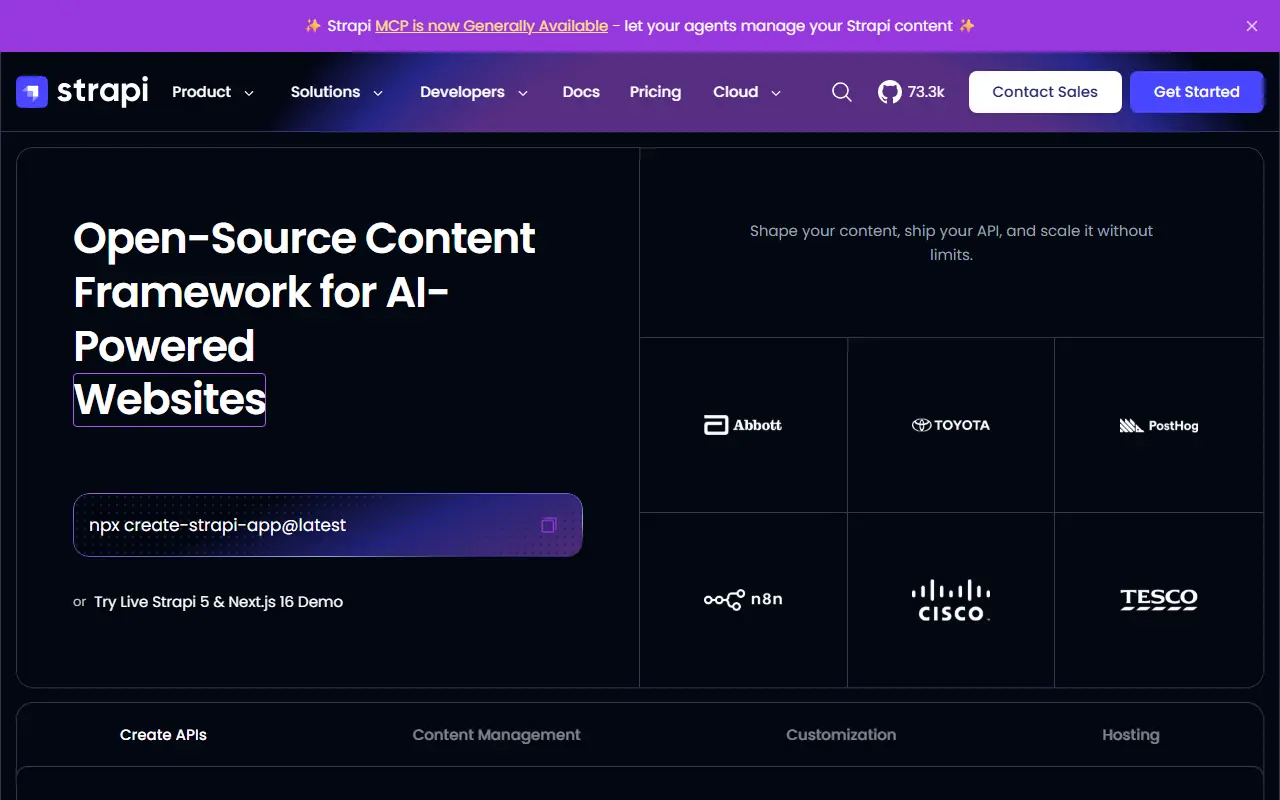
Strapi is a headless content management system. Developers define content models, and Strapi generates a complete API that a website, mobile app or other client can consume, while editors get a friendly admin interface for writing and managing content. It is written entirely in JavaScript and TypeScript on Node.js.
A visual Content-Type Builder lets you design structures without code, and every content type gets REST and GraphQL endpoints automatically. Granular roles and permissions, a media library, internationalization and draft and publish workflows are built in. It works with SQLite, PostgreSQL, MySQL and MariaDB, and offers a plugin system and a customizable admin dashboard. Requests pass through routes, middlewares, controllers and services, which is where backend customization happens. Strapi AI adds help with content modeling, media alt text and translations.
You can self-host Strapi on your own infrastructure or use Strapi Cloud, the managed service. Its license is listed as 'Other' in the repository metadata, so confirm the terms for any enterprise features. It suits teams building Jamstack or multi-channel sites that want a flexible, developer-first backend.
Key features
- Visual Content-Type Builder
- Auto-generated REST and GraphQL APIs
- Granular roles and permissions
- Media library with internationalization
- Draft and publish workflow
- Plugin system and customizable admin panel
- SQLite, PostgreSQL, MySQL and MariaDB support
Pricing: Strapi Cloud has no free tier on this page: Starter is $35, Pro $90 and Business $450 per project per month. Custom limits go through sales.
#4
A self-hostable data platform that wraps any SQL database with instant REST and GraphQL APIs, a no-code admin app, authentication and an MCP server.
- GitHub stars
- 39k
- Last commit
- today
- Latest release
- v12.6.1
- Self-hosted
- Yes
- Hosted version
- Available
directus.com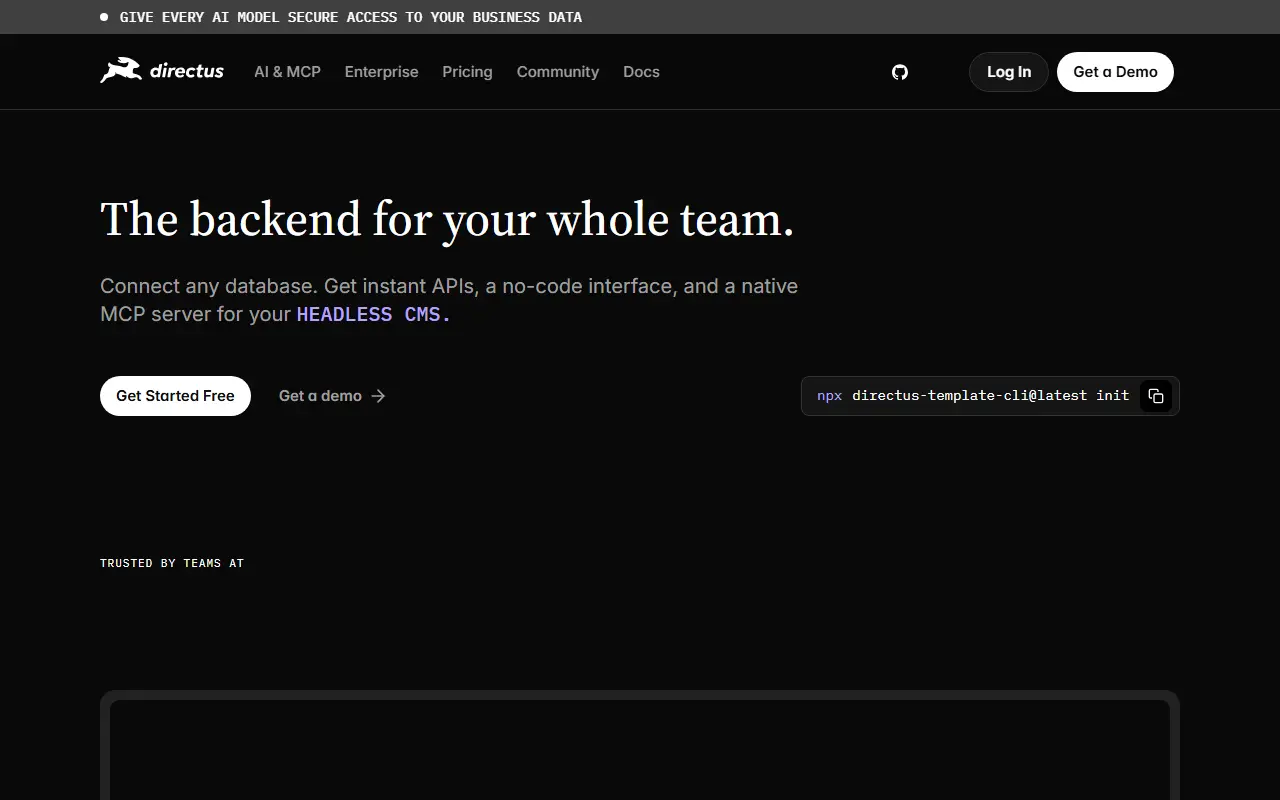
Directus is a collaborative backend and headless CMS that sits on top of an existing SQL database. You connect a database, and it generates production-ready REST and GraphQL APIs, leaving your schema exactly as built, along with a no-code interface where non-developers can manage content and data.
Beyond content management it provides authentication and access control, so the same install can power websites, apps, admin panels and internal tools. A native Model Context Protocol server gives AI assistants such as Claude, ChatGPT and Cursor secure access to business data. Supported databases include SQLite, MySQL, PostgreSQL and SQL Server, and the app is built with TypeScript and Vue. A template CLI, run through npx, can initialize a project quickly.
Directus can be self-hosted on servers you control, or run on the vendor's Directus Cloud. The repository license is listed as 'Other', so review the terms to see which uses are free. It suits teams that want an API and admin layer over data they already have, without writing a custom backend.
Key features
- Instant REST and GraphQL APIs over any SQL database
- No-code data and content interface
- Authentication and role-based access
- Native MCP server for AI assistants
- Works with SQLite, MySQL, PostgreSQL and SQL Server
- Project templates via npx CLI
Pricing: Core is free with 3 seats. Team is $599 per month billed monthly or $499 per month on an annual commitment; Enterprise is custom. Directus Cloud hosting is a $99 per month add-on, with a 14-day cloud trial.
#5
A cloud-native, plugin-extensible API gateway that also handles LLM and MCP traffic, runs natively on Kubernetes and can be self-hosted or used as a cloud service.
- GitHub stars
- 44k
- Last commit
- 25 days ago
- Latest release
- 3.9.4
- Licence
- Apache-2.0
- Self-hosted
- Yes
- Hosted version
- Available
konghq.com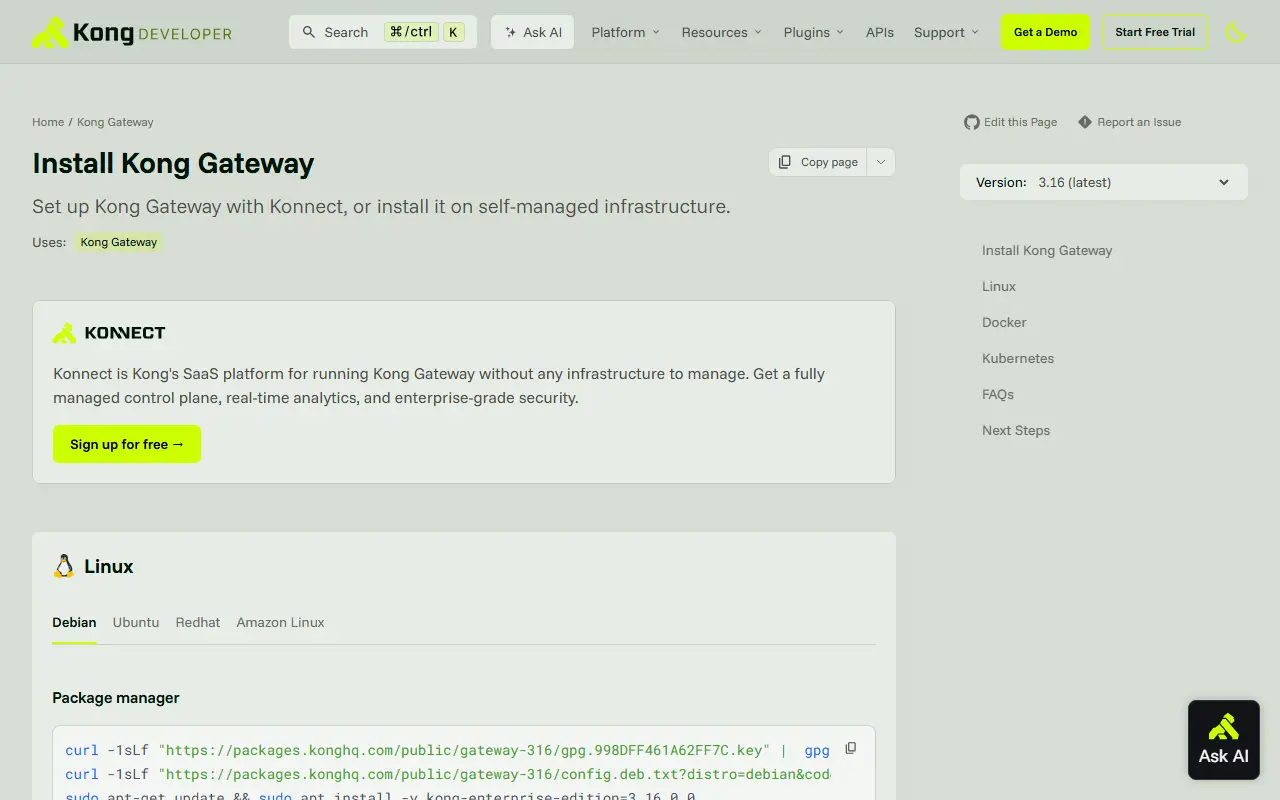
Kong, also called Kong Gateway, is a cloud-native and platform-agnostic API gateway that has expanded to cover LLM and MCP traffic. It is written in Lua, released under the Apache-2.0 license, and extended through plugins. It proxies, routes, load balances and health checks traffic and handles authentication, sitting as a central layer in front of microservices or conventional APIs.
For AI workloads it adds multi-LLM support, semantic security, and security and analytics for MCP traffic. Kong runs natively on Kubernetes through its official Ingress Controller. The quickstart uses docker-compose, adds authentication to an API in a few minutes, and a Docker procedure covers a DB-less mode, with other distributions listed on the official installation page.
You can run Kong on your own infrastructure, in the cloud, on bare metal or in containers, or sign up for a free trial of the cloud-hosted Kong Konnect. It suits platform and API teams managing many services who need a gateway with a plugin ecosystem and an upgrade path to AI traffic management.
Key features
- API gateway with routing and load balancing
- Extensible through a plugin system
- Authentication and health checking
- Multi-LLM and MCP gateway capabilities
- Kubernetes Ingress Controller
- Docker, DB-less and cloud-hosted deployment
Pricing: Kong Konnect's AI Management Plus plan starts at $25 per month plus usage, with a 30-day free trial. Enterprise is custom and billed annually; API and event management rates are not shown.
#6
Hasura GraphQL Engine gives applications a single, secure API over databases such as PostgreSQL, MongoDB, ClickHouse and SQL Server.
- GitHub stars
- 32k
- Last commit
- 2 days ago
- Latest release
- v2.51.6
- Licence
- Apache-2.0
- Self-hosted
- Yes
- Hosted version
- Available
hasura.io
Hasura GraphQL Engine is an open-source project for building applications on top of existing data through a single, composable and secure API endpoint. It creates GraphQL APIs automatically, adds fine-grained access control, and can trigger webhooks on database events. The repository holds two generations: V2, the current stable engine, and the V3 engine that powers Hasura DDN. It is released under the Apache-2.0 license.
V3 supports PostgreSQL and its flavors, MongoDB, ClickHouse and Microsoft SQL Server, and lets you write custom business logic with TypeScript, Python and Go connector SDKs. Data connectors link sources to the engine, and the connectors are available as open source from the Connector Hub. The repository's topics also mention BigQuery, REST APIs and subgraph support. The repository is a large mono-repo, so shallow clones are recommended.
Key features
- Automatic GraphQL APIs over your data
- Fine-grained access control rules
- Webhooks triggered by database events
- Support for PostgreSQL, MongoDB, ClickHouse and SQL Server
- Connector SDKs for TypeScript, Python and Go
- V2 stable engine and V3 engine in one repository
Pricing: DDN Free costs nothing. DDN Advanced starts at $30 per active model per month, with a free trial; DDN Base also has a trial but its price is not shown. Private DDN and Enterprise support are by sales.
#7
An open-source Firebase alternative built on PostgreSQL, Hasura GraphQL, authentication, storage and serverless functions, available hosted or self-hosted.
- GitHub stars
- 9.4k
- Last commit
- today
- Latest release
- mcp@0.3.1
- Licence
- MIT
- Self-hosted
- Yes
- Hosted version
- Available
nhost.io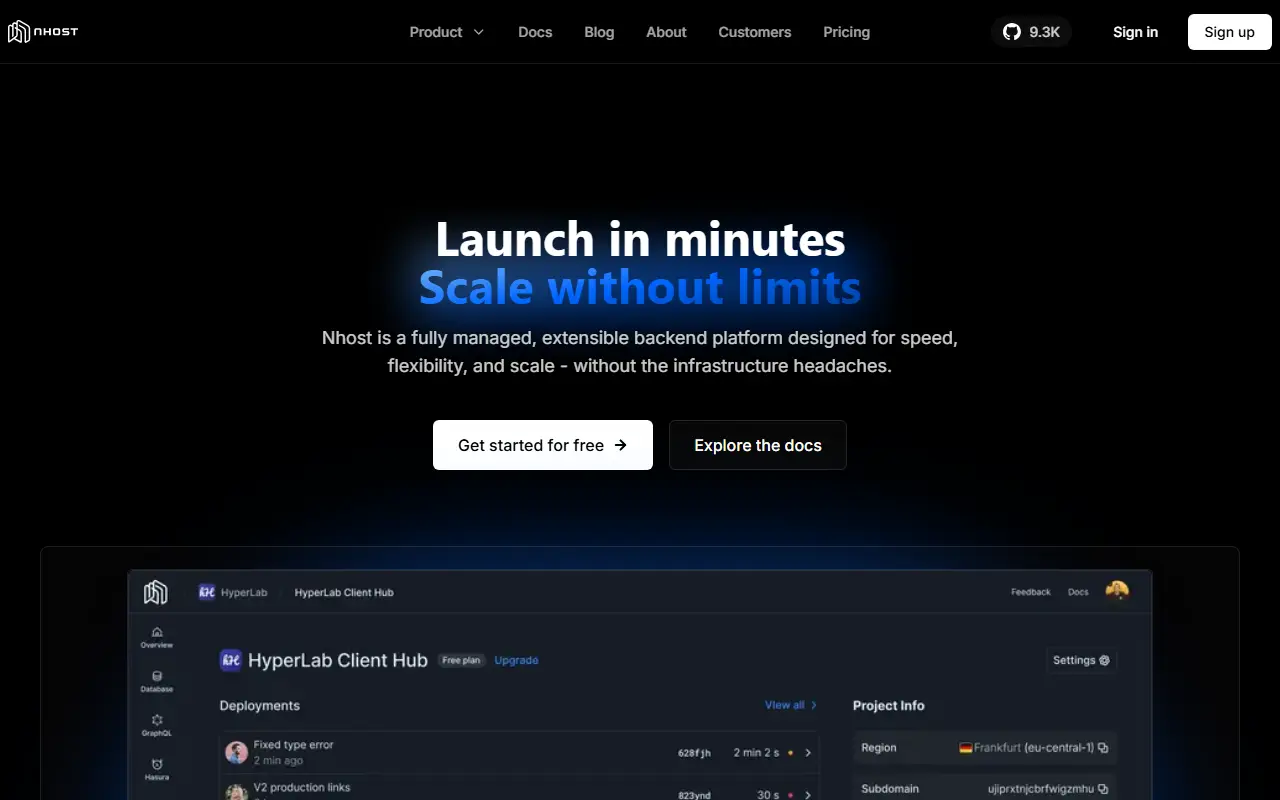
Nhost is an open-source backend platform positioned as a Firebase alternative with GraphQL. It is built around open source, GraphQL, SQL and a good developer experience, and gives frontend developers a complete backend without writing server code.
The stack combines a PostgreSQL database, an instant GraphQL API through Hasura, an authentication service, a storage service and serverless functions written in Node.js, in JavaScript or TypeScript. The Nhost CLI creates a local development environment that follows database migrations and Hasura metadata, and a client package called nhost-js is used from the app. Nhost is frontend agnostic, with topics listing Next.js, React, Vue and Flutter.
You can use the Nhost hosted platform, develop locally with the CLI or self-host the entire stack, with an example docker-compose file provided. The project is written in TypeScript and licensed under MIT. It suits developers who prefer SQL and GraphQL to a proprietary NoSQL backend.
Key features
- PostgreSQL as the core database
- Instant GraphQL API via Hasura
- Built-in authentication service
- File storage service
- Serverless functions in Node.js
- CLI for local development
- Docker Compose self-hosting
Pricing: Free Starter plan with one active project. Pro starts at $25 and Team at $599 per month plus usage; Enterprise is custom. A self-hosted option is also listed.
#8
GraphQL Mesh composes diverse API sources into a single GraphQL schema and is part of The Guild's Hive ecosystem.
- GitHub stars
- 3.5k
- Last commit
- yesterday
- Latest release
- release-1791907719670
- Licence
- MIT
the-guild.dev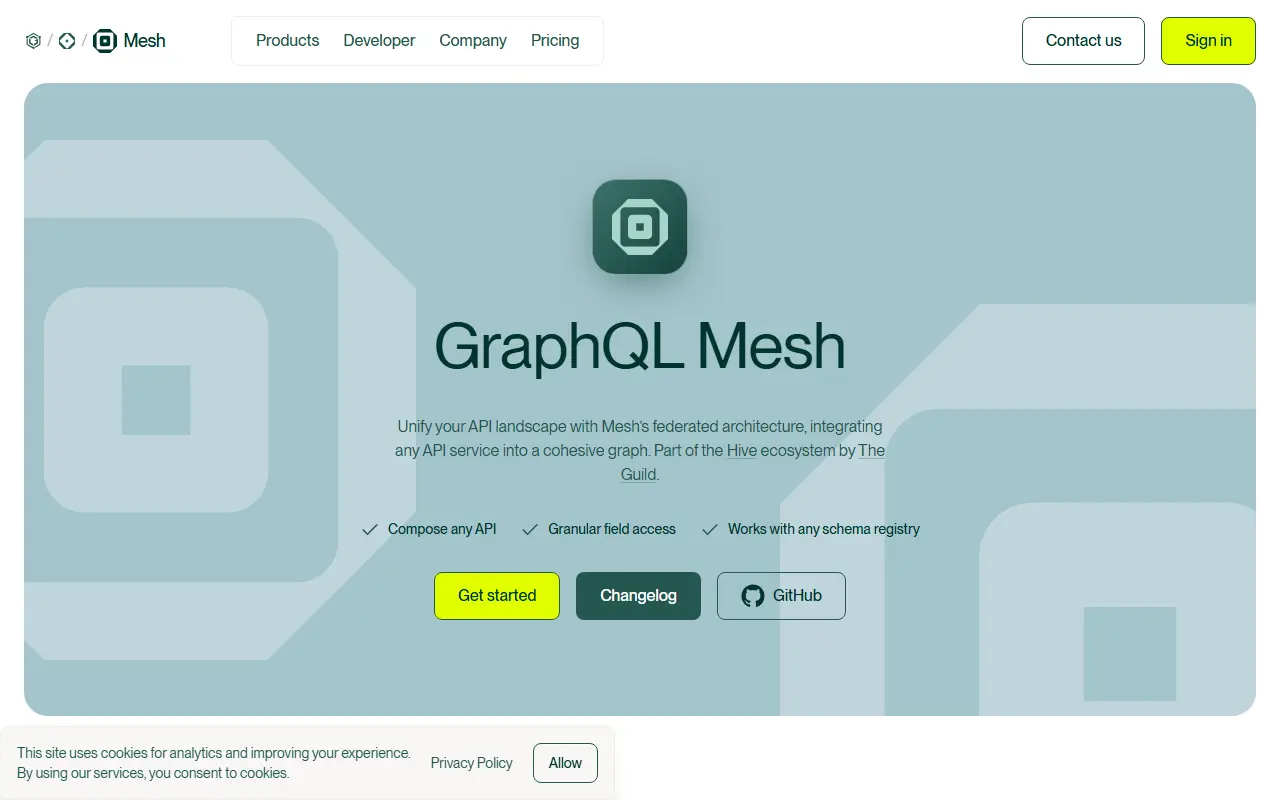
GraphQL Mesh is a tool from The Guild for bringing different API services together as one graph. It uses a federated architecture to integrate any API service into a cohesive graph, and sits alongside Hive Gateway, Hive Router, Yoga and other libraries in the same stack.
The site presents GraphQL as a universal query language, so data can be fetched directly from any data source without intermediaries. Its OmniGraph concept composes diverse sources into a single GraphQL schema. Three headline points are composing any API, granular field access and compatibility with any schema registry.
The code is MIT licensed and hosted on GitHub. Documentation, a changelog, product updates and case studies are linked from the site.
Key features
- Federated integration of any API into one graph
- GraphQL as a universal query language over any source
- OmniGraph composes sources into one schema
- Works with any schema registry
Commercial AWS AppSync alternatives
Hosted, closed-source products that compete with AWS AppSync.
AWS AppSync alternatives: questions
- What is the best open-source alternative to AWS AppSync?
- Supabase is the top-ranked open-source alternative to AWS AppSync on Enlisted: An open-source Postgres development platform bundling a database, auth, auto-generated APIs, realtime, storage and vector tools, often chosen as a Firebase alternative. Other strong options are Appwrite, Strapi, Directus and Kong.
- What are the best commercial alternatives to AWS AppSync?
- Firebase, Amazon API Gateway, Apollo GraphOS, AWS Amplify and Azure API Management are among the hosted, closed-source alternatives to AWS AppSync listed on Enlisted, which lists 9 in total. Compare their pricing and features on each tool page.
- Are these AWS AppSync alternatives free?
- All 8 are open source, so the code is free to use under its licence, and all of them can be self-hosted on your own server or computer. 7 also offer a paid or managed cloud version if you'd rather not host it yourself.
- How is this list of AWS AppSync alternatives ranked?
- By a score built from GitHub stars, star growth over the last 30 days and how recently the code changed. 8 of these projects shipped code in the last 30 days. Data is refreshed daily, and nobody can pay to move up.
 TrackMedia
 TrackRev