7,363 open-source and SaaS tools, with GitHub stats refreshed every day.

4 alternatives ranked by real activity

Open-source Auvik alternatives

A curated, ranked list of the 4 best open-source alternatives to Auvik.

The best open-source alternative to Auvik is NetBox. If that doesn't suit you, other good options are NetAlertX, Scanopy and Oxidized.

Auvik alternatives are mainly networking & VPN tools. 4 of them shipped code in the last 30 days, 4 can be self-hosted, and 2 use a permissive licence.

Last updated October 3, 2026 · ranked by GitHub stars, growth and recent commits

NetBox

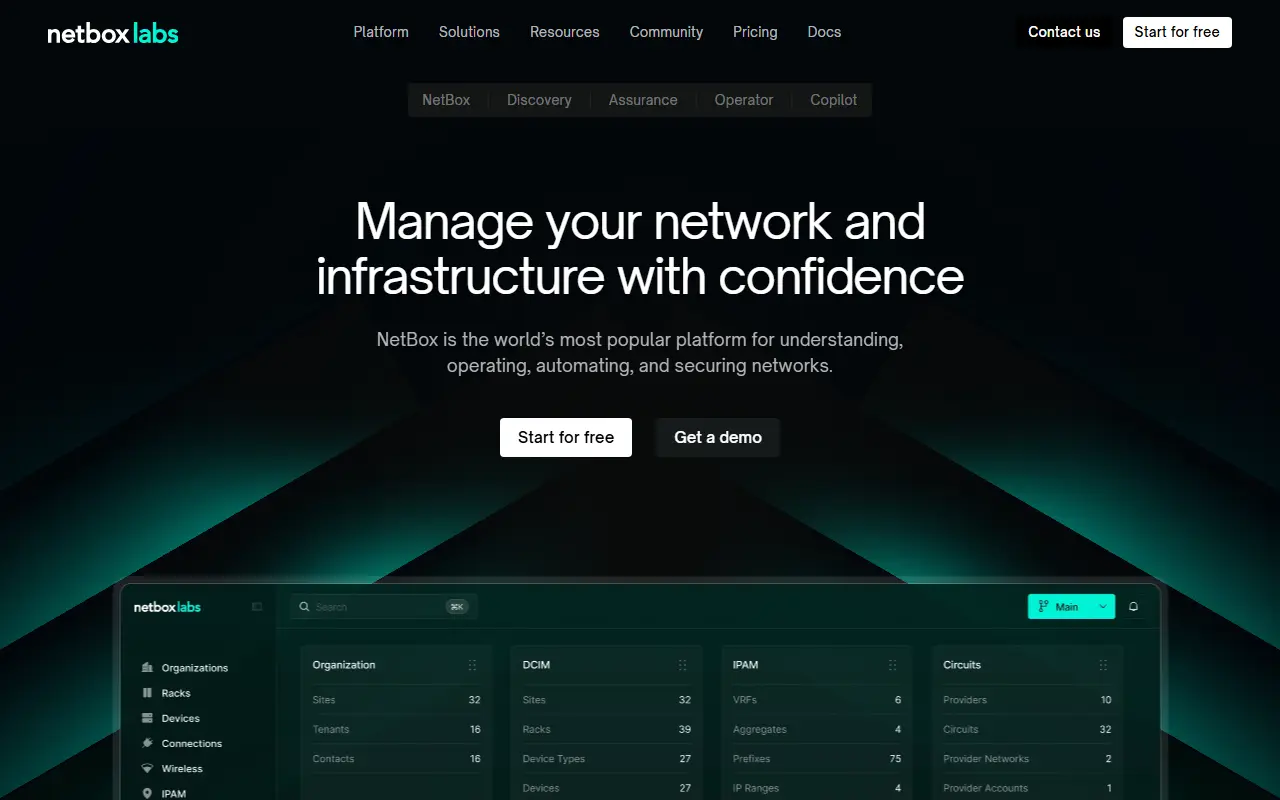
NetBox is an open-source source of truth for network infrastructure, covering IP address management and data center documentation with a programmable API.

GitHub stars
22k
Last commit
today
Latest release
v4.7.2
Licence
Apache-2.0
Self-hosted
Yes
Hosted version
Available
netboxlabs.comNetBox homepage screenshot

NetBox is a web application for documenting and modeling network infrastructure. It acts as the source of truth for what a network is supposed to look like, storing racks, devices, cables, IP addresses, VLANs, circuits, power and VPNs in one interlinked data model. It is built for network engineers who need that record to be accurate and queryable.

Rather than talking to network devices directly, NetBox exposes its data through a web interface and programmable APIs so that separate automation, monitoring and assurance tools can consume the intended state. That separation lets a team swap individual tools while keeping a predictable workflow, and a plugin system extends the core data model.

The Community edition is open source under the Apache 2.0 license, runs on Python and Django, and can be deployed on your own servers. NetBox Labs also offers NetBox Cloud as a managed service and NetBox Enterprise as a commercial edition. It is often described as a successor to older IPAM and DCIM applications.

Key features

  • Rack, device and cable documentation
  • IP address and VLAN management
  • Circuit, power and VPN tracking
  • Programmable APIs for automation tools
  • Plugin support for extending the data model
  • Built on Python and Django

Pricing: NetBox Cloud tiers (Starter, Professional, Premium) are not priced publicly; each plan is quoted through the sales team.

NetAlertX

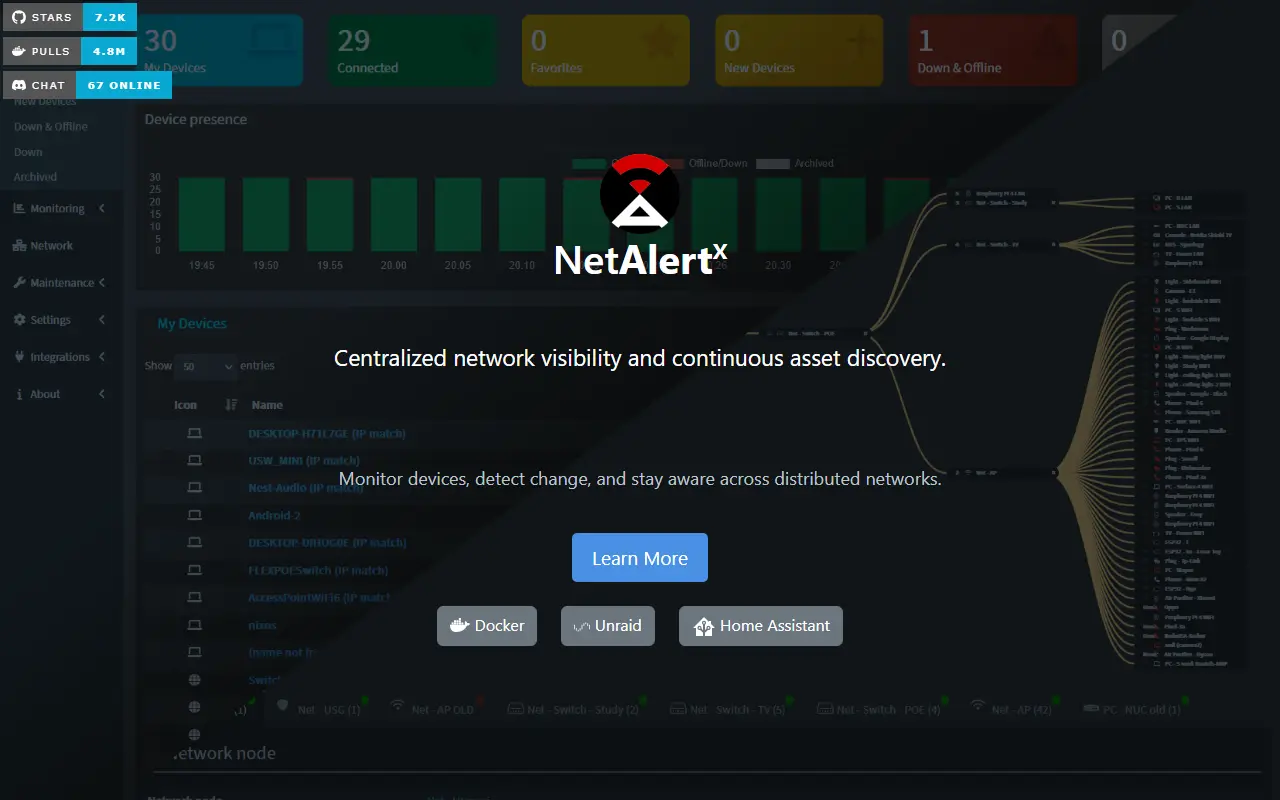
A self-hosted network visibility and asset discovery platform that monitors connected devices across sites and VLANs and alerts on new or changed hardware.

GitHub stars
7.2k
Last commit
yesterday
Latest release
v26.10.0
Licence
GPL-3.0
Self-hosted
Yes
netalertx.comNetAlertX homepage screenshot

NetAlertX is a platform for network visibility and asset intelligence, built for people running homelabs, IT departments, managed service providers and distributed setups. It keeps discovering devices on segmented networks, VLANs, branch offices and other remote sites and presents them in one interface, giving a live view of what is connected.

That inventory helps spot shadow IT, unauthorized hardware and IPAM drift, supports compliance work and lets service teams react to changes that matter. Multi-site sync, reporting, workflows and webhooks automate follow-up, which the project presents as a way to get ahead of issues while avoiding the weight of a complete network management system or SIEM. Topics mention ARP scanning, network monitoring, asset management and DCIM.

NetAlertX is written in Python and licensed under GPL-3.0. The recommended way to run it is with Docker, using a data directory that holds the config and database folders, and the README warns that the docker-compose file changed recently and a migration guide should be read first. It suits homelab owners and managed service providers who want lightweight device tracking.

Key features

  • Continuous network device discovery
  • Multi-site sync across networks
  • Alerts when new devices appear
  • Reporting and workflow automation
  • Webhook integrations for automation
  • Presence and maintenance tracking
  • Deployment through Docker containers

Pricing: Free and open source under the GPL-3.0 licence.

Scanopy

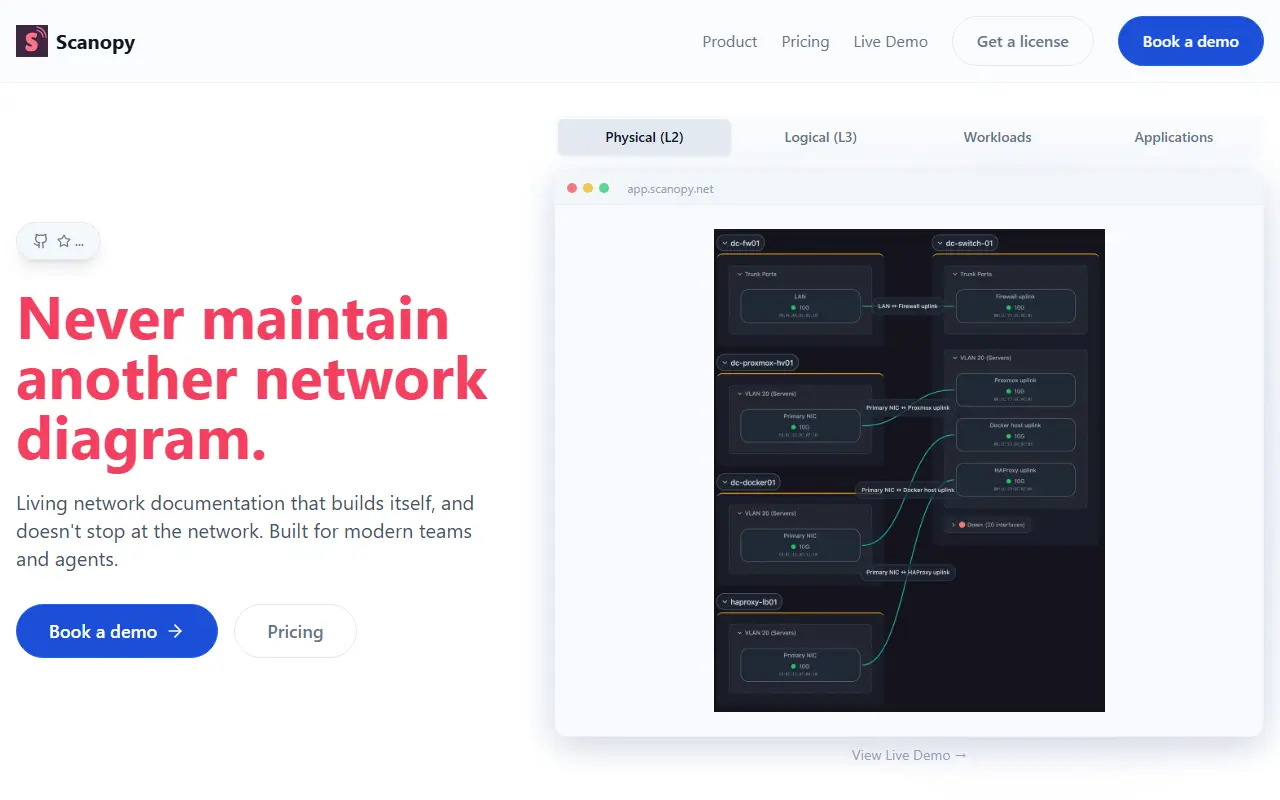
Scanopy automatically scans your network on a schedule and keeps physical, logical, workload and application diagrams up to date without manual drawing.

GitHub stars
5.8k
Last commit
yesterday
Latest release
v0.17.18
Licence
AGPL-3.0
Self-hosted
Yes
Hosted version
Available
scanopy.netScanopy homepage screenshot

Scanopy is network documentation software that builds and maintains diagrams for you. A single daemon scans your infrastructure on a schedule and turns each scan into a model of what is actually running, so teams no longer have to redraw diagrams by hand whenever something changes. It is written in Rust.

Each scan produces four views: a physical layer 2 view of switches, ports and links, a logical layer 3 view of subnets, a workloads view and an applications view. The project contrasts this with hand-drawn diagrams that go stale quickly and with infrastructure-as-code state that can miss drift. Maps can be exported as SVG, Mermaid or Confluence content, embedded as live maps, or fed into an existing source of truth.

Scanopy is licensed under AGPL-3.0 and is aimed at home labs, network administrators and IT teams that want accurate network docs. You can host it yourself, or use the vendor's cloud version, which the README says is available with a free trial.

Key features

  • Scheduled network scanning by a single daemon
  • Physical layer 2 network view
  • Logical layer 3 subnet view
  • Workload and application views
  • Export to SVG, Mermaid and Confluence
  • Embeddable live network maps

Pricing: Free self-hosted Community Edition. Cloud plans start at $79.99 per month billed annually; commercial self-hosted licenses cost $4,000 or $6,000 per year, with no per-device fees.

Oxidized

Oxidized is an extensible tool that backs up network device configurations on a schedule and is positioned as a replacement for RANCID.

GitHub stars
3.6k
Last commit
2 days ago
Latest release
0.37.0
Licence
Apache-2.0
Self-hosted
Yes

Oxidized is an open-source tool that backs up the configuration of network devices, such as equipment running IOS or JunOS. It is presented as a replacement for RANCID, the older tool many network teams have used for the same job. It is described as light and extensible, and it supports well over 100 different device operating system types.

It adjusts its worker threads automatically to hit the retrieval interval you configure. A REST API lets you move a node to the front of the queue, reload the node list, fetch configurations and view the version history and diffs of a device. It can also listen for syslog events from IOS and JunOS devices to trigger a fetch as soon as a configuration changes, and with the git output module, git blame then shows who made each change.

Node inventories can come from CSV files, SQL databases, SQLite, MySQL or an HTTP source, and configurations can be written to Git, git-crypt, HTTP or plain files. Hooks can send notices through services such as Slack, AWS SNS or XMPP. It is written in Ruby, licensed under Apache-2.0 and installable on Debian, Ubuntu, Red Hat family systems, FreeBSD or in Docker and Podman. The maintainer is asking for additional maintainers.

Key features

  • Scheduled configuration backups for network devices
  • Supports over 130 device operating system types
  • REST API for nodes, configurations and diffs
  • Syslog-triggered fetches on configuration changes
  • Git output with per-change author tracking
  • Hooks for Slack, AWS SNS and XMPP notices
  • Node sources from CSV, SQL or HTTP

Pricing: Free and open source under the Apache-2.0 license.

Auvik alternatives: questions

What is the best open-source alternative to Auvik?
NetBox is the top-ranked open-source alternative to Auvik on Enlisted: NetBox is an open-source source of truth for network infrastructure, covering IP address management and data center documentation with a programmable API. Other strong options are NetAlertX, Scanopy and Oxidized.
Are these Auvik alternatives free?
All 4 are open source, so the code is free to use under its licence, and all of them can be self-hosted on your own server or computer. 2 also offer a paid or managed cloud version if you'd rather not host it yourself.
How is this list of Auvik alternatives ranked?
By a score built from GitHub stars, star growth over the last 30 days and how recently the code changed. 4 of these projects shipped code in the last 30 days. Data is refreshed daily, and nobody can pay to move up.

People also look for alternatives to…

View all